
3D printing has moved far beyond being a hobby for technology enthusiasts. Businesses can now use additive manufacturing to create prototypes, customized products, replacement parts, educational models, accessories, and even specialized industrial components without investing in traditional moulds or large production lines. This has created several 3D Printing Business Ideas for entrepreneurs who want to start small and expand as demand grows.
For an entrepreneur, the biggest advantage of a 3D printing business is flexibility. You do not necessarily need a large factory or a complete production setup from day one. A desktop printer, suitable materials, design software, and a dedicated workspace can be enough to start offering selected products or services. As your customer base grows, you can add more printers, different materials, better finishing equipment, or specialized technologies.
However, starting a 3D printing business is not simply about purchasing a printer and selling printed objects. The more sustainable opportunities usually come from solving a specific customer problem. This could mean producing a replacement component that is difficult to source, creating a prototype within a few days, exploring small-scale manufacturing business ideas , or helping a company introduce 3D printing into its manufacturing process.
Is 3D Printing Still a Profitable Business in 2026?
Yes, a 3D printing business can be profitable in 2026, but profitability depends heavily on the business model you choose. Selling generic decorative products, for example, can expose you to strong price competition. A specialized service such as engineering prototyping, custom spare parts, architectural models, or B2B manufacturing can create more value because customers are paying for expertise, speed, customization, and problem-solving rather than simply paying for plastic.
The overall market outlook is also strong. Grand View Research estimates that the global 3D printing market will grow from about $37.6 billion in 2026 to $168.9 billion by 2033, representing a CAGR of 23.9%. Its research also identifies prototyping as the largest application segment and automotive as the leading vertical in 2025.
India is showing particularly strong growth in some parts of the market. The Indian fused deposition modeling (FDM) 3D printing market was estimated at $37.8 million in 2025 and is projected to reach $263 million by 2033, representing a 27.7% CAGR from 2026 to 2033. Desktop 3D printers are also expected to be the fastest-growing printer segment in the Indian FDM market.
What Do You Need to Start a 3D Printing Business?
The equipment required depends on what you plan to sell. Someone making customized desk accessories from home will have very different requirements from a company producing engineering prototypes or dental models.
The first decision should therefore be your business niche, not your printer. Once you know what you want to produce, you can select the printing technology, material, software, finishing equipment, and workspace accordingly.
Choose the Right 3D Printing Technology
FDM is generally the easiest technology for a beginner because it works with filament and can be used for prototypes, functional parts, organizers, décor, educational models, and many customized products. Resin printing is more suitable when you need fine details and smooth surfaces, such as miniatures, jewellery patterns, dental models, and highly detailed figurines.
More advanced businesses may eventually work with technologies such as SLS, SLA, selective laser melting, or other industrial additive manufacturing processes. These require significantly more technical knowledge and investment.
Set Up a Suitable Workspace
A home-based business can work well for smaller FDM operations, but the workspace should not be treated like an ordinary desk. You need enough room for the printer, filament storage, finished products, failed prints, tools, and post-processing.
Ventilation is particularly important. NIOSH warns that 3D printing can involve exposure to ultrafine particles and chemical emissions, while some post-processing materials and solvents can create additional hazards. Engineering controls such as suitable ventilation, enclosure systems, and HEPA filtration can help reduce exposure.
Get Design and Slicing Software
A printer is only one part of the production system. You may need CAD software to create or modify models and slicing software to convert those models into instructions the printer can understand.
For example, a product-design business may need software such as Fusion, SolidWorks, Blender, or similar tools, while a beginner making simple models may be able to start with more accessible design software.
Build a Material and Finishing Setup
Your material selection should match the application. PLA can be useful for many decorative and general-purpose products, while stronger engineering materials may be necessary for functional parts exposed to heat, impact, or mechanical stress.
You should also budget for nozzles, build plates, tools, adhesives where appropriate, cleaning equipment, sanding supplies, paints, packaging, and replacement components. These small expenses can have a meaningful impact on your actual margins.
Understand the Business and Legal Requirements
If you operate commercially in India, you should assess the appropriate business structure, tax requirements, invoicing software requirements, local permissions, and product-specific regulations. GST requirements can depend on factors such as turnover, type of supply, and whether exceptions apply, so entrepreneurs should verify their situation rather than relying on a single turnover number. CBIC notes that GST registration rules include a general threshold along with exceptions, which is an important consideration when evaluating 3D Printing Business Ideas.
For medical, safety-critical, children’s, food-contact, automotive, or aerospace products, additional standards and certifications may apply. These categories should not be treated like ordinary decorative products.
Best 3D Printing Business Ideas for Beginners and Specialized Entrepreneurs
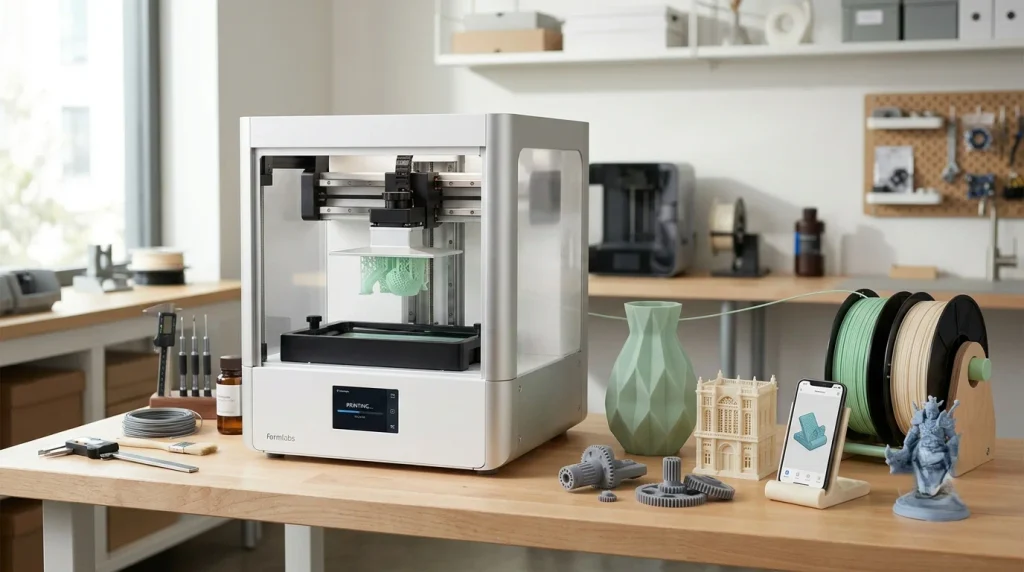
The best 3D printing business idea is not necessarily the one that requires the cheapest printer. A stronger opportunity is one where customers have a clear reason to choose you instead of buying an inexpensive mass-produced product.
Here are some of the most practical opportunities to consider.
1. Local 3D Printing and Prototyping Service
A local 3D printing service is one of the simplest ways to start because you do not have to develop a complete product catalogue. Customers can send you their STL or CAD files, explain what they need, and pay you to print the item.
Your customers could include engineering students, architects, product designers, small manufacturers, hobbyists, startups, schools, and local businesses. The opportunity becomes more valuable when you offer additional services such as file correction, scaling, material selection, assembly, finishing, and delivery, making these 3D Printing Business Ideas more appealing to a wider range of customers.
Instead of charging only by filament weight, calculate the price using material consumption, machine time, electricity, post-processing, design work, packaging, failure allowance, and your desired margin. This prevents you from accepting technically difficult orders that look profitable but actually consume several hours of machine and labour time.
2. Custom Home Décor and Functional Products
3D printing allows you to create products that would be difficult or expensive to manufacture in small quantities using conventional methods. Examples include planters, lampshades, organizers, wall décor, desk accessories, storage solutions, and customized holders.
The stronger opportunity is to combine aesthetics with functionality. Rather than selling another generic vase, you could create modular organizers for small apartments, customized desk systems, cable-management products, or décor designed around particular interior styles.
This model works especially well online because you can showcase the product visually and offer customization without maintaining a large inventory.
3. Personalized Gifts and Corporate Merchandise
Personalization can increase the perceived value of relatively small printed objects. You can create nameplates, desk signs, awards, trophies, keychains, photo stands, wedding keepsakes, event merchandise, and corporate gifts.
The important part is to sell the occasion, not just the object. For example, a company may not care about buying 100 generic 3D-printed pieces, but it may be interested in branded employee awards for an annual event.
This model can also create repeat business through event planners, HR teams, schools, wedding planners, cafés, hotels, and local businesses.
4. 3D-Printed Jewellery and Fashion Accessories
Detailed 3D printing can support jewellery design, especially for customized shapes and patterns. Depending on the production process, 3D printing can be used to create prototypes, patterns, molds, or final components.
The business can focus on custom designs rather than competing directly with conventional jewellery stores. Customers could request initials, geometric patterns, personalized shapes, or limited-edition collections.
Resin printing can be particularly useful where fine details are important. However, entrepreneurs should understand the material and post-processing requirements before selling products that come into prolonged contact with skin.
5. Miniatures, Collectibles and Hobby Products
Gaming communities, collectors, hobbyists, model makers, and tabletop enthusiasts can form a specialized customer base for detailed 3D prints.
The biggest opportunity is not simply printing existing files. You can create original designs, develop themed collections, offer customized miniatures, or collaborate with artists who license their designs to you.
Copyright and licensing should be taken seriously. A character appearing in a popular movie, game, anime, or comic is not automatically available for commercial reproduction just because a digital model exists online.
6. Educational STEM Models and Learning Kits
Schools, coaching centres, colleges, and parents can use physical models to make complex concepts easier to understand. You could create anatomical models, molecular structures, geometric shapes, mechanical demonstrations, architectural models, and engineering components.
A stronger business model is to sell a complete learning kit instead of an individual printed object. A kit could contain several models, an instruction booklet, activity sheets, and QR codes leading to demonstrations or explanations.
This also gives you an opportunity to develop recurring institutional relationships rather than relying entirely on individual online orders.
7. Rapid Prototyping for Startups and Product Designers
Rapid prototyping is one of the most commercially interesting 3D printing applications because businesses are often willing to pay for speed and iteration.
A startup developing a physical product may need several versions before finalizing the design. 3D printing allows designers to create and test these versions quickly without committing to expensive production tooling. Autodesk highlights rapid prototyping as a major advantage because designs can move from digital models to physical prototypes much faster, making this one of the practical 3D Printing Business Ideas for entrepreneurs. (Autodesk)
You can increase your value by offering CAD modification, design-for-manufacturing feedback, prototype testing, finishing, and multiple iterations rather than simply printing the file supplied by the client.
8. Architectural and Real Estate Models
Architects and real estate developers can use physical models to present buildings, interiors, townships, commercial developments, and urban plans.
A professional service can take a digital architectural model and convert it into a physical scale model. You can further differentiate the business through landscaping, colour, lighting, removable sections, detailed interiors, and presentation bases.
The customer here is not buying plastic. They are buying a physical sales and presentation tool that can help them communicate a complex project to investors, clients, or buyers.
9. Custom Spare Parts and Replacement Components
This is a particularly interesting B2B opportunity because many businesses and consumers struggle to find inexpensive replacement parts for older equipment.
You could produce brackets, covers, knobs, clips, mounts, adapters, housings, fixtures, and other non-critical components where appropriate. Reverse engineering can become an additional service if you can accurately measure or scan an existing part and recreate the design, making it a practical option among 3D Printing Business Ideas.
However, safety-critical components should not be casually reproduced. Parts used in brakes, medical devices, pressure systems, aircraft, or other high-risk applications require appropriate engineering validation and regulatory consideration.
10. Robotics, Drone and Electronics Components
Robotics teams, makers, engineering students, drone enthusiasts, and electronics developers frequently require custom enclosures, brackets, mounts, frames, sensor holders, and protective cases.
The advantage of this niche is customization. A customer may need a component that does not exist as an off-the-shelf product, but the quantity may be too small to justify conventional manufacturing.
Offering both design and printing can make this business more valuable. Instead of waiting for the customer to provide a perfect file, you can help them convert their requirements into a printable design.
11. Student Project and Engineering Model Services
Engineering and design students regularly need physical prototypes for academic projects, competitions, exhibitions, and presentations, making student-focused services one of the practical 3D Printing Business Ideas.
You can offer affordable packages based on the student’s requirements. For example, a basic package could include printing only, while higher-priced packages could include CAD modification, assembly, finishing, and multiple prototype iterations.
The challenge is to maintain student-friendly pricing without allowing complicated projects to consume unlimited design time. Clearly defining the number of revisions and delivery timelines can protect your margins.
12. Sell 3D Models and STL Files Online
A 3D printing business does not always need to sell physical products. If you have strong design skills, you can create STL or other digital 3D files and sell them online.
The advantage is that there is no physical inventory or shipping for each sale. One original design can potentially be sold repeatedly, although the marketplace will still require marketing, quality control, customer support solution, and compliance with licensing rules.
A collection of related designs can work better than uploading isolated files. For example, instead of selling one organizer, you could develop a complete modular desk-organization collection.
13. Freelance 3D CAD and Product Design
If your strength is design rather than manufacturing, you can start with almost no printing equipment.
Businesses need CAD models for prototypes, product visualization, engineering drawings, 3D renders, and manufacturing preparation. You can offer these services remotely and outsource the physical printing when a client requires it.
This model can also become a gateway into a larger 3D printing company. Once you understand what customers regularly request, you can invest in the equipment needed for the most profitable applications.
14. 3D Printer Repair and Maintenance
As the installed base of printers increases, technical support becomes another business opportunity.
You can offer nozzle replacement, calibration, bed leveling, troubleshooting, firmware assistance, preventive maintenance, component replacement, and upgrades. For businesses operating several printers, maintenance contracts can potentially provide more predictable revenue than individual repair jobs, making this a practical option among 3D Printing Business Ideas.
This model requires technical knowledge and should not be approached simply as a quick side business. Customers will expect you to diagnose problems accurately and avoid damaging expensive equipment.
15. 3D Printer Rental and Managed Printing
Some schools, colleges, startups, workshops, and businesses may want access to a 3D printer without purchasing one immediately.
A rental business can therefore combine equipment rental with training, installation, materials, technical support, and maintenance. This managed-service approach can be more valuable than simply handing over a machine.
However, equipment utilization and damage risk are important. A printer that remains unused for most of the month ties up capital without generating sufficient revenue.
16. 3D Printing Material Distribution
Filament, resin, powders, replacement parts, nozzles, build plates, and other consumables create a recurring supply opportunity.
A local supplier can differentiate itself through reliable inventory management system, quick delivery, technical advice, sample packs, and application-specific recommendations. B2B customers may value consistent material availability more than the lowest price.
This model becomes particularly attractive when combined with printing services or technical support because the same customers can generate revenue through multiple channels.
17. 3D Printing Training and Workshops
Training can target schools, colleges, engineering students, corporate teams, makerspaces, and entrepreneurs.
Rather than teaching only how to operate a printer, you can build courses around practical outcomes, making 3D Printing Business Ideas more accessible to beginners. For example, a workshop could teach participants how to design a simple product, prepare it for printing, operate the printer, identify common failures, and calculate production costs.
This makes the training more commercially useful than a basic demonstration of how a printer works.
18. 3D Printing Consultancy for Businesses
Larger businesses may understand that 3D printing could be useful but may not know where to apply it.
A consultant can evaluate the company’s existing production process and identify suitable use cases such as prototypes, jigs, fixtures, replacement parts, low-volume production, or customized components.
The consultant can then recommend suitable printers, materials, software, workflows, and cost models. This is a knowledge-heavy business, so experience and case studies matter more than simply owning expensive equipment.
19. Small-Batch Manufacturing for Niche Products
3D printing can make sense when a product has relatively low demand or requires frequent design changes.
Instead of producing thousands of units upfront, you can manufacture smaller batches based on actual orders. This reduces the risk of holding large amounts of inventory.
The model is particularly useful for niche accessories, replacement products, specialized tools, hobby components, and products with frequent design updates.
20. Advanced Automotive and Industrial Components
Automotive and industrial applications can provide larger B2B opportunities, but they also require much higher technical standards, making them specialized 3D Printing Business Ideas.
Businesses may use additive manufacturing for prototypes, tooling, jigs, fixtures, custom components, and selected production parts. Industrial 3D printing is particularly valuable where traditional manufacturing would require expensive tooling or where complex geometry is difficult to produce conventionally.
The barrier to entry is higher because customers may require dimensional accuracy, material specifications, repeatability, testing, traceability, and certifications.
21. Medical and Dental Models
Healthcare is another specialized application where 3D printing can create patient-specific anatomical models, surgical planning models, dental models, educational models, and other applications.
However, this should not be treated like an ordinary home-printing business. Medical applications can involve strict requirements for materials, accuracy, sterilization, data handling, clinical validation, and regulatory compliance.
The opportunity is therefore best suited to entrepreneurs with the appropriate technical and healthcare partnerships.
22. Custom Orthotics and Prosthetic Solutions
3D printing can support customized prosthetics, orthotics, assistive devices, and related products where personalization is important.
The value comes from creating solutions that fit an individual’s measurements rather than producing a standard-size product. However, healthcare professionals and relevant regulatory requirements should be involved where the product is intended for clinical use.
This is a high-potential but high-responsibility category. It requires substantially more expertise than ordinary consumer 3D printing.
Low-Cost 3D Printing Business Ideas You Can Start From Home
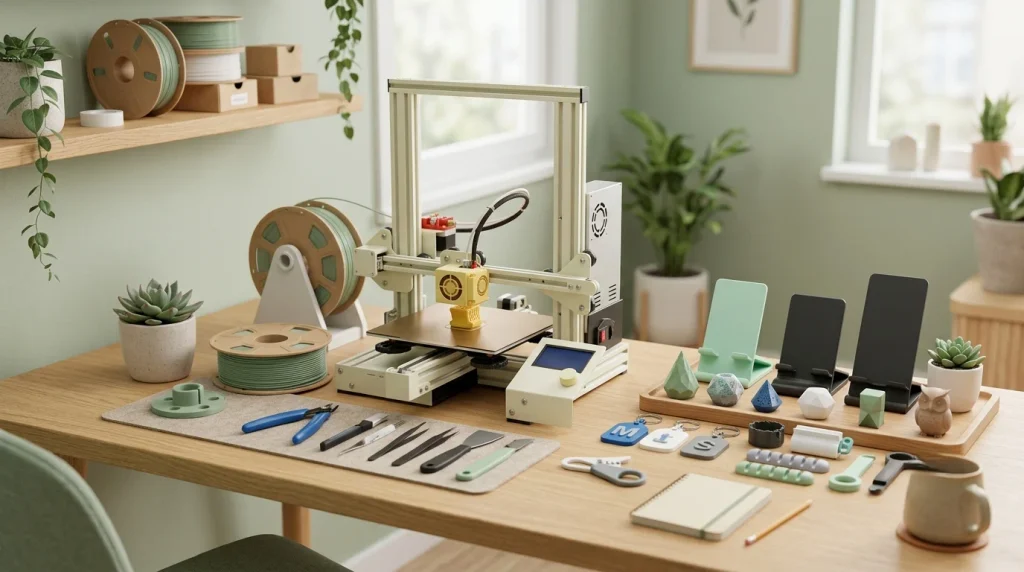
A home-based 3D printing business does not have to begin with an industrial printer. In fact, starting with a smaller setup can be a sensible way to validate demand before investing heavily in equipment.
The easiest opportunities to test from home are those that use relatively compact FDM printers and do not require specialized industrial materials or highly regulated applications.
Personalized Desk and Workspace Accessories
Cable organizers, headphone stands, pen holders, laptop accessories, phone stands, monitor accessories, and small storage products are relatively easy to demonstrate and customize.
You can create a small catalogue and offer colour, size, name, or configuration choices instead of maintaining hundreds of separate products.
Customized Keychains and Small Gifts
Small products are useful for learning because they consume relatively little material and allow you to test different designs quickly.
Instead of competing only on price, create collections for birthdays, weddings, corporate events, college societies, festivals, and business promotions.
Student Prototyping
A home printer can serve students who need small models for engineering, architecture, design, or science projects.
You can charge separately for design assistance, printing, finishing, and urgent delivery. This makes the business more sustainable than treating every project as a simple print job.
Digital 3D Design Services
If your budget is extremely limited, begin with design rather than printing.
A capable computer and design software can allow you to create CAD models and STL files for customers. Once the design service generates enough demand, you can invest in a printer and bring physical production in-house.
Small Home Décor Products
Planters, organizers, wall pieces, desk décor, lampshade components, and other compact products can be produced in small batches.
The important thing is to develop a recognizable design style. A store selling random 3D-printed objects will be harder to remember than a brand specializing in a particular aesthetic or customer problem.
How Much Does a 3D Printing Business Make?
There is no reliable single figure for how much a 3D printing business can make every month. A home-based business selling small customized products has a completely different revenue model from an engineering prototyping company serving industrial clients, which is why 3D Printing Business Ideas should be evaluated based on costs, demand, and target customers.
The most useful way to estimate earnings is to work backwards from your orders, average order value, production capacity, and operating costs.
| Business model | Main revenue driver | Typical cost pressure | Scalability |
| Custom products | Number of orders and average order value | Material, packaging, marketing | Medium |
| Print-on-demand service | Machine hours and print volume | Failed prints, electricity, labour | High |
| Prototyping | Project value and revisions | Design labour, machine time | High |
| CAD freelancing | Projects and design hours | Software and skilled labour | High |
| Digital STL files | Number of downloads/sales | Design time and marketplace fees | Very high |
| Printer maintenance | Repairs and service contracts | Spare parts and technician time | Medium |
| Material distribution | Sales volume | Inventory and logistics | High |
| Industrial printing | Contract value | Equipment, certification, skilled labour | High |
For example, suppose a home-based operator sells customized products with an average order value of ₹1,000. At 100 orders a month, monthly sales would be ₹1 lakh. But ₹1 lakh in sales is not ₹1 lakh in profit. Material, failed prints, electricity, packaging, delivery, marketplace fees, advertising, labour, equipment depreciation, and taxes all need to be considered.
A better pricing formula is:
Selling Price = Material Cost + Machine Cost + Labour + Post-Processing + Packaging + Overheads + Profit
Machine cost should include depreciation or the expected replacement cost of the printer. This is often ignored by beginners and can make an apparently profitable business look better on paper than it really is.
The most important metric is also not simply the number of printers you own. It is how effectively you use them. A single printer that receives consistent paid orders can be more valuable than five machines sitting idle.
How to Market a 3D Printing Business and Attract Customers
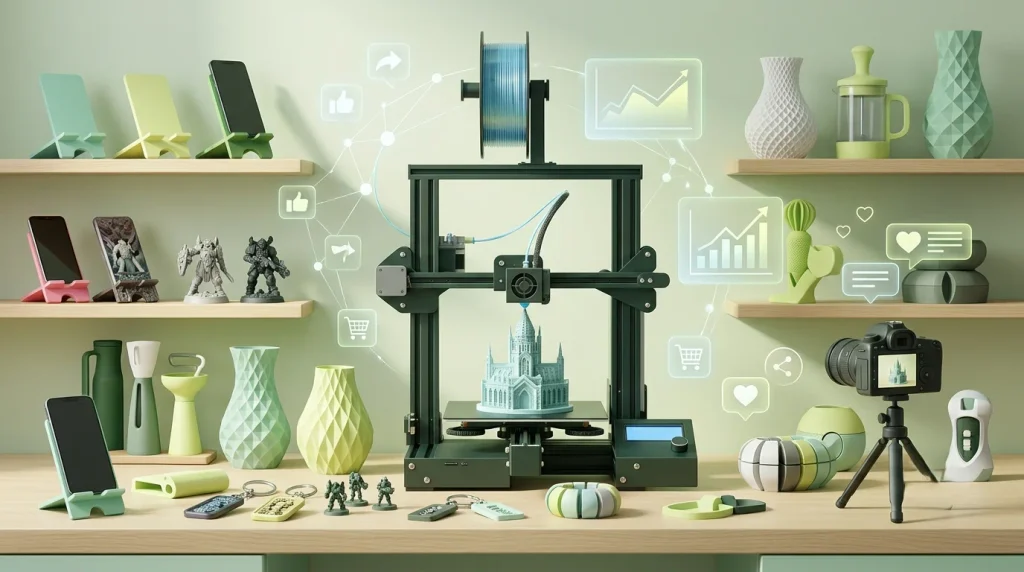
Marketing a 3D printing business requires a slightly different approach because many customers may not understand what the technology can actually do.
Instead of repeatedly saying that you offer “high-quality 3D printing,” show customers the problem you can solve.
Create Demonstration-Based Content
A simple before-and-after video can communicate the value of 3D printing better than a long advertisement. Show the original broken part, the digital model, the printing process, and the finished replacement.
For consumer products, show customization. For engineering services, show the prototype iteration. For architecture, show the digital model becoming a physical scale model.
Build a Strong Local Presence
If your business provides physical printing services, local marketing can be surprisingly important.
Connect with:
- Engineering and architecture colleges
- Product designers
- Local manufacturers
- Startup incubators
- Architects and interior designers
- Schools and coaching centres
- Robotics clubs
- Event planners
- Electronics and hobby communities
These relationships can create repeat B2B orders that are more valuable than relying only on individual social media purchases.
Use Instagram and Short-Form Video
3D printing is highly visual, making it suitable for Instagram Reels, YouTube Shorts, and similar formats.
Content ideas include:
- Time-lapse printing videos
- Failed print versus successful print
- Custom product transformations
- “How this part was made” videos
- Material comparisons
- Prototype iterations
- Customer projects
- Design-to-product demonstrations
The objective is to make potential customers understand what they can order from you.
Build SEO Around Problems, Not Technology
Instead of targeting only phrases such as “3D printing service,” create content around customer needs.
For example, a business could target searches related to:
- Custom prototype printing
- Replacement plastic parts
- 3D printing for engineering projects
- Architectural model making
- Custom product prototyping
- 3D printing services for startups
- Custom manufacturing for small quantities
This can attract people who already have a problem they want to solve.
Develop B2B Case Studies
Once you complete a successful project, document it.
Explain what the customer needed, what conventional option created a problem, what you produced, how long it took, and what changed after using your solution. With customer permission, include photographs and measurable results.
This is particularly powerful for industrial and professional services because businesses want evidence that you can handle real projects.
Common Challenges When Starting a 3D Printing Business
3D printing has a relatively accessible entry point, but that does not mean the business is effortless. Several operational issues can reduce profitability if they are ignored.
Print Failures Can Eat Into Your Margins
A failed print does not only waste filament. It also consumes machine time, electricity, labour, and delivery time.
Track your failure rate from the beginning. If certain materials or designs repeatedly fail, identify the cause instead of simply absorbing the cost into your business.
Competing Only on Price Is Risky
Desktop printers have become more accessible, which means customers can find many small printing businesses.
Trying to become the cheapest provider is rarely a strong long-term strategy. Specialization is usually better. You could become known for engineering prototypes, architectural models, personalized corporate gifts, robotics parts, or a specific type of consumer product.
Design Skills Can Become a Bottleneck
Customers often do not arrive with perfect printable files. They may have a photograph, rough sketch, broken component, or verbal description.
If you can turn those inputs into production-ready designs, you can charge for the expertise instead of competing only on printing rates.
Material Selection Requires Technical Knowledge
Different applications require different material properties. A visually attractive print may still fail if it is exposed to excessive heat, mechanical stress, chemicals, or outdoor conditions.
Understanding tensile strength, flexibility, heat resistance, layer adhesion, moisture sensitivity, and post-processing requirements can significantly improve the quality of your service.
Home Printing Requires Proper Safety Controls
3D printers involve heated components, moving parts and, depending on the technology and materials used, chemical emissions and ultrafine particles. NIOSH recommends appropriate controls such as ventilation, filtration, safer material choices where possible, and proper operating procedures. (CDC)
This is particularly important if your business operates from a room shared with family members, employees, customers, or children.
Copyright and Product Licensing Can Become a Problem
Printing a model that you downloaded from the internet does not automatically give you commercial rights to sell the resulting object.
You should check the licence attached to digital files and avoid selling copyrighted characters, branded products, logos, or designs without appropriate permission. This becomes even more important if you build an online store around third-party STL files.
Scaling Requires More Than Buying More Printers
Adding machines can increase production capacity, but it also increases maintenance, quality-control, material management, electricity usage, workspace requirements, and monitoring.
A better approach is to first identify which products or services generate consistent demand. Then automate or standardize the production process before adding capacity.
What Does the Future of the 3D Printing Business Look Like?
The future of 3D printing is increasingly moving toward digital manufacturing, customization, localized production, and low-volume manufacturing, including custom manufacturing for small quantities , rather than simply producing novelty objects.
The global market projections reflect this shift. Grand View Research expects the global additive manufacturing market to reach approximately $168.9 billion by 2033, growing at a 23.9% CAGR between 2026 and 2033. Prototyping remains the largest application segment, while industrial applications continue expanding.
India also has a strong opportunity to develop its additive manufacturing ecosystem. The government’s National Strategy on Additive Manufacturing has focused on building domestic capabilities in materials, machines, processes, software, research, and skilled manpower. In 2026, government and industry stakeholders were still actively discussing advanced manufacturing and additive manufacturing as part of India’s manufacturing strategy, creating opportunities for entrepreneurs exploring 3D Printing Business Ideas.
The entrepreneurs most likely to benefit will be those who treat 3D printing as a manufacturing capability, rather than as the product itself.
Final Thoughts
A 3D printing business can be started on a relatively small scale, but choosing the right niche is more important than buying the most expensive printer you can afford. A beginner can start with customized products, student projects, local printing services, small décor items, or CAD design and gradually move toward higher-value B2B applications.
For entrepreneurs with technical skills, 3D Printing Business Ideas in prototyping, replacement components, robotics, architecture, industrial tooling, and specialized manufacturing can offer stronger differentiation. These businesses may require more investment and expertise, but customers are also paying for technical knowledge, accuracy, speed, and problem-solving.
The market data points toward continued growth, but a growing industry does not guarantee success for every business. The strongest approach is to identify a specific customer problem, test demand with a small setup, track your real production costs, build a portfolio, and expand only after you have consistent orders.
FAQs About Starting a 3D Printing Business
Is 3D Printing A Good Business To Start In 2026?
Yes, provided you choose a suitable niche. The global 3D printing market is expanding rapidly, while India’s FDM market is also projected to grow strongly through 2033. However, entrepreneurs should focus on solving a specific customer problem instead of simply selling generic printed objects.
Can I Start A 3D Printing Business From Home?
Yes. Many smaller businesses can operate from a dedicated home workspace, particularly those focused on FDM printing, customized products, small prototypes, CAD services, and digital 3D files. However, ventilation, electrical safety, material storage, noise, workspace requirements, and applicable local business rules should be considered before starting.
How Much Money Do I Need To Start A 3D Printing Business?
The investment varies substantially depending on the business model. A small home-based operation can start with a desktop printer and basic tools, while engineering, medical, and industrial applications require significantly more expensive equipment and infrastructure. It is better to determine your target application first and then calculate the required investment.
Which 3D Printing Business Is Best For Beginners?
Local 3D printing services, customized products, student prototypes, small home décor products, personalized gifts, and CAD design services are relatively accessible starting points. Beginners should ideally avoid highly regulated applications such as medical implants or safety-critical industrial components until they have the necessary technical expertise and compliance systems.
Is a 3D Printing Business Profitable?
It can be, but there is no universal profit margin or monthly income figure. Profitability depends on machine utilization, pricing, material costs, failed prints, labour, marketing, delivery, equipment depreciation, and the value of the service. Specialized B2B services can potentially command higher prices than generic consumer products because customers are paying for expertise and problem-solving as well as the printed object.