

It is not a simple task to handle recurring payments and customer subscriptions without the proper tools. The best subscription billing software solutions offer companies automation in invoicing, revenue management, as well as handling complicated billing cycles with ease. Regardless of whether you are operating a SaaS business or handling the operations of membership plans, selecting the appropriate platform will ensure that the operations are smooth, churn is minimised, and the financial operations are clearly seen. This guide discusses the available alternatives that are best to choose so as to make an informed choice to suit your business needs.
What are Subscription Billing Software?
Subscription billing software is are product that has been developed to streamline recurrent payment procedures of companies that provide subscription-based services. These applications take care of invoice creation and payment collection, as well as tracking of revenues and customer lifecycle management. They assist in a number of billing plans, such as use-based plans, monthly plans, and tiered plans. The best subscription billing software also supports adherence to financial regulations, multiple currencies, and full compatibility with existing business systems, which allows making a single working cycle.
Essential Features to Look for in Subscription Billing Software
To choose the appropriate billing platform, one should be aware of the features that are most significant in the work of your business. The most suitable solutions are those with highly functional features that are not limited to straightforward payment processing, but enable growth and scalability.
- Automated Invoicing: Invoices should be generated and dispatched automatically according to your billing schedule and get rid of manual work and save on errors, and give the customers a chance to pay on time and get reminders and invoices.
- Revenue Recognition Compliance: Find the one that adheres to such accounting principles as ASC 606 and IFRS 15 to enable your finance department to provide the correct financial report and simplify the audit.
- Different Payment options: The option of accepting different types of payment like credit cards, e- wallets and bank transfers gives customers flexibility and increases success rates with regard to the payment mode in different markets.
- Reporting and Analytics: you can easily decide on your business due to the detailed dashboards that keep track of the metrics such as monthly recurring revenue, churn rates, customer lifetime value and subscription growth.
- Integration Capabilities: Complete integration with your existing CRM, accounting software, and other business applications will provide an integrated ecosystem, which will eliminate the existence of data silos and simplify business.
Comparison Table for Top 10 Subscription Billing Software
| Name | Rating | Best Feature |
| Zoho Billing | 4.5/5 | Low-code customisation options |
| Sage Intacct | 4.6/5 | AI-powered accounting automation |
| Paddle | 4.4/5 | Complete tax compliance handling |
| Younium | 4.7/5 | Model Context Protocol support |
| Maxio | 4.3/5 | Comprehensive lifecycle management |
| Sticky.io | 4.5/5 | Advanced payment routing system |
| ChargeOver | 4.4/5 | Extensive integration ecosystem |
| RecVue | 4.6/5 | Dynamic product catalogue |
| Recurly | 4.5/5 | Multi-gateway payment processing |
| Stax Bill | 4.4/5 | Automated revenue recovery |
Top 10 Subscription Billing Software
1. Zoho Billing
Rating: 4.5/5
Website: zoho.com
Best Use Cases: Small to medium businesses needing flexible billing automation
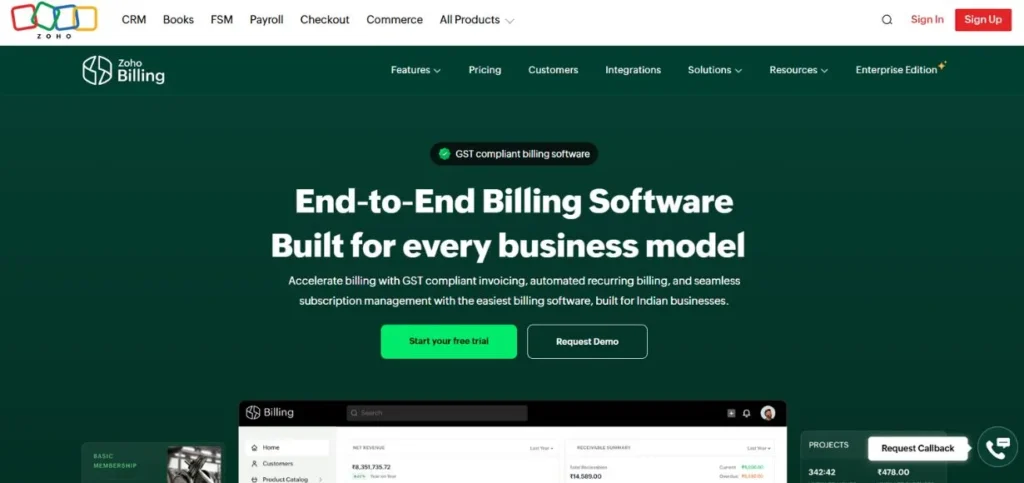
Zoho Billing is a full-fledged solution to recurring payment and subscription life cycles. Businesses can use this platform to cope with complex billing situations and still remain simplistic in their daily work. The software is compatible with simple monthly plans, as well as advanced usage-based pricing systems, thus it is flexible to fit any business needs. Zoho Billing does not have the problem of churn as the company concentrates on its customers by providing improved subscription management and clear communication. The site is mobile friendly and the owners of the business are able to check billing transactions anywhere.
Key Features:
- Trial management capabilities
- Hosted payment pages
- Mobile billing access
- Tax calculation automation
- Multi-entity operational support
Pros:
- Affordable pricing tiers
- Intuitive user interface
- Strong customization options
Cons:
- Limited advanced analytics
- Learning curve exists
- Fewer enterprise features
Pricing: plan starts at $29/month
Also Rerad: Best Time Tracking Software
2. Sage Intacct
Rating: 4.6/5
Website: sage.com
Best Use Cases: Mid-market companies requiring robust accounting integration
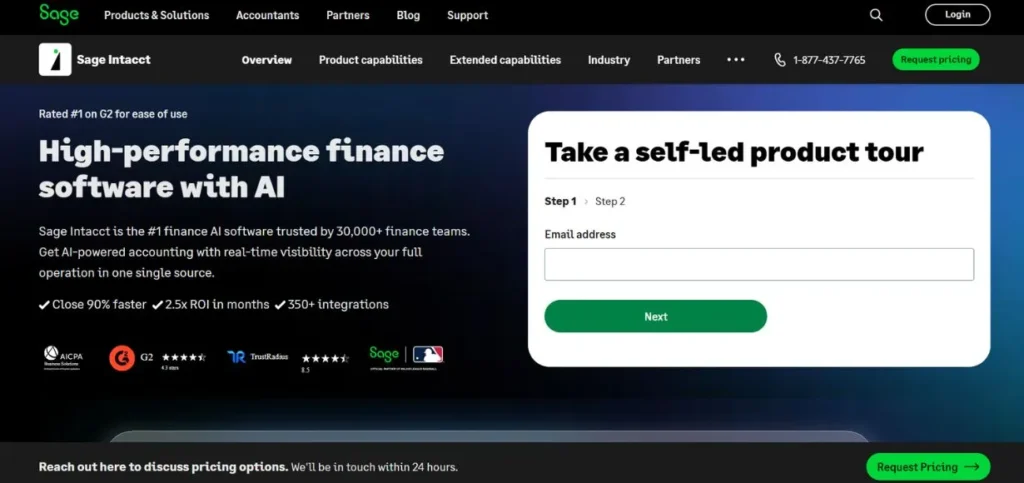
Sage Intacct is a good financial management system which has got its own subscription billing features. The system also features the use of artificial intelligence to automate the basic accounting operations, and has made a long way to eliminate the manual burden. The smart general ledger gives real-time visibility of the financial health of over one entity. Unified reporting is also useful in ensuring accuracy of the reports between the regions and currencies that are used by companies having complex organisational structures. The strength of the platform is that it incorporates subscription billing and a complete accounting suite, which is one of the origins of financial reality of businesses in its development.
Key Features:
- Financial automation based on AI.
- Multi-entity management
- Payables automation
- Receivables management tools.
- Real-time budgeting
Pros:
- Superior financial reporting.
- Scalable for growth
- Strong multi-entity support
Cons:
- Higher price point
- Complex initial setup
- Training investment is required.
Pricing: Custom pricing
3. Paddle

Rating: 4.4/5
Website: paddle.com
Best Use Cases: Global SaaS businesses handling international transactions
Paddle is a payment processor and merchant of record, and it implies that it takes care of the compliance of sales taxes internationally. Such privileged position eliminates the burden of working under the constantly changing international tax regulations. Multi-product subscriptions are not problematic and the system provides the protection of fraud, which reduces the threat of chargebacks. Developers welcome the fact that the entire API is well documented and it is easier to integrate. The enterprises and consumers are being secured through security measures, like the GDPR compliance and the 3D-Secure authentication. Expanding firms internationalisation is made relatively easy by the most suitable subscription billing software like Paddle.
Key Features:
- Global tax management
- Multi-product support: Subscription.
- Dunning is an automated process.
- Multiple payment methods
- Full REST API
Pros:
- Comprehensive tax handling
- Strong fraud protection
- Developer-friendly platform
Cons:
- Higher transaction fees
- Some lack in customization.
- Less control flexibility
Pricing: Custom pricing
4. Younium
Rating: 4.7/5
Website: younium.com
Best Use Cases: B2B SaaS companies with complex revenue models
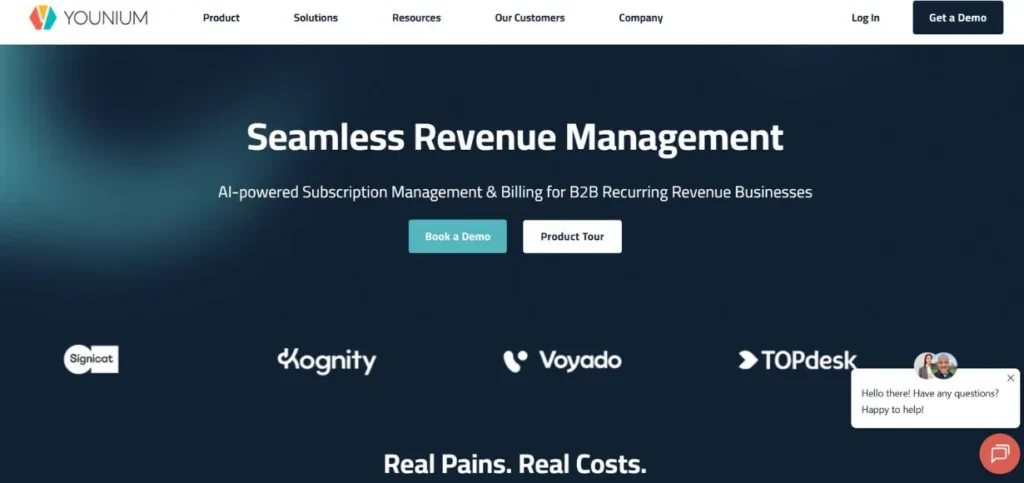
Younium is a specialist in the delivery of B2B SaaS-based businesses that require sophisticated billing functionality in addition to the streamlined subscription management. The system brings together pricing, quoting, invoicing, and recognition of revenue to a single system. The distinction between Younium and this one is that it uses Model Context Protocol, which enables businesses to connect the internal AI systems and billing data to obtain a better understanding. The revenue engine is too fully in line with the international accounting standards and works with different currencies and enterprises. Particularly Younium is useful to those firms that must be preoccupied with usage-based charges, hybrid charges, and mid-term corrections in contracts to enable their operations to run smoothly.
Key Features:
- Context Protocol integration Model Context Protocol integration
- ASC 606 compliance
- Multi-currency support
- Custom dashboard creation
- Advanced reporting engine
Pros:
- Excellent B2B features
- AI-ready infrastructure
- Full compliance assistance.
Cons:
- Complex for simple needs
- Custom pricing only
- Steeper learning curve
Pricing: Custom pricing
5. Maxio
Rating: 4.3/5
Website: maxio.com
Best Use Cases: Growing subscription businesses needing lifecycle management
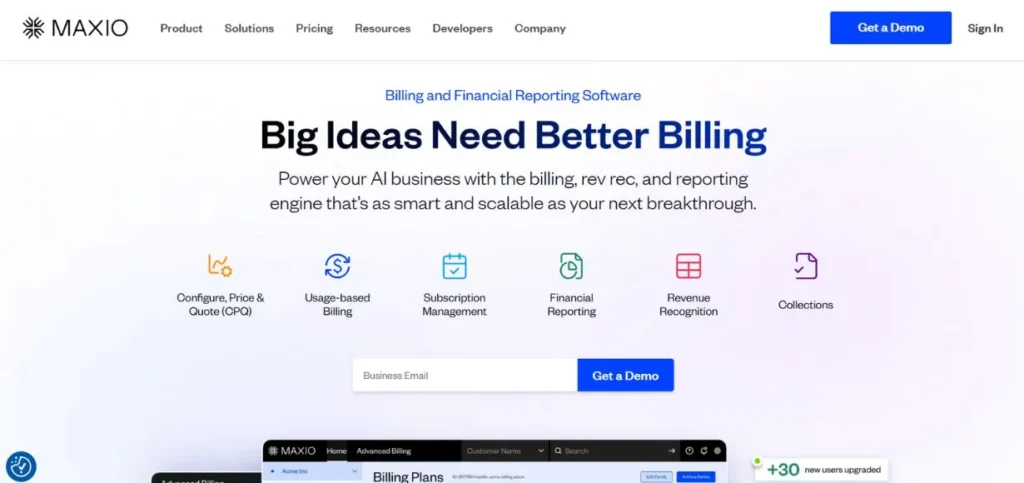
Solutions introduced by Maxio are specifically targeted at managing all the processes of subscription lifecycle including acquisition to renewal. The platform will be an integrated system of billing automation and analytics system that could help businesses to understand the trend of customer behaviour.
The companies can track automatic renewals and easily upgrade processes and come up with subscription performance reports. The analytics dashboards make it possible to see the most significant metrics, on which the strategic decisions are made. Maxio will help in the optimization of pricing and the reduction of churn of businesses through better payment management and delivery of messages in a business-specific manner.
Key Features:
- Analytics dashboard suite
- Invoicing automation
- Renewal management
- Upgrade handling
- Performance tracking
Pros:
- Strong lifecycle tools
- Good analytics features
- Free trial available
Cons:
- Pricing complexity
- Limited customization
- Fewer integrations
Pricing: Free
6. Sticky.io
Rating: 4.5/5
Website: sticky.io
Best Use Cases: High-volume merchants requiring advanced payment routing
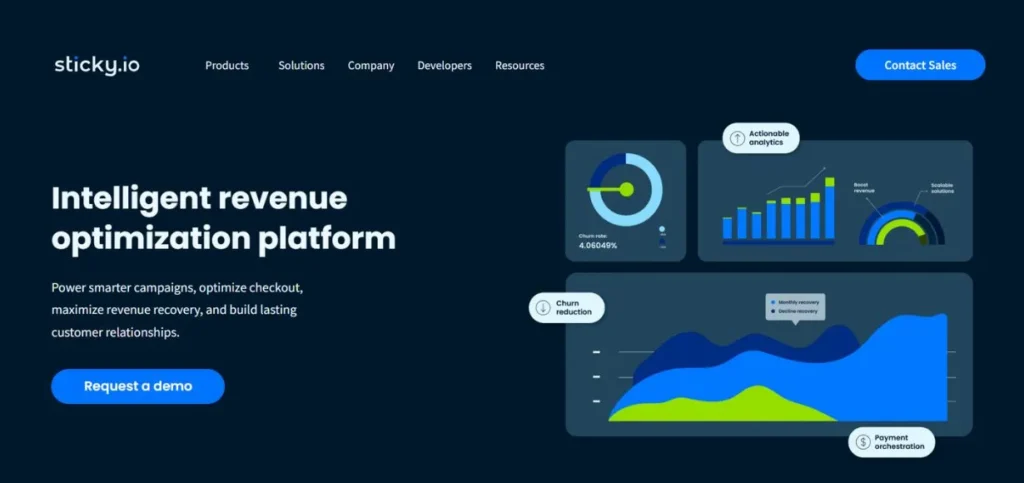
Having been in the business of serving thousands of merchants over a span of eleven years, Sticky.io is good at processing large volumes of transactions with high levels of reliability. The platform has enhanced routing of payments in various regions maximising the rates of authorisation and minimising the cost of processing.
The features of AI actively attempt to reduce involuntary churn, whereby payment failures are recognised and rectified automatically. The wide partner network comprises more than 400 integrations, which encompass payments, fulfilment, tax compliance and marketing tools. The billing process is easy to manage in different regions with multi-entity support. This is one of the best subscription billing software to scale business because of the performance it guarantees, even when the transaction rates are at their highest.
Key Features:
- Advanced payment routing
- AI churn reduction
- Multi-entity support
- Customizable offer structures
- 400+ integrations
Pros:
- Excellent routing capabilities
- Proven scalability
- Strong integration ecosystem
Cons:
- Custom pricing only
- Complex for beginners
- Enterprise-focused features
Pricing: Custom pricing
7. ChargeOver
Rating: 4.4/5
Website: chargeover.com
Best Use Cases: Businesses needing extensive third-party integrations
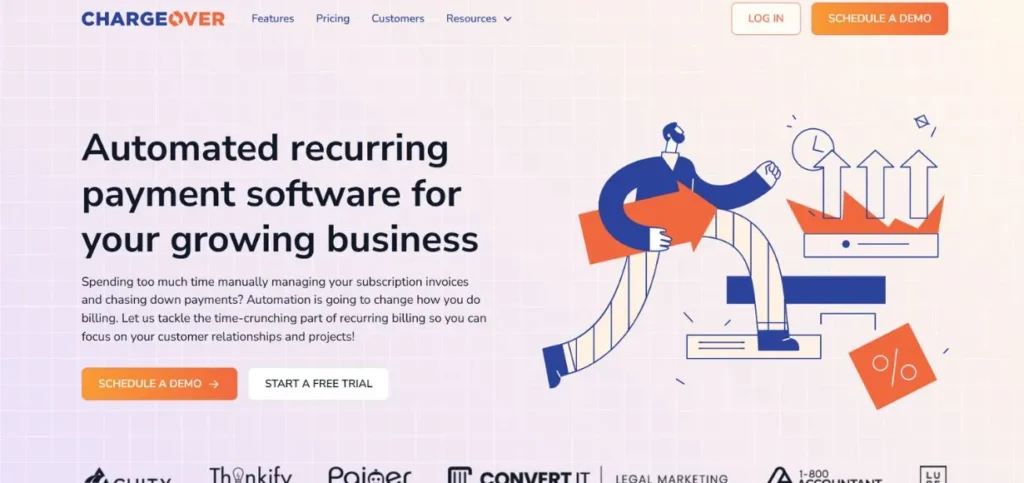
ChargeOver brands itself as an extremely networked billing platform that is compatible with 60+ business applications and 50+ payment gateways. Such a wide integrative capability enables companies to establish a tailored billing ecosystem that fits their own operational processes.
The platform provides a platform of dynamic pricing that can change according to changes in business requirements. Real-time tracking will present the immediate payment/billing status of all customers. Security is also given a priority with encryption mechanisms securing all the transactions. ChargeOver can be expanded with businesses as they grow and keep track of key SaaS indicators, and also calculates lifetime value to guide retention tactics.
Key Features:
- 60+ tool integrations
- Real-time tracking
- Automated billing
- Management of product catalogue.
- Payment retry automation
Pros:
- Ample integration capabilities.
- Strong API capabilities
- Good security measures
Cons:
- Interface feels dated
- Limited reporting depth
- Moderate learning curve
Pricing: Starting at $229/month
8. RecVue
Rating: 4.6/5
Website: recvue.com
Best Use Cases: Enterprises requiring comprehensive financial compliance
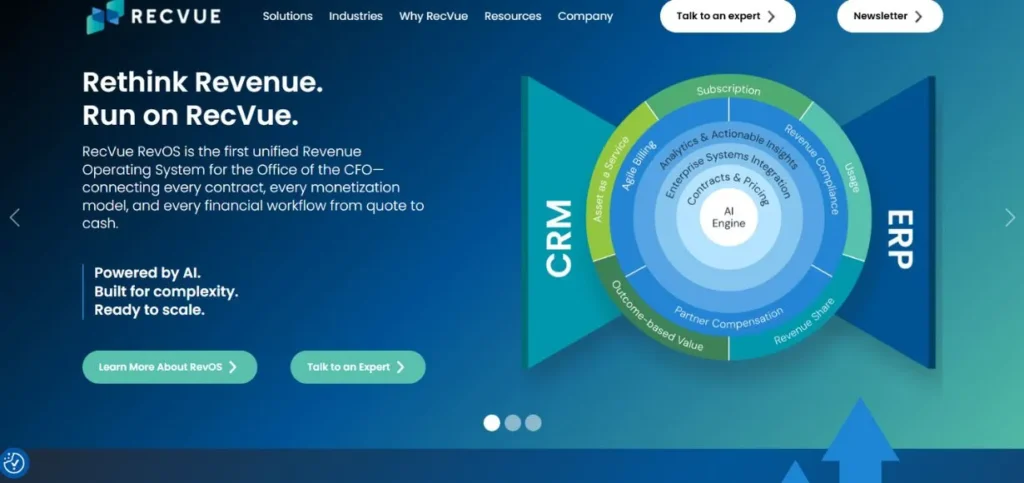
RecVue coordinates the entire billing cycle particularly in relation to financial excellence and accounts receivable. The system supports the high-level subscription services like upgrades and downgrades and changes in between without creating billing errors. Multi-currency functionality allows conducting the operations globally without compliance with the ASC 606 and IFRS 15 requirements.
The dynamic product and pricing policy gives the businesses room to experiment with different revenue strategies. The RecVue is extensively adaptable to the requirements of individual businesses as it has customizable workflows and powerful APIs. The analytics capabilities will provide an in-depth insight into payment patterns, revenue patterns, and customer trends upon which they will base their sound strategic decisions.
Key Features:
- Accounting records are made automatically.
- Customizable dashboards
- Revenue recognition tools
- Dynamic pricing system
- Quote automation
Pros:
- Strong compliance features
- Excellent customization
- Comprehensive analytics
Cons:
- Higher complexity
- Custom pricing required
- Implementation time
Pricing: Custom pricing
9. Recurly
Rating: 4.5/5
Website: recurly.com
Best Use Cases: Established businesses needing reliable multi-gateway processing
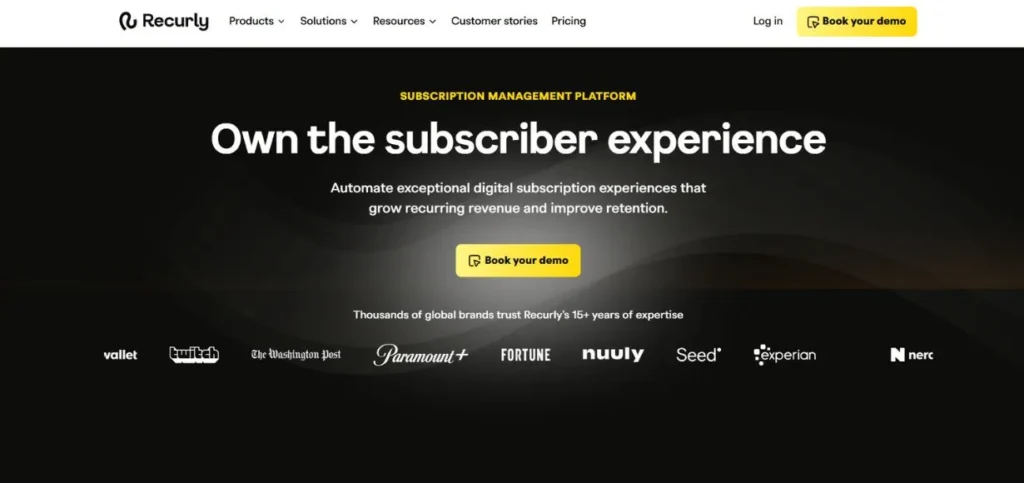
Having more than 16 years of operational experience, Recurly has become a reputable company in terms of being one of the best subscription billing software systems. The platform automates periodic billing and offers advanced tools for churn management, allowing companies to retain more clients.
The multi-gateway payment processing provides redundancy of the transactions and also enables global operation in a variety of currencies. Modern analytics provide insights into trends in subscriber behaviour that are used to develop retention tactics. The platform is compatible with different CRM systems, accounting software, and marketing automation. The pricing models are customizable, with simple subscriptions to complicated usage-based billing proposals.
Key Features:
- Automated recurring billing
- Dunning management
- Revenue recognition
- Multi-gateway processing
- Subscriber lifecycle tracking
Pros:
- Proven reliability
- Strong churn management
- Good analytics tools
Cons:
- Higher pricing tier
- Complex pricing structure
- Limited customization
Pricing: Free
10. Stax Bill
Rating: 4.4/5
Website: staxbill.com
Best Use Cases: Companies focused on maximising revenue recovery
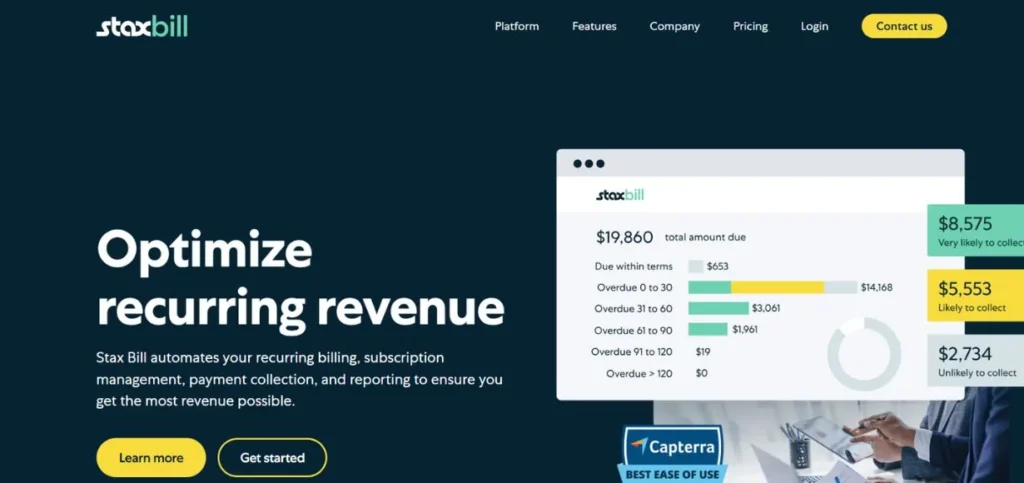
Stax Bill focuses on automated recurrent billing and has made specific emphasis on the recovering of failed payments. The site states that it assists companies in reclaiming up to 4 percent of their revenue by means of intelligent payment collecting functionalities that minimise payment rejection. The ability to do custom invoicing as well as dynamic pricing allow businesses to have flexibility in the way they charge their customers.
Enhanced retention rates are achieved via automated lifecycle communications, which ensure subscribers are kept updated on their journey. The system can ensure the accuracy of billing through automated calculation eliminating the human factor. These features make Stax Bill particularly handy to those companies, whose business involves payment recovery being a significant part of bottom-line performance.
Key Features:
- Online payment system.
- Custom invoicing
- Dynamic pricing
- Lifecycle communications
- Revenue recovery tools
Pros:
- Strong recovery features
- Good automation
- Flexible pricing models
Cons:
- Limited integrations
- Smaller user base
- Less robust reporting
Pricing: Custom pricing
How to Choose the Right Subscription Billing Software
The choice of the billing platform should be carefully made depending on your business needs and developmental path. The correct decision would address both the immediate operation requirements and future scalability and remain within the budget limits.
- Business Size and Complexity: Determine whether your subscription model is simple or complex which includes various products, usage-based payment and global payments.
- Integration Requirements: Assess your current technology stack i.e. CRM, accounting software, and marketing software.
- Compliance and Security Requirement: How do financial regulations affect your business by business industry and geographic markets?
- Recovery and Management of Payments: Think about the amount of revenue you are losing to bad payments and customer turnover.
- Scalability and Pricing Structure: Evaluate how the pricing changes as your business grows in each platform, so that you do not get unexpected costs as you grow in terms of transactions.
Conclusion
Selection of the best subscription billing software changes the way businesses are conducted in terms recurring revenues and customer relations. The appropriate platform automated the tedious processes, financial compliance, and insights that will grow the strategy.
You want global taxes to be processed, AI-driven features, or several integrations, and there will be a solution to that. Assess your business needs properly, look at scalability and choose a platform that allows you to meet present business needs and pursue long-term success.
Frequently Asked Questions
Q1: What is subscription billing software? What is the use of this software?
A: Subscription billing software automates recurring payment procedures, customer subscription management, invoice generation, revenue tracking, and different billing models such as monthly and usage-based pricing to businesses that provide subscription services.
Q2: What is the average price of subscription billing software?
A: Pricing is highly varied in the range of between $29/month basic plans to enterprise-wide pricing that goes up to thousands of dollars. Most of the providers have custom prices that are charged depending on the volume of transactions, number of subscribers, and features that are needed. Others are cent cent-percentage-based transaction fee rather than a monthly fee.
Q3: Is subscription billing software able to accept international payments?
A: There are no such programs that do not allow multi-currency transactions, international payment options and tax compliance in the world; most of our top subscription billing software supports them. Virtual solutions such as Paddle also serve as a merchant of record in order to ease the process of cross-border billing and remittance of taxes.
Q4: What is the difference between payment processing software and subscription billing software?
A: Payment processors just take care of transactions, and subscription billing software takes care of the whole process of subscription and automated renewals, prorated billing, upgrades, downgrades, revenue recognition, customer communications, and in-depth analytics over and above basic payment processing.
Q5: Should I have technical knowledge to use the subscription billing software?
A: The vast majority of the existing platforms have user-friendly designs that need minimal technical knowledge. Nonetheless, developer support can be helpful in implementation and customisation, particularly when the system is to be integrated with other systems or when the developer has to construct a specific workflow using APIs.
Continue Exploring: Top Data Classification Tools