
Telecom expense management, or TEM, is the practice of tracking, auditing, and controlling every dollar a business spends on voice, data, mobile, and increasingly cloud and SaaS services. Managing these expenses can get complicated as a business grows. When a company has hundreds or thousands of telecom services to track, even small billing errors can add up to significant costs.
This is where Telecom Expense Management (TEM) comes in. TEM helps businesses track, manage, and reduce their telecom spending by bringing bills, contracts, services, usage, and costs into one place. TEM companies can also help identify billing errors, unused services, contract issues, and opportunities to save money. But with so many providers offering different features and services, choosing the right TEM company can be difficult. Read this article to understand telecom expense management, what these telecom expense management companies do, and the top providers worth considering in 2026.
What Is Telecom Expense Management?
Telecom expense management is inclusive of the entire life span of a telecom asset including requesting of a line, provisioning of a device and auditing of a subsequent bill identifying anomalies and error. When the service is no longer required it will be “retired” from use.
A TEM program typically includes:
- Invoice processing and auditing across every carrier and vendor
- Inventory management system, so you know exactly what services and devices are active
- Dispute management to recover overcharges
- Contract management, including renewal tracking and rate benchmarking
- Usage analysis and reporting for finance and IT leadership
- Mobile device and BYOD lifecycle management solutions
In Gartner’s 2024 Market guide for Telecom Expense Management services three core capabilities are highlighted as critical to a successful TEM solution: ‘cost optimization’, ‘asset inventory’ and ‘workflow automation’. In 2026 most enterprise level platform offer these three functionalities from a single, integrated dashboard: rather than in parallel.
Why Do Businesses Need Telecom Expense Management Companies?
A mid-sized company with operations across a few states or countries deals with dozens of carrier relationships. Each has its own billing format, rate structure, and renewal schedule. Finance teams end up approving invoices without the time to check them line by line.
The cost of that gap is significant. Industry estimates from Socium IT put unmanaged telecom overpayment in the range of 20% to 30% of total spend, driven by billing errors, unused services, and contracts running on legacy rates. Cass Information Systems, one of the older names in this space, has processed and managed upward of USD 90 billion in annual telecom and technology spend for its client base, a scale that gives a sense of how large this problem is across the market.
Reasons businesses bring in a specialist TEM company:
- Billing errors go unnoticed without dedicated audit staff, and carriers rarely flag their own mistakes
- Device and line inventories drift out of date the moment IT stops tracking offboarding closely
- Contract renewal dates slip past, locking companies into outdated pricing for another term
- Multi-carrier, multi-country environments need standardized reporting finance can actually use
- Internal IT and procurement teams have neither the bandwidth nor the specialized tooling to run continuous audits
Working with a dedicated provider frees internal teams to focus on strategy instead of manually reconciling invoices every month.
Key Features to Look for in Telecom Expense Management Companies
Before you sign a contract with your TEM company, check for the following features:
- Invoice auditing accuracy: ask how many invoice formats and parsers the platform supports; leading providers process thousands of unique invoice templates
- Mobile device lifecycle management: this matters if BYOD or large device fleets are part of your environment
- Dispute resolution track record: ask for real recovery numbers from existing clients, not projected savings
- Integration with existing systems: ServiceNow, ERP, and procurement platform compatibility saves months of implementation time
- Reporting built for non-specialists: your finance team should read dashboards without a training course
- Managed service vs. software-only model: software platforms need internal staff to run them; managed services execute the work for you, often at 20% to 40% better outcomes according to Socium IT’s 2026 market analysis
- Contract terms and pricing model: some vendors charge a flat fee, others take a percentage of savings identified; know which one fits your budget
List of Top Telecom Expense Management Companies
1. Tangoe
- Rating: 4.4/5 on Gartner Peer Insights (71 reviews)
- Website: tangoe.com
- Best For: Fortune 1000 enterprises with global, complex telecom footprints
Tangoe’s software manages telecom, mobility, and cloud expenses together, and utilizes artificial intelligence to process invoices to a scale it claims that others on this list cannot. Implementation is 120-180 days and usually an internal TEM team is in place to best leverage the system.
Key Services:
- Invoice processing and automated error detection
- Global carrier and vendor management
- Mobile device lifecycle and inventory tracking
- Contract compliance monitoring
- Cloud cost visibility through Tangoe One Cloud
Industries Served:
- Financial services
- Healthcare
- Retail and manufacturing
- Government and public sector
- Technology and telecommunications
Why Choose Tangoe:
If your organization operates across dozens of countries and needs a single platform with deep carrier relationships and patent-backed automation.
2. Calero (Calero-MDSL)

- Rating: 4.3/5 on Gartner Peer Insights (17 reviews)
- Website: calero.com
- Best For: Organizations with large mobile fleets and active BYOD programs
Calero positions itself as a Communications Lifecycle Management platform rather than a narrow TEM tool, making it a notable option among telecom expense management companies. It bundles telecom, mobile device management, and financial analytics together. Most recently, it has added its own generative AI, available through its Calero Assistant tool, which can query data conversationally.
Key Services:
- Wireless and mobile device lifecycle management
- Invoice auditing and cost allocation
- Asset and inventory management
- Financial analytics and reporting
- MDM integration for BYOD environments
Industries Served:
- Education
- Healthcare
- Professional services
- Retail
- Manufacturing
Why Choose Calero:
Companies managing thousands of mobile devices, especially with mixed corporate-owned and BYOD policies.
3. Sakon
- Rating: 4.6/5 on Gartner Peer Insights (123 reviews)
- Website: sakon.com
- Best For: Enterprises standardized on ServiceNow
Sakon runs a cloud-based platform with tight ServiceNow integration, covering communications lifecycle management, mobility, and traditional TEM in over 100 countries. Its reporting layer is built to be usable by people outside a dedicated telecom team, which shows in its Gartner Peer Insights score, currently the highest among major TEM vendors.
Key Services:
- Communications lifecycle management
- Mobility management across global markets
- Invoice processing and dispute management
- ServiceNow-native workflow automation
- Usage analytics and reporting
Industries Served:
- Technology
- Financial services
- Pharmaceuticals
- Manufacturing
- Retail
Why Choose Sakon:
Sakon plugs in IT service management with less friction than platforms built as standalone tools.
4. Asignet (formerly Cass Information Systems TEM)
- Rating: 4.1 out of 5 stars (12 reviews)
- Website: asignet.com
- Best For: Enterprises needing high-volume automated invoice processing across many countries
Asignet is built upon its patent-protected RPA-as-a-Service automation engine, making it a notable option among telecom expense management companies. It manages telecom expense reporting across 185+ countries and payments to more than 114 countries, powered by its 3,800+ invoice parsers. Asignet claims its automation capabilities are among the most extensive in TEM software.
Key Services:
- Automated invoice processing across 185+ countries
- Inventory discovery and contract management
- Dispute resolution
- Multi-currency payment management
- Telecom and mobility spend optimization
Industries Served:
- Banking and financial management services
- Retail chains with distributed locations
- Logistics and transportation
- Healthcare networks
- Global manufacturing
Why Choose Asignet:
Businesses with a genuinely international footprint and heavy invoice volume benefit most from the automation depth here.
5. brightfin
- Rating: 4.5/5 on Gartner Peer Insights (70 reviews)
- Website: brightfin.com
- Best For: ServiceNow-native organizations wanting workflow automation across mobile, telecom, and cloud
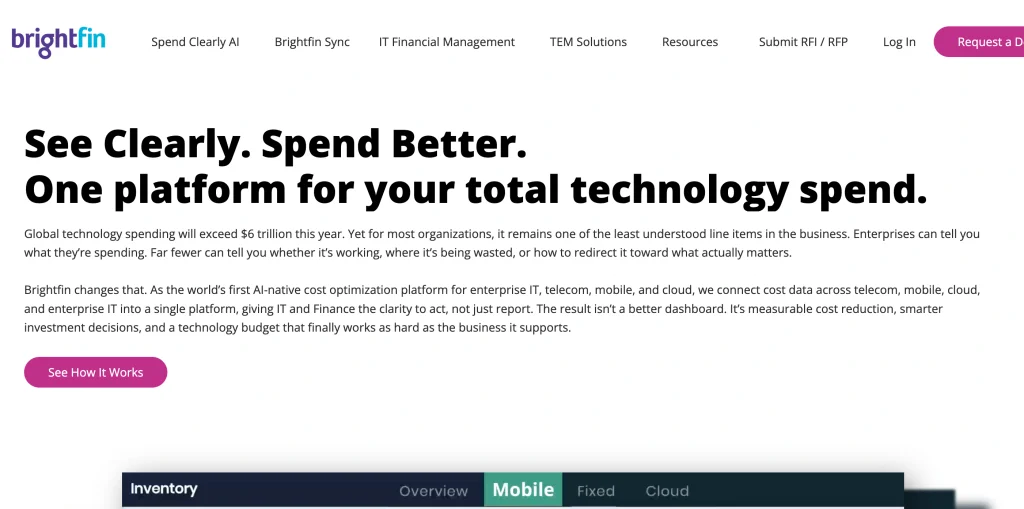
brightfin operates as an IT Expense Management and IT Finance Management provider, accessible natively through ServiceNow or as a standalone SaaS platform. It covers mobile, fixed telecom, and cloud spend under one workflow engine, with a strong focus on unified endpoint management alongside expense tracking.
Key Services:
- Unified Endpoint Management (UEM)
- Telecom and cloud lifecycle management
- Bill payment and procurement
- ServiceNow-native workflow automation
- Cost allocation and departmental billing
Industries Served:
- Government agencies
- Enterprise IT departments
- Financial services
- Healthcare systems
- Education
Why Choose brightfin:
For teams that want expense management inside a tool they already use daily.
Also Read :
6. vCom Solutions
- Rating: 4.1 out of 5 stars (24 reviews)
- Website: vcomsolutions.com
- Best For: Mid-market companies wanting a managed-service approach with hands-on support
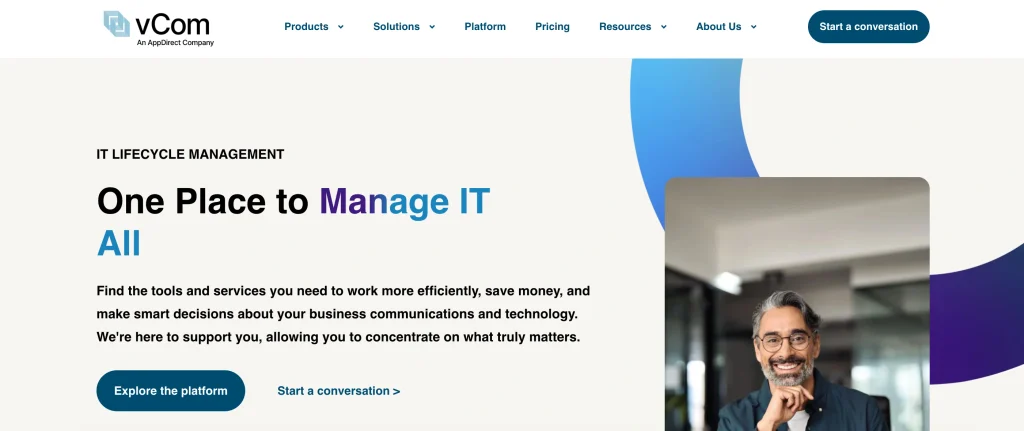
VCom offers a solution that balances software and fully managed services, making it a practical option among telecom expense management companies. It helps mid-market firms keep costs under control while providing centralized visibility into telecom, mobility, and cloud spending without requiring a full TEM team. Its main dashboard brings together multiple vendors, giving IT and finance teams a unified view of their expenses.
Key Services:
- Centralized spend visibility dashboard
- Cost optimization and analytics
- Contract lifecycle management
- Invoice auditing and processing
- Vendor sourcing support
Industries Served:
- Mid-market enterprises across sectors
- Retail
- Professional services
- Healthcare
- Financial services
Why Choose vCom:
Companies with a small-scale deployment but with complex operations.
7. WidePoint
- Rating: No Gartner Peer Insights rating currently listed. Honorable Mention Vendor in the Gartner Magic Quadrant for Managed Mobility Services
- Website: widepoint.com
- Best For: Government agencies, regulated organizations, and enterprises needing secure telecom lifecycle management
Wide Point offers comprehensive telecom lifecycle and expense management in mobile and fixed communications with focus on government and regulated markets. The ITMS platform simplifies the consolidation of the telecom asset and service inventory, supports contract management, invoice auditing, procurement, reporting and claims recovery.
Key Services:
- Telecom expense management and invoice auditing
- Telecom asset and inventory management
- Contract and SLA management
- Rate-plan optimization
- Procurement and MACD order management
- Dispute recovery and reconciliation
- Managed mobility and device lifecycle services
- Reporting and dashboard analytics
Industries Served:
- Federal, state, and local government
- Healthcare
- Transportation and airlines
- Financial and regulated industries
- Commercial enterprises
Why Choose WidePoint:
Organizations that may benefit from WidePoint’s combination of telecom lifecycle management, expense control, and managed mobility capabilities.
8. Tellennium
- Rating: 5.0/5 on Gartner Peer Insights (3 ratings)
- Website: tellennium.com
- Best For: Mid-market and enterprise organizations wanting a high-touch managed TEM service
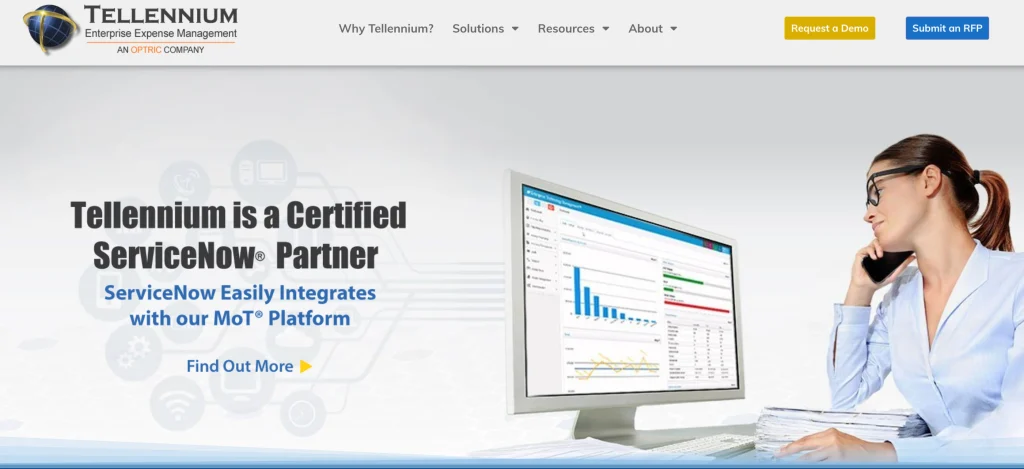
Tellennium combines its MoT SaaS platform with U.S.-based domain experts to manage auditing, optimization, invoice processing, and vendor management, making it a notable option among telecom expense management companies. Unlike a telecom-only platform, MoT brings telecom, mobile, cloud, utilities, and SaaS services together on a single platform.
Key Services:
- Automated invoice processing and reconciliation
- Telecom audit and optimization
- Detailed inventory management
- Contract management and renewal tracking
- Procurement and order management
- Managed mobility services
- Vendor negotiation and strategic sourcing
- Cloud management platform and SaaS expense management
- ServiceNow integration
Industries Served:
- Healthcare
- Financial services
- Manufacturing
- Retail
- Large enterprise organizations
Why Choose Tellennium:
Companies that want more than software alone can benefit from Tellennium’s combination of its MoT platform and dedicated expense-management specialists.
9. Avotus
- Rating: 4.0 / 5 stars on Gartner Peer Insights (3 reviews)
- Website: avotus.com
- Best For: Enterprises needing detailed telecom invoice management, inventory control, and wireless optimization
Avotus offers a modular TEM platform covering inventory, purchasing, invoicing, and analytics. Its system brings telecom invoices and assets into a centralized environment, compares invoices against inventory and contracts, and supports dispute management and charge allocation.
Key Services:
- Telecom invoice processing and auditing
- Cross-vendor inventory management
- Purchasing and MACD workflow management
- Contract and invoice validation
- Dispute management and recovery
- Cost allocation and chargeback
- Telecom expense analytics and reporting
- Wireless asset lifecycle management
- Mobile rate-plan optimization
Industries Served:
- Financial services
- Insurance
- Healthcare
- Large enterprise organizations
- Organizations with complex wireless environments
Why Choose Avotus:
Avotus is a strong choice for businesses that want granular control over telecom invoices, assets, purchasing, and reporting
10. Upland Cimpl

- Rating: 4.5/5 on Gartner Peer Insights (7 ratings)
- Website: uplandsoftware.com
- Best For: Mid-size and enterprise organizations wanting software-led technology expense management
Upland Cimpl enables telecom and technology expense management through a single, integrated platform, making it a strong option among telecom expense management companies. Organizations can link IT assets and technology services to invoice details, usage information, and various contracts. The platform simplifies service ordering and billing while providing clear visibility into technology spending and usage trends.
Key Services:
- Telecom and technology expense management
- Inventory and asset management
- Invoice and contract tracking
- Usage and cost analysis
- Automated billing and payment workflows
- Procurement workflows and approvals
- Cost allocation and reporting
- Vendor and provider management
- Managed reporting and analysis
Industries Served:
- Financial services
- Healthcare
- Education
- Government and public sector
- IT and enterprise organizations
Why Choose Upland Cimpl:
Cimpl works well for organizations that want to retain internal ownership of their TEM program while using the software services.
Benefits of Working With a Telecom Expense Management Company
- Fewer manual errors. Automated invoice parsing removes the risk of a finance team member missing a line item buried in a 40-page bill.
- Better contract terms. TEM providers benchmark your rates against market data and flag renewals before they lock you into another cycle at outdated pricing.
- Cleaner device and line inventory. You stop paying for lines nobody uses because offboarding never triggered a cancellation.
- Time back for IT and finance. Save time and start spending that time on higher-value work.
- Scalability without added headcount. Adding a new office, acquiring a company, or expanding into a new country does not mean hiring more internal telecom staff.
- Sustainability and compliance reporting. With Scope 3 emissions reporting requirements expanding, several providers now track telecom asset data that feeds directly into sustainability disclosures.
How to Choose the Best Telecom Expense Management Company
Choose the best TEM for your business by weighing on the following factors:
- Start with your scale. A company running 200 mobile lines does not need Tangoe’s Fortune 1000 infrastructure; a global enterprise with 50,000 devices does.
- Decide between software and managed service. If you have internal staff who can run a platform daily, a software-only vendor works.
- Check geographic coverage against your footprint. A provider strong in North America might not have the carrier relationships you need across Asia-Pacific or Latin America, currently the fastest-growing TEM region at a 14.18% CAGR through 2031 according to Mordor Intelligence.
- Ask for references in your industry. A healthcare-specific compliance requirement or a retail chain’s high device turnover changes what “good service” looks like.
- Request a sample audit. Most vendors will run a pilot audit on a batch of your invoices before you sign anything. Use this to see actual, not projected, recovery numbers.
- Review the contract structure. Review the model, savings, etc before signing the contract.
- Confirm integration requirements. Verify that the TEM platform connects without custom development work.
Conclusion
It is very uncommon to find telecom costs being properly analyzed, and quite typical for the difference between what is billed and what is used to balloon unnoticeably. Telecom expense management companies are equipped to address this. This might include any number of tools, such as automated bill auditing, contract re-negotiating, or total device lifecycle management.
The right choice depends less on brand recognition and more on your scale, your geographic footprint, and whether you want a tool to run yourself or a team to run it for you. Given a market projected to more than double by the early 2030s, the providers covered here are worth a serious look before your next contract renewal locks you into another year of guesswork.
FAQs
1. What Exactly Does a Telecom Expense Management Company Do?
They audit your telecom bills, identify and track inventory of devices/services, challenge invoices with carriers and identify issues where you’re being overcharged. They also present reporting on how the money for all voice, mobile, data-often even cloud services- is spent.
2. How Much Money can be Saved from Using a TEM Provider?
It’s an estimation with all calculations pointing 20%-30% of untethered telecom expense may be much higher than it needs to be due to errors and unused services alone. The actual savings will vary with your present state and the provider’s depth of audit.
3. Is TEM for Large Enterprises Only?
No. TEM providers service small business, mid-market, and large enterprises. However, mid-market and small businesses are likely to leverage more of a ‘managed service’ model compared to larger companies (who would utilize software platforms and internally managed staff).
4. What is the Difference Between TEM Software and a TEM Managed Service?
Software based solutions simply put auditing and tracking functionality in the hands of your team where a “managed service” can have the TEM provider’s own team conduct the audit, disputes, and reporting on your behalf.
5. How Long Will Implementing a TEM Solution Take?
This depends quite a bit between providers and company size. Implementation timelines can range from 120-180 days with an enterprise grade solution like Tangoe, down to possibly shorter implementation for a mid-market managed service.
6. Will TEM Include Cloud & SAAS Expenses Too?
Increasingly so, major providers like Tangoe and Calero have incorporated visibility into cloud costs along with telecom and mobile spending within their solutions.