

The computer-aided design (CAD) has transformed the way we design and produce things. Starting with the drawing tools and ending up with the sophisticated 3D tools, CAD software is used by engineers, architects, designers, and students to make their ideas work. However, professional CAD software may be expensive. That is where Free CAD Software comes in to the rescue. Free CAD Software provides you with powerful, free design tools. Be it a student studying design, a hobbyist with a personal project in the works, or a professional in need of a cost-effective solution, there is a Free CAD Software application that will best suit your requirements.
Today, we are going to discuss the most optimal Free CAD Software options. You will understand what each program is unique and which one suits best to various activities, and how to choose the appropriate tool to use in your projects. It is time to enter the free design software world and learn about some brilliant tools that will not cost you a single penny.
What is Free CAD Software?
Free CAD Software is a computer software that assists you in making technical drawings, 3D models, and design blueprints without having to pay any license fee. These tools are similar to costly professional tools, but they do not need monthly fees or acquisition expenses.
There are a lot of design tasks that Free CAD Software can cope with. It is possible to draw 2D floor plans, make 3D product models, create machine parts, or create files that can be 3D printed. Most of these programs are open-source, i.e., their code is free and constantly being enhanced by developers worldwide.
Why Look for Free CAD Software?
- Cost savings: Design tools are available to everyone, as you do not have to spend hundreds or thousands of dollars on purchasing expensive software licenses.
- Learning opportunities: Novices and students can learn and train in CAD without having to spend money or experience time-limited trials.
- No subscription fees: Free CAD Software does not require any monthly fees and allows permanent access, unlike paid software.
- Community support: The vast majority of the free software has a good user community where people share tips, tutorials, and find solutions to their problems in no time.
- Regular updates: Most Free CAD Software is regularly updated and has additional features by special development teams.
Top 10 Free CAD Software
1. FreeCAD
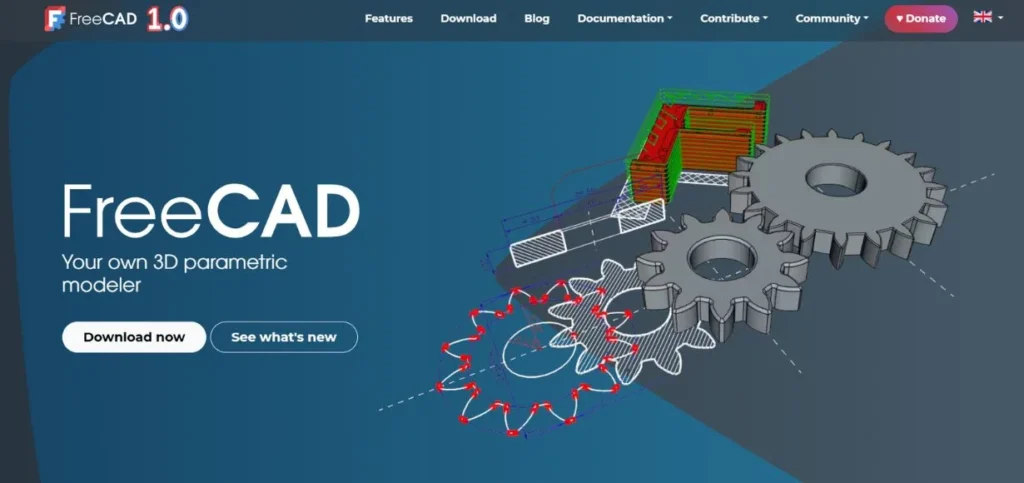
FreeCAD is an effective open source 3D CAD software that is used in product design, mechanical engineering, and architecture. It employs parametric modeling, and this implies that you can do your design changes by altering parameters. The program is compatible with Windows, Mac, and Linux. FreeCAD is compatible with a wide range of file formats and also has sophisticated features such as finite element analysis and robot simulation. It is open-source and constantly being improved by a volunteer group of developers.
The software is ideal for those who are learning CAD and those who are on complex projects. Scripting FreeCAD supports Python, which can be used to automate its tasks and to make bespoke tools that meet a particular requirement.
Key Features:
- The 3D modeling system is parametric.
- The support of multi-platform compatibility.
- Huge file format coverage.
Pros:
- Completely free forever
- Active community support
- Regular feature updates
Cons:
- Steep learning curve
- The interface can lag
- Limited rendering options
Best For: Engineering
Pricing: Free
Website: https://www.freecadweb.org/
2. Fusion 360 Personal
Autodesk has a free version named Fusion 360 Personal that can be used in non-commercial practice. It integrates CAD, CAM, and CAE tools. The software is cloud-based, which means that your designs are stored on the Internet and can be accessed at any point. Fusion 360 is professional 3D modeling, simulation, and manufacturing software.
It is good for product designing, 3D printing layout, and mechanical engineering. The personal version has much of the paid version, but is limited in cloud storage and more advanced manufacturing tools. The programs are automatically updated, so you never need to download any updates to keep you up to date with the latest features and security enhancements.
Key Features:
- Cloud-based design platform
- Integrated CAM tools
- Live working capabilities.
Pros:
- Professional tool quality
- Cloud storage included
- Excellent 3D printing
Cons:
- An internet connection is required.
- Limited for business
- Learning curve exists
Best For: Prototyping
Pricing: Free (Personal Use)
Website: https://www.autodesk.com/products/fusion-360/personal
3. Tinkercad
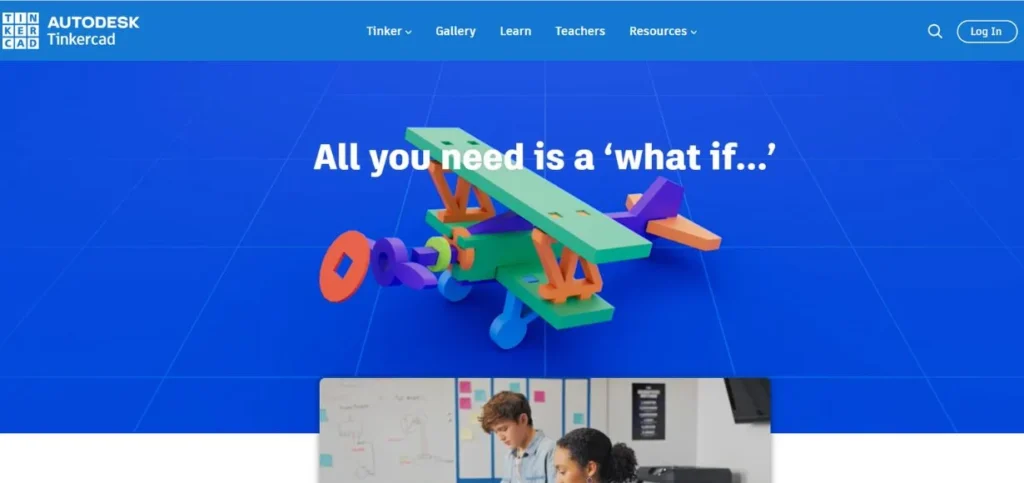
Tinkercad is a browser-based CAD software created by Autodesk and is ideal to learn and use in education. There are no downloads or installations necessary – it can all be run in your web browser. The program involves straightforward drag-and-drop functions to create three-dimensional models out of basic figures. Tinkercad has gained popularity in schools to impart simple concepts of 3D design to the students.
It has a huge collection of ready-to-use shapes and has the ability to import created designs. The software is directly linked to the 3D printing services, which means that it is easy to translate digital designs into physical objects. Tinkercad also has the electronics simulation capability to design and test circuit designs, prior to the actual construction of real projects.
Key Features:
- Based on the browser design interface.
- Simple drag-drop operations
- Direct 3D printing
Pros:
- Very easy learning
- No installation required
- Great for beginners
Cons:
- Limited advanced features
- Connection to the internet was necessary.
- Basic modeling only
Best For: Education
Pricing: Free
Website: https://www.tinkercad.com/
You may want to read: Amazon Marketing Strategy
4. SketchUp Free
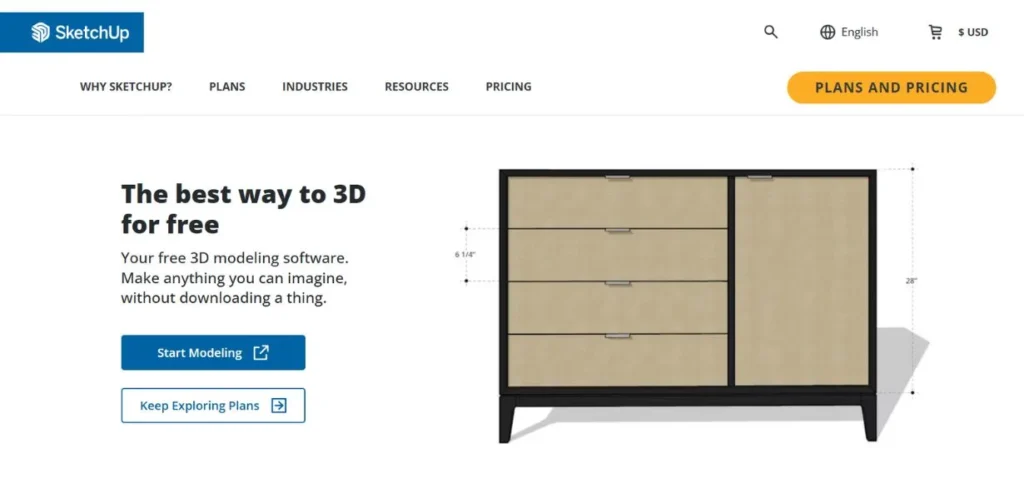
SketchUp is a web-based version of the popular 3D modeling software. It is created with architectural design, interior design, and 3D modeling. The software has an easy-to-use push-pull interface that renders the process of generating 3D models out of 2D shapes extremely straightforward. SketchUp Free is also accompanied by 3D Warehouse, which is a huge array of free 3D models, drawn by users all over the globe.
You are able to download furniture, vehicles, people, and architectural items, which you can use in your work. The software is ideal for the visualization of building designs, room layouts, and landscape projects. It is less complex than the paid one, but the modeling capabilities can still be powerful to meet most design requirements.
Key Features:
- Rudimentary push-pull modeling.
- Access to the warehouse
- Architectural design focus
Pros:
- Easy to learn
- Large model library
- Great for architecture
Cons:
- Limited file exports
- Connection to the internet was necessary.
- Fewer advanced tools
Best For: Architecture
Pricing: Free
Website: https://www.sketchup.com/plans-and-pricing/sketchup-free
5. Onshape
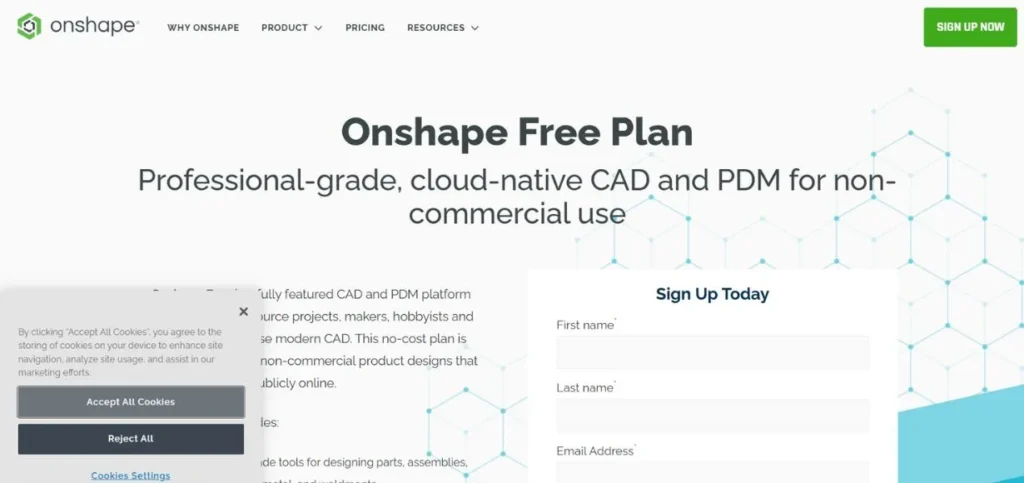
Onshape is a professional cloud-based CAD system that has a free plan for public projects. It offers a complete 3D CAD that has real-time collaboration capabilities. It is also great when used by a team since many users can be involved in a design at once. Onshape also has version control, meaning that you are able to monitor changes and restore a prior version in case of necessity.
The software provides the assembly tools that are of professional quality, simulation tools, and manufacturing preparation. Your designs are constantly saved to the cloud, thus allowing you to access them at any time and through any device, so long as there is an internet connection. The free version makes it mandatory that all designs are public, though there is no limitation on the quality of the available CAD tools.
Key Features:
- Live group work.
- Cloud-based version control
- Expert parametric modelling.
Pros:
- Professional-grade tools
- Very good cooperation characteristics.
- Automatic cloud backup
Cons:
- Public projects only
- An internet connection is needed.
- Learning curve present
Best For: Collaboration
Pricing: Free (Public Projects)
Website: https://www.onshape.com/en/products/free
6. LibreCAD
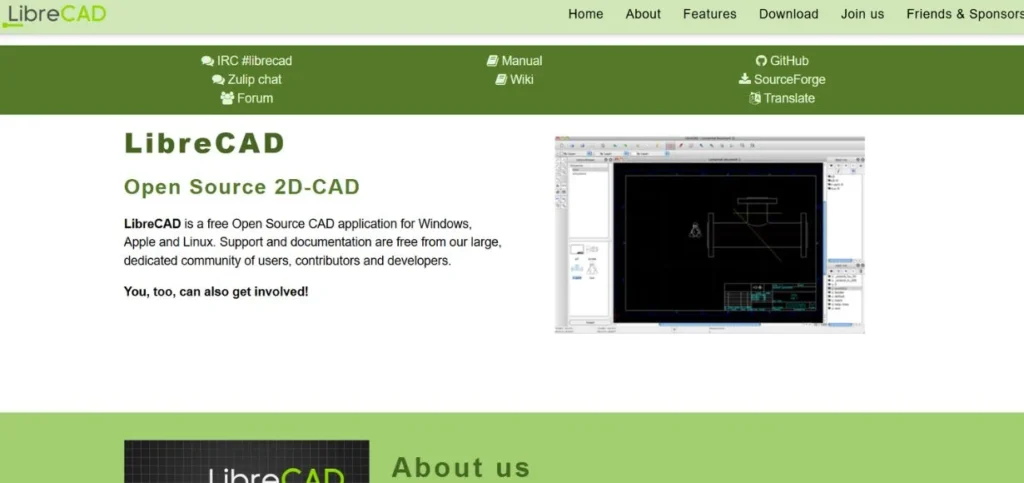
LibreCAD is a 2D computer-aided design application designed to be open-source and free to use, which is best suited to technical drawing, floor plans, and mechanical design. It is based on QCAD and can only be drafted on a 2D level, and no 3D modeling can be done. The program has all the tools needed to draft lines, circles, arcs, dimensions, and text.
LibreCAD is provided with layers, blocks, and templates to organize complex drawings. It can read and write DXF files and, thus, can be used together with other CAD software. The software itself is not a heavy one, and it does not need powerful hardware to operate. Architects, engineers, and drafters find LibreCAD to be excellent since they mainly use technical drawings in 2D and do not need the features of 3D modeling.
Key Features:
- Pure 2D drafting
- DXF file compatibility
- Performance requirements: lightweight.
Pros:
- Fast and stable
- No 3D complexity
- Standard file support
Cons:
- No 3D capabilities
- Limited modern features
- Basic user interface
Best For: Drafting
Pricing: Free
Website: https://librecad.org/
Also Read: Top Game Development Companies in India
7. OpenSCAD

TpenSCAD is a special CAD program that produces 3D models using programming code rather than drawing tools. You write scripts to describe your design, but you do not click and drag to make up your design. The benefit of this is that it creates parametric models that are easy to modify through the changing of code values. OpenSCAD is particularly popular in 3D printing communities and programmers who believe in the quality and repeatability of the code design.
The software can generate complex geometric shapes, perform Boolean operations, and be used to generate detailed patterns. Despite being very difficult to learn without knowing programming, it is unparalleled in accuracy and capability of producing complex, mathematically-defined models that would be irritating to work with in other CAD systems.
Key Features:
- Script-based 3D modeling
- Accuracy of parametric design.
- Boolean operation support
Pros:
- Extremely precise results
- Parametric design control
- Great for repetition
Cons:
- Programming requires knowledge.
- No visual design
- Steep learning curve
Best For: Programming
Pricing: Free
Website: https://openscad.org/
8. Blender
Blender is chiefly regarded as a software of 3D animation and rendering; however, it also comprises strong CAD-like modelling software. It is open-source and totally free, and has a huge global community. Although not a conventional CAD software, Blender is a good organic modelling software, architectural visualisation software, and the making of detailed 3D objects for a wide range of uses. The software incorporates sophisticated elements such as sculpting, texturing, animation, and photorealistic rendering.
Blender is able to process product visualization, architectural walkthroughs, and design projects that require quality visuals. It has precision modeling tools and measurement add-ons that render it technical. There is a frequent update of the software found with ample learning materials, therefore making it easily accessible, even though the interface of the software is initially complicated.
Key Features:
- Advanced 3D modeling
- Photorealistic rendering ability.
- Animation and simulation
Pros:
- Very powerful capabilities.
- Active community support
- Quality of professional rendering.
Cons:
- Complicated interface first.
- Not traditional CAD
- Overwhelming for beginners
Best For: Visualization
Pricing: Free
Website: https://www.blender.org/
9. DraftSight
DraftSight is a commercial, open-source 2D and 3D CAD software that is freely available to individuals, students, and eligible institutions of education. It has a familiar interface that is close to AutoCAD, thus users can easily switch between programs. DraftSight should also have complete 2D drafting software, simple 3D modeling, and good compatibility with industry-standard files. The software is customizable using the APIs, and it has various features such as batch plotting, sheet sets, and advanced dimensioning.
Although the free version is somewhat limited compared to the paid version, it still includes professional-level tools that may be useful in the majority of design projects. DraftSight is very good for technical illustration, architectural, and mechanical design.
Key Features:
- AutoCAD-like familiar interface.
- Professional 2D drafting
- Suitability with industry standards.
Pros:
- Professional tool quality
- Familiar interface design
- Very good file compatibility.
Cons:
- Free version limitations
- It needs a registration process.
- Periodic stability problem.
Best For: Professional
Pricing: Free (Personal/Education)
Website: https://www.3ds.com/products-services/draftsight-cad-software/
10. SolveSpace
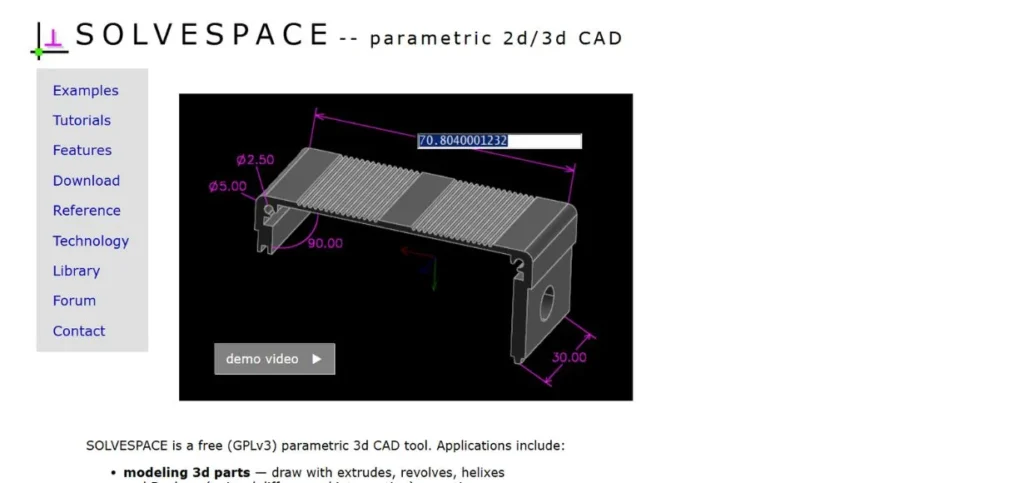
SolveSpace is a 3D, parametric CAD system concentrating on parametric modeling. It is intended to be used in making exquisite mechanical components and systems where precision of dimensions and positioning of components is vital. The software has a special constraint solver that automatically upholds design relationships when you make changes to your models. SolveSpace is also suitable for mechanical engineering and product design, and other applications where it is necessary to have geometric relationships between objects precisely.
Although it is absolutely free, it has professional-level parametric modeling features. The software is simple with a focused interface that does not add unnecessary complexity and gives thorough design tools. SolveSpace is able to export into different formats and fits well into the 3D printing process.
Key Features:
- Parametric modeling Constraint-based.
- Definite geometric relationships.
- Clean focused interface
Pros:
- Elaborate constraint solver.
- Professional parametric instruments.
- Lightweight and fast
Cons:
- Limited file formats
- Small user community
- Fewer learning resources
Best For: Precision
Pricing: Free
Website: https://solvespace.com/
How to Choose the Right Free CAD Software
- Consider your primary use: Consider whether you should have 2D drafting, 3D modeling, or both to suit the software capabilities of projects.
- Evaluate your skill level: Select software that best fits your level of experience, between easy-to-use and high-tech professional.
- Check file compatibility: Make sure that the software is compatible with file formats that are commonly used by colleagues, clients, or other programs in your workflow.
- Review system requirements: Ensure that your computer meets the requirements of running the software without any performance problems or crashes.
- Look for learning resources: Select software that has good tutorials, documentation, and community support to aid you to learn effectively.
Conclusion
The way we think of design and engineering has been changed by Free CAD Software. Starting from easy 2D drawing and up to the complex 3D models, these tools offer professional-level features at a fraction of the cost. You can be a student studying the principles of design, you can be a hobbyist creating your own projects, or you can be a professional who wants to find cost-effective solutions. There exists a Free CAD Software that fits your needs.
Our ten programs that we have discussed have various strengths and specializations. FreeCAD is the best in parametric modeling, whereas Tinkercad is more of a 3D design accessible to everyone. Fusion 360 Personal puts professional tools in the hands of an individual user, and SketchUp Free eases the architectural design. All Free CAD Software has its purposes and target users.
Frequently Asked Questions
Q: Does Free CAD software, as a student tool, have the potential to handle professional projects?
A: Yes, several Free CAD software programs among the students, like FreeCAD, Fusion 360 Personal, and Onshape, are professional and applicable in a real-world setting, as an internship or in portfolio building.
Q: Is Free drafting software equally accurate as paid ones?
A: Free drafting software such as LibreCAD and DraftSight is as precise and accurate as the expensive software, and is capable of all standard measurements, dimensioning, and specifications.
Q: What is the procedure for downloading safe links of Free CAD software?
A: Always download Free CAD software download files from official websites listed in this article to ensure you get authentic, virus-free, and up-to-date versions of the software.
Q: Which Free CAD software for 3D printing works best?
Free CAD programs to 3D printing material options: 3D printing the correct export format models and embedded 3D printing readiness programs can be created easily using free CAD software, such as Tinkercad, FreeCAD, and Fusion 360 Personal.
Q: Do I need to be connected to the internet with any of the Free CAD Software?
A: Not all of the Free CAD Software should have to be internet-enabled. FreeCAD, Libre CAD, and Blender can be run online, and cloud computing apps like Tinkercad, Sketchup Free, and Onshape need to be run online.