
AI content detectors have become increasingly useful in 2026 as businesses, educators, publishers, and content teams look for ways to identify text generated or assisted by artificial intelligence. These tools analyse writing patterns, sentence structures, word choices, vocabulary, and other signals to estimate whether content may have been produced using AI.
With the growing use of tools such as ChatGPT and other generative AI platforms, checking content originality has become an important part of many writing and publishing workflows. AI detectors can be used for academic assignments, website content, marketing materials, research documents, and professional writing. Their results, however, should be interpreted carefully because detection accuracy can vary.
In this blog, we will take a look at 10 Best AI Content Detectors in 2026.
What Are AI Content Detectors & How Do They Work?
AI content detectors are software tools designed to analyse written text and estimate whether it was created by an artificial intelligence system. They examine linguistic patterns, sentence structures, word choices, predictability, and writing characteristics commonly associated with AI-generated content.
These tools are used by educators, publishers, businesses, marketers, and content creators to assess whether text may have been produced or assisted by generative AI tools. However, AI detection results are estimates rather than definitive proof, as human-edited AI content and naturally predictable writing can sometimes produce misleading results.
How Do AI Content Detectors Work?
- Text Analysis: The detector examines the submitted content to identify patterns across sentences, paragraphs, and individual words.
- Predictability Check: It evaluates how predictable the word choices and sentence sequences are compared with patterns commonly found in AI-generated text.
- Writing Pattern Analysis: Tools assess factors such as sentence length, structure, vocabulary, repetition, and overall linguistic consistency.
- AI Pattern Comparison: The content may be compared against patterns associated with text produced by different generative AI models.
- Probability Scoring: Many detectors provide a percentage or score indicating the estimated likelihood that AI generated the content.
- Highlighted Results: Some platforms identify specific sentences or sections that they consider more likely to have been generated by AI.
- Human Review: Results should be considered alongside human assessment because AI detectors can produce both false positives and false negatives.
Why Use An AI Content Detector?
AI content detectors can help users assess whether written material may have been generated or assisted by artificial intelligence. They are useful for educators reviewing assignments, publishers checking submissions, businesses monitoring content workflows, and website owners evaluating articles before publication.
These tools analyse writing patterns, sentence structures, word choices, and other linguistic signals to estimate the likelihood of AI involvement. They can also support editorial review by highlighting sections that may require closer examination or additional fact-checking. For organisations managing large volumes of content, detectors can provide a quick initial screening before human evaluation.
However, their results should not be considered definitive evidence because detection accuracy can vary depending on the content, language, editing, and AI system involved. Using an AI detector alongside human judgment can provide a more balanced approach to reviewing content, maintaining quality, and understanding how text was potentially created or modified.
Comparison Of AI Content Detectors
| AI Content Detectors | Best For | Free Plan | AI Detection | Plagiarism Check | Key Highlight |
| Originality.ai | Publishers, SEO teams & agencies | Limited/free credits | Yes | Yes | AI detection, plagiarism and content-quality workflows |
| GPTZero | Students & educators | Yes | Yes | Available through additional features | Sentence-level AI analysis and education-focused tools |
| Copyleaks AI Detector | Businesses & multilingual teams | Limited | Yes | Yes | 30+ language support and extensive integrations |
| Smodin AI Detector | Students, writers & researchers | Yes | Yes | Yes | 100+ language support and multiple writing tools |
| Turnitin AI Detector | School & universities | Institutional access | Yes | Yes | Integrated academic submission and similarity workflows |
| QuillBot AI Detector | Students & casual users | Yes | Yes | Available Separately | Simple AI detection within QuillBot’s writing ecosystem |
| Sapling AI Detector | Businesses & developers | Limited/free access | Yes | No | Document, sentence and token-level analysis with API |
| ZeroGPT | Quick AI-content checks | Yes | Yes | Additional tools available | Simple interface and multiple document formats |
| Scribbr AI Detector | Students & academic writers | Yes | Yes | Yes | Free checks and paragraph-level AI feedback |
| Pangram | Enterprises, publishers & educators | Yes | Yes | No | AI-generated, AI-assisted and mixed-content detection |
List Of 10 Best AI Content Detectors In 2026
1. Originality.ai
- Best for: Publishers, agencies, content teams, and professional writers
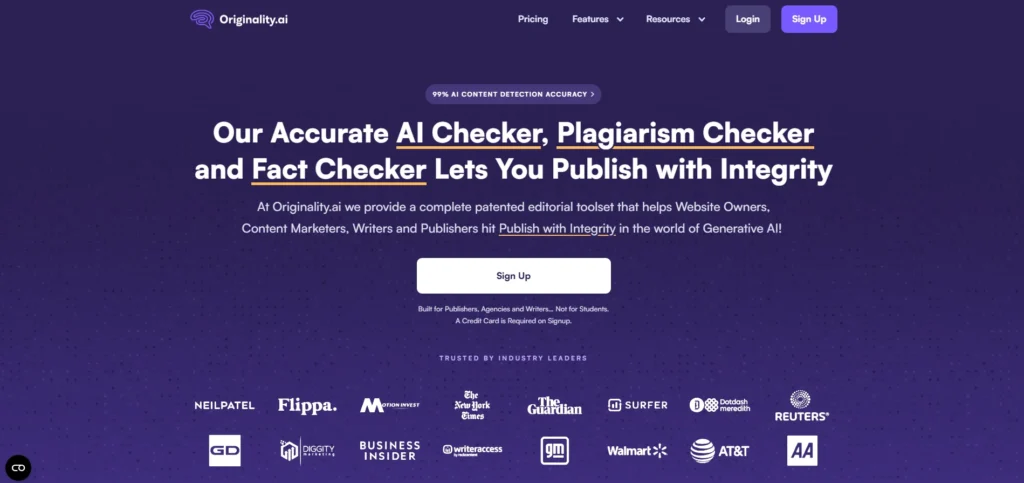
Originality.ai is an AI content detection platform designed for publishers, educators, agencies, students, and content teams.
Its AI Scan can classify content as AI-generated, human-written, or mixed while providing probability scores and highlighted sections. The platform is particularly useful for reviewing outsourced content and auditing website copy.
Its newer AI Allowance feature also supports workflows where some level of AI assistance is acceptable, making it relevant for teams managing hybrid human-AI content.
Key features:
- AI, human, and mixed-content classification
- AI probability scoring
- Highlighted AI-generated sections
- AI Allowance for hybrid content
- Content authenticity analysis
Pros:
- Designed for professional content workflows
- Provides detailed AI analysis
- Supports mixed-content assessment
- Useful for publishers and agencies
Cons:
- Many advanced features require a paid plan
- Detection scores should not be treated as definitive proof
Pricing:
- Basic– Free
- Pro– $12.95/month
- Enterprise– $136.58/month
2. GPTZero
- Best for: Students, educators, and academic content checking
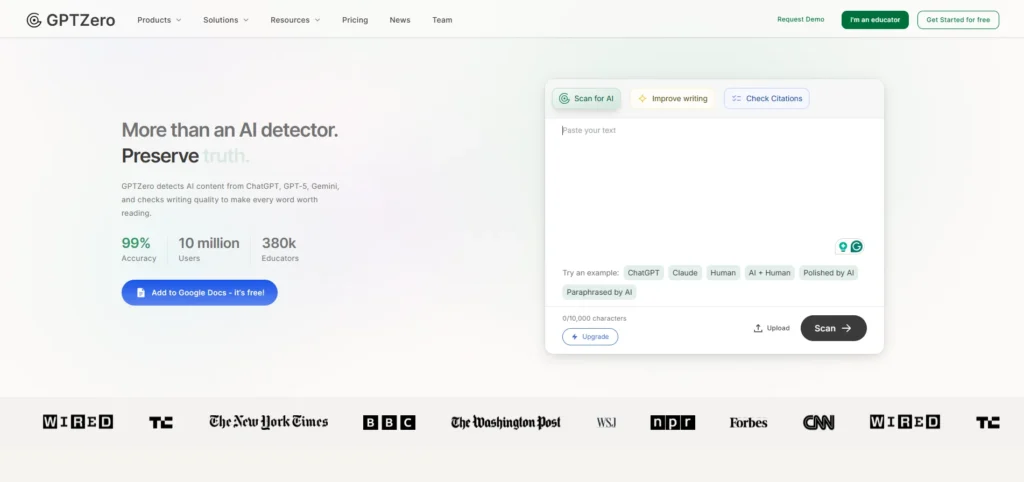
GPTZero is an AI detection platform focused on identifying AI-generated writing from models such as ChatGPT, GPT-4, Gemini, and Llama.
Its technology uses deep learning and sentence-level classification to estimate whether content was generated by AI. Users can submit pasted text as well as documents and image files, while the platform can analyse multiple files in a workflow, similar to how time tracking software helps manage and monitor work processes.
It is particularly relevant for educational environments and users who want sentence-level insights rather than only an overall detection score.
Key features:
- Sentence-level AI classification
- Deep-learning detection
- Supports multiple AI models
- DOCX, PDF, and image uploads
- Batch file analysis
Pros:
- Strong focus on education
- Provides sentence-level results
- Supports different document formats
- Tracks newer AI models
Cons:
- Detection is not infallible
- Advanced features may require an account or paid access
Pricing:
- Premium– ₹419.30/month
- Professional– ₹839.30/month
3. Copyleaks AI Detector
- Best for: Businesses, educators, and multilingual content teams
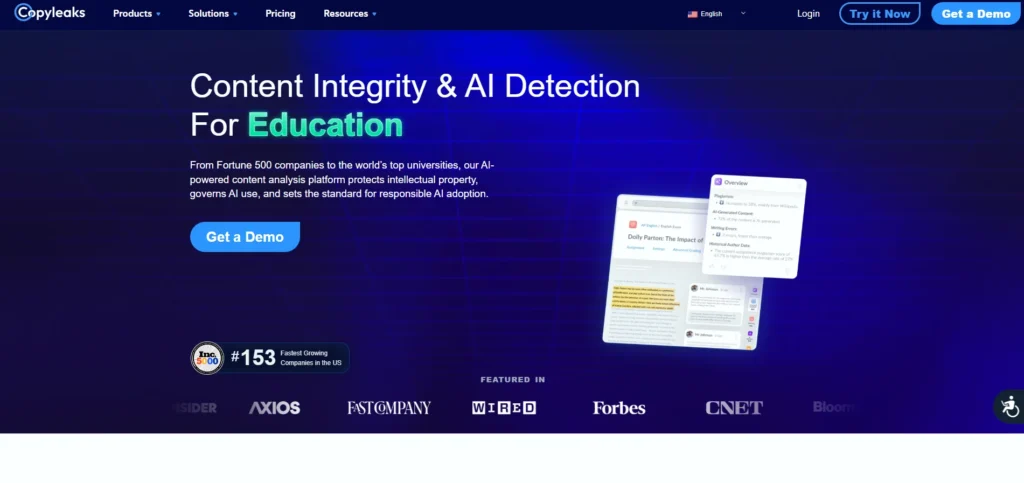
Copyleaks AI Detector identifies potentially AI-generated content from models including ChatGPT, Gemini, Claude, and others.
It supports software more than 30 languages and provides AI Logic features that explain why specific passages may have been flagged. The platform also offers browser extensions, Google Docs integration, API access, and LMS integrations for educational institutions.
Its combination of AI detection, plagiarism checking, and content-integrity tools makes it suitable for organisations managing larger volumes of written content through content syndication software.
Key features:
- 30+ language support
- AI Logic explanations
- Sentence-level AI insights
- Plagiarism detection
- Browser extension
- Google Docs integration
- API and LMS integrations
Pros:
- Broad language support
- Multiple integration options
- Combines AI and plagiarism checking
- Suitable for enterprise workflows
Cons:
- Advanced features require paid access
- Large feature set may feel complex for occasional users
Pricing:
- Personal– $13.99/month
- Pro– $74.99/month
- Enterprise– Talk to Sales
- Education– Talk to Sales
4. Smodin AI Detector
- Best for: Students, teachers, researchers, and multilingual users
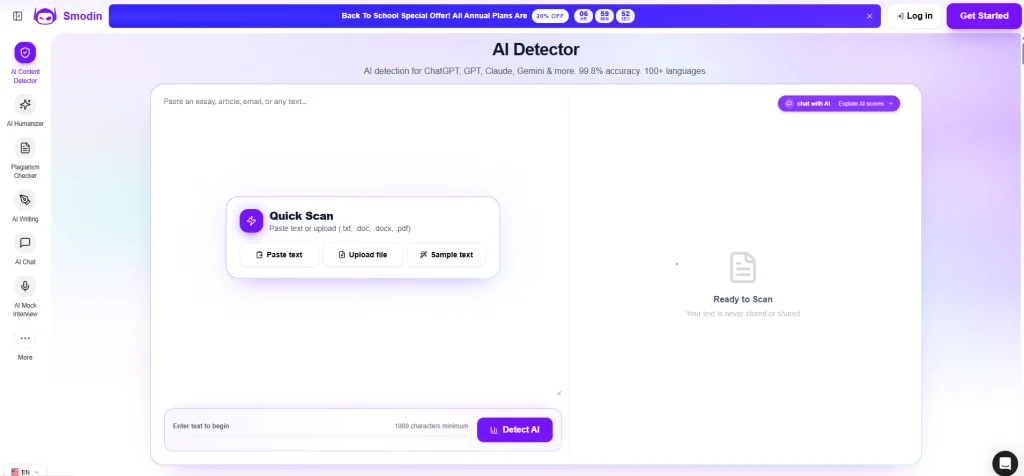
Smodin AI Detector analyses written content to estimate whether it was generated by AI models such as ChatGPT, GPT, Claude, and Gemini.
The platform supports more than 100 languages and provides AI-versus-human probability scores along with sentence-level highlights. Users can paste text or upload supported document formats.
Smodin also connects AI detection with plagiarism checking, rewriting, and other writing tools, making it useful for users who want several content-analysis functions alongside content analytics tools within one platform.
Key features:
- 100+ language support
- AI probability scores
- Sentence-level highlights
- Text and document uploads
- Plagiarism checker
- AI writing tools
- API availability
Pros:
- Extensive language support
- Easy-to-use interface
- Offers multiple writing tools
- Useful for academic and professional content
Cons:
- Some advanced features require paid plans
- Accuracy claims are based largely on provider testing
Pricing:
- Starter– ₹942/mo
- Premium– ₹1449/mo
5. Turnitin AI Detection
- Best for: Schools, colleges, universities, and educators
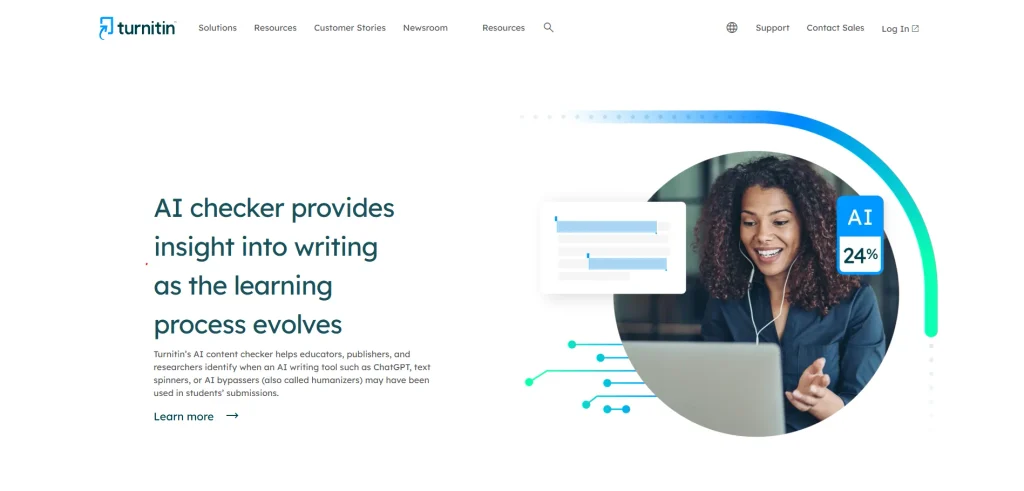
Turnitin’s AI Writing Detection is designed primarily for educational environments and helps instructors identify text that may have been generated or modified using generative AI.
Its AI Writing Report provides an overall percentage for qualifying text and identifies categories such as likely AI-generated or AI-paraphrased writing. The system is integrated into eligible Turnitin products rather than being a typical standalone consumer detector.
Turnitin itself advises that AI detection should not be used as the sole basis for academic misconduct decisions.
Key features:
- AI Writing Report
- AI-generated text detection
- AI-paraphrased text detection
- Submission-level percentage
- Integration with Turnitin products
- Education-focused workflow
Pros:
- Built for academic environments
- Integrates with Turnitin workflows
- Provides detailed submission reports
- Regular model updates
Cons:
- Generally accessed through institutional licenses
- Not designed primarily for individual consumers
- Turnitin warns that results can be inaccurate
Pricing:
- Basic– $6.59/Month
- Ultimate– $24.00/Month
- Standard– $14.00/Month
6. QuillBot AI Detector
- Best for: Students, writers, and everyday content checking
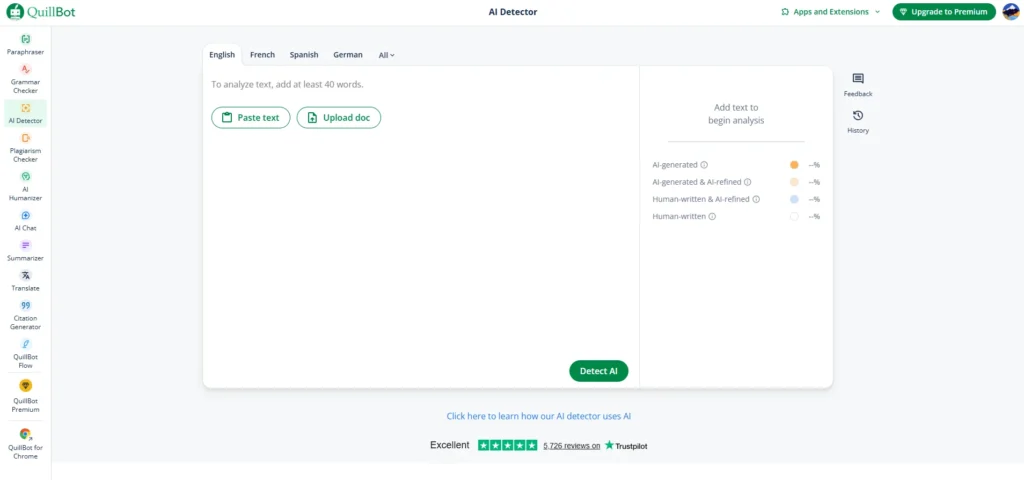
QuillBot AI Detector is a free AI detection tool that allows users to check written content without paying for the detection itself.
It analyses text to estimate whether it contains AI-generated writing and is part of QuillBot’s broader writing and paraphrasing ecosystem. Free users can upload one file at a time, while Premium users can upload up to 20 files simultaneously.
This makes it convenient for students, writers, and individuals who need straightforward AI detection without a separate paid subscription.
Key features:
- Free AI detection
- File uploads
- Batch uploads for Premium users
- Integration with QuillBot’s writing ecosystem
- AI content analysis
Pros:
- AI detection is free
- Simple to use
- Suitable for individual users
- Premium supports batch uploads
Cons:
- Fewer advanced detection controls than some enterprise tools
- Free file-upload functionality is more limited
Pricing:
- Monthly– ₹799 per month
- Quarterly– ₹567 per month
- Annually– ₹334 per month
7. Sapling AI Detector
- Best for: Businesses, educators, content reviewers, and developers
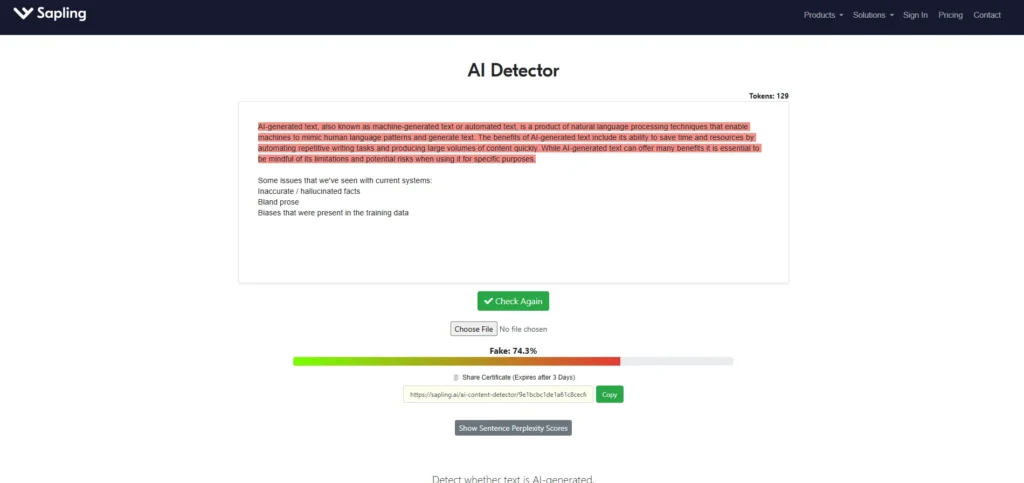
Sapling AI Content Detector analyses text to estimate the probability that it was generated by AI. Its system can provide an overall document score as well as sentence-level and token-level probabilities.
The platform supports AI models from providers including OpenAI, Google, Anthropic, Meta, and Mistral. Sapling also provides an API for integrating AI detection into applications, marketplaces, content pipelines, and other workflows.
The platform emphasises that detector results should be treated as screening signals rather than definitive evidence.
Key features:
- Document-level AI probability
- Sentence-level analysis
- Token-level probabilities
- HTML heatmap
- API access
- Support for multiple AI models
Pros:
- Useful for developers and businesses
- Detailed detection information
- Large API input capacity
- Supports multiple AI model families
Cons:
- Free web version has input limits
- API features are more relevant to technical users
Pricing:
- Free– $0
- Pro– $25 / month
- API– Metered
- Contact Sales
8. ZeroGPT
- Best for: Students, writers, and quick AI-content checks
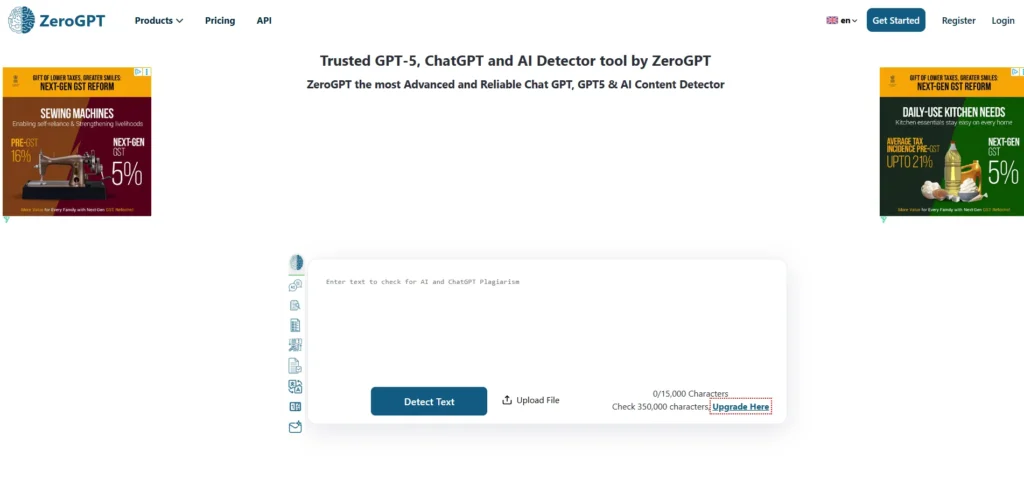
ZeroGPT is an AI content detection tool that analyses text for patterns associated with AI-generated writing.
It supports detection for major AI models, including ChatGPT, Claude, Gemini, DeepSeek, Llama, and others. Users can paste text or upload documents in formats such as TXT, DOCX, PDF, and ODT.
The platform provides sentence-by-sentence analysis and AI detection results. Premium users receive larger file limits and batch-processing capabilities, while free users can perform smaller checks.
Key features:
- AI-generated content detection
- Sentence-level breakdown
- Multiple AI model support
- TXT, DOCX, PDF, and ODT uploads
- Batch processing for premium users
- Large-document support on paid plans
Pros:
- Simple interface
- Supports multiple document formats
- Covers several major AI models
- Useful for quick checks
Cons:
- Free file limits are restricted
- Detection results should be interpreted cautiously
Pricing:
- Free– $0
- Pro– $9.99/month
- Plus– $16.99/month
- Max– $20.99/month
9. Scribbr AI Detector
- Best for: Students, academic writers, and multilingual users
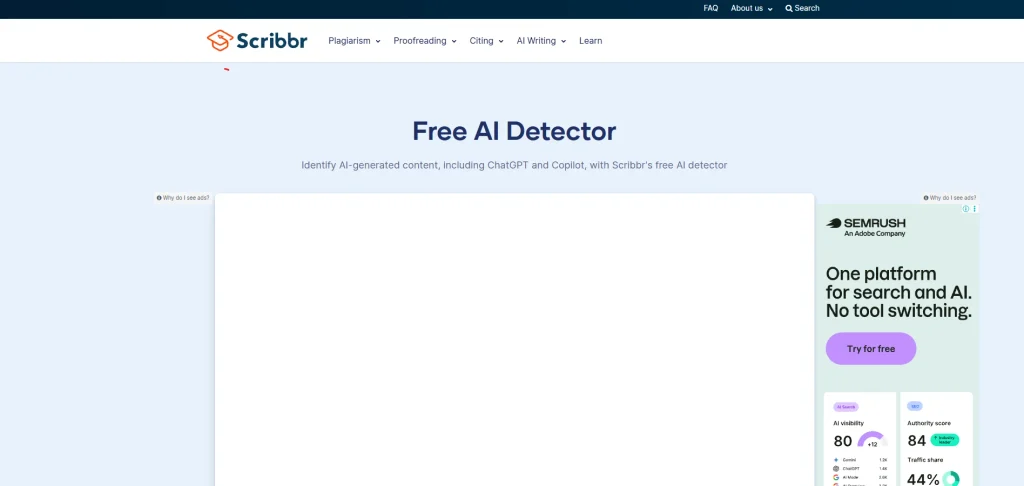
Scribbr AI Content Detector is designed for checking whether text may be AI-generated, AI-refined, or human-written. Its free version offers unlimited checks with a limit of up to 1,200 words per submission and does not require an account.
The tool provides paragraph-level feedback and supports multiple languages, including English, German, French, and Spanish.
Scribbr also offers a Premium AI Detector with broader model coverage. The company emphasizes that detection scores are indicators rather than conclusive proof of authorship.
Key features:
- Free AI detection
- Paragraph-level feedback
- AI-refined content identification
- Multilingual support
- No sign-up for free checks
- Premium detection option
Pros:
- Easy to use
- Free version available
- Supports multiple languages
- Useful for academic writing
- Clear AI probability results
Cons:
- Free submissions have word limits
- Premium features require payment
- Results are not definitive proof of AI use
Pricing:
- Free
10. Pangram
- Best for: Enterprises, publishers, educators, and AI-content governance
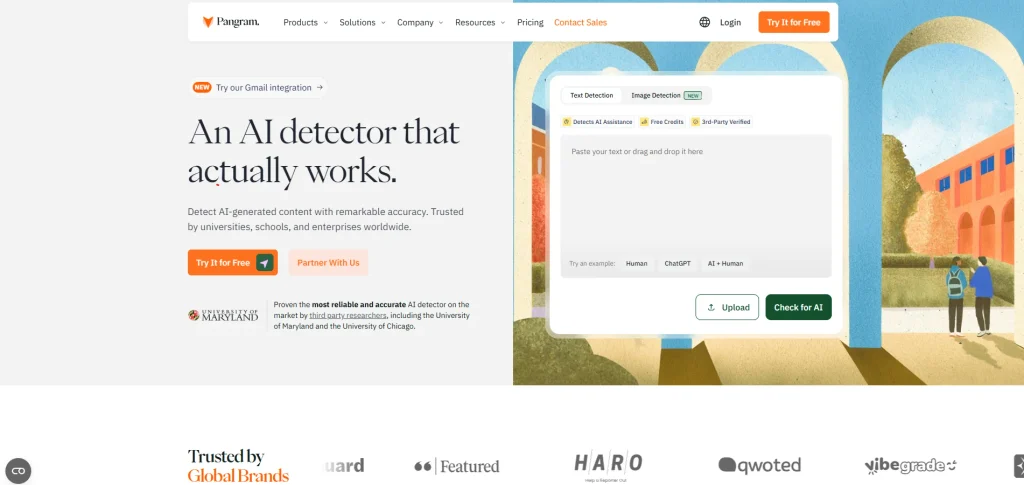
Pangram is an AI Content detection platform designed to distinguish human-written, AI-generated, and AI-assisted content.
Its newer Pangram 4 model is designed to identify fully AI-generated, mixed-author, and AI-assisted writing with greater granularity. Pangram also provides browser integration, API access, centralised management, and enterprise security features.
Its detection technology uses large datasets and machine-learning models to identify subtle patterns in writing. The platform is particularly relevant to organisations that need scalable AI-content screening and governance.
Key features:
- AI-generated content detection
- AI-assisted writing detection
- Mixed-content analysis
- Browser integration
- API integration
- Centralised management
- Enterprise security
Pros:
- Detailed AI-assistance detection
- Enterprise-focused features
- API and browser integration
- Supports large-scale workflows
Cons:
- Advanced enterprise features may be unnecessary for casual users
- Paid features are better suited to organisations
- Detection results still require contextual review
Pricing:
- Personal
- Free– $0
- Individual– $20/month
- Professional– $65/month
- Business
- Team– $20/seat/month
- Enterprise– Contact Sales
How Accurate Are AI Content Detectors?
These tools examine factors such as sentence predictability, vocabulary, phrasing, structure, and writing patterns to determine whether text resembles AI-generated content, while content optimization software can help improve clarity, readability, and overall content quality.
Results can vary depending on the AI model used, the amount of human editing, the length of the text, and the language or writing style. Heavily edited AI content may be harder to identify, while formal or highly predictable human writing can sometimes be incorrectly flagged as AI-generated.
Different detectors may also produce different results when analysing the same text. Therefore, AI detection scores are best treated as indicators rather than definitive proof of AI authorship. Human review, context, and other evidence should be considered before making important decisions based on a detector’s result.
Can AI Content Detectors Be Fooled?
AI content detectors can sometimes be inaccurate or produce misleading results, particularly when text has been heavily edited, paraphrased, translated, or mixed with human-written material. These tools generally look for statistical and linguistic patterns associated with AI-generated writing rather than identifying a unique marker that proves how the text was created.
As a result, sophisticated AI outputs may be difficult to classify, while naturally structured human writing can occasionally be flagged incorrectly. Changes in vocabulary, sentence structure, tone, and formatting may also affect detection results. Different AI detectors can produce different scores for the same piece of content because they use different detection methods and models.
Newer generative AI systems can further make detection challenging as their writing becomes more varied and natural. Therefore, detector results should be treated as indicators rather than definitive evidence, especially when they are being used for academic, professional, or publishing decisions.
Free vs Paid AI Content Detectors
Free and paid AI content detectors can both help identify text that may have been generated or assisted by artificial intelligence, but they often differ in features, limits, reporting, and accessibility.
- Free AI Content Detectors: These are suitable for occasional users who need basic AI detection without paying subscription fees.
- Word Limits: Free versions commonly impose daily or per-scan word limits, while paid plans generally provide higher or more flexible usage limits.
- Detection Reports: Free tools may provide simple probability scores, whereas paid versions can offer detailed reports and highlighted sections.
- Additional Features: Paid detectors may include plagiarism checking, grammar tools, originality analysis, API access, and integrations.
- Accuracy and Testing: Pricing does not automatically guarantee better detection accuracy, so users should consider independent testing and tool performance.
- Best for Students: Free options may be sufficient for occasional assignments or basic content checks, depending on available limits.
- Best for Businesses: Paid plans can be more practical for agencies, publishers, educators, and businesses processing large volumes of content regularly.
- Privacy Considerations: Before uploading sensitive material, check the platform’s privacy policy, data storage practices, and terms regarding submitted content.
Which Should You Choose? The choice depends on your content volume, required features, budget, and need for detailed analysis rather than simply choosing based on price.
How To Choose The Right AI Content Detector
Choosing an AI content detector requires considering accuracy, usability, supported languages, reporting features, pricing, and the specific purpose for which you need detection.
- Detection Accuracy: Compare independent testing results and user feedback to understand how consistently the tool identifies AI-generated and human-written content.
- Supported Languages: Choose a detector that supports the languages you regularly analyse, especially when reviewing multilingual or translated content.
- Ease of Use: Select a platform with a simple interface, clear instructions, quick processing, and easily understandable detection results for users.
- Reporting Features: Look for detailed reports, highlighted sections, probability scores, and explanations that make detection results easier to interpret.
- Pricing Plans: Compare free and paid plans based on word limits, scanning frequency, available features, and your expected content volume.
- Privacy and Security: Check how the platform handles uploaded content, stores submitted text, protects user information, and manages data retention.
- Additional Features: Consider tools offering plagiarism checking, grammar analysis, originality assessment, API access, or integrations alongside AI content detection capabilities.
Conclusion
AI content detectors have become valuable tools for reviewing text in education, publishing, marketing, and professional communication. The 10 best AI content detectors in 2026 offer different approaches to identifying AI-generated writing, with features such as detailed reports, originality checks, plagiarism detection, and integration options.
However, no detector should be treated as a completely reliable source of proof because results can be affected by editing, writing style, language, and the AI model used. Users should consider accuracy, ease of use, pricing, supported languages, and reporting features when selecting a tool. Combining detector results with human review can provide a more balanced assessment of content.
FAQs
What Is An AI Content Detector?
An AI content detector is a software tool that analyses text to estimate whether it was generated or assisted by artificial intelligence.
Are AI Content Detectors Accurate?
AI content detectors can provide useful indications, but their results are not always completely accurate and may vary based on writing style and editing.
Who Can Use AI Content Detectors?
Students, teachers, publishers, marketers, businesses, writers, and website owners can use AI content detectors to review and assess written content.
Can AI Content Detectors Detect ChatGPT-Generated Content?
Many AI detectors are designed to identify patterns associated with ChatGPT and other AI writing tools, but detection results should be interpreted alongside human review.