
Artificial intelligence has turned out to be an essential part of contemporary human resource management. The HR teams are not restricted to administrative roles like payroll, documentation and coordination of recruitments anymore. They are expected to play a strategic role in workforce planning, employee engagement, performance optimization and organizational development instead. This change is facilitated by AI Tools for HR that automate repetitions of the workflow, process large volumes of information regarding the workforce, and make, based on such information, better decisions. The technologies help organizations to hire better candidates, identify the skills missing, predict employee turnover, tailor the learning process, and monitor the degree of engagement in real-time.
Major HR functions like talent acquisition, performance management, employee wellness, succession planning, and diversity, equity, and inclusion have been extended to the adoption of AI solutions. By implementing AI in the context of HR practices, organizations will be more efficient (and productive), less biased, enhance workforce experiences, and produce more flexible and resilient workforces. This source talks about the most effective AI applications in human resource departments and how they are transforming the management of people.
Why Is AI Becoming Essential for HR?
The following eight issues explain why AI has become a necessity in the current staffing setups:
1. Anticipating Employee Turnover before it Occurs: AI can be used to predict employee turnover by studying trends in performance, absenteeism, and engagement and workload rates to determine employees who are likely to leave. This enables the HR departments to nip support programs, career development plans or workload allocation to enhance retention early.
2. Early Detection of Engagement Problems: AI will monitor employee engagement on a continuous basis through pulse surveys and other feedback mechanisms and communication channels as opposed to annual surveys. This assists the HR in identifying a falling morale or the tension of a team or a leadership problem before it turns out to be a bigger problem.
3. Minimizing Bias in Hiring and HR Decisions: Artificial intelligence has the potential to consider human resources based on their skills, experience, and job-related information instead of personal traits. It also compares job description and evaluation to identify bias lingo and assists HR in designing more balanced and inclusive hiring and promotion procedures.
4. Individualizing Learning and Career Management AI-based learning systems evaluate employee abilities and performance history and career objectives to suggest individual training trajectories. This guarantees that employees get appropriate development opportunities as well as assisting organizations in sealing the skills gaps effectively.
5. Screening of Resumes: AI can be used to perform repetitive administrative duties, including the screening of resumes, scheduling interviews, workflows, payroll, as well as policy responses. This will save time and money spent on manual work, increase accuracy and enable the HR professionals to engage on more valuable projects.
6. Increasing Workforce Planning and Decision-Making: AI uses historical workforce data to predict the future hiring requirements, staffing skills gaps, and simulate future workforce conditions. These understandings assist the leadership in making wise choices regarding recruitment, restructuring and long term talent approach.
7. Enhancing Performance Management: The AI tools will combine performance data, feedback and goal progress into actionable insights. This promotes the ongoing performance dialogue, objective appraisal, and improved fit of personal objectives with organizational goals.
Benefits of Using AI Tools in HR
Traditional HR practices are unable to keep pace as the dynamics of organizations and workforce become increasingly multifaceted. AI-based HR solutions can provide more than automation quantifiable benefits. They boost precision, better the experiences of employees, and promote people strategies based on data throughout the organization.
1. Faster and Smarter Hiring: AI saves a lot of time in the time to hire aspect because it is used to screen the resumes, match the candidates, schedule the interviews and carry out the initial assessments. This enables the recruiters to concentrate on high quality interactions and only the most appropriate get to the next stage.
2. Better Retention of Employees: The AI has the potential to assist the HR teams in detecting early indicators of dissatisfaction or burnout, based on the interaction data, performance trends, and behavioral patterns. This allows proactive retention measures in time before key employees make decisions to quit.
3. Data-Driven HR Decisions: AI will morph data on the workforce into actionable information. Instead of depending on assumptions, HR leaders are able to make evidence-based decisions regarding promotions, investing in training, planning compensation, and restructuring the workforce.
4. Better Employee Experience: AI enhances the interactions between employees and HR through individualized learning suggestions, chatbots providing instant HR service, etc. The more rapidly responsive, the more personalized route of development, and intelligent feedback systems will become the more engaging and satisfied people will be.
5. More Efficiency in Operations: Repeated activities like documentation, onboarding, attendance, and reporting are automated to eliminate errors and administrative burdens and allow the HR teams to concentrate on strategic projects.
6. Better Diversity, Equity, and Inclusion Performance: AI assists in removing the use of biased terms, equalizing assessment, and tracking DEI indicators, which facilitate the adoption of more fair, transparent, and inclusive HR practices.
How to Choose the Right AI Tool for HR
The choice of the appropriate AI-based HR tool is the key to finding the real impact. Hundreds of platforms exist, which means that the HR leaders have to consider not only the features of the tools, but also the long-term value, usability, and compatibility with the business objectives. 8 key aspects are to be taken into account here:
1. Make Your HR Objectives Clear: Begin by determining what is your greatest problem, be it high turnover, recruiting slowly, lack of engagement, or skill shortages. Select the tools that can target your highest priorities directly and not necessarily adopt AI because it is important.
2. Evaluate Data Safety and Data Integrity: The HR systems deal with employee information that is very sensitive. Make sure that the vendor adheres to effective data protection, regulatory, and access controls and encryption.
3. Assess Integration Capabilities: The AI solution must seamlessly combine with your current HRMS, ATS, payroll, and collaboration solutions. Eventually, a seamless integration will avoid silos of data and it will optimize automation.
4. Put a premium on Ease of Use and Adoption: The value is only created when an advanced AI tool is used by teams. Find out the user-friendly interfaces, low level of training and good user support.
5. Scalability and Check Customization: Select tools that can accommodate your working patterns, business strategies and policies. Scalability is used to make sure the platform is useful as your organization grows.
6. Evaluate AI Transparency and Bias Controls: Learn the way the AI makes decisions. The tool ought to have interpretable insights, bias control, and human control possibilities.
7. Reporting and Analytics Analysis: The strong AI HR tools offer real-time dashboards, predictive insights, and actionable recommendations and not only the raw data.
List of Top AI Tools for HR Teams
1. Peoplebox.ai
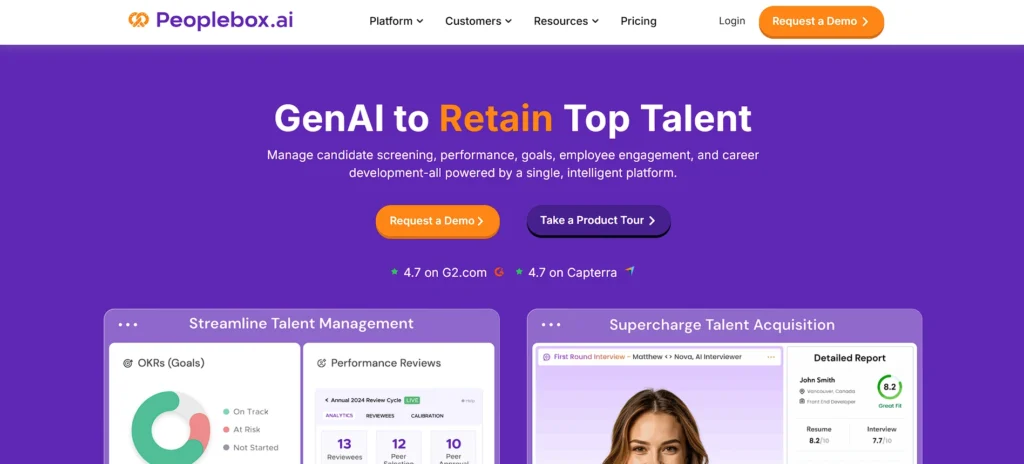
Peoplebox.ai is an artificial intelligence (AI) based human resource management tool that streamlines and speeds up the recruitment process by automating the process of recruiting and sorting resumes. The platform applies machine learning models to process thousands of resumes within minutes, and selects the most suitable candidates, according to the profile and experience as well as the relevancy of the candidates to the job. Recruiters are sent a priority list of qualified applicants rather than manually going through each application to reduce time-to-hire and remove human error.
Another contextual consideration that peoplebox.ai does is career progression, exposure to projects, and possible job fit, which guarantees better hiring decisions. Its artificial intelligence filters and adaptable scoring plans enable the HR department to integrate the hiring processes to suit the business requirements.
Peoplebox.ai allows recruiters to commit to strategy hiring, engagement, and employer building by limiting redundant screening efforts. The platform is appropriate in the case of organizations that wish to scale recruitment, enhance the quality of hiring, and develop a data-driven and organized process of talent acquisition.
Key Features:
- Smart parsing and analysis of resumes.
- Candidate matching engine based on skills.
- Smart shortlisting and ranking system.
- Job-matching algorithms that are custom.
- Support tools against bias-reduction.
- Hiring workflow management in a centralized manner.
Best for:
- Mid-market and enterprise level HR teams, fast growing companies.
Pricing:
- Performance Management: $8 emp/ month
- Individuals development plans: $3 emp/ month
- Engagement: $2/emp/ month
- 360 degree: $2/ emp/ month
- Compensation: $5/ emp/ month
2. SeekOut
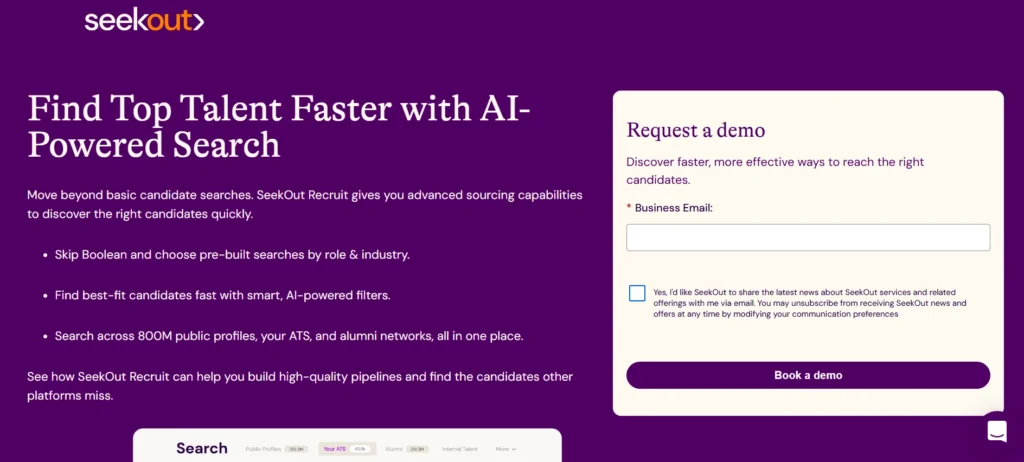
SeekOut is an AI-based talent intelligence and recruiting search engine and one of the leading AI tools for HR that assists the HR department in finding qualified applicants outside the conventional job boards. It checks millions of personal pages, job sites, and publicly available databases to identify qualified workers who are not actively seeking work. The AI engine of SeekOut evaluates experience, certifications, technical skills, and job trends to provide very targeted candidate suggestions.
Enterprise recruiters rely heavily on the platform to create diverse pipelines, fill roles that are difficult to fill, and plan strategically regarding their workforce.
Its powerful search and filtering feature allows recruiters to narrow down searches based on different data points such as location, level of experience, diversity measurements, and niche skills.
SeekOut also offers insights into the labor market that help organizations understand talent availability and hiring competitiveness. By automating the sourcing process and improving search accuracy, SeekOut significantly reduces recruiter workload while increasing the quality and diversity of candidate pools.
Key Features:
- Artificial intelligence candidate recruiting.
- Intelligent talent search filters.
- Diversity and inclusion sourcing solutions.
- Real-time skill analysis
- Talent market insights
- CRM and ATS integrations
Best:
- Enterprise recruitment and strategic talent sourcing.
Pricing:
- Custom Pricing
3. HireVue
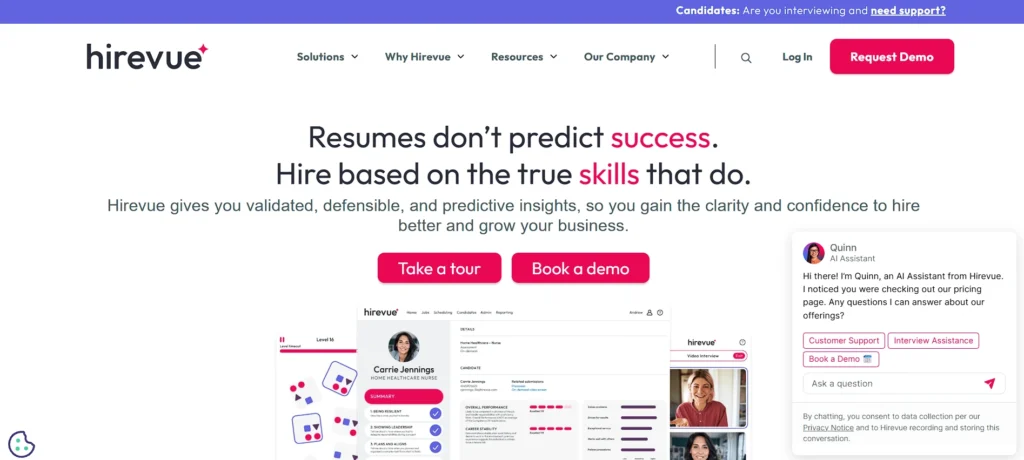
HireVue is an AI recruitment platform that transforms the modern hiring process by providing on-demand video interviews and formatted assessments. It enables the applicants to take interviews remotely, and the recruiters can view responses in large amounts. HireVue is one of the leading AI tools for HR, using AI to assess structured answers, job competencies, and communication patterns to reinforce coherent and data-driven hiring choices.
The platform standardizes interviews, which assist organizations to minimize bias and enhance the accuracy of hiring. HireVue also provides job simulations, game-based assessments, and skills testing to offer a more comprehensive view of the candidates other than video interviewing. Its automation capabilities go a long way in minimizing scheduling delays and workload during the interview coordination.
HireVue is usually the software of organizations with large volumes of applicants or widely dispersed hiring teams. HireVue allows HR teams to hire more quickly, gain better insight into candidates, and have fairer hiring through automation, structured assessment models, and AI-driven insights.
Key Features:
- On-demand video interviews
- Formal recruitment tests.
- Candidate intelligence powered by AI.
- Game based testing and skills.
- The frameworks of bias-reduction interviews.
- Recruitment automation on an enterprise level.
Best:
- Volume and enterprise recruiting teams.
Pricing:
- Custom pricing
4. Jobvite
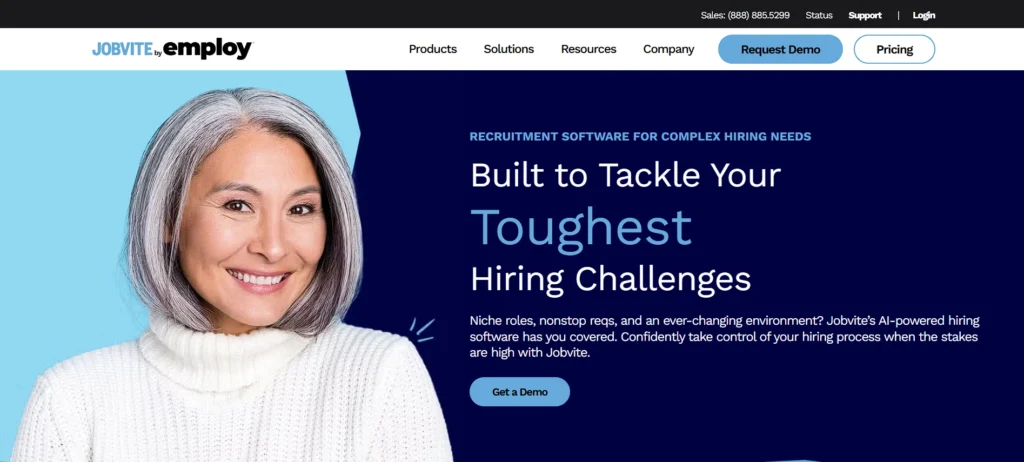
Jobvite is an artificial intelligence-based recruitment marketing and candidate relationship management platform and one of the leading AI tools for HR that enables organizations to attract, engage, and develop talent in the long run. Rather than concentrating on only active recruitment, Jobvite enables HR departments to build long-term relationships with their prospective talent pools via automated campaigns and personalized interaction.
Its AI engine analyzes candidate behavior, interaction history, and hiring patterns to suggest the most appropriate time and approach to reconnect with prospects. Jobvite also centralizes candidate information, allowing recruiters to monitor pipeline performance and anticipate hiring requirements.
The platform is a unified system for recruitment marketing, applicant tracking, referrals, and analytics. Jobvite helps organizations improve recruiter productivity, reduce talent drop-off, and retain high-potential candidates by prioritizing them and automating engagement workflows to ensure ready talent pipelines.
Key Features:
- Artificial intelligence candidate nurturing.
- Automated interaction campaigns.
- Talent rediscovery tools
- Recruitment CRM
- Hiring pipeline analytics
- ATS, marketing integrations.
Best for:
- Recruitment teams are large (growing and mid) and large.
Pricing:
- Custom pricing
5. Bonusly
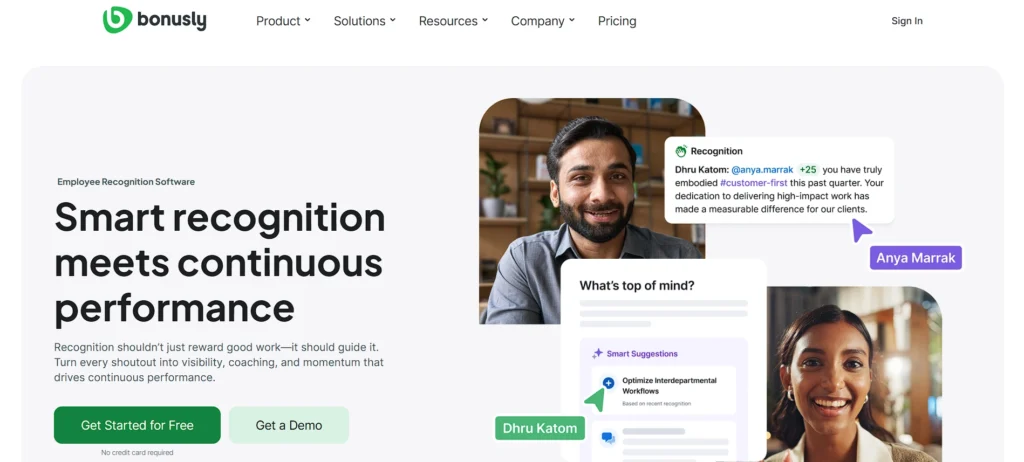
Bonusly is an AI-based employee recognition and rewards platform that assists companies in reinforcing the workplace culture and engagement. It lets the employees provide public and peer-to-peer recognition based on the company values, and AI will analyze the recognition patterns to identify high-performing patterns and engagement patterns. As one of the leading AI tools for HR, the insights provided by Bonusly can help HR teams know what motivates employees and which are the most engaged or the most disengaged teams and in what areas they need to improve their cultures.
The platform is connected to collaboration tools and HR systems that form the recognition part of the daily processes. Bonusly also has a flexible reward marketplace where employees can redeem their points to get gift cards, donations, or even customized perks.
With the help of AI, which monitors recognition data and engagement indicators, Bonusly helps to build a culture proactively, increase morale, and strengthen beneficial practices throughout the company.
Key Features:
- AI-based recognition analytics.
- Peer-to-peer reward system
- Individualized reward market place.
- Involvement and culture dashboard
- Team performance insights
- The integrations of collaboration tools.
Best for:
- It is that of SMBs and mid-market organizations.
Pricing:
- Free: $0 free forever
- Team: $3 / month
- Organisation: Custom pricing
6. Helpjuice
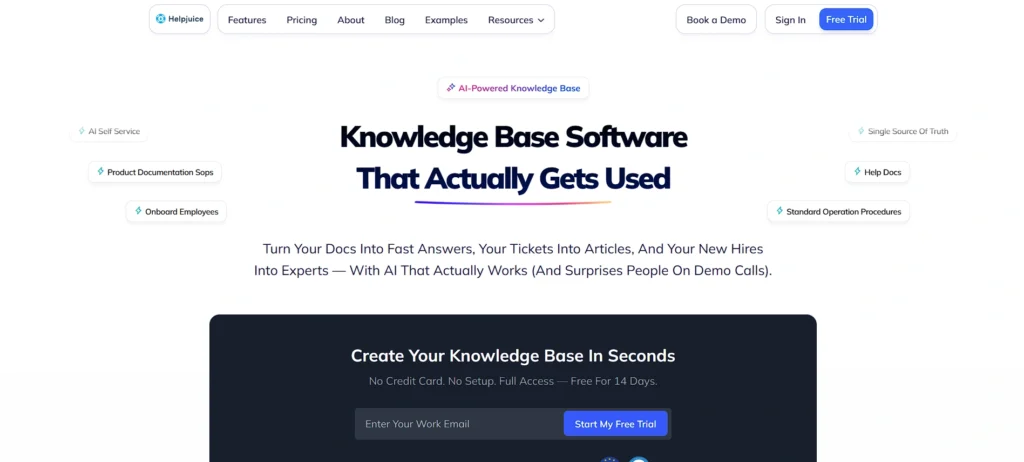
Helpjuice is an AI-based knowledge management system that consolidates the internal documentation and HR policies, SOPs, and training resources. It enables organizations to establish knowledge bases that are structured and easily searched and accessed by the employees. The AI-based search engine by Helpjuice comprehends natural language queries and provides relevant solutions, which saves time spent on information search. It is one of the leading AI tools for HR that helps streamline HR operations efficiently.
The platform, also, can support multilingual, collaboration tools, and version control and is, therefore, suitable to global teams. Helpjuice is used by HR departments to automate the onboarding process and streamline operations, as well as enhance internal communication. Its analytics services give data on content usage, knowledge gaps, and employee information requirements.
Helpjuice will help increase productivity, minimise the number of repetitive HR-related questions, and promote the sharing of knowledge within the organisation by providing employees with access to constantly updated information.
Key Features:
- AI-powered search engine
- Support chatbot 2 Knowledge chatbot.
- Medical collaboration tools.
- Version control system
- Multilingual documentation
- Knowledge usage analytics
Best to:
- Mid-sized organizations or large organizations.
Pricing:
- Knowledge Base: at $249/month
- AI Knowledge Base: $449/month
- Unlimited Ai Knowledge Base: $ 799/month
7. Lattice
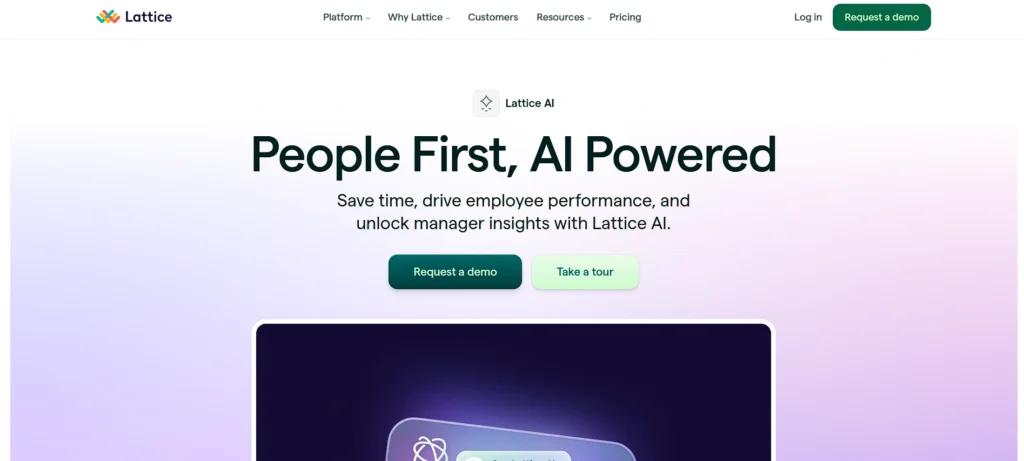
Lattice is a performance management service that provides AI in order to improve the quality of feedback and performance reviews, as well as people analytics. Its AI writing assistant will assist managers generate more understandable, realistic and objective feedback. Lattice unites the performance data, engagement metrics, and goal progress into a single system.
The platform allows uninterrupted feedback, formalized, and live performance feedback, facilitating the transition of past annual appraisal systems. The aspects of AI will determine trends and emphasize areas of development and help HR teams establish equal assessment systems.
Also offered by lattice, are engagement surveys and people analytics, which allow organizations to know how performance relates to retention and morale. Lattice enhances the consistency and visibility of feedback to improve the conversation between managers and employees and assists the HR team to perform business-oriented performance program design.
Key Features:
- In AI-assisted feedback writing, the AI assists in creating feedback texts, though it does not compose the message itself.
- Automation of performance review.
- Engagement analytics
- Goal and growth tracking
- Bias detection support
- People data dashboards
Best:
- SMB and middle-market HR teams.
Pricing:
- Custom pricing
8. 15Five
15Five is an engagement and performance platform which uses AI to align personal employee objectives and organizational priorities. The system acts as one of the AI tools for HR, assisting HR teams and managers to monitor progress, performance risk, and coach employees more efficiently. Its AI-driven insights point to goal alignment, patterns of engagement, and trends of productivity across teams. 15Five supports weekly check-ins, ongoing feedback, structured reviews, and people analytics, allowing data-driven performance management.
Manager coaching tools and engagement surveys are also included in the platform, helping leaders enhance team effectiveness. Through these features, 15Five supports proactive performance improvement and leadership development by processing goal achievement and behavioral data via AI.
15Five helps organizations enhance transparency, accountability, and build more robust cultures of feedback.
Key Features:
- AI-based goal insights
- OKR and progress tracking
- Continuous feedback system
- Manager coaching tools
- Engagement analytics
- This is predicted performance trends.
Best for:
- Smaller enterprises and medium-sized companies.
Pricing:
- Engage: $4 / month
- Perform: $11/month
- Total Platform: $ 16/ month
- Manager Product: $49/ month
9. Effy
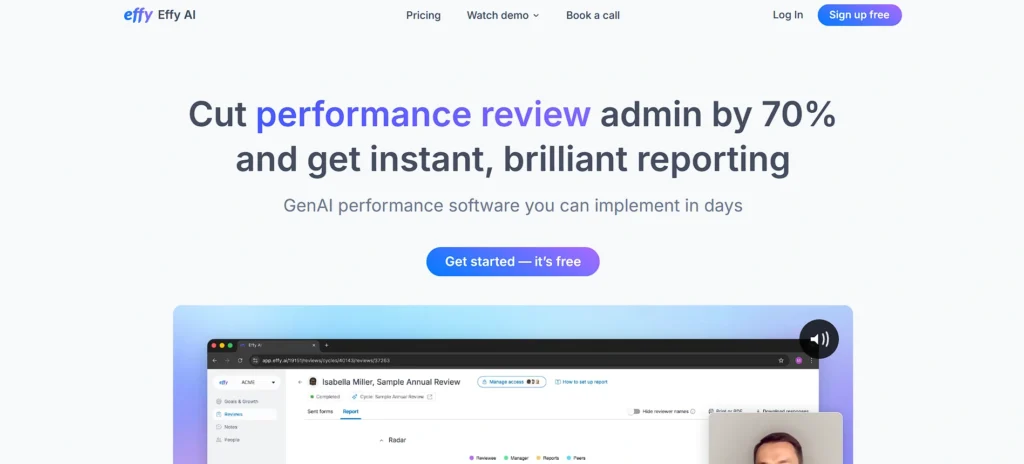
Effy is an AI-based performance review system that aims at streamlining the 360-degree feedback platform. It automates the establishment, allocation, monitoring and reporting of multi-rater ratings. Effy summarizes the responses, determines major themes of performance and creates structured review reports within the AI engine.
The platform is also Slack-integrated and therefore participation is easy and response rate is high. Effy specifically works well with organizations that are implementing formal feedback programs or with those who are in the need of lightweight performance tools. Effy helps to lower the workload of the HR people and enhance the quality of feedback by automating the administrative processes and feedback analysis.
Firms have clear details about the strengths, areas of development, and team dynamics. The Efficacy allows the companies to conduct systematic reviews when promoting, probating, evaluating leadership, and developing plans without sophisticated system configurations.
Key Features:
- Automated 360-review workflows
- Summaries of performance generated by AI.
- Slack integration
- Feedback monitoring boards.
- Formatted review templates.
- Report on development insights.
Best for:
- Lightweight and first time performance programs.
Pricing:
- On time review: $3/ month
- Continuous review: $6/ month
- Performance suite: $9/month
10. Leena AI
Another AI-assisted HR support and operations system is Leena AI, one of the leading AI tools for HR, intended to automate employee self-service, minimize HR workload, and enhance internal service delivery. The tool is compatible with leading enterprise software like SAP SuccessFactors, Oracle, Workday, ADP, and Microsoft Office 365, which facilitates access to HR-related data across the platforms. Leena AI is a natural language processing engine that makes it easier to use chatbots that are intelligent to respond to employee HR inquiries, navigate policies and procedures, and assist with daily chores such as leave requests, payroll inquiries, and benefits information.
Its chatbot is contextually and purposefully mindful and provides correct answers in more than 100 languages, making it suitable for the global and dispersed labor force. Leena AI also helps the workflow of ticketing, forwarding the complicated queries to the HR teams and resolving the simple ones immediately.
The platform enhances response time, gives employees immediate solutions, and enables HR professionals to address strategic, as opposed to transactional, inquiries by automating routine contact points with HR.
Key Features:
- HR chatbot support using AI.
- Natural language interpretation.
- Multilingual answers (100 and more languages).
- HRIS and collaboration integration.
- There are automated ticketing and escalating processes.
- Self-service for HR tasks
Best for:
- Every company that requires automated human resource support and employee service assistance.
Pricing:
- Custom pricing
Future Trends of AI in HR
There will always be more reinvention of HR through AI. Five significant trends in HR technology in the future are as follows:
- Anticipatory and Preventive HR: AI will anticipate more attrition, performance risk and shortage of skills before they can affect business performance.
- Employee Experiences that Are Hyper-Personalized: AI will be used to develop insights that will be used to personalize learning, benefits, career paths, and engagement programs.
- AI-Powered Workforce Design: With AI, organizations will be able to model the team structure, optimize positions, and simulate a workforce situation.
- HR and Manager AI Assistants: AI copilots will be directly integrated into HR systems, Slack, and CRM tools, and are to be used in day-to-day people management decisions.
- Honest and ethical AI Governance: More focus will be put on explainable AI, bias audit, regulatory compliance, and responsible data usage.
Conclusion
AI has not only shifted guarantee towards optional upgrade, but also towards a strategic requirement by the HR teams in the present day. The HR leaders will be leading the business results, creating strong cultures, and predicting the workforce challenges before they occur. This is achievable through AI tools for HR and AI-based HR software, which automates the tedious tasks, uncovers latent trends in people data, and provides real-time information in hiring, engagement, performance, and employee well-being.
AI allows HR professionals to be more precise, scaled, and impactful in their work as it can result in smoother and more equitable hiring, customized development, and active burnout reduction. Companies using AI in the HR department are in a better position to attract the best talent, retain the most talented employees, and develop workforces that are relevant to the future. This is not aimed to substitute human judgment, but to enhance it using smart systems that enable HR departments to emphasize on what is most important: people, culture, and organizational success over time.
FAQs
1. Can AI HR Systems Be Used Only With Large Companies?
No, most artificial intelligence HR solutions target startups, SMEs, and medium-sized businesses too.
2. Is AI The Solution To Employee Turnover?
Yes, AI tools are able to detect risks of disengagement and attrition early enough to respond with retention efforts.
3. Are AI HR Platforms Safe In Terms Of Employee Data?
The standards of security, encryption and compliance of reputable sellers of AI HR are strict.
4. Will AI Be Used To Substitute The HR Professionals?
No, AI is not replacing human decisions, it assists the HR teams to automate their work and get insights.
5. What HR Activities Can AI Be Most Useful In?
The most impacted areas are recruitment, engagement, performance management, workforce analytics and employee wellness.