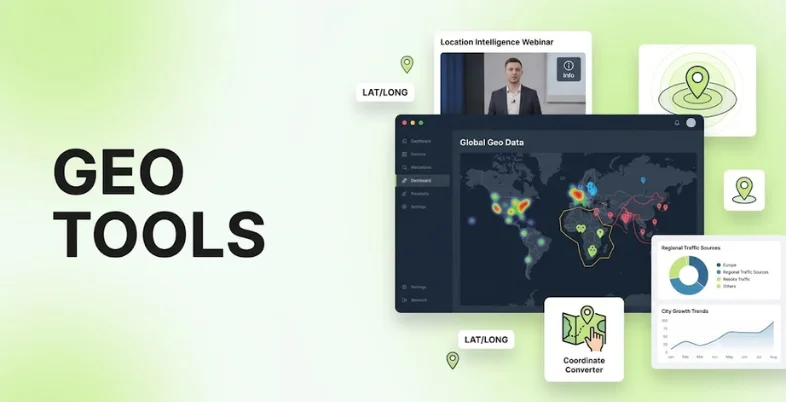
Generative Engine Optimization (GEO) has become an important digital marketing strategy in 2026 as users increasingly rely on AI-powered search engines for information, recommendations, and answers. GEO tools help marketers analyse AI search visibility, track brand mentions, identify content opportunities, and improve the likelihood of appearing in AI-generated responses.
Unlike traditional SEO platforms, these tools focus on how content is discovered, interpreted, and referenced by generative search systems. Businesses, publishers, and agencies can use GEO tools to monitor performance across emerging AI search platforms and develop content strategies aligned with changing search behavior, user intent, and evolving digital discovery patterns.
What is GEO
Generative Engine Optimization (GEO) is the practice of improving a brand’s content and online presence so it has a better chance of being understood, mentioned, or referenced by AI-powered search and answer engines. Unlike traditional SEO, which primarily focuses on improving rankings in conventional search engine results, GEO considers how generative AI systems process information and create direct responses to user queries.
GEO strategies can include creating clear and authoritative content, providing relevant information, maintaining consistent brand details, using structured content, and earning mentions from credible sources. Businesses can apply GEO across websites, articles, product pages, digital publications, and other online channels.
As AI-powered platforms increasingly influence how users research businesses, products, services, and topics, GEO provides a framework for understanding and improving visibility within these emerging search experiences. GEO does not guarantee inclusion in AI-generated responses, as these systems can change their outputs and sources.
GEO vs SEO: What’s the Difference?
GEO and SEO both focus on improving online visibility, but they target different search experiences. SEO primarily aims to improve a website’s visibility and rankings in traditional search engine results, while GEO focuses on how content appears within AI-generated answers and responses.
| Factor | GEO | SEO |
| Full Form | Generative Engine Optimization | Search Engine Optimization |
| Primary Focus | Visibility in AI-generated responses | Visibility in traditional search results |
| Main Platforms | AI search and answer engines | Google, Bing, and other search engines |
| Key Goal | Increase brand mentions and citations in AI responses | Improve organic search rankings and website traffic |
| Content Approach | Clear, authoritative, answer-focused content | Keyword-focused, useful, optimized content |
| Important Signals | Brand mentions, citations, source authority, contextual relevance | Keywords, backlinks, technical SEO, content quality |
| User Approach | Users often receive direct AI-generated answers | Users typically browse and select search results |
| Measurement | AI mentions, citations, visibility, response presence | Rankings, organic traffic, impressions, clicks |
| Relationship | Complements traditional SEO | Provides the foundation for search visibility |
In practice, GEO and SEO can work together. Strong SEO can help establish authoritative online content, while GEO focuses on how that information may be interpreted and represented by AI-powered search systems.
Why GEO Tools Matter Now
GEO tools are becoming increasingly relevant as people use AI-powered search platforms to research products, services, brands, and everyday questions. Traditional search visibility alone may not show how a business appears in AI-generated answers, making it harder for marketers to monitor this emerging channel.
GEO tools provide insights into brand mentions, citations, competitors, search queries, and the sources referenced by generative engines. They can also help identify content gaps and understand how AI systems interpret a brand or topic.
For businesses, these insights can support content planning and broader search strategies. As AI search continues to develop, GEO tools provide a way to monitor changes in visibility and understand how a brand’s online information is represented across generative search experiences.
Comparison of GEO Tools for AI Search
| GEO Tools | Best For | AI Search Monitoring | Key Strength | Pricing Models |
| Profound | Enterprise GEO programs | Multiple AI platforms | Enterprise analytics and AI visibility | Subscription |
| Otterly.AI | Small businesses and marketers | ChatGPT, Google AI Overviews and other platforms | Simple prompt and brand tracking | Subscription |
| Peec AI | Agencies and marketing teams | Multiple AI engines | Brand visibility and competitor analysis | Subscription |
| Scrunch AI | Dedicated GEO programs | Multiple AI platforms | AI visibility and website optimization | Subscription |
| AthenaHQ | Marketing Teams | Multiple AI platforms | Brand representation and action insights | Credit/subscription |
| AirOps | Content Teams | AI search and content workflows | Content creation and optimization | Subscription/custom |
| Semrush AI Visibility Toolkit | SEO Professionals | Multiple AI search platforms | GEO combined with traditional SEO | Subscription |
| Ahrefs Brand Radar | SEO and content teams | AI search and other discovery channels | AI visibility with Ahrefs data | Subscription |
| SE Ranking | SEO agencies and businesses | AI Overviews, AI Mode, ChatGPT, Perplexity, Gemini | SEO + AI visibility | Subscription |
| Rankscale | Agencies and growing businesses | 17+ AI engines | Broad engine coverage and credit-based tracking | Credit/subscription |
List of 10 Best GEO Tools for AI Search
1. Profound

Profound is a GEO and AI visibility platform designed for businesses that want to monitor how their brands appear across generative search engines. As one of the emerging geo tools, it tracks AI responses, brand mentions, citations, competitors, and search behavior across multiple AI platforms.
The platform also provides analytics and content-oriented workflows for teams managing AI search visibility at scale. Its enterprise-oriented capabilities make it relevant to larger marketing, SEO, and content teams that need structured monitoring and deeper insights into AI-generated search experiences.
Key Features:
- AI search visibility tracking
- Brand and competitor monitoring
- Citation analysis
- Prompt tracking
- AI search analytics
- Content optimization workflows
- Enterprise reporting
Pros:
- Broad AI visibility capabilities
- Suitable for larger teams
- Detailed analytics and reporting
- Supports content workflows
Cons:
- Can be expensive for smaller businesses
- Advanced features may require higher-tier plans
Pricing:
- For Brands
- Trial: Free
- Enterprise: Custom
- For Agencies
- Agency Growth: $99/month + add-ons
- Agency Enterprise: Custom
2. Otterly.AI
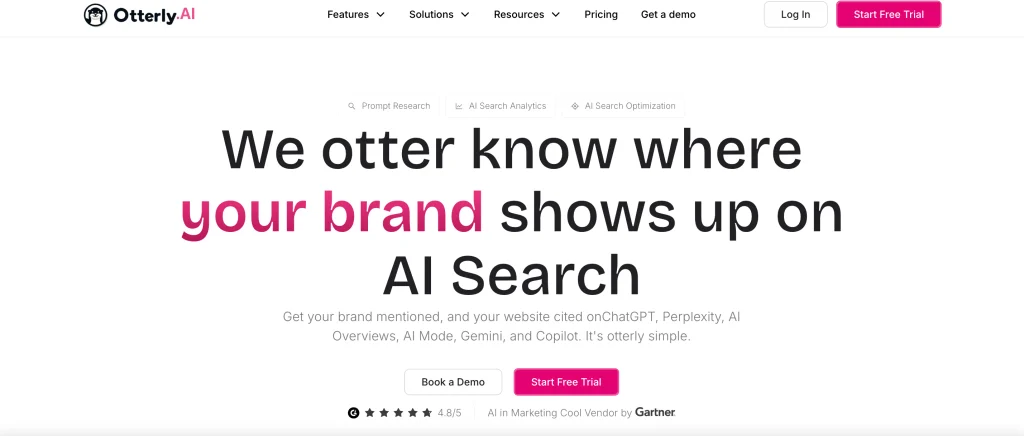
Otterly.AI is a GEO monitoring platform focused on tracking how brands appear in AI-generated search results. It monitors platforms such as ChatGPT, Google AI Overviews, Perplexity, and Microsoft Copilot, depending on the selected plan.
Users can track prompts, brand mentions, citations, competitors, and changes in visibility over time. The platform also offers GEO audits to evaluate website pages.
Its relatively accessible entry-level offering makes it suitable for marketers, consultants, and smaller teams beginning to monitor AI search visibility.
Key Features:
- AI visibility monitoring
- Prompt tracking
- Brand mention tracking
- Citation monitoring
- Competitor analysis
- GEO audits
- Visibility reports
Pros:
- Relatively accessible for smaller teams
- Easy-to-understand monitoring
- Covers multiple AI platforms
- Useful for ongoing tracking
Cons:
- Prompt allowances vary by plan
- Some AI platforms require higher tiers or add-ons
Pricing:
- Lite: $25/month
- Standard: $160/month
- Premium: $422/month
- Enterprise: Custom
3. Peec AI
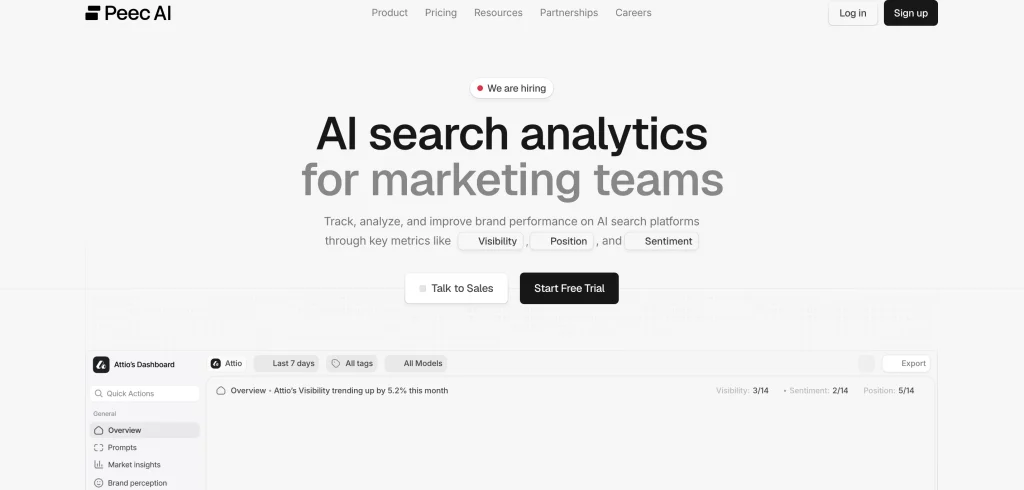
Peec AI is an AI search analytics platform that helps businesses monitor brand visibility across generative search engines. Among emerging geo tools, it provides information about brand mentions, rankings, sentiment, citations, competitors, and tracked prompts.
Users can analyse how their brand is represented in AI-generated answers and identify changes in visibility. Peec AI is positioned toward marketing and SEO teams that need focused AI search analytics rather than a broad traditional SEO suite.
Its reporting and competitive insights can support regular GEO monitoring and content strategy development.
Key Features:
- AI visibility tracking
- Prompt monitoring
- Brand mentions
- Sentiment analysis
- Citation analysis
- Competitor benchmarking
- Reporting and analytics
Pros:
- Focused GEO analytics
- Useful competitor insights
- Tracks important AI search metrics
- Suitable for agencies and marketing teams
Cons:
- Pricing depends on usage and plan
- Some AI engine coverage may require additional plans
Pricing:
- Starter: $95/mo
- Pro: $245/mo
- Advanced: $495/mo
- Enterprise: Custom
4. Scrunch AI

Scrunch AI is a GEO platform designed to help businesses understand and improve their presence across AI-powered search experiences. It monitors brand mentions, AI responses, citations, competitors, and other visibility signals across multiple generative platforms.
The platform also focuses on technical AI discoverability and persona-based search analysis. This allows teams to examine how different audiences may encounter their brand through AI search.
Scrunch can therefore support organisations looking beyond conventional rankings toward broader AI search visibility and content optimization.
Key Features:
- AI search monitoring
- Brand visibility tracking
- Persona-based analysis
- Citation tracking
- Competitor monitoring
- AI crawler insights
- GEO optimization
Pros:
- Broad AI search coverage
- Useful persona-based analysis
- Combines monitoring with optimization
- Suitable for dedicated GEO programs
Cons:
- Pricing can be relatively high
- Some advanced capabilities target larger organisations
Pricing:
- For brands
- Core: $250/mo
- Enterprise: Custom
- For Agencies
- Agency Core: $500/mo
- Enterprise: Custom
5. AthenaHQ
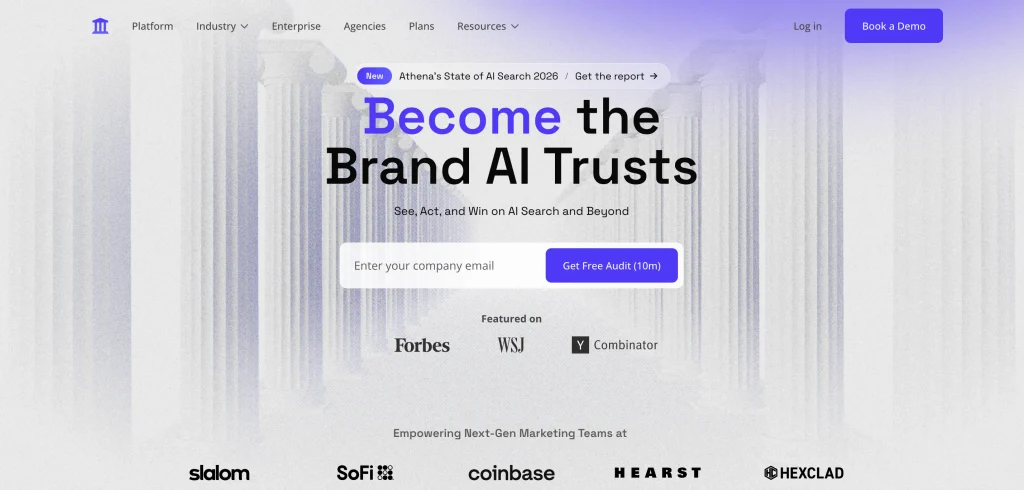
AthenaHQ is an AI visibility platform that tracks how brands are represented across multiple AI search engines. As one of the emerging geo tools, it can monitor brand mentions, citations, competitors, sentiment, and AI-generated responses across platforms including ChatGPT, Perplexity, Google AI Overviews, Gemini, Claude, Copilot, and Grok.
The platform also provides integrations with analytics and search-data sources, helping marketing teams connect AI visibility with broader performance information.
Its wide platform coverage makes it relevant for businesses seeking centralised monitoring of their presence across several AI search environments.
Key Features:
- Multi-platform AI monitoring
- Brand mention tracking
- Citation analysis
- Competitor tracking
- Sentiment analysis
- GA4 and GSC integrations
- AI visibility reporting
Pros:
- Broad AI platform coverage
- Useful for marketing teams
- Includes citation and sentiment analysis
- Integrates with analytics platforms
Cons:
- Credit-based usage can require monitoring
- Advanced plans may be costly for smaller businesses
Pricing:
- Essential: Free
- Starter: $245/month
- Enterprise: Custom
Also Read :
6. AirOps

AirOps combines AI-powered content production with search optimization and GEO-related workflows. Rather than focusing only on visibility monitoring, it helps teams research, create, optimize, and scale content designed for search and AI discovery.
The platform is particularly relevant to organizations managing large content operations and programmatic SEO campaigns. AirOps can connect content creation with search insights, allowing marketing teams to develop and optimise pages at scale.
Its broader content-production focus distinguishes it from tools primarily built for AI visibility monitoring.
Key Features:
- AI content creation
- Content optimization solutions
- Programmatic SEO
- Search research
- Content workflows
- AI search monitoring
- Scalable content operations
Pros:
- Combines content creation and optimization
- Suitable for large content teams
- Supports programmatic workflows
- Useful beyond GEO monitoring
Cons:
- Broader platform can be complex for beginners
- Custom pricing may make budgeting difficult
Pricing:
- Solo: Custom
- Pro: Custom
- Enterprise: Custom
7. Semrush AI Visibility Toolkit
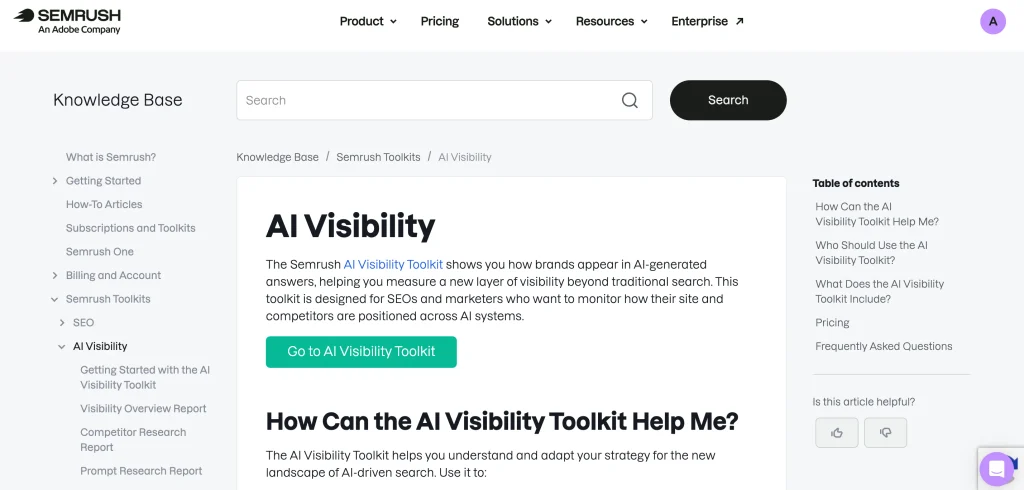
Semrush’s AI Visibility Toolkit extends the company’s established SEO platform into AI search visibility. As one of the geo tools available to marketers, it helps monitor how brands appear in AI-generated answers, analyse competitors, examine citations, and track visibility across relevant AI search experiences.
Because it sits within the broader Semrush ecosystem, users can connect AI visibility insights with traditional SEO, keyword research, content, and competitive-analysis workflows.
This makes it particularly relevant for businesses and agencies already using Semrush that want to incorporate generative search monitoring into their existing marketing processes.
Key Features:
- AI visibility tracking
- Brand monitoring
- Competitor analysis
- Citation analysis
- SEO research
- Content optimization
- AI search reporting
Pros:
- Connects GEO with traditional SEO
- Useful for existing Semrush users
- Broad digital marketing ecosystem
- Provides competitive insights
Cons:
- Some capabilities depend on plan
- May be more extensive than needed for simple GEO monitoring
Pricing:
- SEO: $117.33/mo
- AI Visibility: $99/mo per domain
- Traffic & Market: $289/mo
- Local: $30/month per location
- Content: $60/mo
- Social: $20/mo
- Advertising: $99/mo
- AI PR: $149/mo
- Enterprise: Custom
8. Ahrefs Brand Radar

Ahrefs Brand Radar is an AI visibility and discovery tool that shows how brands appear across AI-generated answers.
It uses a large database of search-backed prompts and allows users to benchmark brand visibility against competitors. The tool identifies cited pages and domains and provides visibility insights across AI platforms.
Ahrefs also connects AI visibility with channels such as traditional search, YouTube, Reddit, and TikTok. This makes Brand Radar particularly useful for SEO teams already working within the Ahrefs ecosystem.
Key Features:
- AI visibility tracking
- Brand benchmarking
- Citation discovery
- Competitor analysis
- Search-backed prompt database
- YouTube and Reddit insights
- AI search research
Pros:
- Large search-backed dataset
- Strong competitor benchmarking
- Connects AI and traditional search insights
- Useful for established Ahrefs users
Cons:
- Higher pricing can limit accessibility
- Primarily focused on monitoring and discovery rather than content creation
Pricing:
- Lite: $129/mo
- Standard: $249/mo
- Advanced: $449/mo
9. SE Ranking
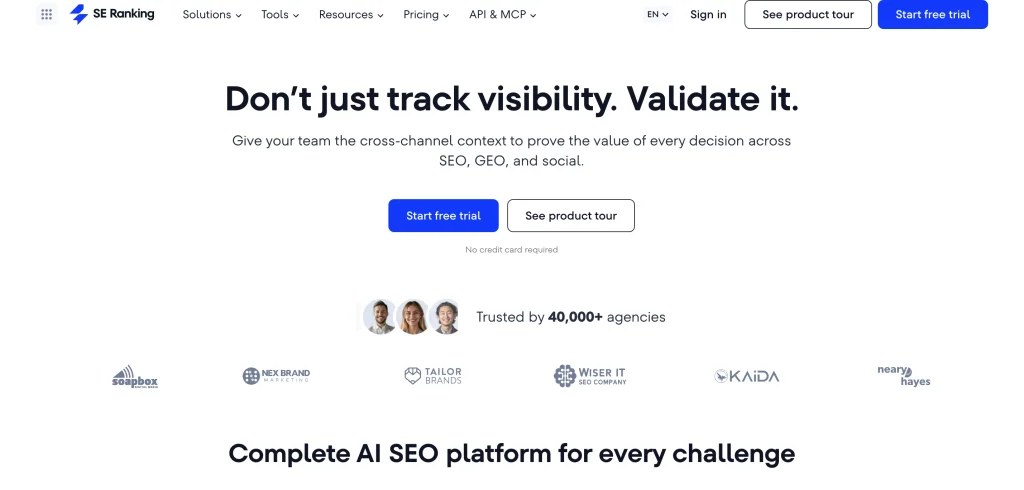
SE Ranking has expanded its traditional SEO platform with AI search visibility capabilities that allow users to monitor brand mentions and other signals within generative search. As one of the geo tools supporting AI visibility tracking, it helps marketers understand how their brands appear across emerging search experiences.
Its broader SEO ecosystem also includes keyword tracking, competitor research, website analysis, and content-related tools. This combination can help marketers connect conventional search performance with emerging AI search visibility.
SE Ranking is therefore relevant for businesses and agencies that want to manage traditional SEO and AI search monitoring within one broader digital marketing analytics platform.
Key Features:
- AI visibility monitoring
- Brand mention tracking
- Traditional rank tracking
- Competitor research
- Website auditing
- Content tools
- SEO reporting
Pros:
- Combines SEO and AI visibility
- Broad digital marketing toolkit
- Useful for agencies
- Established SEO platform
Cons:
- GEO features may be less specialised than dedicated platforms
- Feature availability depends on the selected plan
Pricing:
- Core: $103.20/mo
- Growth: $223.20/mo
- Enterprise: Custom
10. Rankscale
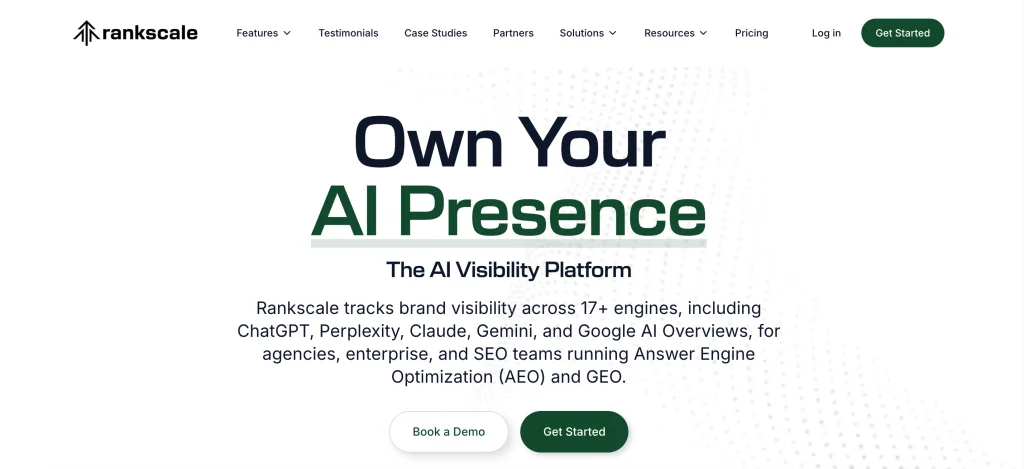
Rankscale is a credit-based AI visibility platform designed to monitor brand presence across a broad range of generative search engines.
It tracks AI mentions, citations, sentiment, competitors, and visibility while also providing page audits. The platform supports numerous AI engines and offers features such as API access and white-label reporting on higher plans.
Its credit-based model allows teams to adjust monitoring according to their query requirements. Rankscale can therefore suit agencies and marketing teams seeking broad AI search coverage with flexible usage options.
Key Features:
- AI visibility tracking
- 17+ AI engines
- Citation analysis
- Sentiment analysis
- Competitor benchmarking
- Page audits
- API access
- White-label reporting
Pros:
- Broad engine coverage
- Flexible credit-based model
- Useful agency features
- Includes page audits and sentiment analysis
Cons:
- Credit consumption requires monitoring
- Advanced API and white-label features require higher plans
Pricing:
- Pro: $84/month
- Growth: $327/month
- Enterprise: $663/month
What to Look for in a GEO Tool
Choosing a GEO tool requires evaluating its AI search coverage, tracking capabilities, reporting features, usability, integrations, pricing, and ability to monitor brand visibility effectively.
- AI Platform Coverage: Choose tools that monitor multiple AI search platforms, allowing you to compare brand visibility across different generative engines.
- Brand Mention Tracking: Look for accurate tracking of brand mentions, recommendations, and references within AI-generated responses across relevant queries and platforms.
- Citation Monitoring: Select tools that identify websites and sources cited by AI engines, helping you understand which content influences generated answers.
- Competitor Analysis: Choose platforms that compare your brand with competitors, revealing differences in mentions, citations, visibility, and positioning across AI responses.
- Query Tracking: Check whether the tool allows customised queries related to your products, services, industry, audience, and important customer search intentions.
- Reporting Features: Look for dashboards and reports that clearly present visibility trends, mentions, citations, competitors, and other useful GEO performance metrics.
- Pricing and Integrations: Compare pricing, usage limits, team features, API access, and integrations to ensure the tool fits your marketing workflow.
How GEO Tools Work
GEO tools monitor how brands and content appear across AI-powered search platforms by analysing generated responses, citations, mentions, queries, competitors, and visibility patterns.
- Track AI Search Queries: GEO tools monitor selected queries to see how AI search engines respond to questions related to your brand, products, or industry.
- Analyze AI Responses: The tools examine generated answers to identify whether your brand, website, products, or services are mentioned.
- Monitor Brand Mentions: They track how frequently and in what context a brand appears across different AI-generated responses.
- Check Citations: GEO platforms identify websites, pages, and sources referenced by AI systems when generating responses.
- Measure Visibility: Some tools calculate visibility metrics to help users monitor changes in brand presence across AI search results.
- Analyze Competitors: GEO tools can compare brand mentions and citations with competitors to provide insights into their presence within AI-generated answers.
- Identify Content Gaps: The analysis can reveal topics, questions, or information where a brand has limited visibility or lacks relevant content.
- Generate Reports: Dashboards and reports organise GEO data, making it easier to monitor trends and evaluate changes in AI search visibility.
How to Use GEO Tools to Improve AI Search Visibility
GEO tools provide insights into AI search visibility, helping businesses identify content gaps, monitor brand mentions, analyse competitors, and improve information presented across generative search platforms.
- Identify Target Queries: Select relevant questions and search terms that potential customers may use when looking for your products, services, brand, or industry information.
- Monitor Brand Mentions: Track how frequently your brand appears in AI-generated responses and examine the context in which it is mentioned.
- Analyze Citations: Identify websites and pages frequently cited by AI platforms, then evaluate their content quality, relevance, authority, and information structure.
- Find Content Gaps: Use GEO data to identify questions or topics where competitors receive mentions while your website provides limited relevant information.
- Create Answer-Focused Content: Develop clear, comprehensive content that directly addresses common questions and provides useful, well-supported information for readers and AI systems.
- Strengthen Online Authority: Build credible brand mentions through high-quality publications, industry resources, reputable websites, and consistent business information across online platforms.
- Track Competitors: Monitor competing brands to understand which topics, queries, and content sources contribute to their visibility in AI-generated answers.
- Measure Changes Regularly: Recheck important queries periodically to monitor changes in mentions, citations, visibility, and how AI platforms represent your brand.
Conclusion
These tools are becoming increasingly useful in 2026 as businesses adapt their content strategies to AI-powered search and generative answer platforms. These tools can help monitor brand visibility, analyse AI responses, identify content gaps, track mentions, and understand how information is represented across different AI search experiences.
The 10 best GEO tools offer different features, pricing models, reporting capabilities, and levels of automation for marketers, agencies, publishers, and businesses. As AI search continues to evolve, combining GEO insights with traditional SEO, quality content, strong sources, and consistent brand information can help businesses better understand and manage their presence across emerging AI-driven discovery channels.
FAQs
1. What are GEO Tools?
GEO tools are software platforms that help businesses monitor and improve their visibility across AI-powered search engines and generative answer platforms.
2. How do GEO Tools Work?
GEO tools analyse AI-generated responses, brand mentions, search queries, citations, competitors, and other signals to provide insights into how brands appear in AI search results.
3. Why are GEO Tools Important in 2026?
GEO tools can help businesses understand changing search behavior as users increasingly use AI platforms to find information, recommendations, products, and services.
4. Can GEO Tools Replace Traditional SEO Tools?
GEO tools complement rather than replace traditional SEO tools. Businesses can use both to monitor conventional search rankings and visibility across AI-generated search experiences.