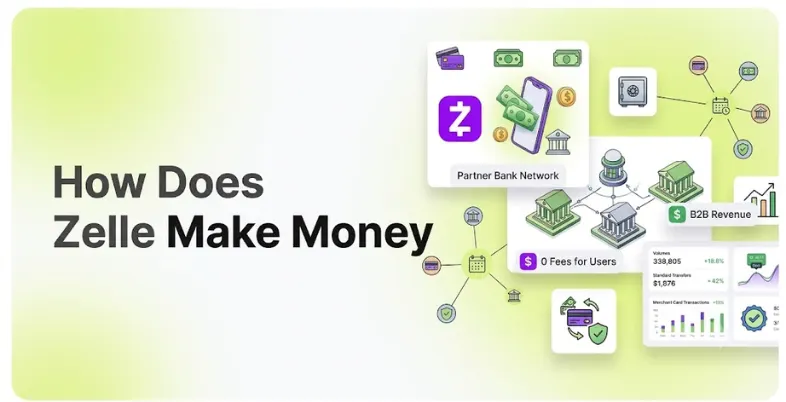
Free money transfers, instant payments, and no separate digital wallet—how does a payment platform offer these benefits while keeping its business running? How does zelle make money is a fascinating question that highlights how fintech companies can create value without relying on direct transaction fees from consumers. Launched in 2017 by Early Warning Services (EWS), Zelle connects participating banks and credit unions, allowing users to send and receive money directly between eligible U.S. bank accounts. Instead of charging users for standard transfers, the platform operates through a bank-focused business model that supports digital payments and helps financial institutions compete with independent payment apps.
Zelle’s growing transaction volume highlights its position in the U.S. payments industry. In 2025, the network processed more than $1.2 trillion across 4.2 billion transactions. But transaction volume alone does not explain how the business generates revenue. In this guide, we explore Zelle’s revenue model, market value, profitability, and the challenges shaping its future.
What Is Zelle?
Zelle is a U.S.-based peer-to-peer (P2P) payment network that allows individuals and eligible small businesses to send and receive money directly between participating U.S. bank accounts. Launched in 2017 by Early Warning Services (EWS), a financial technology company owned by major U.S. banking institutions, Zelle was designed to make digital payments faster, simpler, and more convenient.
Unlike traditional money transfer services that require users to maintain a separate digital wallet, Zelle connects participating financial institutions to facilitate bank-to-bank transfers. Users can typically send money using the recipient’s enrolled U.S. mobile phone number or email address without sharing their bank account details. Eligible transfers are generally completed within minutes, although processing times may vary depending on enrollment status, bank policies, and security checks.
One of Zelle’s biggest advantages is its integration with existing banking services. Instead of requiring consumers to download a separate payment application, many participating banks offer Zelle directly through their mobile banking apps and online banking portals. This makes it convenient for users who want to split bills, repay friends, send money to family members, or make payments to eligible small businesses.
Zelle primarily operates in the United States and focuses on domestic transfers between eligible bank accounts. It does not function like a traditional digital wallet where users keep a separate balance within the payment application. Instead, money moves between the sender’s and recipient’s eligible bank accounts.
The platform is also different from payment services that generate revenue through instant transfer fees, stored balances, or extensive merchant payment services. Zelle generally allows consumers to send and receive money without a separate transfer fee, although participating financial institutions may have their own account terms and charges. Its business model centers on providing payment infrastructure to banks and helping them deliver convenient digital payment services to their customers.
Zelle at a Glance
| Category | Details |
| Launch year | 2017 |
| Parent company | Early Warning Services, LLC |
| Business model | Bank-partnered payment network |
| Primary service | Peer-to-peer money transfers |
| Main market | United States |
| Supported payment method | Transfers between eligible participating bank accounts |
| Recipient information | Enrolled U.S. mobile number or email address |
| Consumer transfer fees | Generally free; bank terms may vary |
| Access method | Participating banks’ mobile apps and online banking |
| Primary users | Individuals and eligible small businesses |
| Main competitors | Venmo, Cash App, and PayPal |
| International transfers | Primarily designed for domestic U.S. transfers |
How Does Zelle Work?
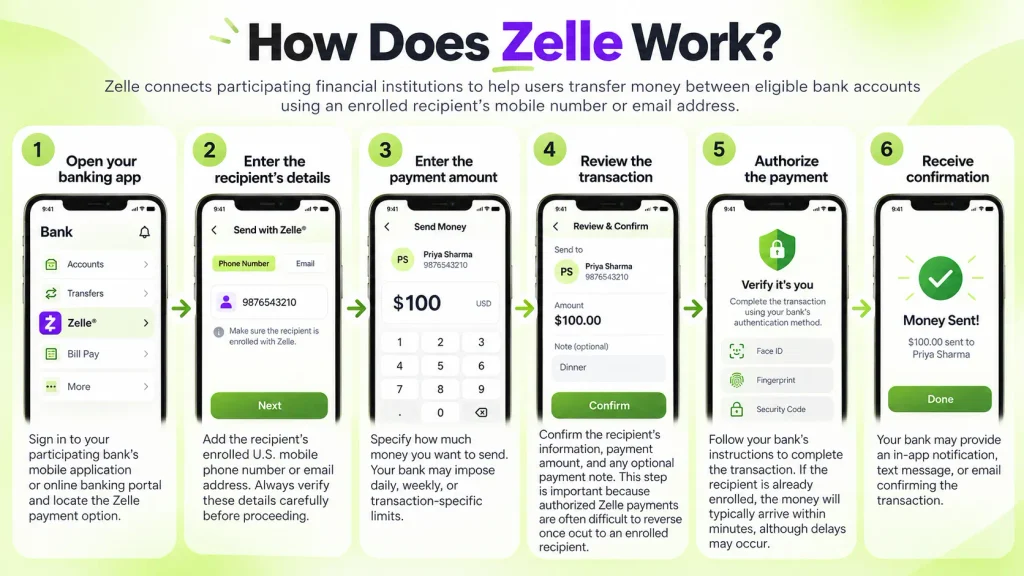
Zelle connects participating financial institutions to help users transfer money between eligible bank accounts. Understanding how does zelle make money starts with its bank-focused network, which uses an enrolled recipient’s mobile number or email address to identify where the payment should be delivered, making the process simpler than manually entering bank account information.
Here is how a typical Zelle payment works:
- Open your banking app: Sign in to your participating bank’s mobile application or online banking portal and locate the Zelle payment option.
- Enter the recipient’s details: Add the recipient’s enrolled U.S. mobile phone number or email address. Always verify these details carefully before proceeding.
- Enter the payment amount: Specify how much money you want to send. Your bank may impose daily, weekly, or transaction-specific limits.
- Review the transaction: Confirm the recipient’s information, payment amount, and any optional payment note. This step is important because authorized Zelle payments are often difficult to reverse once sent to an enrolled recipient.
- Authorize the payment: Follow your bank’s instructions to complete the transaction. If the recipient is already enrolled, the money will typically arrive within minutes, although delays may occur.
- Receive confirmation: Your bank may provide an in-app notification, text message, or email confirming the transaction.
What Makes Zelle Different From Other Payment Apps?
Zelle’s main distinction is that it is a payment network integrated into participating banks rather than a standalone digital wallet. Services such as Venmo, Cash App, and PayPal offer wallet-based functionality and additional features, while Zelle focuses primarily on facilitating transfers between eligible bank accounts.
For example, when you send money through Zelle, you generally do not need to add funds to a separate Zelle balance before making a payment. The transaction is initiated through your participating bank, and the money is transferred to the recipient’s eligible bank account.
This structure benefits both consumers and financial institutions. Consumers get a convenient way to transfer money, while banks can offer a digital payment service within their existing platforms. For Zelle’s operator, this bank-partnered structure provides the foundation for its business model and explains why the service can generally remain free for individual users.
Is Zelle Still Available as a Standalone App?
No. Zelle discontinued its standalone consumer application in April 2025. Consumers generally need to access the service through a participating bank or credit union that offers Zelle.
This change reinforces the platform’s bank-centered business model. Rather than relying on a separate consumer app, Zelle operates primarily through financial institutions that already have established customer relationships, banking infrastructure, and account verification processes.
Overall, Zelle’s combination of direct bank transfers, broad financial institution integration, and generally fee-free consumer payments makes it an important part of the U.S. digital payments ecosystem. Understanding how does zelle make money provides a useful foundation for exploring its revenue model, the role of its banking partners, and how it generates economic value without charging consumers a standard fee for every transfer.
Zelle Net Worth & Market Value
Zelle is one of the major peer-to-peer payment networks in the United States, but its exact net worth and standalone market valuation have not been publicly disclosed. The platform is operated by Early Warning Services (EWS), a privately held financial technology company owned by major U.S. banks. Therefore, its financial value cannot be calculated accurately from transaction volume alone.
Zelle’s operational growth, however, demonstrates its importance in the digital payments industry. In 2025, consumers and small businesses sent more than $1.2 trillion through Zelle across 4.2 billion transactions, representing 20% year-over-year growth in total payment value. The following table summarizes Zelle’s publicly reported performance and financial information available.
Also read:
- How to Build a Personal Money System
- How Does Tubi Make Money
- How Insurance Companies Make Money
- How Financial Advisors Make Money
Zelle Net Worth & Market Value:
| Financial metric | Numerical data |
| Launch year | 2017 |
| Transaction volume in 2024 | Over $1 trillion |
| Transaction volume in 2025 | Over $1.2 trillion |
| Total transactions in 2024 | 3.6 billion |
| Total transactions in 2025 | 4.2 billion |
| Year-over-year payment value growth in 2025 | 20% |
| Enrolled accounts in 2024 | 151 million |
| Accounts using Zelle in December 2025 | 100 million |
| Average daily payment value in 2025 | Approximately $3.4 billion |
| Small-business payment volume in 2025 | $357 billion |
| Banks and credit unions offering Zelle | 2,400+ |
| Official standalone net worth | Not disclosed |
| Official standalone market valuation | Not disclosed |
| Official standalone annual revenue | Not disclosed |
| Official standalone net profit | Not disclosed |
How Does Zelle Make Money?
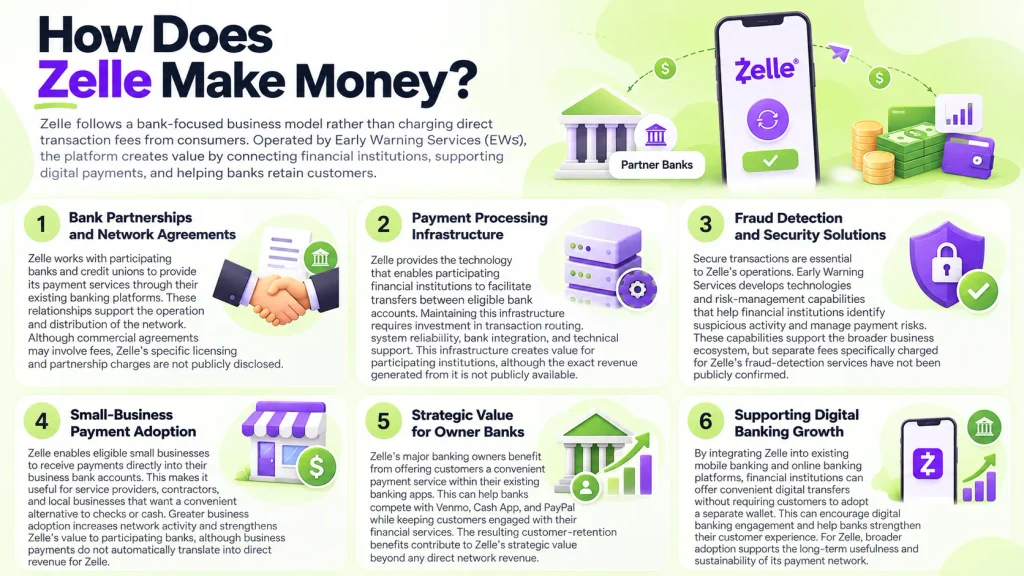
Zelle follows a bank-focused business model rather than relying on direct transaction fees from consumers. Operated by Early Warning Services (EWS), the platform creates value by connecting financial institutions, supporting digital payments, and helping banks retain customers. Here are the key ways Zelle’s business model generates economic value.
Step 1: Bank Partnerships and Network Agreements
Zelle works with participating banks and credit unions to provide its payment services through their existing banking platforms. These relationships support the operation and distribution of the network. Although commercial agreements may involve fees, Zelle’s specific licensing and partnership charges are not publicly disclosed.
Step 2: Payment Processing Infrastructure
Zelle provides the technology that enables participating financial institutions to facilitate transfers between eligible bank accounts. Maintaining this infrastructure requires investment in transaction routing, system reliability, bank integration, and technical support. This infrastructure creates value for participating institutions, although the exact revenue generated from it is not publicly available.
Step 3: Fraud Detection and Security Solutions
Secure transactions are essential to Zelle’s operations. Early Warning Services develops technologies and risk-management capabilities that help financial institutions identify suspicious activity and manage payment risks. These capabilities support the broader business ecosystem, but separate fees specifically charged for Zelle’s fraud-detection services have not been publicly confirmed.
Step 4: Small-Business Payment Adoption
Zelle enables eligible small businesses to receive payments directly into their business bank accounts. This makes it useful for service providers, contractors, and local businesses that want a convenient alternative to checks or cash. Greater business adoption increases network activity and strengthens Zelle’s value to participating banks, although business payments do not automatically translate into direct revenue for Zelle.
Step 5: Strategic Value for Owner Banks
Zelle’s major banking owners benefit from offering customers a convenient payment service within their existing banking apps. This can help banks compete with Venmo, Cash App, and PayPal while keeping customers engaged with their financial services. The resulting customer-retention benefits contribute to Zelle’s strategic value beyond any direct network revenue.
Step 6: Supporting Digital Banking Growth
By integrating Zelle into existing mobile banking and online banking platforms, financial institutions can offer convenient digital transfers without requiring customers to adopt a separate wallet. This can encourage digital banking engagement and help banks strengthen their customer experience. For Zelle, broader adoption supports the long-term usefulness and sustainability of its payment network.
Is Zelle Profitable?
Zelle’s profitability cannot be confirmed because the company does not publicly disclose separate financial statements showing its revenue, operating expenses, or net profit. The platform operates under Early Warning Services (EWS), a privately held financial technology company owned by major U.S. banking institutions. Although Zelle has demonstrated substantial growth in payment activity, its transaction volume alone does not establish whether it is profitable.
In 2025, Zelle processed more than $1.2 trillion across 4.2 billion transactions, representing 20% year-over-year growth in payment value. This scale demonstrates strong adoption and makes the network an important part of participating banks’ digital payment services. However, processing a large amount of money does not mean Zelle earns that amount as revenue. Its financial performance depends on its commercial arrangements with banks, technology and infrastructure costs, fraud prevention investments, and ongoing operational expenses.
Zelle’s business model may also deliver indirect financial benefits to its banking partners by helping them retain customers and compete with alternative payment platforms. These strategic benefits can make the network valuable even without charging consumers for standard transfers. Therefore, understanding how does zelle make money requires examining its bank partnerships and broader business strategy. Zelle appears to have a substantial and growing payment operation, but its standalone profitability remains publicly unverified.
How Does Zelle Make Money Without Charging Users?
Zelle’s business model is different from that of payment apps that generate revenue through instant transfer fees, digital wallet balances, or merchant payment charges. Instead of charging consumers for standard transfers, Zelle operates through a network of participating banks and credit unions. The service is managed by Early Warning Services (EWS), which provides the technology and infrastructure that supports the payment network.
- Bank-Focused Business Model: Zelle distributes its services through participating financial institutions rather than relying primarily on a standalone consumer application. Banks integrate Zelle into their mobile banking apps and online banking platforms, giving customers access to digital transfers through services they already use. These partnerships support the network’s operations, although the exact licensing or access fees paid by individual banks are not publicly available.
- Shared Payment Infrastructure: Developing and maintaining a payment network requires technology for transaction routing, bank connectivity, security, and system reliability. Zelle provides shared infrastructure that allows participating institutions to facilitate transfers between eligible bank accounts. This creates operational value for banks, which can offer a convenient payment service without independently building an entirely separate peer-to-peer network.
- Indirect Benefits for Participating Banks: Even when consumers do not pay a transfer fee, Zelle can create financial value for the banks that offer it. Convenient digital payments can encourage customers to continue using their existing bank accounts and mobile banking services instead of switching to competing payment platforms. These customer-retention and engagement benefits help explain why banks have a strategic interest in supporting the network.
- Growth in Small-Business Payments: Zelle also supports eligible small businesses that want to receive payments directly into their business bank accounts. Greater business adoption expands the network’s usefulness and increases its role in everyday payments. However, business payment volume should not be confused with Zelle’s revenue, and any applicable business fees depend on the participating financial institution’s terms.
- Fraud Prevention and Risk Management: Payment security is essential to maintaining trust in a digital payment network. Early Warning Services develops risk-management and fraud-detection capabilities that support financial institutions. These capabilities help the broader banking ecosystem manage payment risks and protect customers. However, there is no publicly confirmed breakdown showing how much separate revenue Zelle earns specifically from fraud prevention or security services.
- Value Created Through Bank Ownership: Zelle is operated by Early Warning Services, which is owned by major U.S. banking institutions. This ownership structure gives participating banks a shared payment network that helps them compete with independent fintech companies. Consequently, Zelle’s value extends beyond direct revenue: it also supports the long-term competitiveness of its banking owners.
How Does This Revenue Model Work?
The following table summarizes how the different components contribute to Zelle’s business model.
| Component | How it contributes |
| Bank partnerships | Provide distribution and support the network’s operations |
| Payment infrastructure | Enables transfers between participating financial institutions |
| Customer retention | Helps banks keep customers engaged with their banking services |
| Small-business adoption | Expands the network’s usefulness and transaction activity |
| Fraud prevention | Supports security and risk management |
| Strategic bank ownership | Helps traditional banks compete with independent payment apps |
Risks and Challenges in Zelle’s Business Model
Although Zelle has established a strong position in the U.S. digital payments market, its business model faces several risks that could affect its growth, reputation, and long-term sustainability. Here are the key challenges the platform must address.
- Fraud and Scams: Zelle’s fast payment process can make fraudulent transactions difficult to recover once authorized. Scammers may trick users into sending money to the wrong person or making payments under false pretenses. Zelle and its banking partners must continue investing in fraud detection, customer education, and security measures.
- Dependence on Banking Partners: Zelle relies on participating banks and credit unions to distribute its services. Changes in partnership agreements, bank policies, or technology infrastructure could affect its reach and operations. Maintaining strong relationships with financial institutions is essential to the network’s success.
- Limited Direct Revenue Opportunities: Zelle generally offers consumers free standard transfers, which supports adoption but limits opportunities to generate revenue directly from individual users. Introducing substantial consumer fees could reduce its competitive advantage and discourage customers from using the service.
- Intense Market Competition: Zelle competes with payment platforms such as Venmo, Cash App, and PayPal. These alternatives offer additional features, including digital wallets, debit cards, merchant payments, and other financial services. Zelle must continue improving its convenience, security, and functionality to remain competitive.
- Regulatory and Compliance Requirements: Payment networks must address evolving requirements related to consumer protection, fraud prevention, privacy, and financial crime. Changes in regulations or reimbursement expectations could increase operating costs and require updates to Zelle’s policies and processes.
- Limited Financial Transparency: Zelle does not publicly disclose standalone financial statements detailing its revenue, expenses, or net profit. This makes it difficult for analysts and investors to evaluate its profitability, calculate its margins, or compare its financial performance directly with publicly traded payment companies.
- Cybersecurity and Data Protection: Because Zelle operates through participating financial institutions, maintaining secure technology integrations and protecting sensitive payment information are critical. Cybersecurity incidents or system disruptions could damage consumer trust and increase operational costs.
Zelle vs Other Payment Apps
| Feature | Zelle | Venmo | Cash App | PayPal |
| Primary use | Direct bank transfers | Social payments | Payments and financial services | Online and international payments |
| Standard transfer fees | Generally free | Generally free for eligible standard transfers | Generally free for eligible standard transfers | Depends on payment type |
| Transfer speed | Usually within minutes | Standard bank transfers typically take 1–3 business days | Standard withdrawals typically take 1–3 business days | Varies by payment method |
| Separate digital wallet | No separate wallet required | Yes | Yes | Yes |
| Bank integration | Integrated into participating banks’ apps | Linked bank accounts | Linked bank accounts | Linked bank accounts |
| Business payments | Available to eligible businesses | Available | Available | Extensive merchant payment features |
| International transfers | Primarily U.S. domestic transfers | Primarily U.S. domestic payments | Primarily U.S. domestic payments | Supports international payments |
| Main advantage | Convenient bank-to-bank transfers | Social payment features | Additional financial services | Online checkout and international reach |
Conclusion
Zelle demonstrates how a digital payment network can create business value without charging consumers for standard money transfers. Instead of relying on direct transaction fees, Zelle operates through Early Warning Services and a network of participating banks and credit unions. Its business model focuses on payment infrastructure, banking partnerships, fraud prevention capabilities, and the strategic benefits it provides to financial institutions.
With billions of transactions processed annually, Zelle has become an important part of the U.S. digital payments ecosystem. However, its transaction volume should not be confused with revenue or profit, as its standalone financial results and market valuation are not publicly disclosed.
Looking ahead, Zelle’s success will depend on maintaining strong banking partnerships, improving fraud prevention, expanding its usefulness for eligible small businesses, and competing with platforms such as Venmo, Cash App, and PayPal. Ultimately, exploring how does zelle make money reveals how its biggest advantage lies in making bank-to-bank payments convenient while supporting the broader banking ecosystem.
Frequently Asked Questions
1. How does Zelle Make Money?
Zelle operates through Early Warning Services and participating financial institutions. Its business model creates value through payment infrastructure, bank partnerships, and services supporting the digital payments ecosystem. Its exact revenue breakdown is not publicly disclosed.
2. Is Zelle Free to Use?
Zelle generally allows consumers to send and receive money without a separate transfer fee. However, individual banks may have their own account terms, fees, or transaction limits.
3. What is Zelle’s Net Worth in 2026?
Zelle’s standalone net worth has not been officially disclosed. Since it operates under privately held Early Warning Services, its independent market valuation is not publicly available.
4. Is Zelle Profitable in 2026?
Zelle’s standalone profitability cannot be confirmed because separate revenue, expense, and net profit figures are not publicly disclosed. Its substantial transaction volume demonstrates operational scale but does not establish profitability.
5. Who owns Zelle?
Zelle is operated by Early Warning Services, LLC, a financial technology company owned by major U.S. banking institutions, including Bank of America, JPMorgan Chase, Wells Fargo, U.S. Bank, PNC Bank, Capital One, and Truist.