

Becoming a travel agent can be a practical career option for people who enjoy travel, planning, customer interaction, and sales. Travel agents help clients choose destinations, plan itineraries, book flights and hotels, arrange tours, and manage other parts of a trip.
You do not necessarily need a specific degree or years of travel-industry experience to enter the profession. You can start by working with an established agency, joining a host agency, or building your own independent travel business. Training, industry knowledge, supplier relationships, and strong customer service skills can help you build credibility and attract clients.
This guide explains how to become a travel agent in 2026, including the qualifications you need, skills to develop, business models, training, startup costs, salary expectations, and host agencies to consider.
What Is A Travel Agent?
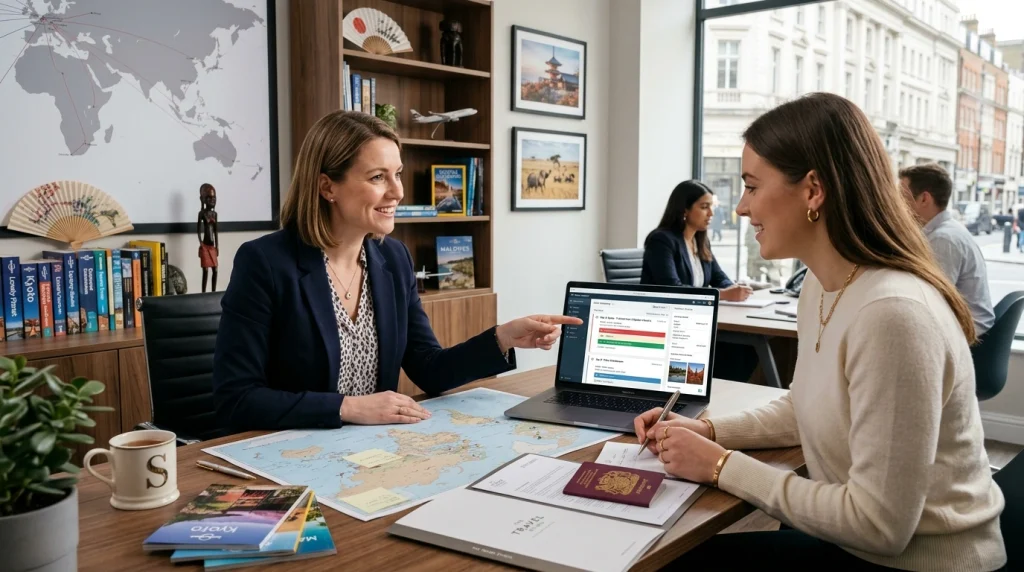
A travel agent is a professional who helps individuals or groups plan and book travel arrangements. This can include flights, hotels, cruises, transportation, tours, travel insurance, and complete holiday packages. Travel agents understand travel products and booking systems and use this knowledge to recommend suitable options based on a client’s budget, preferences, and itinerary.
What Does A Travel Agent Do?
A travel agent’s role involves much more than simply booking flights or hotels. The exact responsibilities depend on whether the agent works for an agency, operates independently, or specializes in a particular type of travel.
Common responsibilities include:
Understanding Client Requirements
Travel agents first understand where the client wants to travel, their budget, preferred dates, number of travelers, interests, and other requirements. This information helps them create suitable travel options.
Planning Travel Itineraries
Agents can prepare complete itineraries covering flights, accommodation, transportation, activities, tours, and other services. They may also suggest alternative destinations or travel arrangements when the original plan does not fit the client’s budget.
Booking Flights and Accommodation
Travel agents use supplier platforms, booking systems, or Global Distribution Systems (GDS) to search for and reserve flights, hotels, and other travel products.
Arranging Tours and Activities
Depending on their specialization, agents may arrange sightseeing tours, cruises, adventure activities, destination experiences, transfers, and holiday packages.
Explaining Travel Requirements
Agents may help clients understand passport, visa, insurance, baggage, cancellation, and other travel requirements. They should verify current requirements rather than relying on outdated information.
Managing Changes and Cancellations
Travel plans can change because of flight delays, cancellations, personal emergencies, or changes in client requirements. Travel agents may help clients modify reservations or communicate with suppliers.
Providing Customer Support
Customer service is an important part of the job. Agents may communicate with clients before, during, and after their trip and help resolve booking-related issues.
Selling Travel Products
Travel agents also have a sales role. They need to explain the value of different travel products, prepare quotations, follow up with prospects, and convert inquiries into bookings.
Is Travel Agent A Good Career In 2026?
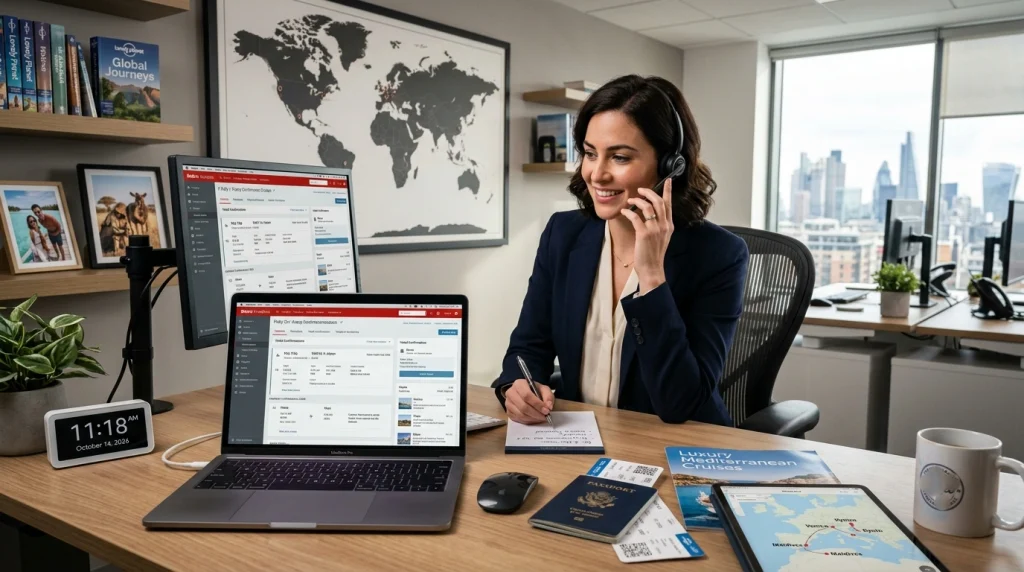
A travel agent career can offer several different paths in 2026. You can work as an employee, operate as an independent travel advisor, specialize in a niche, or eventually build a travel agency.
The role has also changed considerably because travelers can now make many bookings themselves through online travel platforms. This means travel agents increasingly need to provide value through expertise, personalization, convenience, problem-solving, and access to specialized travel products.
For example, an agent who specializes in luxury holidays, destination weddings, cruises, corporate travel, group tours, or complex international itineraries can provide a level of planning and personal assistance that may be difficult for a traveler to manage alone.
Current industry training also reflects the broader nature of the role. IATA’s entry-level travel and tourism training covers areas such as travel products, customer service, airfares, ticketing, travel documents, and GDS-based reservations.
Another advantage is flexibility. Some host-agency models allow travel professionals to operate their businesses remotely rather than maintaining a traditional travel-agency office.
However, income is not guaranteed, particularly for independent agents. Your earnings can depend on bookings, commissions, service fees, repeat customers, niche, supplier relationships, and marketing performance.
Who Can Become A Travel Agent?
You do not necessarily need a specialized degree to start a career as a travel agent. The exact requirements depend on your employer, business model, location, and the type of travel services you plan to sell.
A. Required Qualifications
A basic educational qualification such as a high school or equivalent qualification can be enough for some entry-level positions. A degree or diploma in travel and tourism, hospitality, business, marketing, or a related field can be helpful but is not always mandatory.
Relevant training can strengthen your knowledge of:
- Travel and tourism operations
- Airfares and ticketing
- Hotel and accommodation products
- Travel documentation
- GDS and reservation systems
- Customer service
- Travel sales
- Destination knowledge
For people who want structured industry training, IATA offers a Foundation in Travel and Tourism Diploma covering customer service, travel products, travel requirements, airfares, ticketing, and GDS reservations.
If you want to operate your own agency, business registration, tax requirements, contracts, insurance, and accreditation requirements may also apply depending on your location and business model.
IATA has separate accreditation requirements for travel agencies and provides country-specific requirements, including an India-specific checklist.
B. Must-Have Skills for a Travel Agent
A successful travel agent needs a combination of travel knowledge, communication ability, sales skills, and attention to detail.
Communication Skills
You need to understand what clients want and explain travel options clearly. Good communication is particularly important when discussing prices, schedules, restrictions, and booking conditions.
Customer Service
Travel agents work closely with clients, so patience and responsiveness are important. A positive customer experience can also encourage repeat bookings and referrals.
Sales Skills
Travel agents need to convert inquiries into bookings. This requires understanding customer needs, explaining suitable options, handling objections, and following up professionally.
Organization
An agent may manage multiple clients, booking deadlines, payment schedules, travel documents, and supplier communications at the same time.
Attention to Detail
Small errors in names, dates, passport information, destinations, or booking details can create expensive problems. Accuracy is therefore an important part of the job.
Destination Knowledge
You should understand the destinations you sell. This includes knowledge of attractions, seasons, transportation, accommodation options, local customs, and important travel requirements.
Digital Skills
Modern travel agents should be comfortable using email, social media, websites, online booking systems, CRM tools, spreadsheets, video calls, and other digital platforms.
C. Personality Types Best Suited for a Travel Agent Career
People who enjoy interacting with others and solving practical problems may find this career particularly suitable.
You may enjoy the profession if you are:
- Comfortable talking to different types of people
- Curious about destinations and cultures
- Patient when handling customer questions
- Organized and detail-oriented
- Comfortable with sales and negotiation
- Good at managing multiple tasks
- Flexible when plans change
- Interested in building long-term client relationships
You do not have to be an experienced traveler to start. However, developing strong destination knowledge and industry expertise can help you become more useful to clients.
How To Become A Travel Agent: Step-By-Step Guide
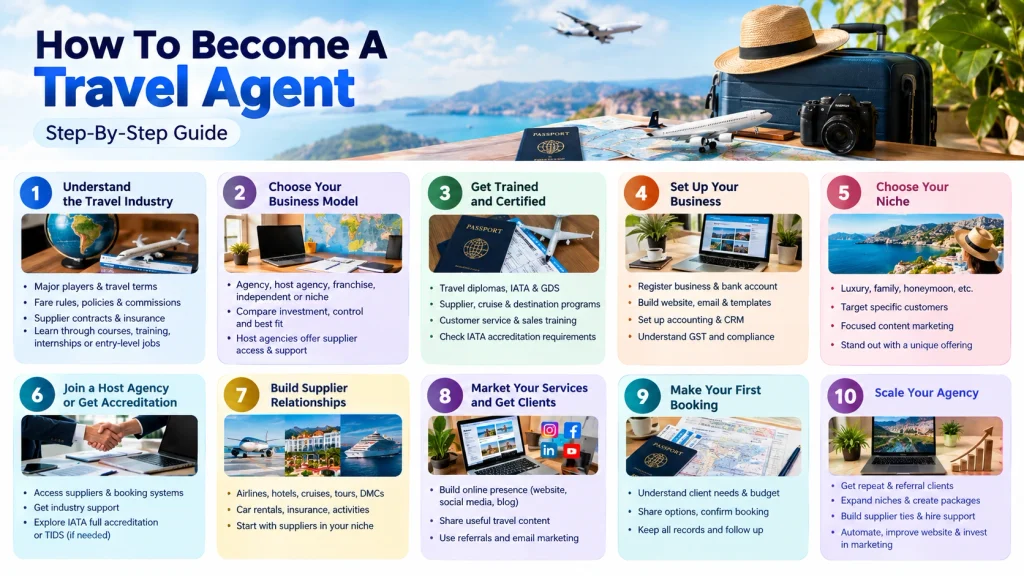
Step 1 : Understand the Travel Industry
Start by learning how the travel industry works.
Understand the major players involved in a booking, including airlines, hotels, tour operators, cruise companies, destination management companies, online travel agencies, GDS providers, and travel agencies.
You should also learn basic travel terminology, fare rules, cancellation policies, commissions, supplier contracts, travel insurance, visa requirements, and booking processes.
You can gain this knowledge through formal courses, industry training, internships, entry-level travel jobs, supplier training, and practical experience.
Step 2 : Choose Your Business Model
Before investing money, decide how you want to work.
| Business Model | How It Works | Initial Investment | Control | Best Suited For |
| Work for a Travel Agency | Work as an employee or travel consultant | Low | Low to Medium | Beginners who want structured experience |
| Host Agency | Operate independently while using a host’s supplier relationships, systems, and support | Low to Medium | Medium to High | New independent travel advisors |
| Franchise | Operate under an established travel brand and business system | Medium to High | Medium | Entrepreneurs who want an established framework |
| Independent Agency | Build your own travel brand and supplier relationships | Medium to High | High | Experienced agents and entrepreneurs |
| Niche Travel Business | Focus on a specific customer or travel category | Low to Medium | High | Agents with specialist knowledge |
A host agency can reduce some of the operational work involved in starting independently. Host agencies commonly provide access to supplier relationships, booking technology, training, marketing resources, or administrative support, although the exact package varies between companies.
Step 3 : Get Trained and Certified
Training is not just about learning different destinations. It can help you understand booking procedures, travel products, customer service, sales, ticketing, and industry technology.
You can consider:
- Travel and tourism diplomas
- IATA training
- GDS training
- Supplier-specific training
- Cruise-line training
- Destination specialist programs
- Host-agency training
- Travel sales and customer-service courses
IATA’s Foundation in Travel and Tourism program is designed for entry-level professionals and includes GDS-based reservation training. Its Travelport+ version, for example, is an approximately 200-hour self-study program with an examination.
Certification is not automatically the same as agency accreditation. If you want to become IATA accredited, you need to meet IATA’s applicable agency requirements. IATA provides separate country-specific requirements for accreditation.
Step 4 : Set Up Your Business
If you plan to operate independently, set up the basic business infrastructure before taking bookings.
This can include:
- Choosing a business name
- Selecting an appropriate business structure
- Completing applicable registrations
- Setting up a business bank account
- Understanding applicable tax requirements
- Creating a professional website
- Setting up business email
- Creating quotation and invoice templates
- Selecting accounting software
- Setting up a CRM or client management system
- Reviewing appropriate insurance
- Creating terms and conditions
If you operate in India, make sure you understand the applicable GST, business registration, consumer, payment, and other compliance requirements for your specific business structure.
Step 5 : Choose Your Niche
You do not have to sell every type of travel.
Choosing a niche can make it easier to position your services and target specific customers.
Potential niches include:
- Luxury travel
- Family holidays
- Honeymoons
- Destination weddings
- Corporate travel
- Group tours
- Adventure travel
- Cruises
- Religious tourism
- Solo travel
- Student travel
- Medical tourism
- International holidays
- Domestic weekend trips
For example, instead of marketing yourself simply as a “travel agent,” you could specialize in international honeymoon planning or corporate business travel.
A niche can also make your content marketing more focused because you know which destinations, questions, offers, and travel problems your audience is interested in.
Step 6 : Join a Host Agency or Get Accreditation
If you are starting independently, you need to decide how you will access suppliers, booking systems, industry support, and accreditation.
A host agency can provide an existing framework for independent advisors. Alternatively, an experienced agency may choose to pursue its own accreditation and supplier relationships.
IATA offers two relevant agency programs: full accreditation and the Travel Industry Designator Service (TIDS). The requirements and benefits are different, so agencies should review the applicable IATA requirements before choosing a route.
Do not assume that you need full IATA accreditation simply because you want to become a travel agent. Your requirements depend on the services you provide and the way your business operates.
Step 7 : Build Supplier Relationships
Supplier relationships can give you access to travel products, booking systems, commissions, promotions, and specialist knowledge.
Potential suppliers include:
- Airlines
- Hotels
- Cruise companies
- Tour operators
- Destination management companies
- Car rental companies
- Travel insurance providers
- Local activity providers
- Transfer companies
Start with suppliers relevant to your niche instead of trying to build dozens of relationships immediately.
For example, a cruise specialist may prioritize cruise lines and cruise-related suppliers, while a corporate travel agency may focus more heavily on airlines, hotels, ground transportation, and corporate booking systems.
Step 8 : Market Your Services and Get Clients
Once your business is ready, focus on generating inquiries.
Create a professional online presence through:
- A travel website
- Google Business Profile where applicable
- YouTube
- Email marketing
- Travel blogs
- Destination guides
- Referral programs
Content marketing can be particularly useful for travel agents. You can create content around questions such as “best time to visit Bali,” “7-day Europe itinerary,” “family-friendly destinations,” or “honeymoon packages under ₹2 lakh.”
Instead of only posting promotional offers, provide useful travel information that demonstrates your knowledge.
Referrals can also become an important source of business. Ask satisfied customers to recommend your services to friends, family, and colleagues.
Step 9 : Make Your First Booking
Your first booking is an important opportunity to test your complete process.
Start by understanding the client’s requirements and budget. Research suitable options, prepare a clear quotation, explain inclusions and exclusions, and confirm the client’s approval before proceeding.
Keep records of:
- Client details
- Travel dates
- Passport information where necessary
- Supplier details
- Booking references
- Payment status
- Cancellation conditions
- Important deadlines
- Client communications
After completing the booking, follow up with the client and make sure they have the required documents and information.
Step 10 : Scale Your Agency
Once you have a steady flow of clients, focus on improving the business rather than simply taking more bookings.
You can scale by:
- Increasing repeat bookings
- Building referral programs
- Expanding into profitable niches
- Creating destination packages
- Developing supplier relationships
- Hiring support staff
- Automating repetitive tasks
- Improving your website
- Investing in paid advertising
- Creating destination-focused content
- Expanding into corporate or group travel
Track metrics such as inquiries, conversion rate, average booking value, repeat customers, referral bookings, and marketing costs.
How Much Does It Cost To Become A Travel Agent?
The cost depends heavily on whether you work for an existing agency, join a host agency, or establish an independent agency.
A person working as an employee can start with very little personal investment. An independent agency can require considerably more money because of business setup, technology, marketing, accreditation, office requirements, and working capital.
| Expense | Estimated Cost in India | What It Covers |
| Basic Travel Training | ₹5,000–₹50,000+ | Travel operations, destinations, sales, booking basics |
| Advanced/GDS Training | ₹10,000–₹75,000+ | Reservation and GDS skills |
| Business Registration & Compliance | ₹5,000–₹25,000+ | Registration and professional setup, depending on structure |
| Website & Domain | ₹5,000–₹30,000+ | Domain, hosting and basic website |
| Branding | ₹2,000–₹20,000+ | Logo, templates and basic brand assets |
| Marketing | ₹5,000–₹50,000+ | Social media, content and advertising |
| CRM/Business Software | ₹0–₹10,000+ per month | Client and booking management |
| Host Agency | Varies | Joining fees, monthly fees or other charges depending on provider |
| IATA Accreditation | Varies | Application, financial and other applicable requirements |
| Office Setup | ₹0–₹2,00,000+ | Optional for home-based vs. physical agency |
| Initial Working Capital | ₹25,000–₹2,00,000+ | Business and operating expenses |
These are planning ranges rather than fixed industry fees. Actual costs can vary substantially based on your location, business structure, training provider, technology choices, host-agency agreement, and whether you operate from home or maintain an office.
For example, IATA’s requirements for agency accreditation can include financial standing, staff qualifications, premises, and security/procedural requirements, so full accreditation should be treated separately from simply completing travel-agent training.
A home-based business working through a host agency can therefore have a very different startup cost from a fully independent agency with its own office and accreditation.
Read More:
- Small Town Business Ideas
- Manufacturing Business Ideas
- Solar Power Business Ideas
- Business Ideas in Textile Industry
Travel Agent Salary: How Much Do Travel Agents Make In 2026?

Travel agent income varies significantly according to experience, location, employer, specialization, sales performance, and whether the person is an employee or an independent agent.
For salaried travel agents in India, Indeed reported an average base salary of about ₹16,852 per month based on 29 reported salaries, updated in February 2026. Its listings also show substantial variation across cities and employers.
Travel consultant roles can show higher figures in some locations. Glassdoor’s 2026 data shows an average base pay of around ₹25,000 per month for travel consultants in India, with additional pay reported separately. Recent submitted salaries vary significantly by city and experience.
| Career Stage | Indicative Monthly Earnings in India | Typical Position |
| Entry Level | ₹15,000–₹25,000 | Junior Travel Agent / Travel Executive |
| Early Career | ₹20,000–₹35,000 | Travel Agent / Travel Consultant |
| Experienced | ₹30,000–₹50,000+ | Senior Travel Consultant |
| Specialist/Manager | ₹40,000–₹70,000+ | Senior Specialist / Travel Manager |
| Independent Agent | Highly variable | Commission and/or service-fee based |
These figures should be treated as indicative rather than guaranteed salary bands. For example, Indeed’s current travel-agent data reports an average of ₹16,852 per month, while current travel-consultant salary data on Glassdoor reports a ₹25,000 monthly average base pay. Different job titles and datasets can therefore produce different figures.
Independent travel agents generally do not have a fixed salary. Their earnings may come from supplier commissions, service fees, planning fees, markups where permitted, or a combination of revenue sources.
This means an independent agent’s monthly income can fluctuate considerably depending on the number and value of bookings.
10 Best Host Agencies In 2026
A host agency allows an independent travel professional to operate under an established travel-industry framework. Depending on the provider, a host can offer supplier relationships, booking tools, training, marketing resources, support, and commission arrangements.
There is no single host agency that is suitable for every travel professional. Before joining, compare the commission structure, fees, training, supplier portfolio, technology, support, contract terms, and availability in your country.
Here are 10 host agencies frequently featured in 2026 host-agency directories and industry discussions:
1. Travel Planners International
Travel Planners International provides support and resources for independent travel advisors. It is particularly relevant for people looking for a host-agency structure rather than building every supplier relationship independently.
2. OutsideAgents.com
OutsideAgents.com is a host agency serving independent travel professionals and provides access to training, technology, supplier relationships, and business support.
3. Cruise Planners
Cruise Planners operates a franchise and travel-advisor model with a strong focus on cruises, vacations, and travel experiences. It may be relevant for entrepreneurs interested in a structured travel-business model.
4. Nexion Travel Group
Nexion Travel Group supports independent travel professionals with technology, education, marketing, supplier relationships, and operational resources. It caters to different types of travel advisors, including new professionals and experienced agencies.
5. Travel Edge
Travel Edge operates within the luxury and premium travel segment and works with travel advisors through its broader travel network.
6. Dream Vacations
Dream Vacations offers a franchise-based approach to operating a travel business, with training, technology, marketing resources, and supplier relationships.
7. Avoya Travel
Avoya Travel works with independent travel advisors and provides technology, supplier relationships, marketing, and business-development resources. Its 2026 guide also highlights training and niche selection as important steps for new travel advisors.
8. KHM Travel Group
KHM Travel Group provides host-agency services and resources for independent travel advisors, including education, technology, supplier relationships, and business support.
9. Fora
Fora provides a modern host-agency platform for independent travel advisors, including training, technology, supplier access, and business resources. Its current guidance for new advisors follows a structured process covering business models, host agencies, training, legal requirements, bookings, marketing, and growth.
10. Travel Leaders Network
Travel Leaders Network is a large travel-agency network backed by Internova. Its network represents thousands of agency locations across the United States and Canada and provides access to travel suppliers, industry resources, and professional support.
When evaluating any host agency, check whether it accepts advisors from your country. Many of the major host-agency models are designed primarily around the US market, so an Indian travel professional should verify country eligibility, supplier access, commission arrangements, and local compliance requirements before joining.
Conclusion
Learning how to become a travel agent does not necessarily require a specialized degree or years of previous experience. You can enter the industry by working for an established agency, joining a host agency, or eventually building an independent travel business.
The first step is to understand the industry and develop practical skills in travel planning, customer service, sales, booking systems, and destination knowledge. From there, choose a business model, complete relevant training, set up your business, select a niche, develop supplier relationships, and start marketing your services.
If you plan to operate independently, pay particular attention to the difference between training, accreditation, and general business registration. IATA provides country-specific requirements for agencies seeking accreditation, including requirements applicable to India.
The travel-agent profession can offer both salaried employment and entrepreneurial opportunities. Your potential income and growth will depend on your business model, experience, customer base, specialization, sales ability, and the travel products you sell.
FAQs
1. Can I become a travel agent without a degree?
Yes. A specialized degree is not always required to become a travel agent. Many entry-level roles focus more on travel knowledge, communication, customer service, sales, and booking skills. Relevant travel and tourism training can help you develop these skills.
2. How long does it take to become a travel agent?
The timeline depends on your chosen path. Someone joining an existing agency may start after completing the employer’s training, while an independent agent may need additional time for business setup, training, supplier relationships, and other requirements.
3. Do I need IATA accreditation to become a travel agent?
Not necessarily. IATA accreditation is an agency accreditation program and is different from simply completing travel-agent training. Whether you need accreditation depends on your business model and the travel services you intend to provide. IATA publishes specific accreditation requirements by country.
4. Can I become a travel agent from home?
Yes. Home-based travel businesses are possible, particularly through business models such as host agencies or independent travel advising. However, you still need to understand the business, tax, contractual, and regulatory requirements that apply to your location and services.
5. How much does a travel agent earn in India?
Salaries vary by role, location, experience, and employer. Indeed reported an average base salary of about ₹16,852 per month for travel agents in India in February 2026. Travel consultant positions can have different salary levels, with Glassdoor reporting around ₹25,000 per month as average base pay in its current India data. Independent agents have variable income because earnings can depend on commissions, service fees, and booking volume.