
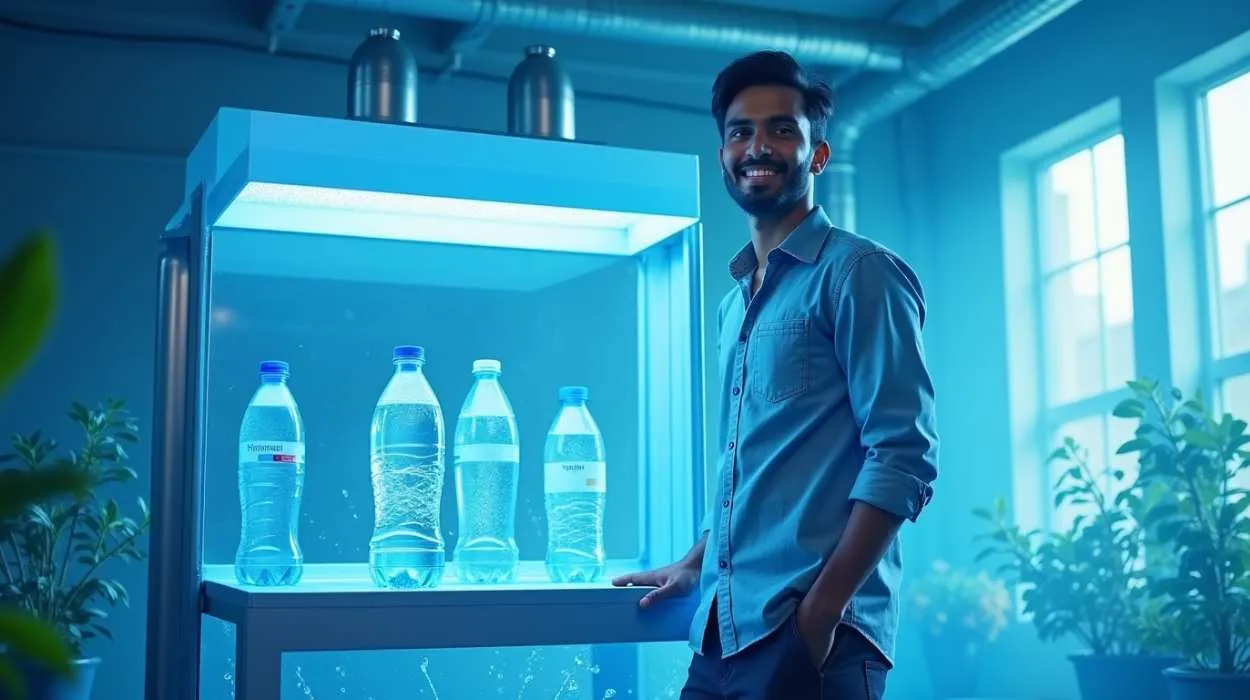
The business idea of bottled water in India is an unprecedented entrepreneurial prospect in the current market of health conscious people. Bottled water industry has experienced tremendous growth with increased awareness on water quality, increased urbanization and higher consumer preference of safe drinking water.
How to start a bottled water business is complex to implement, and it needs thorough planning, adherence to regulations, and proper execution whether you want to have a small-scale operation or a large manufactured plant. Our ultimate guide will take you through each of the steps, market research, licensing, production and distribution required, to bring your entrepreneurial dream to a profitable reality in the Indian burgeoning packaged drinking water industry.
Quick Overview of the Bottled Water Market in India
The bottled water industry in India has become one of the fastest-growing water business sectors of the beverage industry with a figure of above 16,000 crores and an annual rate of growth of around 20%. The industry is propelled by poor quality of ground water, health awareness and easy consuming habits. IMARC Group reports the market size in 2024 at USD 9.5 billion and projects a strong compound annual growth rate (CAGR) of ~12.45% from 2025 to 2033.
Cities are driving the demand whereas country markets are becoming untapped at a very high rate. Big brands such as Bisleri, Kinley, and Aquafina take up the organized segment, but there is also a lot of potential in the market to create a regional and niche brand and gain their presence in the market.
Market Potential of Bottled Water in India
The market size of bottled water in India is vast and the penetration is yet to be at 15% as compared to the world. The growth of the tourism industry, a rise in disposable incomes, the development of the hospitality industry, and the infrastructure development generate various revenue sources.
By 2028, the industry is expected to hit 40000 crores and the per capita intake of the product is expected to be doubled. The cities of Tier-2 and Tier-3 have specially appealing prospects when the awareness rises.
Also, high value segments such as mineral water, alkaline water, and flavored versions are on the increase providing entrepreneurs with a wide range of positioning and greater profit margins in this vibrant market.
How Much Does It Cost to Start a Bottled Water Company?
| Investment Category | Small Scale (1,000-2,000 LPH) | Medium Scale (4,000-6,000 LPH) | Large Scale (10,000+ LPH) |
| Machinery & Equipment | ₹8-12 lakhs | ₹25-40 lakhs | ₹80 lakhs-2 crores |
| Infrastructure Setup | ₹5-8 lakhs | ₹15-25 lakhs | ₹50 lakhs-1 crore |
| Licenses & Registration | ₹50,000-1 lakh | ₹1-2 lakhs | ₹2-5 lakhs |
| Raw Materials (Initial Stock) | ₹1-2 lakhs | ₹3-5 lakhs | ₹8-15 lakhs |
| Branding & Packaging | ₹2-3 lakhs | ₹5-8 lakhs | ₹15-25 lakhs |
| Working Capital | ₹3-5 lakhs | ₹10-15 lakhs | ₹30-50 lakhs |
| Total Investment | ₹20-31 lakhs | ₹59-95 lakhs | ₹1.85-4.15 crores |
Step-by-Step Guide: How to Start a Bottled Water Business
Step1: Do Market Research.
The basis of learning to start a bottled water business is to do a thorough market research. Research your target geography, from where or to whom you will sell the software, how your competitors set their prices, and the demand pattern.
Conduct surveys on potential buyers such as retailers, hotels, restaurants and offices to establish their preferences and quantity of purchases. To assess the viability of the location you have chosen and to suffer sustainable growth, test the availability of water sources, labs and accessibility of transport.
- Identify where your demand lies — urban, semi-urban, or rural zones.
- Study competitor pricing and top brands like Bisleri, Kinley, or Bailley.
- Survey buyers — hotels, restaurants, offices, retailers.
- Assess local water source availability, testing labs, and transport access.
Step 2: Select your Business Model.
The appropriate business model defines both the level of operations and the capital needs when it comes to learning to start a bottled water business. You can either decide to produce your own brand, you can be a franchisee of the already existing brands such as Bisleri or Kinley or you can choose to be a contract manufacturer.
Depending on your capital base and market positioning approach, you can consider these types of bottle sizes (200ml pouches, 500ml, 1L or 20L jars), target customers (retail, bulk, and premium), and favorable distribution channels (direct supply, distributor network, online channelers).
- Choose between own brand, franchise, or contract manufacturing.
- Decide on bottle sizes: 200 ml, 500 ml, 1 L, or 20 L jars.
- Define your target audience: retail, corporate, or premium segment.
- Set up distribution channels — direct delivery, distributors, or e-commerce.
Step 3: Validate Your Business (MSME/Udyam, GST)
Legal registration also defines who you are in business and opens government incentives that are critical in how to start a bottled water business. Classify micro, small or medium enterprises by registering through Udyam (MSME) portal allowing subsidies, access to loans without difficulty and tax deductions.
Register GSTs since they are required in manufacturing and interstate trading. Select dedicated business form which is either sale proprietorship, partnership, LLP or private limited company according to your business size, liability and based on long-term sustainability and credibility consideration.
- Register under Udyam (MSME) for government benefits & loans.
- Apply for GST to trade legally across states.
- Select your business structure — proprietorship, LLP, or Pvt. Ltd.
Step 4: Apply for Licenses
The most important regulatory compliance method to start a bottled water business legally is the need to obtain any licenses and certifications. ISI certification (bureau of Indian standards meetings license) applies to have quality assurance- mandatory to sell packaged drinking water.
Get FSSAI (Food Safety and Standards Authority of India) license concerning manufacturing of food products. Obtaining State Pollution Control Board pollution control clearance and local municipal authorities trade license. Other registration is that of the water testing laboratory and certification of water quality sources by the authoritative agencies.
- Obtain ISI certification (BIS) — mandatory for packaged drinking water.
- Get FSSAI license for food-grade manufacturing compliance.
- Apply for Pollution Control Board clearance & Trade License.
- Set up a water testing lab and certify your source water quality.
Step 5: Set Up Infrastructure
The right infrastructure is the backbone to the manner in which to start a bottled water business. Obtain, or rent 1,500-5,000 sq ft area based on production capacity to make sure that it has space to produce, store, and do office functions.
Equip necessary equipment such as water treatment equipment (RO, UV, ozonation), automatizer bottle filling and capping equipment, labeling equipment, and quality testing equipment.
Provide continuous electricity supply using backup generators, effective drainage systems, clean production areas according to the GMP standards, and sufficient storage areas of the finished products.
Pro Tip: Opt for semi-automatic machines initially to reduce capex.
Step 6: Branding & Packaging
One of the ways that would make your product stand out by starting a bottled water business successfully is creation of interesting branding and appealing packaging. Create an outstanding brand name, logo and tagline that will be reminiscent of purity, health and trust.
Create promotional label designs that meet the FSSAI regulations that show required information, including brand name, manufacturing date, batch number, the FSSAI license and contact details of the customer care center.
Select quality PET bottles or pouches such that they are durable and hygienic. Get a professional packaging that attracts your target segment and at the same time does not cost too much in your competitive pricing.
- Create a memorable brand name that conveys purity, trust, freshness.
- Design attractive labels — ensure FSSAI-compliant info (license no., batch, contact).
- Smart Move: Offer unique bottle shapes or sustainable packaging to stand out.
Step 7: Distribution and Marketing.
When executing the how to start a bottled water business plan, erecting strong distribution networks and strategic marketing can be used to speed up growth.
Form relationships with local shops, supermarkets, hotels, restaurants, company offices and event planners. Introduce delivery trucks to support effective logistics with the greatest amount of coverage.
Take advantage of digital marketing via social media, Google advertisements and local directories to create brand awareness. Promote via local activities, promotional schemes and sustainability in prices so that the markets can be entered successfully and the sales volumes made to be sustainable at all times.
- Build ties with local stores, hotels, and corporate offices.
- Launch delivery vans or partner logistics for daily distribution.
- Use Instagram, Google Ads, and local SEO to boost brand discovery.
Water Bottle Business Profit Margin
- Small operations: These normally have 25-35 percent profit margins after considering the costs of production, packaging, and distribution costs.
- Medium-large scale plants: A margin of 35-45 is attainable based on economies of scale, the advantage of bulk purchasing, and the optimization of operations.
- Premium segment positioning: Fetching 40-50 percent discounts based on value additions such as increased dependability of mineral enrichment, alkaline water or environmentally friendly packaging to appeal to quality conscious buyers.
- Bulk/institutional supply: Has a steady 20-30% with consistent volumes provided by corporate client, hotels and events with a predictable cash flow.
- Local brand advantage: Regional brands have a reduced cost of transportation and marketing as they attain better margins than national brands within a particular territory.
- 20 liter jar business: It offers recurring business with 30-40% profit margins due to home and business delivery services under subscription business model.
Licenses & Legal Requirements
- BIS License-ISI Mark: It is an obligatory certification of Bureau of Indian standards that certifies the quality of the product by requiring it to be of the national standards of packaged drinking water.
- FSSAI License: registration by Food Safety and Standards Authority is needed so as to manufacture, store and distribute food products such as bottled water.
- State Pollution Control Board Clearance: Clearance of waste management, water discharge and pollution control compliance of the manufacturing facility.
- Trade License: Municipal corporation authorization to carry out commercial manufacturing unit in the jurisdictions that show compliance to local jurisdiction.
- GST Registration: Registration required to conduct the business operations in the form of Goods and Services Tax which allows legal invoicing as well as interstate trade transactions.
- Udyam Registration: MSME certification that facilitates access to schemes by the government, subsidies, priority lending and other benefits of small-scale industries.
- Certificate of Water Source Testing: Certificate of the water quality, issued by a government authorized laboratory, is confirming that the source water meets drinking water standards.
- License of factory: Authorization of the state government according to Factories Act to run manufacturing unit with a definite capacity of machinery and labour force.
How to Start a Bottled Water Business from Home: Quick Points Only
- Begin with 200ml-1L pouch/bottle production: minimum machinery input ( 3-8 lakh rupees ) can be used to be operated in the home based business with little space requirement.
- Get home industry license: Apply to register micro-enterprise to carry out the manufacturing at residential premises up to approved limits.
- Install small RO-UV pollution system: Small scale water treatment system (200-500 LPH capacity) that fits inside 300-500 sq ft specially allocated space.
- Manual or semi-automatic filling: The manual sealing machines should be started with, and then semi-automatic systems will be installed as the business expands progressively.
- Target hyperlocal markets: Target instant neighborhoods, local stores, small retailers and direct home delivery within 5-10 km range.
- Small staffing need: Would have a requirement of 2-3 workers initially dealing with production, packaging as well as local distribution to manage operational expenses.
- Online marketing emphasis: Use social media and WhatsApp business, and Google My Business to promote and attract customers cheaply.
- Adhere to residential area requirements: Make sure that operations do not breach the regulations of residential zoning; noise, waste management meet local municipal requirements.
- Gradual scaling method: reinvestment of profits in a systematic manner to upgrade the equipment, increase capacity and later shift to the commercial facility.
Bottled Water Business Plan
| Business Component | Description | Timeline |
| Executive Summary | Business concept, vision, mission statement, and investment overview | Week 1 |
| Market Analysis | Target market identification, competitor analysis, demand assessment | Weeks 2-3 |
| Business Structure | Legal entity selection, registration, ownership structure definition | Week 4 |
| Product Line | Bottle sizes (200ml-20L), quality standards, product variants | Week 5 |
| Production Setup | Machinery procurement, infrastructure development, capacity planning | Months 2-3 |
| Licensing | BIS, FSSAI, pollution clearance, trade license applications | Months 2-4 |
| Sourcing Strategy | Water source identification, testing, raw material suppliers | Month 3 |
| Pricing Strategy | Cost calculation, competitive pricing, margin determination | Month 4 |
| Distribution Plan | Channel identification, logistics setup, territory mapping | Month 4-5 |
| Marketing Strategy | Brand development, promotional campaigns, digital presence | Month 5-6 |
| Financial Projections | Investment breakdown, revenue forecasts, break-even analysis | Month 6 |
| Launch | Commercial production commencement, market entry | Month 6 |
Marketing & Branding Strategies
- Local associations: Partner with the grocery stores, kirana shops, restaurants, gyms, and salons as a place to put the products and ensure regular presence.
- Free sampling promotions: give out free bottles in outdoor activities, shopping centers, exhibitions and in the community functions to create brand awareness.
- Online marketing: Instigate active social media marketing on Instagram, Facebook using compelling information about purity, manufacturing process, certification.
- Marriage and wateronel: maximize Google My Business profile, online business directories that guarantee their presence in case of online search by the client to the nearest supplier of water.
- Car branding: Delivery cars with body decals- employ car delivery cars as a form of mobile advertisements with eye-catching decals having contact details that will have constant brand recall.
- Referral programs: When existing customers successfully refer prospective customers, offer them a discount, or a product free to continue customer expansion in an organic way.
- Corporate tie-ups: Approach offices, factories, educational institutions of competitive rates of bulk supply contract to guarantee constant rate of revenues.
- Promotion on festivals: Get special offers to customers during regional festivals, and in summer months, water consumption is highly high in the region, and therefore, run numerous special offers.
- Quality certifications on display: Must also conspicuously indicate BIS, FSSAI certifications in package, marketing materials, which will instil consumer credibility and trust.
- Community: Sponsor local sports tournaments, other community activities – position brand as a community-focused, socially responsible company.
Conclusion
Even to know how to start a bottled water business in India, one has to plan, abide by regulations and ensure that it is continuous in various aspects of operation. The industry has a great growth potential in an environment with rising demand, growing markets and a good business environment for entrepreneurs at different levels of investment. The success rests upon keeping the standards of quality uncompromising, establishing powerful systems of distribution, as well as establishing unique brand recognition within competitive markets.
Such a detailed step-by-step plan that will consider market research, licensing, infrastructure, and marketing plans can help those interested in starting their own business to set up profitable operations in this crucial industry. With proper planning, sufficient capital investment and customer-sensitive style your bottled water business would attain a sustainable growth and at the same time benefiting the community health by availing safe and quality drinking water to the community.
FAQs
Is the business in bottled water profitable?
Yes, the bottled water industry is a very lucrative industry with a 25-50% margin in terms of growth and positioning. It is a good business opportunity with stable cash flows and scalability opportunities due to high demand, frequent consumption behavior, and the relatively small costs incurred during operation after the initial establishment.
What is the start up cost of a water bottle company in India?
Initial expenses are quite variable depending on scale: small business operations cost 20-31 lakh, medium-sized plants cost 59-95 lakh and large facilities cost 1.85-4.15 crores. Depending on the production capacity selected, investment includes machinery, infrastructure, licenses, branding and working capital.
What do I do to open my own bottled water company?
Begin with the market research, choice of business model, registration of business entity, acquisition of the required license (BIS, FSSAI, pollution clearance), establishment of production infrastructure with purification and filling equipment, branding work, and distribution channel development to penetrate the market.
Should I have a license to sell bottled water?
Yes, bottled water is sold on several licenses such as obligatory certifications of BIS (ISI mark), FSSAI license to manufacture food products, State Pollution Control Board cleansing, municipal trade license, GST registration with administrative obligations of meeting the legal standards and consumer protection requirements.