
Have you ever purchased a product on a site that was not written in your native language? Perhaps the pages appeared odd, the text was difficult to read and you exited the site in a flash. And now imagine your business trying to sell something in a foreign country. When you only talk one language you are losing a massive market.
Welcome to the year 2025 where the world of business has changed and Multilingual AI is driving it.
These are the figures. The e-commerce market in the world will surpass the $8 trillion mark in 2017. One of the main components of that success: people buy something on the websites in their native language. A study conducted by CSA Research shows that 4 out of 10 consumers will never purchase on websites that are written in other languages. The point is simple: unless you communicate in the language of your customer you are virtually invisible.
In comes multilingual AI agents. They are much more than swanky translators. They are smart, programmed helpers that can talk to customers, respond to queries, create marketing text, and even make sales calls, in dozens of languages, any time of day. It is as though you have a native speaker on your team in every country that you wish to do business in, but without the huge overhead. Its demand is skyrocketing; conversational AI is supposed to increase by more than 23 percent per year, and it will exceed more than 40 billion dollars by 2028.
Why Multilingual AI Is So Critical for Global Campaigns
A world wide marketing campaign is similar to the construction of a bridge. You can construct a one lane bridge and hope that everyone will use it. Or you might construct a multi-lane super highway which links directly to all the major cities. Multilingual AI is such a superhighway.
Why can it not be just nice to have anymore but essential?
- It overcomes the language barrier: An AI agent can immediately speak to a customer in Japan in Japanese, a client in Brazil in Portuguese or a lead in Germany in German. This eliminates the major point of friction in international business.
- It creates trust and individualization: By speaking the language of a person you are respecting him. It sends a clear message: We care about you and we made a move to come to you. This creates instant trust and the customer feels noticed, resulting in a significantly higher engagement and loyalty.
- It offers 24 hour worldwide support: Your New York team is asleep and your Sydney customers are coming to work. There is no sleep in multilingual AI agents. They are able to respond to customer requests, resolve issues, and develop leads 24/7, in any time zone, and provide uniform customer experience.
- It increases the conversion rates: Keep in mind the 40 percent of consumers who do not shop on foreign-language sites. When you localize your customer experience–the initial advertisement they come across to the last checkout support, you are far more likely to make a sale. It is that simple.
- It acquires market intelligence: These are AI agents that are a goldmine. They gather information about what people in other parts of the country are demanding, what their frustrations are and what cultural factors they consider when making purchases. This is priceless information to optimise your global strategy.
Criteria for Evaluating Multilingual AI Agents
You have decided that you want to begin using AI, but there are so many options. So, this is how to choose the right one.
- Precision and subtlety of language: Does the AI perform a word-to-word translation or demonstrates that it knows context, idiom and cultural slang? The finest agents will have the true meaning of the words.
- Integration capabilities: How simply can the AI be integrated with your current systems? Seek smooth connections with your CRM ( such as Salesforce or HubSpot), e-commerce store ( Shopify) and messaging tools ( WhatsApp or Messenger).
- Modalities supported: Can the AI only deal with text chats, or can it deal with voice calls, emails, and social media comments? The greater the number of channels it supports (text, voice, video), the more flexible it is.
- Scalability: Is the agent able to perform 100 conversations a day as well as it performs 100,000? Your AI should be capable of growing along with your business without so much as breaking a sweat.
- Usability: Do you have to have a team of PhDs to install it and run it? The most useful tools will have drag-and-drop, no-code interfaces so that your marketing or support teams can create and launch agents without code.
- Cost-effectiveness: How is it priced? Per conversation, monthly subscription or otherwise? Make sure the price is appropriate to the value and ROI it has to your business.
Comparative Analysis Table
| Name | Creator/Owner | Modalities Supported | Language Support | Best For |
| Adobe Agent-Orchestrator | Adobe | Text, Web Personalization | 100+ | Enterprise Marketing Personalization |
| Smartcat AI Agents | Smartcat | Text, Document | 280+ | Automated Translation & Localization Workflows |
| Ringg AI Voice Agents | Ringg | Voice | 20+ | Outbound Sales Calls & Appointment Setting |
| Kruti by Ola Krutrim | Ola | Text, Voice | 22 (Indian) | Hyper-local Campaigns in India |
| Conversica AI Assistants | Conversica | Text (Email, SMS) | 10+ (Business) | Automated Sales Lead Nurturing |
| Oracle AI Agents for Sales | Oracle | Text, Data Analytics | Extensive | Augmenting Sales Teams in the Oracle Ecosystem |
| IBM Watson Assistant | IBM | Text, Voice | 20+ | Enterprise-Grade Customer Service (esp. Voice IVR) |
| Google Gemini 2.5 Models | Text, Voice, Image, Video | 100+ | Building Custom, Cutting-Edge AI Agents | |
| Gupshup Auto Bot Builder | Gupshup | Text (Messaging Apps) | 100+ | WhatsApp & Messaging App Chatbots |
| Microsoft Multilingual LLM | Microsoft | Text, Voice | Extensive | Building on the Microsoft/Azure Ecosystem |
Top 10 Multilingual AI Agents in 2025
These are some of the most powerful and innovative multilingual artificial intelligence (AI) tools that you can obtain today. We have told you what is special about each one, who it is targeted at, and where it works best.
1.Ecosystem Adobe Agent-Orchestrator
Adobe Agent-Orchestrator Ecosystem is not a product, but more of a broad network. It is located within the Adobe Experience Cloud and is the central orchestrator of all your customer engagements. With the Adobe AI engine, Sensei, you can create, manage and deploy custom AI agents in all aspects of your digital world. As an example, one agent may be customizing a web site to a Spanish visitor in real time and another agent may be responding to a chat question in French simultaneously.
The two are based on the same central data and content storage. It is one of the best Multilingual Ai agents. This helps to keep your brand on point, and each customer experience is extremely personal, since it tracks all the stages of the process: the initial advertisement to after sales services. Therefore, it is an effective tool in case of large businesses.
- Supported Languages: Excellent coverage of over 100 languages in text-based tasks, and excellent support of the most widely spoken languages of the world, including English, Spanish, French, German, Japanese, and Chinese. Voice abilities are on the increase.
- Best Use Cases: Huge scale marketing personalization, unification of content and commerce, orchestration of customer journeys across many digital touchpoints, and A/B testing of localised content at scale.
Pros:
- Intensive connection to Adobe Experience Cloud (Analytics, Target, AEM).
- Fantastic at producing very personal, brand-consistent customer experiences.
- Adobe Sensei-powered powerful data analytics and insights.
Cons:
- Difficult and costly to implement; suits big businesses.
- Needs great investment in the rest of the Adobe ecosystem to realize its potential.
Website: https://www.adobe.com/sensei.html
2. Smartcat AI Agents
Smartcat is not the same. It began as a top translation platform and today it is a complete AI-driven localization ecosystem. Multilingual AI Agents created by Smartcat are designed to automate and accelerate all stages of the translation and content-adaptation process. You simply instruct the agent to download new material off your blog or site, run it through one of the best translation engines, and send it over to a human translator in the vast Smartcat marketplace to give it a final proofread-without you lifting a finger.
That is the secret of Smartcat: this loop of AI and human, which keeps the process quick and the quality high. This is not just about chatbots; this is about creating a continuous, automated pipeline of any type of content whether that is marketing materials, legal documents or software user interfaces. Due to this fact, Smartcat is essential to companies that require high-quality localization throughout their business.
- Supported Languages: Smartcat covers over 280 languages, dialects and language pairs, which is one of the most comprehensive platforms in terms of pure language coverage.
- Best Uses: Ongoing localization of sites and software, management of large-scale translation projects, automation of content operations, and the involvement of professional human translators to deliver quality.
Pros:
- Huge language coverage and access to a market of human linguists.
- Superior workflow automation of continuous localization.
- Clear, usually more affordable, pricing of the translation services.
Cons:
- Not as much of a focus on real-time conversational AI (such as sales or customer-support bots).
- The primary strength of its work is the translation process rather than direct contact with customers.
Website: https://www.smartcat.com/
3. Ringg AI Voice Agents
Ringg AI specializes in voice. It has AI Voice Agents that are able to make and receive phone calls conversing with a human-like level of skill. These are not regular robotic robocallers. They know what people say, handle interruptions, make concise questions and modify their script as the chat progresses. The platform allows you to create campaigns to accomplish a wide variety of tasks, including lead qualification: an agent can call thousands of leads, identify those who are interested and schedule appointments directly into the calendar of your sales team.
It is one of the best Multilingual Ai agents. The technology developed by Ringg is capable of processing the real-life spoken language, with various accents and dialects, which is why it can be an efficient method of scaling the sales development and customer outreach on the global scale.
- Supported Languages: More than 20 languages are fully supported with great-quality and natural-sounding voices such as English, Spanish, Portuguese, French, German, etc.
- Best Uses: Outbound sales development, lead qualification and scoring, appointment setting, customer surveys, and event reminders through phone calls.
Pros:
- Very natural and human sounding voice dialog.
- Very scalable to make thousands of calls at the same time.
- Easy syncing of data and leads with the most popular CRMs.
Cons:
- A voice-centric application; not a one-stop text or email application.
- The effectiveness may differ according to the quality of the contact list.
Website: https://www.ringg.ai/
4. Kruti by Ola Krutrim
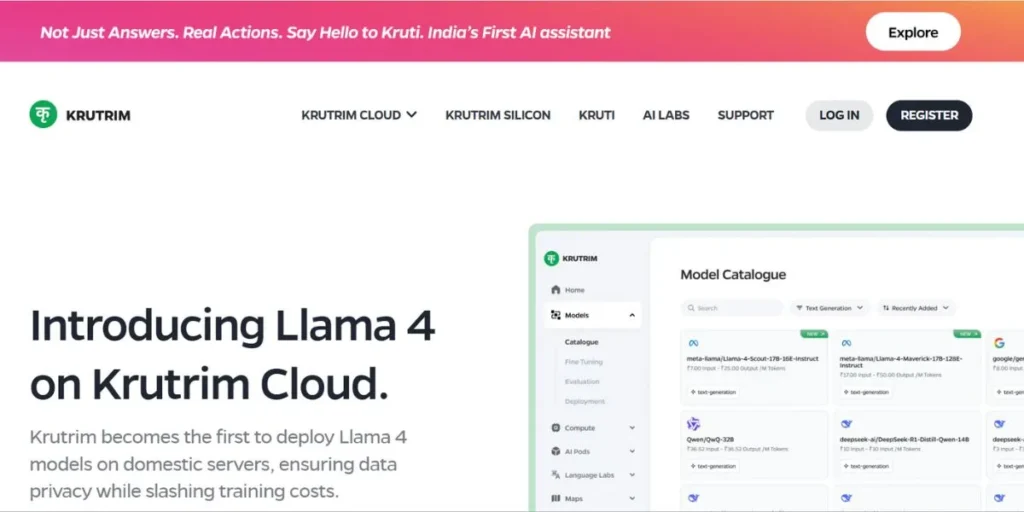
Similarly, Multilingual AI Agents like Kruti by Ola Krutrim is an Indian born AI agent. It is able to read, write and speak 22 out of 23 major languages in India. The model is only trained with Indian data, hence is aware of the way people intermix Hindi and English in a single sentence (“code-switching”). Due to this, Kruti is capable of supporting customer support chatbots, voice assistants, and e-commerce even in cities such as Tier-2 and Tier-3 cities. It assists companies to access the Indian market which is diverse.
- Supported Languages: Supports 22 Indian languages and can create content in 10, including Hindi, Tamil, Telugu, Marathi, and Bengali and many more.
- Best Uses: Hyper-local consumer support to the Indian customers, creation of localized content, voice-based services to the multilingual demographics, and e-commerce in Tier-2 and Tier-3 cities in India.
Pros:
- Incomparable knowledge of Indian languages, dialects and cultures.
- Computationally efficient and accessible in design.
- It is the first of its kind model that provides a major competitive edge in the Indian market.
Cons:
- It is currently only available to Indian languages, therefore, not appropriate in the global campaigns beyond India.
- Being a new player, its ecosystem and integrations are still in the process of development.
Website: https://olakrutrim.com/
5. Conversica AI Assistants
Conversica leads the market in what the company terms Revenue Digital Assistants(tm). These artificial-intelligence assistants are concentrated on a single objective: revenue generation. They conduct dialogues via email, SMS and chat, all on their own. They make follow-ups to leads, re-qualify them as needed and nurture customers. The magic is that these chats are very human.
It is one of the best Multilingual Ai agents. When a lead has not been responding after some time, the assistant can follow up after several months with a personalized message to rekindle the interest. The assistant also understands when to pass a lead to a human salesperson and when to keep on softly nurturing and thus no opportunity is lost and only hot and qualified leads are passed on to the sales team.
- Supported Languages: Conversica supports most of the major business languages such as Spanish, French, German, Portuguese, and Japanese and it prefers words that you would use in the office.
- Best Uses: Key use cases are automation of top-of-funnel sales activities, lead nurturing and follow up, re-engaging cold leads and customer advocacy and retention.
Pros:
- Demonstrated success in increasing lead interaction and a more healthy sales pipeline.
- Excellent in having natural, long-term conversations.
- Fully embedded with Salesforce and other large CRM/marketing automation systems.
Cons:
- It is mainly centered on textual communication (email and SMS).
- May be a high-end product, targeted at performance-based sales and marketing departments.
Website: https://www.conversica.com/
6. Oracle AI Agents for Sales
Oracle AI Agents for Sales can be added to the existing businesses that already use the big set of enterprise software developed by Oracle. These agents are not an independent product, they are a full component of Oracle Sales and Fusion Cloud. Their primary advantage is that they have the ability to utilize the great volume of data that is already present in your Oracle CRM and ERP systems.
The AI is able to review previous sales to provide a salesperson with real-time talking points, automate data entry, forecast which deals will most likely close and suggest the next best action. It is not so much a standalone chatbot as it is an intelligent data-driven layer on top of your entire sales team, enabling them to work smarter, faster and more effectively on a global level.
- Supported languages:Oracle Cloud has a lot of language support, which is in line with their global enterprise customer base.
- Best Uses: Sales augmentation to enterprise sales teams, sales forecasting and analytics, automation of administrative work to sales reps, and data-driven recommendations in the sales cycle.
Pros:
- Integration and data synergy with Oracle Cloud, CRM, and ERP that cannot be beaten.
- It is concerned with supplementing human sales teams and not merely substituting tasks.
- Based on the enterprise-level security and data governance of Oracle.
Cons:
- The value is virtually trapped in the Oracle ecosystem.
- Not a quick, stand-alone product to companies that already have a different CRM platform.
Website: https://www.oracle.com/ai/
7. IBM Watson Assistant (Multilingual Voice)
IBM Watson Assistant is developed with decades of enterprise AI research and trust. It allows you to build, deploy, and control AI-powered assistants anywhere- websites, mobile apps, phone systems, and messaging platforms. The most significant attribute of Watson is its robust Natural Language Understanding (NLU) engine that is capable of sensing the intent of the user despite the complexity or ambiguity of the language.
It also has powerful multilingual voice features that integrate with voice gateways to develop advanced Interactive Voice Response (IVR) systems that do not aggravate customers. It is one of the best Multilingual Ai agents. Watson Assistant is the solution of choice in regulated industries like finance, healthcare, and government where large organizations require a proven, scalable, and trustworthy AI partner with data privacy, security, and governance.
- Supported Languages: NLU and dialogue broadly supported in more than 20 languages, with high-quality text-to-speech and speech-to-text in a dozen of the most popular languages.
- Best Uses: Enterprise level customer service automation, creating advanced voice assistants (IVR), internal employee helpdesks, and implementing assistants in regulated industries.
Pros:
- NLU industry-leading in intent detection.
- High emphasis on enterprise security, privacy of data and scalability.
- Superb voice integration and telephony.
Cons:
- The platform may also be more steeply-learning than simpler bot builders.
- May be pricier than other competitors, as the company has an enterprise focus.
Website: https://www.ibm.com/watson/assistant/
8. Google Gemini 2.5 Models (Flash & Pro)
The Gemini 2.5 models of Google are not pre-packaged AI agents. They are the fundamental engines to drive the next generation of AI agents. Consider Gemini to be an ultra-sophisticated brain that programmers can use to create their own unique multilingual agents.
Gemini 2.5 Pro is the engine. It provides the best reasoning and multimodal functions in complex tasks. Its much faster, much more efficient twin is called Gemini 2.5 Flash, which is ideally suited to high-volume, low-latency services such as real-time chat support. Gemini enables the most context-aware and versatile agents ever, with a huge context window, and native multimodal understanding (text, images, audio, and video). In global campaigns, its advantage is in the state-of-the-art translation and reasoning skills in as many languages as possible, and as such it is the reference point when it comes to high-end AI applications.
- Supported Languages: By being a Google-based model, it offers one of the broadest language coverages possible, with support and advanced features in more than 100 languages and basic knowledge in many others.
- Best Uses: Best use cases include developing bespoke AI agents with unique requirements, driving multimodal applications (e.g., image and text analysis), real-time translation services, and volume conversational AI.
Pros:
- Reasoning, translation and multimodality state-of-the-art performance.
- Very scalable and efficient, particularly the Flash model.
- High flexibility in the hands of developers to create any type of AI agent.
Cons:
- It is not an out-of-the-box solution: it is a foundational model. It needs development resources to develop an agent.
- It may be cumbersome to tune and apply without artificial intelligence knowledge
Website: https://deepmind.google/technologies/gemini/
9. Gupshup Auto Bot Builder
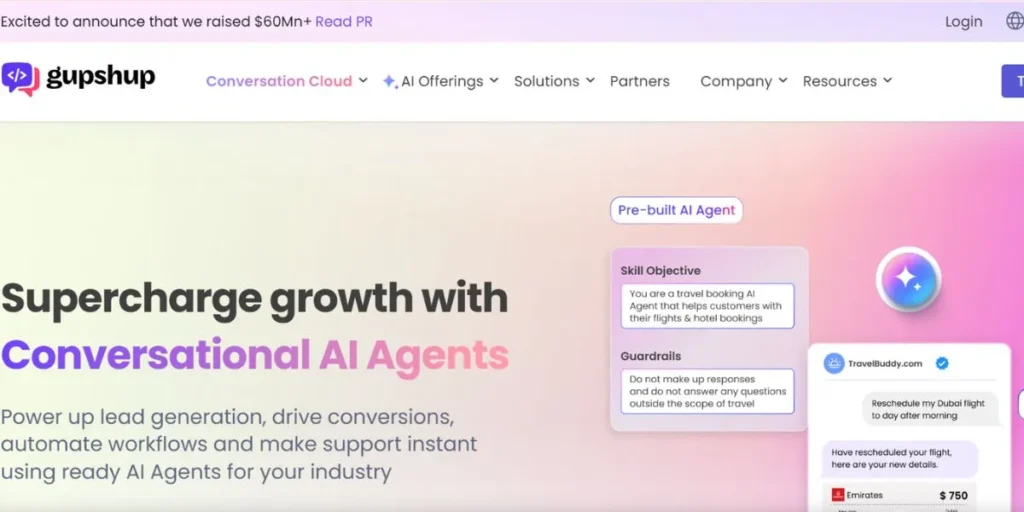
Gupshup is the most preferred conversational messaging. Its Auto Bot Builder enables companies to construct and roll out chatbots on over 30 messaging platforms, with particular emphasis on WhatsApp. Marketing or support teams can build rich conversation flows using an easy no-code/low-code interface without writing a single line of code.
The Auto Bot Builder is fueled by state of the art language models that can interpret user intent based on unstructured text, search answers in your knowledge base (such as documents or websites), and hold natural conversations. The fact that it has a build once, deploy anywhere strategy, and extensive knowledge of the messaging app environment makes it the ideal tool when it comes to businesses that wish to reach out to customers through the platforms they utilize on a daily basis.
- Supported Languages: It supports more than 100 languages, which is perfect when deploying bots on messaging platforms such as WhatsApp that are global.
- Best Use Cases: WhatsApp marketing and support automation, e-commerce chatbots on messaging apps, lead generation through chat, and customer engagement on social media.
Pros:
- Very simple no-code bot builder.
- Indefinite support of numerous messaging channels.
- It is a great tool in companies targeting regions where WhatsApp is strong.
Cons:
- Not as voice- or email-oriented.
- Might not have the deep enterprise integrations of a platform such as Oracle or Adobe.
Website: https://www.gupshup.io/
10. (Bonus) Microsoft Multilingual LLM Initiative
The Multilingual LLM Initiative of Microsoft is not a single product. All Microsoft AI work is based on fundamental research and development. The work appears in numerous locations, including real-time translation in Microsoft Teams and Skype, and multilingual capabilities of Azure AI services. Microsoft desires to have universal models that can perform tasks in a variety of languages without the need to retrain it on each language. Much of this work is the pledge to assist in “low-resource” languages–those with minimal data available online. With the help of such tools as Azure Bot Service or Dynamics 365 AI, you can access this multilingual basis that is constantly evolving and prioritizes inclusivity and access to a wide range of languages.
- Supported Languages: Deep support via Azure AI Services, and strategic emphasis on the low-resource language expansion.
- Best Use Cases: Its best use cases include developing multilingual applications in the Azure cloud, translation integration into Microsoft products, enterprise AI solutions, and studies on linguistic inclusivity.
Pros:
- Close integration with the whole Microsoft ecosystem (Azure, Office 365, Teams).
- Heavy investment in promoting a broader and more comprehensive set of languages.
- Azure cloud reliability and security on an enterprise level.
Cons:
- It is a low-level technology, not a mere, off-the-shelf agent.
- It is best suited to people who have already invested in or are willing to invest in the Microsoft tech stack.
Website: https://www.microsoft.com/en-us/research/project/project-z-code/
Implementation Challenges & Insights
Multilingual AI agents are not plug and play. You will have to be ready to face some real life obstacles:
- Everything Is Data Quality: The data that an AI agent is trained on makes it as smart as it can be. The AI will answer messily, in case your knowledge base or product information is messy. Make your data clean and organize it prior to implementation.
- Hold the Human Touch:It is not to add a frustrating robotic wall between you and your customers, but to make things more efficient. It should always have an easy escalation to the human path in case the AI is stuck or the customer is becoming frustrated.
- Not translation but Cultural Adaptation: Direct translation is not always culturally appropriate or even offensive. The thumbs-up emoji is a positive sign in the West but it is a rude gesture in other regions of the world. Such cultural differences need to be considered in your AI strategy, and it may need to adjust responses to particular regions.
- Privacy and Compliance: When you are doing business across the world, you must negotiate a maze of data-privacy regulations such as GDPR in Europe. Make sure that your selected AI provider offers a strong security and compliance to safeguard the data of your customers.
Future Trends in Multilingual AI (Late 2025 and Beyond)
Multilingual AI agents are gaining momentum and here are three things that we are going to see soon:
- Anticipatory AI: No more waiting to be asked, the agents will be able to see what customers may need and do it before users even utter a word. An example is that an AI might observe that a person is stagnating on a checkout page and say, “It looks like you are shipping to Brazil. Would you have me pre-compute the import duties to you in Brazilian Real?”
- Voice to voice translation in real-time: AI will translate speech in real-time and will make a conversation between speakers of various languages sound natural.
- Emotional intelligence: Agents will have a better understanding of sentiment, what users are feeling (anger, confusion, happiness) and will be able to respond with empathy.
- Hyper-personalization at scale: AI agents will have a memory of all the previous interactions and preferences and will be able to provide conversations with an unbelievable level of relevance.
Suggested Read: No-Code AI Tools to Create Custom AI Agents
Conclusion & Strategic Takeaways
Monolingualism is the greatest obstacle to international development. The internet has eliminated boundaries but language and cultural boundaries exist. The tools that can help any type of business to overcome these obstacles are multilingual AI agents.
They are not futuristic anymore; they are viable, strong and a must in contemporary business. Chances are you are an enterprise personalizing every touchpoint with Adobe, a startup scaling sales with Ringg, or a brand connecting with the heart of India with Kruti, but there is an AI agent waiting to help you speak the language of your customers.
Start now. Find out the most significant overseas market to your business. Study its language and culture. Then fly a basic multilingual agent to do customer support or lead generation. The knowledge you will acquire will be priceless and the rapport you will establish with those customers may be the cornerstone of your future world domination.
FAQs
1. What is a multilingual AI agent?
A multilingual AI agent is a computer program that applies artificial intelligence (such as natural language processing) to communicate with humans in a wide variety of languages.
2. Do these AI agents cost a lot to utilize?
The price is very different. Other platforms have free or low entry schemes. Solutions such as Adobe or Oracle are enterprise-grade and may be quite an investment.
3. Are human customer support teams going to be fully replaced by AI agents?
No. The most effective is a human + AI strategy. AI agents can also be incredible at answering routine, frequently asked questions and tasks 24/7, leaving your human agents free to deal with more complex tasks.
4. What are my options in selecting an AI agent for my business?
The first thing you should do is to identify your main objective. Do you have to automate sales calls (Ring)? Enhance localization of the websites (Smartcat)? Or offer a WhatsApp service (Gupshup)?