
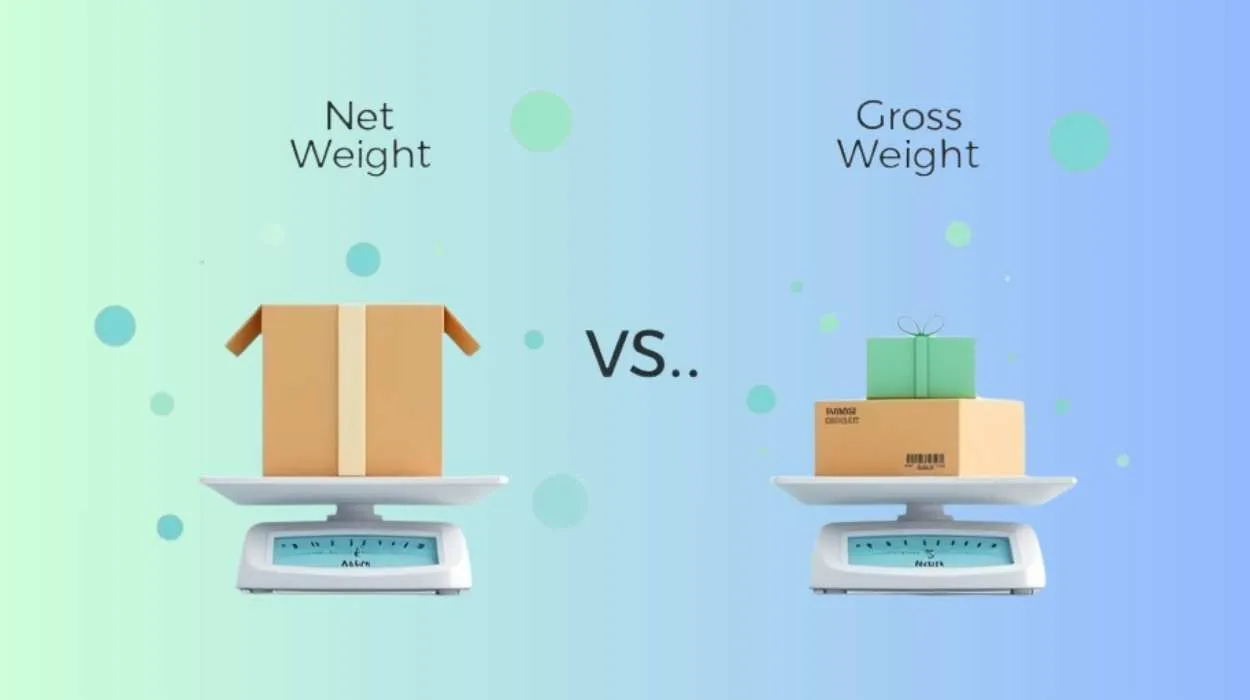
Two weight numbers will be observed in a grocery store or when a business makes a large shipment: Net Weight vs Gross Weight.
Initially, they might appear to be confusing. But a pantry, trade, and shipping are all based on these two figures. Being aware of the difference can make you save money by not paying too much for shipping, paying a fine because your bag of chips is too heavy, or feeling cheated by a bag of chips with a lot of air in it.
Our guide of Net weight vs Gross weight will explain all you will need to know in understandable language—no complicated mathematics– easy descriptions.
Why understanding net weight and gross weight is Important
To the shoppers, net weight reflects the quantity of product you have paid. These figures impact shipping expenses, legislation, and security to the corporations.
Get them wrong, and you may:
- Excessive cost: Trucks and ships will be charged based on the overall weight of the vehicle.
- Pay fines: Governments impose restrictions on the weight of heavy trucks.
- Damage product: Knowledge of weight will prevent the crushing of fragile products.
Net weight matters to customers. It tells you the actual amount of product you’re paying for, without counting the packaging. When you buy rice, flour, or any packaged item, the net weight helps you know exactly how much usable product you’re getting, which makes pricing fair and transparent.
Gross weight is essential for businesses, shipping companies, and logistics. It includes the product plus the packaging, which helps calculate shipping costs, storage space, and transportation safety. Trucks, planes, and warehouses need the gross weight to avoid overloading and plan deliveries properly.
In simple terms, net weight protects the buyer, and gross weight helps move products safely and efficiently. Both are needed so that trade, packaging, and shipping work smoothly without confusion.
What Is Net Weight?
Net weight is just the weight of the product itself, without counting the box, bottle, or any packaging. It tells you how much you’re actually getting inside.
For example, if a packet of rice says Net Weight: 1 kg, it reflects that there’s 1 kg of rice inside the packet—not including the plastic bag. This helps you know exactly what you’re paying for and avoids confusion.
Net weight matters because it keeps things fair for buyers. When companies clearly mention net weight, you don’t have to guess how much product is inside. It also helps businesses make sure every pack has the same amount of product.
What Is Gross Weight?
Gross weight is the total weight of a product, including everything that comes with it. That means the product itself plus the packaging, container, or box.
For example, if you order a box that contains a 1 kg item and the box weighs 200 grams, the gross weight will be 1.2 kg. This total weight is what matters when the product is being shipped or transported.
Gross weight is essential for shipping and logistics. Delivery companies need to know the full weight so they can calculate shipping costs, plan storage, and make sure vehicles aren’t overloaded.
Net Weight vs Gross Weight (Key Differences)
Here, so that you may see the distinctions with a single eye, is a brief comparison of them:
| Aspect | Net Weight | Gross Weight |
|---|---|---|
| Meaning | Weight of the product alone | Total weight including product and packaging |
| Includes Packaging | No | Yes |
| Includes Container | No | Yes |
| Used For | Product labeling, pricing | Shipping, logistics, transportation |
| Common Example | 1 kg of rice inside a bag | 1.2 kg (rice + bag) |
| Shown On | Product labels | Shipping documents |
| Purpose | Tells how much product you’re buying | Tells how much is being shipped |
| Impact on Cost | Affects product price | Affects shipping cost |
| Customer Concern | What they actually get | Not usually customer-focused |
| Business Use | Manufacturing, retail | Warehousing, freight |
Net Weight Vs Gross Weight Formula
You do not necessarily have to be a scientist. The weights are simply added or subtracted.
1. The Gross Weight Formula
The sum of the product weight and that of the packaging weight will result in the total shipment weight.
Gross Weight = Net Weight + Tare Weight
2. The Net Weight Formula
There is a total weight plus an empty box weight; subtracting the two gives the weight of the item.
Net Weight = Gross Weight − Tare Weight
How to Calculate Net Weight (Net Weight Calculator)
This may be fine when there are only a few items, but a warehouse requires a definite procedure. Here’s a step‑by‑step guide:
- Weigh the container structure: weigh your affair (box, crate, or pallet) on the scale. Such a figure represents the Tare Weight.
- Weight the entire package: put the product based on weight. The former is the Gross Weight.
- Subtract: subtract the first from the second. The rest is the Net Weight.
Example:
- A single wooden crate has a weight of 50 kg (Tare).
- Add the parts of the machine, the scale reads 550kg (Gross).
- 550 – 50 = 500 kg (net weight of the parts).
Does the Net weight include containers?
The short answer is: No.
The contents are only the net weight. To cite an example, 1,000 liters of water in a plastic tank represents the weight of water only. It would add to the weight of a heavy steel drum, but that does not make up part of the net weight.
Net Weights Units and Conversion
Units vary by country. The majority of them utilize the Metric System (gram, kilogram, tonnes). Other systems such as the Imperial System (ounces, pounds, tons) are the U.S. and a few others.
Shipping conversions Elitists will require most of the time are as follows:
- 1 kg = 2.204 lb
- 1 lb = 0.453 kg
- 1 metric tonne = 1,000 kg
- 1 U.S. ton = 2,000 lb
Note: Do you have a ton or U.S. (907 kg) or metric (1,000 kg or ton)? Big mistakes can be made in the case of a 93-kg difference.
Which is Bigger: Net Weight or Gross Weight?
The gross weight is never equal to the net weight.
Imagine this: any product is somehow packaged, at least in some kind of wrap. Gross weight = product + packaging, hence it is always high.
Theoretically, the weight of packaging may balance to zero, yet it is always true that in the real world, Gross > Net.
Common Use Cases by Industry
The manner of using these weights varies according to the nature of the business:
1. Food & Beverage
Restaurants and buyers depend on net weight. The label should show the manufacturer’s net weight so that you know you are getting 500g of pasta and not 450g of cardboard and 50g of pasta.
2. Logistics & Freight
FedEx or Maersk Logistics companies employ gross weight. It informs them whether a plane is capable of flying or whether a ship is balanced. They also use it to bill you.
3. Manufacturing
Manufacturing Companies use the net weight to get a picture of the amount of raw material (steel, plastic) used in a product. It assists them in inventory management and the reduction of waste.
4. Chemicals & Liquids
In this case, the container (tare) may be bulky as in a steel drum. It is a safety requirement to know the net and gross chemical weight.
Conclusion
Learning the net versus gross weight is not only an expert thing to know, it is also a helpful tool that enables you to shop better and create a more successful business.
To recap:
- Net weight = the product.
- Product = gross weight/ package.
Being aware of both saves you the cost of being an overpaying shipper and saves you the cost of being an illegal shipper.
When you see a shipping label or a package of crackers again, you will know just what those numbers are!
FAQs
1. Is it possible that Net Weight and Gross Weight are the same?
When no packaging is applied to a product, the net and gross can be equal. Gross weight is typically greater, though, in shipping.
2. Does it ship on Net or Gross weight?
Shipping cost is typically charged by the gross weight or volumetric weight in the event of the box being large and light.
3. Where am I to find the Tare weight?
The tare is displayed on the door of large containers. One weighs small items when empty or looks in the spec sheet.
4. What is the reason why customs request Data like Net Weight?
Customs taxes are determined using net weight. They do not charge the pallet on which the product is shipped but charge the product.