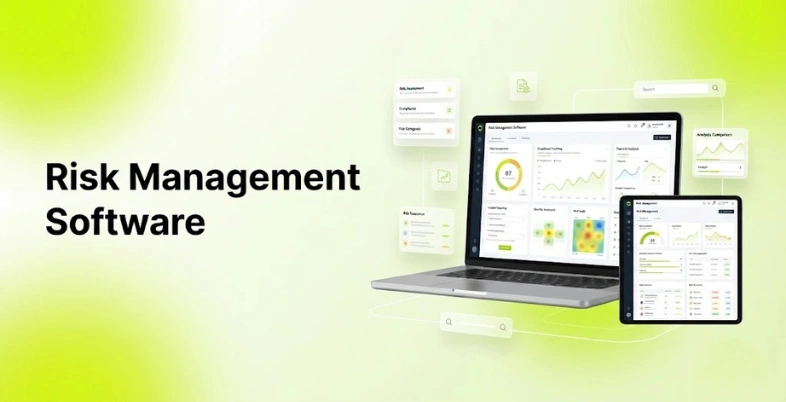
Risk management software helps companies identify, analyze, monitor and control risks that could harm their business. Moving away from spread sheets, emails, and standalone files, teams can utilize a platform to track down potential risks, assign risks to people, follow control procedures, monitor compliance, and react as appropriate to prevent costly issues. Market growth Market demand for these types of solutions is significantly increasing, creating huge demand growth for this type of product.
Coherent Market Insights estimates the total global risk management software market was around $17 billion in 2026 and will grow at an annual compound rate of above 15% to close to $47 billion in 2033. As risks are too difficult to control manually and require many systems to set up, companies are opting out of standalone spreadsheets, and workflows into risk management platforms.
In this article, we explore what risk management software does, the various kinds you can buy, the features that add value, and the 10 best risk management solutions to consider for 2026. Whether you’re replacing a spreadsheet system or looking for your first risk management platform, this guide helps you understand what to look for and make the right choice.
What Is Risk Management Software?
The Risk Management Software refers to a technology platform solution that supports identification, assessment, management and mitigation of operational risks, financial risks, technological risks, third party risks and compliance risks of the organizations. Rather than isolated spreadsheets or headcounts in conference rooms, teams put every risk in a single register, score it on likelihood and severity, assign an owner, and monitor the progress of mitigation efforts in real time.
There are three core components to this software’s job:
Risk identification and registration, from audits, incident reports, due diligence questionnaires, and incident reports
Risk assessment on a common scoring model to show leadership priorities, not alphabet soup
Risk monitoring on a dashboard of critical indicators, control efficacy, and time-to-mitigate
When done well, risk management software embeds risk mitigation into the day-to-day operations of the organization, not a once-a-year spreadsheet review.
Types of Risk Management Software
Every platform has its own specialties and picking the wrong type means wasting both time and money. Here are the main risk management software solutions and what they do:
- Enterprise risk management (ERM) software: provides visibility into financial, strategic, operational and reputational risk at enterprise scale. Supports CIOs and CFOs who want one comprehensive view.
- Governance, risk and compliance (GRC) software: balances risk register functionality with policy and contract management, regulatory mapping, audit management, and issue tracking. Commonly used in financial services, healthcare, and regulated industry.
- Third-party and vendor risk management software: vendor onboarding questionnaires, assurance audits, and third-party remediation management, etc.
- Operational risk management software: risk registers built for ground-level incident data collection, latent failure, and process management. Used in manufacturing, natural resources, and retail.
- Financial risk management software: it deals with credit, market, and liquidity risk modeling. Used mostly in banking and finance; as mentioned earlier, this segment alone is expected to grow from 3.6 billion dollars in 2026 to nearly 9.8 billion dollars by 2034 per Straits Research.
Many vendors mix two or three of these use cases into one platform, so read the documentation to be sure you are buying what you think.
Key Features to Look for in Risk Management Software
The key difference emerges once you read the details of the software. Make sure to look for:
- A central risk register with flexible taxonomies and risk categories aligned to standards like ISO 31000 or COSO ERM
- Workflow automation for assessment, approval, and risk mitigation, ideally built for business users so risk teams do not need to queue for IT
- Role-based user interfaces with separate dashboards for executive and risk team usage
- Audit trail and evidence capture to satisfy regulators and auditors, with less manual admin for risk teams
- A connecting hub that works with Microsoft Power Automate, Jira, Slack, and your other existing tools
- Risk reporting customized for the board, with heat map visualizations and easily interpretable trend lines
- AI-powered risk discovery that analyzes documents, identifies anomalies, and helps groups summarize data faster
Comparison Table
| Tool Name | Best For | Key Feature | Pricing | Compliance Frameworks Supported |
| Riskonnect | Large enterprises needing broad ERM plus claims and insurance risk | Claims administration built into the risk register | From around 283,000 dollars a year | ISO, SOX, GDPR, HIPAA, CPS 230 |
| Archer | Fortune 500 firms wanting deep, fully configurable GRC | Near-infinite no-code configurability with built-in risk quantification | 75,000 to 300,000+ dollars a year | ISO, SOX, NIST, GDPR, industry-specific regulatory content library |
| LogicManager | Mid-size to large teams wanting fast, no-code setup | One-click mapping between risks and controls | Starts around 10,000 dollars a year | ISO, NIST, COBIT, GDPR, CCPA |
| MetricStream | Regulated industries needing AI-driven, no-code GRC | AI engine that interprets policy documents and quantifies risk | Custom quote | ISO 27001, SOC 2, COBIT, NIST, CCAR, SR 11-7, DFAST, SOX |
| ServiceNow IRM | Enterprises already running the Now Platform | Shared data model with IT, HR, and operations workflows | Custom quote | ISO, NIST, SOC 2, GDPR, plus ESG frameworks |
| AuditBoard | Internal audit teams and SOX compliance programs | Purpose-built SOX 404 workflow automation | Starts around 50,000 dollars a year | SOX, ISO, NIST, SOC 2 |
| Resolver | Security, incident, and operational risk teams | Incidents linked directly to the risk register | Custom quote | ISO, NIST, plus corporate security-specific standards |
| OneTrust | Privacy-first compliance and third-party risk programs | Deep privacy regulation mapping across regions | Starts around 25,000 dollars a year | GDPR, CCPA, ISO 27001, SOC 2 |
| SAI360 | Ethics, compliance, and integrated GRC programs | Risk register paired with ethics and compliance training content | Custom quote | COSO ERM, ISO 31000 |
| VComply | Small to mid-size teams needing a lighter, faster GRC tool | Fast rollout with pre-built framework templates | Custom quote, positioned below enterprise pricing | ISO, SOC 2, and common mid-market compliance templates |
List of Top 10 Risk Management Software
1. Riskonnect
- Website: riskonnect.com
- Best for: Big enterprises that need a single platform covering operational, IT, third-party, strategic, and insurable risk as well as claims management
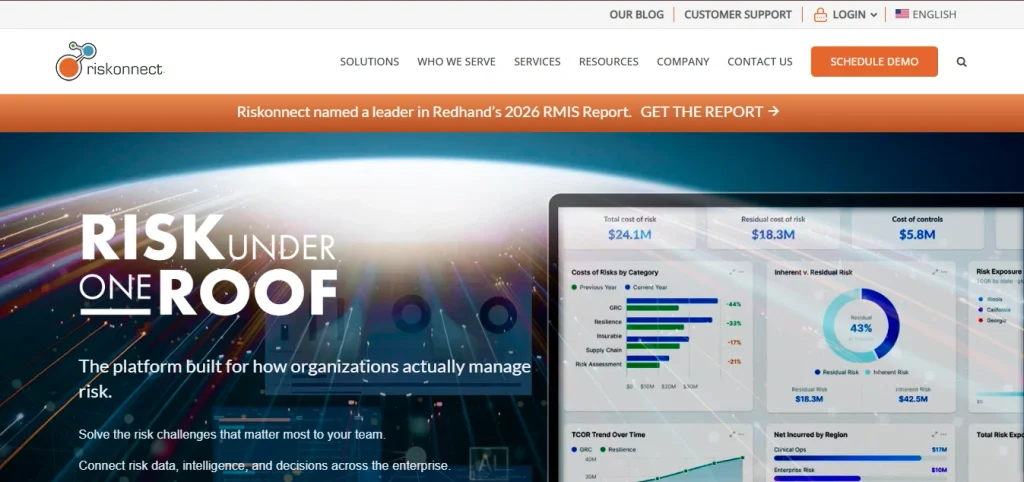
Riskonnect‘s company positioning as a comprehensive ERM platform is designed to scale across all industries. Its deep configurability combined with automation testing tools, automation, and a set of 150-plus out-of-the-box frameworks and mappings lets the product support complex multi-country risk programs. Handling risk data, claims, and insurance risk are also goals for many Fortune 500 risk teams.
Key features:
- Integrated risk register spanning operational, strategic, and insurable risk
- Claims administration module
- Regulatory framework mapping across major global standards
- Automated workflow and approval routing
Pros:
- Covers a wider risk spectrum than most competitors
- Strong automation reduces manual reporting work
- Scales well for multinational organizations
Cons:
- Steep price point puts it out of reach for smaller teams
- Implementation takes real time and internal resourcing
Pricing:
- Enterprise entry pricing runs from roughly 283,000 dollars a year and up, based on modules and user count
2. Archer
- Website: archerirm.com
- Best for: Large enterprises with cross-functional risk needs who want a flexible and modifiable platform for their exact process
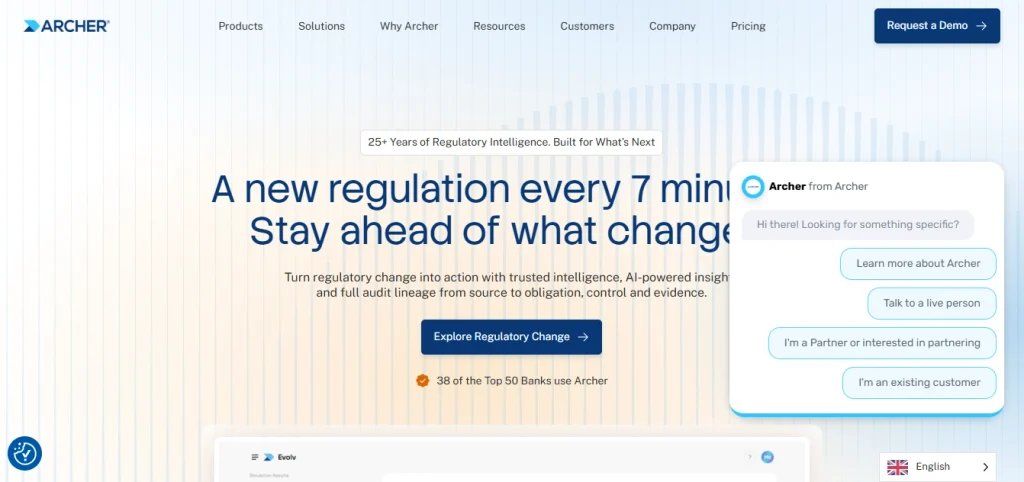
Archer, which was previously RSA Archer, offers truly integrated Risk management software across operational, IT and third-party risk—all in one register with risk quantification and scenario modeling. Several Fortune 500 risk teams have based their entire internal processes on Archer’s architecture—which is why it’s here to stay, even as newer players vie for market share.
Key features:
- Near-infinite configurability through custom applications and workflows, no coding required
- Built-in risk quantification and simulation engine
- Unified data model across risk, audit, and compliance
- Extensive library of pre-built regulatory content
Pros:
- Deepest integrated risk capability among legacy platforms
- Handles complex, large-scale risk profiles well
- Long track record inside regulated industries
Cons:
- Interface feels dated next to newer, lighter competitors
- Steep learning curve slows new-user adoption
- Performance can lag with very large data sets
Pricing:
- Typically 75,000 to 300,000 dollars or more a year depending on modules, users, and deployment model
3. LogicManager

- Website: logicmanager.com
- Best for: Organizations wanting a fast, no-code ERM rollout without a long consulting engagement
LogicManager built its core feature set on a taxonomy-based approach that links risks to the people, processes, and controls that they impact. It offers a fixed price to its licenses, making it easier to plan for a small enterprise team to plug in and start working. A dedicated analyst provides client onboarding and access to free competitor analysis tools, helping to accelerate implementation even further.
Key features:
- Taxonomy infrastructure connecting risks across departments
- One-click compliance mapping to ISO, NIST, COBIT, GDPR, and CCPA
- No-code integration hub connecting to over 7,000 third-party apps
- Pre-built risk and assessment libraries by industry
Pros:
- User-friendly interface compared with legacy GRC suites
- Fixed pricing model with no surprise customization fees
- Strong onboarding and ongoing analyst support
Cons:
- Less flexible than fully custom platforms for unusual workflows
- Cost becomes a barrier for very small organizations
Pricing:
- Starts around 10,000 dollars annually, scaling with modules and users
4. MetricStream
- Website: metricstream.com
- Best for: Regulated industries who want an AI-powered, no-code platform that can be implemented quickly and integrated into their broader GRC system
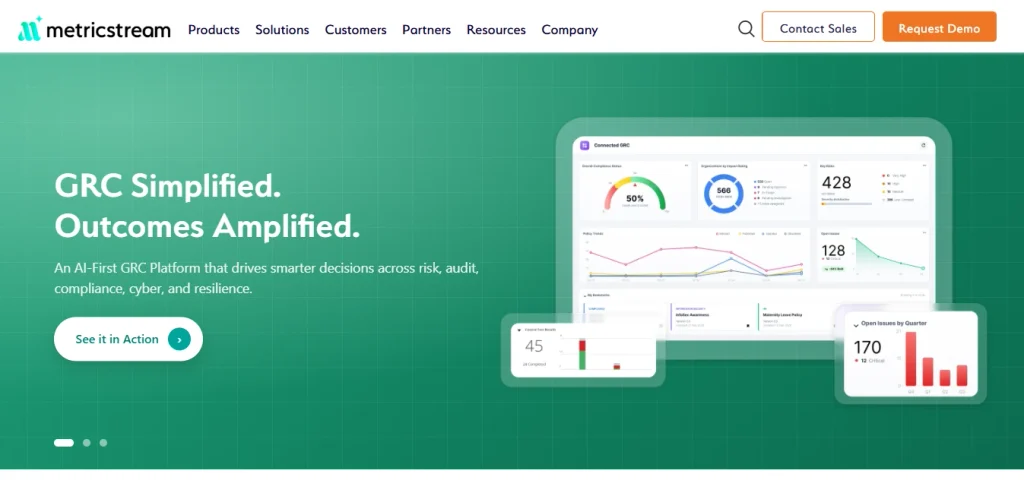
MetricStream, a cloud-based management platform, mobile-responsive Risk management software platform, offers over 1,500 predefined templates aligned to regulations such as SOC 2, COBIT, NIST, and SOX. Its AI capability automates certain manual tasks, such as interpreting policy documents and translating the content into a quantifiable risk score, thanks to a proprietary simulation engine.
Key features:
- AI and machine learning engine for risk identification and document interpretation
- Over 1,500 pre-built regulatory templates
- No-code workflow configuration
- Dynamic dashboards with scalable risk assessments
Pros:
- Fast time to value thanks to pre-built content
- AI reduces manual document review significantly
- Strong regulatory coverage out of the box
Cons:
- Pricing stays fully custom with no published tiers
- Advanced AI features may need a learning period for risk teams
Pricing:
- Custom quote, generally positioned for mid-market to large enterprise budgets
5. ServiceNow IRM

- Website: servicenow.com
- Best for: Large enterprise already using ServiceNow who need risk management on the same data platform as operational and IT workflows
ServiceNow IRM Integrated Risk Management pulls operational risk, IT risk, cyber risk, third-party risk, and ESG onto one platform. Its data architecture makes risk management work feel very familiar to teams that manage incident tickets, change requests, and asset records. The single data platform, which eliminates manual reconciliation across tools, is its key selling point.
Key features:
- Shared data model with ServiceNow IT, HR, and operations modules
- AI-native risk scoring and workflow automation
- Continuous control monitoring
- ESG and operational resilience modules included
Pros:
- Seamless fit for organizations already on the Now Platform
- Reduces duplicate data entry across departments
- Strong automation and AI-assisted insights
Cons:
- Full value depends on deep ServiceNow adoption elsewhere
- Custom pricing makes budgeting harder upfront
Pricing:
- Custom quote, typically enterprise-tier
6. AuditBoard

- Website: auditboard.com
- Best for: Internal audit functions and organizations with SOX compliance programs wanting a new user experience atop a legacy GRC.
AuditBoard‘s roots are audit-first workflows. Audit Board tends to be in G2’s IT Risk Management top 3 year after year, simply because it’s so familiar relative to legacy enterprise suites. Its connected risk architecture makes it a Risk management software solution that consolidates controls, risks and policies to a single data core and then overlays specific apps on top for SOX, operational audit and third-party risk.
Key features:
- Unified risk and controls data core
- Purpose-built SOX 404 workflow automation
- Strong dashboarding and executive reporting
- Dedicated modules for third-party risk and ESG
Pros:
- Consistently rated among the most intuitive GRC interfaces
- Excellent fit for audit-led risk programs
- Fast-growing, well-funded vendor with active development
Cons:
- Weaker privacy regulation coverage compared with privacy-first tools
- Pricing not published, starts around 50,000 dollars a year
Pricing:
- Starts around 50,000 dollars annually, scaling by modules and users
7. Resolver
- Website: resolver.com
- Best for: Security, incident management, and operational risk teams needing to connect physical and digital risk events
Resolver, acquired by Kroll in 2022, built its platform around connecting incidents to underlying risks rather than treating them as separate systems. That link matters for security and operations teams who need to see how a single incident affects multiple risk categories at once. Its 26 years in the category give it depth in operational and corporate security risk that newer entrants have not caught up to yet.
Key features:
- Incident management tied directly to risk registers
- Security and corporate risk-specific modules
- Configurable workflows for investigations and case management
- Reporting built for both risk and security operations teams
Pros:
- Strong for organizations blending physical security and enterprise risk
- Backed by Kroll’s broader risk and investigations expertise
- Flexible workflow configuration
Cons:
- Pricing not public, requires a sales conversation for every quote
- Less focused on financial or credit risk use cases
Pricing:
- Custom quote based on modules and organization size
8. OneTrust
- Website: onetrust.com
- Best for: Global enterprises running privacy-first compliance programs alongside third-party risk management
OneTrust grew out of privacy compliance and has since expanded into full tech risk and compliance coverage. The solution is a Risk management software platform that unifies GDPR, CCPA, and other privacy regulations, regulation monitoring, cyber frameworks, third-party risk, and more in a single tool. Its risk register is highly configurable, as is its library of workflows, templates, and project templates.
Key features:
- Deep privacy regulation mapping including GDPR and CCPA
- Third-party and vendor risk assessment tools workflows
- Unified platform for privacy, security, and compliance risk
- Continuous monitoring across global regulatory changes
Pros:
- Best-in-class privacy regulation coverage
- Lower starting price than several enterprise competitors
- Broad framework support across regions
Cons:
- Some users report support response delays during account issues
- Less depth in pure operational or financial risk modeling
Pricing:
- Starts around 25,000 dollars annually
9. SAI360

- Website: sai360.com
- Best for: Organizations running both ethics, compliance and enterprise risk programs together
SAI360 couples a risk register with compliance, ethics training content, and an easy-to-implement architecture that is most attractive to organizations that want operational risk and code of conduct violations to sit on one dashboard. It has pre-mapped taxonomies such as COSO and ISO 31000, and its low-code approach lets the vendor map your organization’s risk categories at no charge.
Key features:
- Combined risk register and ethics and compliance training library
- COSO and ISO 31000-aligned taxonomies
- Third-party risk and policy management modules
- Configurable dashboards for risk, audit, and compliance teams
Pros:
- Rare combination of training content and asset risk tracking in one license
- Flexible taxonomy setup for varied industries
- Strong fit for ethics and compliance-driven organizations
Cons:
- Pricing stays fully custom, harder to budget in advance
- Smaller integration ecosystem than category leaders
Pricing:
- Custom quote
10. VComply
- Website: v-comply.com
- Best for: Small to mid-size teams that want core GRC functionality without an enterprise price tag or a months-long rollout
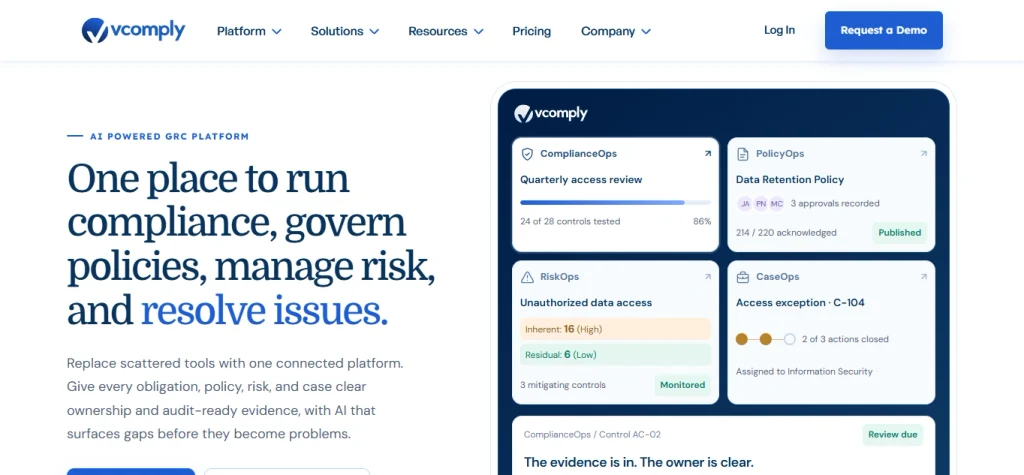
VComply fills the niche in between spreadsheets for risk management and large enterprise suites. This Risk management software handles the basics like risk register, compliance calendar, policy and document management, and audit workflows but not the configuration, workflow, and customization features of legacy platforms.
Key features:
- Centralized risk register with configurable scoring
- Compliance calendar and automated reminders
- Policy management with version control
- Pre-built templates for common frameworks
Pros:
- Faster implementation than enterprise-tier competitors
- Friendlier pricing for mid-market budgets
- Clean, straightforward interface for first-time users
Cons:
- Less depth for highly complex, multi-entity global risk programs
- Fewer advanced AI features compared with top-tier suites
Pricing:
- Custom quote, generally positioned below enterprise pricing tiers
Common Mistakes When Implementing Risk Management Software
- Failing to create the process before you choose a platform: no tool can augment or replace a risk program that has not established a standard taxonomy, scoring method, ownership, and so forth. Establish this first, then select a platform.
- Neglecting change management: you can’t simply train risk owners on what to log and why-if no one is putting risks in the register, it will sit idle until eventually abandoned.
- Choosing technology based on its brand name alone: a platform designed for financial market risk will underperform in managing operational risks for your manufacturing organization, no matter how familiar or prestigious the product is.
- Overlooking the importance of integration: if the risk platform doesn’t integrate with your ticketing, HR, or identity management systems, someone has to retype everything; it will lose accuracy quickly.
- Treating it as a one-and-done project: the goal for your risk register shouldn’t be a one-time data entry and go-live. It needs a continuous refresh cycle.
Conclusion
The best risk management software platform is the one that fits your risk program, not one the vendor sales team claims you need. Organizations managing multiple areas of risk in multiple locations tend to prefer Riskonnect, Archer or Metric Stream.
Teams doing mainly internal audits will prefer Audit Board.Privacy-heavy compliance programs fit OneTrust. Mid-market teams moving off spreadsheets get the fastest win from LogicManager or VComply.
Start by writing down your actual risk taxonomy and reporting needs before you take a single demo call. That single step saves more budget than any feature comparison ever will.
FAQs
What Is The Difference Between Risk Management Software And GRC Software?
Risk management software focuses on identifying, scoring, and tracking risks. GRC software adds governance and compliance layers on top.
Is Risk Management Software Only For Large Organizations?
No. Platforms like VComply and Logic Manager focus on mid-size organizations with lower price points and faster deployment.
Does Risk Management Software Incorporate AI?
Most leading risk management platforms already include AI for identifying risks, interpreting texts and spotting patterns in large data sets.
What Is The Typical Implementation Timeframe?
Small platforms can be implemented within weeks. Enterprise platforms with broad capabilities will require a few months of integration planning.
Can Risk Management Software Completely Replace A Risk Department?
Not entirely. Risk management software can track and report on all risks, but risk expertise is still needed for risk identification.