
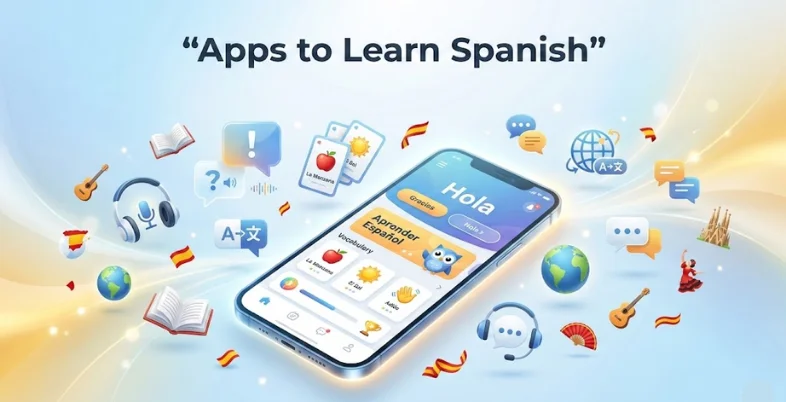
There are a lot of language learning apps, and to do that, it might be a little confusing to decide which one is the right one to purchase, especially when you are new to the world of Spanish. Spanish is the language that is spoken by one of the largest numbers of people in the world, and studying it can lead to a new culture, traveling, a career, and worthwhile dialogues. Modern technology allows you not to go to costly classes or spend much time reading huge textbooks. The language learning applications come to the rescue of Spanish, making it simple, flexible, and enjoyable to learn at any time and place.
These applications target the various learning styles. Others emphasize the vocabulary and grammar, and others assist you in learning to talk with native speakers or learning based on videos, stories, and face-to-face dialogue. No matter how you are as a beginner, a learner who is in the middle or the one striving to be fluent, there is an app that suits your purpose.
There are several great Apps to Learn Spanish that can be used to study the language, and in this blog, we are going to discuss the best apps according to our choice and help you select the one that fits you best.
Why Learning Spanish Through Apps Is So Effective
Mobile app has been one of the most effective and convenient ways of teaching the Spanish language to the present day learners. These applications are meant to be incorporated in busy schedules where you can learn Spanish at your convenience and can have five minutes or even an hour daily. The majority of apps divide lessons into small, easy-to-follow segments, which makes learning not as overwhelming and more coherent.
Learning applications in Spanish also incorporate intelligent skills such as spaced repetition-based, audio-based, and interactive learning, and actual examples to enhance memorability and comprehension. Numerous applications are created to listen and speak, which enables students to become more confident in their pronunciation and conversation. Others even introduce you to native Spanish speakers, and you have a real-life exercise without having to visit a foreign country.
The other significant benefit is personalization. Apps modify the lesson according to your achievements, abilities, and areas of weakness. This helps to make sure that you pay more attention to the aspects that you should be better at. Generally, learning apps in Spanish simplify the process, make it interesting, less expensive, and very effective for learners of all levels.
Benefits of Using Spanish Learning Apps
- Learn Anywhere, Anytime: Study Spanish at your own pace and do it at home while traveling or even during small breaks every day.
- Lessons with Easy-to-follow Pieces: The apps can begin with simple things such as alphabets, basic words and simple sentences.
- Enhances Speaking Fluency: A lot of apps are devoted to pronunciation and communication in real life.
- Interactive and Fun Learning: Games, quizzes, challenges, and so on make the process of learning enjoyable and stress-free.
- Individual Learning Path: Lessons change according to your achievement and learning pace.
- Native Speaker: Exposure, Audio, videos, and chats will make you learn actual accents of Spanish.
- Free or low-cost subscriptions: The majority of applications are available in free versions, or have affordable subscriptions.
- Becoming a Daily Learner: Reminders and streaks will make you consistent and motivated to do so.
How to Choose the Best App to Learn Spanish?
- Your Learning Goal: Choose between basic conversation, fluency, travel Spanish or grammar mastery.
- Learning Style: Select the apps that have videos, audio, games, or reading depending on the best method of learning.
- Speaking Practice: Find apps that have pronunciation checks or that interact with a native speaker.
- Level Support: make sure the app is appropriate to your level, whether it is beginner or advanced.
- Lesson Structure: Choose those apps where the lessons are well structured and clear to follow consistent progress.
- Time Flexibility: Select the apps that can fit your time schedule with long or short lessons.
- Free vs Paid Features: Examine what comes with no cost and proceed with upgrading.
- User Reviews and Ratings: The real user feedback will aid in the determination of the quality and reliability of apps.
List of 15 Best Apps to Learn Spanish
1. Duolingo

One of the most widely used language-learning applications in the world, Duolingo is particularly helpful for those learning Spanish for the first time. Short, game-based lessons that make learning fun rather than stressful are used to teach the language. With integrated listening, reading, writing, and speaking exercises, each lesson focuses on vocabulary, basic grammar, sentence structure, and pronunciation to improve all fundamental language abilities.
Rewards, points, levels, and daily streaks are all used by the app to encourage users to develop regular learning habits. Even with a hectic schedule, practicing Spanish is simple because to its quick and adaptable sessions. Duolingo is incredibly useful for learning common words, phrases, and short sentences, but it is not intended for complex grammar or sophisticated discourse. For novices and casual learners looking for stability and confidence in their Spanish language learning, Duolingo’s free version is a great place to start.
Key Features:
- Game-based Spanish lessons
- Streak and Reward System: This is offered each day to encourage players to continue playing.
- General vocabulary and grammar.
- Conversation and listening activities.
- Beginner-friendly interface
- Free learning option
- Habit-building design
2. Memrise

Memrise is an app for learning Spanish that focuses on enhancing pronunciation and expanding one’s vocabulary. It helps students retain words and phrases over time by using a spaced repetition method. The usage of authentic films from native Spanish speakers is one of its most notable characteristics; it aids learners in comprehending natural accents, pronunciation, and speaking speed in everyday situations. Memrise is particularly useful for enhancing listening skills because it teaches frequently used words and phrases through brief, interactive daily sessions rather than textbook jargon.
Beginners with a little vocabulary and intermediate students wishing to increase their vocabulary can use the app. It is best used in conjunction with a grammar-focused software, though, as it provides very little grammatical training. Additionally, Memrise facilitates offline learning, which makes it useful for people with spotty internet connections. All things considered, it is a great option for students who wish to sound more natural and acquire useful spoken Spanish through exposure to everyday situations.
Key Features:
- Native speaker video clips
- Spaced repetition learning
- Strong vocabulary building
- Improves pronunciation
- Short daily lessons
- Real-life Spanish phrases
- Offline learning mode
3. Busuu

One of the best apps to learn Spanish is Busuu, which provides a structured approach for dedicated students who wish to advance their grammar. Following the CEFR levels, which span from beginner to advanced, makes learning systematic and goal-oriented. The software includes lessons on vocabulary, grammar explanations, writing, listening, and pronunciation practice.
Feedback from native Spanish speakers, who correct responses and pronunciation, is one of Busuu’s most useful features. This helps students become more accurate and self-assured. Additionally, Busuu develops customized study schedules depending on your objectives, skill level, and free time. The classes provide a classroom-like learning experience on your phone and are straightforward, professional, and simple to follow.
The quality of the information makes it worthwhile even though many functions require a premium subscription. All things considered, Busuu is perfect for students looking for an organized method, a strong foundation in grammar, and genuine feedback while learning Spanish at their own speed.
Key Features:
- Spanish courses that are based on CEFR.
- Grammar-focused lessons
- Native speaker feedback
- Personalized study plans
- Writing and oral communication.
- Progress tracking tools
- Lesson structure with a professional teacher.
4. Babbel

Babbel is an app for learning Spanish that aims to assist users in speaking the language fluently in ordinary conversations, travel, work, and shopping. Its courses, which emphasize sentence construction over word memorization, are written by language experts and feature straightforward, understandable grammar explanations. For busy adults, the brief, planned classes are perfect.
Babbel helps students sound more natural by emphasizing pronunciation and speaking practice. Despite being mostly a paid software, the quality of the lessons is excellent. With its clear explanations, helpful vocabulary, and genuine conversational focus, it is particularly appropriate for beginning and intermediate learners who prefer real-world, relevant Spanish over game-based learning.
Key Features:
- Conversation focuses on reality.
- Clear grammar explanations
- Expert-designed lessons
- Speaking practice included
- Short structured sessions
- Real-life vocabulary training.
- Adult learner friendly
5. Pimsleur

Pimsleur is an app for learning Spanish that mostly uses guided audio lessons for speaking and listening. Students pay close attention, react to cues, and work on their pronunciation, sentence structure, and confidence when speaking. Because each session lasts roughly thirty minutes, it is convenient to use while walking or commuting. It is particularly appropriate for aural learners because it requires very little writing or reading.
Repetition is used in the Pimsleur method to aid students in long-term word and phrase retention. It is quite useful for conversational Spanish, despite having little pictures. Beginners, travelers, and even intermediate students who wish to speak fluently and clearly through regular audio practice will find the program excellent.
Key Features:
- Audio-based learning approach.
- Well-developed pronunciation exercise.
- Conversation-based lessons
- Hands-free learning option
- Thirty minutes sessions daily.
- Improves listening skills
- Ideal for auditory learners
Also read: Presentation Software
6. Rosetta Stone

Rosetta Stone is an immersive approach to teach Spanish naturally and without the need for translations. One of the most well-liked apps to learn Spanish employs music, graphics, and context to help users think directly in Spanish, just like kids learn their mother tongue. The software emphasizes reading, listening, speaking, and pronunciation using strong speech recognition technology that improves pronunciation accuracy. Simple words are progressively replaced by complete phrases in the well-structured sessions.
Visual learners and beginners to early intermediate users who desire a solid foundation and enjoy a gradual, steady pace are the best candidates for Rosetta Stone. Its immersion approach promotes long-term memory even if progress may seem slower than with gamified apps. The app is a good option for serious Spanish learners looking for in-depth immersion without translations because it is subscription-based and provides a top-notch, distraction-free learning environment.
Key Features:
- Immersion-like learning process.
- No translation approach
- Speech recognition technology.
- Balanced skill development
- Visual learning support
- Structured lesson flow
- Long-term retention focus
7. FluentU

A Spanish language learning program called FluentU uses real-world video content, including news, commercials, music videos, interviews, and movie excerpts. It aids students in understanding natural Spanish usage in place of conventional instruction. In order to promote context-based vocabulary learning as opposed to memorization, each film has interactive subtitles that let viewers tap terms for rapid definitions and examples. With its quizzes and review capabilities, the app is particularly useful for honing listening skills and comprehending various Spanish accents.
Intermediate learners who wish to increase their fluency but already possess a basic understanding of Spanish are the ideal candidates for FluentU. It could initially be difficult for novices. The software uses a subscription-based business model and customizes learning based on progress. All things considered, FluentU successfully connects classroom instruction with real-world Spanish, making language learning interesting, useful, and culturally rich.
Key Features:
- Real-world Spanish videos
- Interactive subtitles
- Learning vocabulary through the context.
- Enhances comprehension of listening.
- Personalized quizzes
- Cultural exposure
- Most suitable in the intermediate learner.
8. Tandem

Tandem is an app that facilitates live discussions between learners and native Spanish speakers to help them practice speaking the language. It emphasizes actual communication via text, voice messaging, and video calls rather than structured instruction. In order to facilitate mutual learning, users are linked with Spanish speakers who wish to study the language. Additionally, the program enhances speaking confidence, fluency, and cultural understanding while providing translation and correction tools, which are particularly useful for novices.
Tandem functions best when used with an organized learning tool because it does not teach vocabulary or grammar. It is perfect for students who wish to practice speaking Spanish in everyday situations and have normal conversations, which will help them get over their phobia of speaking. Regular use results in obvious progress, even though the quality of the discussion relies on the companion. Tandem is a great tool for genuine communication and cultural immersion, and it offers both free and premium subscriptions.
Key Features:
- Exchange of language with the natives.
- Text, voice, and video chat
- Practice of real life conversation.
- Translation support technology.
- Experience in cultural learning.
- Free basic access
- Practice in confidence-building speaking.
Suggested Read: Video Conferencing Software
9. HelloTalk
One of the best apps to learn Spanish is HelloTalk, a social language learning tool that lets users converse with native speakers all over the world. Students can communicate via audio calls, voice notes, and text messaging. To facilitate easy conversation, the app also has helpful features including translation, pronunciation support, and a grammar checker.
HelloTalk is appropriate for learners of all levels, particularly those who want to increase their confidence and fluency, because it encourages organic, everyday learning instead of formal instruction. Additionally, it assists users in learning cultural idioms and phrases that local speakers frequently use.
HelloTalk’s dynamic, community-based setting makes it an excellent tool for practicing conversations even though it does not provide structured grammar instruction. It can be used in conjunction with another grammar-learning software for optimal outcomes. All things considered, HelloTalk is a powerful tool for developing confidence and practical Spanish communication skills through social engagement.
Key Features:
- Chat with native speakers
- Built-in translation tools
- Pronunciation assistance
- Grammar correction support
- Voice and text messaging
- Community-based learning
- Fluency-focused practice
10. italki

Spanish language learners can take live, one-on-one courses with community tutors and professional teachers through the online language learning platform italki. It emphasizes personalized learning by real-time engagement, in contrast to automated apps. It is perfect for objectives like conversation practice, tests, or business Spanish because learners may select teachers based on experience, cost, accent, and teaching style. Beginners, intermediate, and expert students can all benefit from the adaptable and personalized lessons.
Additionally, the platform has a community section where users may practice writing and ask questions. The pay-per-lesson concept used by Italki gives students financial control. Direct engagement with actual professors is its greatest benefit, as it facilitates rapid improvement of speaking abilities, pronunciation, and confidence. All things considered, Italki is among the best resources for serious Spanish language learners looking for individualized instruction.
Key Features:
- One-on-one Spanish lessons
- There are professional teacher in place.
- Flexible scheduling
- Individualized learning objectives.
- Pay-per-lesson model
- Speaking-focused practice
- Suitable for all levels
11. Lingopie
Lingopie is a Spanish learning app that helps users learn through real TV shows and movies. Instead of traditional lessons, it offers an immersive experience where learners watch Spanish content with interactive subtitles. Users can view Spanish and English subtitles simultaneously, pause videos, and tap on words to see their meanings instantly. This method helps learners understand how Spanish is spoken naturally in real-life situations.
By combining education with entertainment, the app makes learning fun. Beginners may find Lingopie difficult without prior experience, therefore it is best suited for intermediate learners with a basic understanding of Spanish. Additionally, it enhances vocabulary, accents, expressions, listening comprehension, pronunciation, and cultural awareness. Lingopie provides excellent information and a distinctive, efficient method of learning Spanish using real media, although it does require a membership.
Key Features:
- Study via Spanish television.
- Dual subtitle support
- Tap-to-translate words
- Improves listening skills
- The immersion learning: cultural.
- Vocabulary in context
- Intermediate learners
- As a beginner, it is best to use it.
12. SpanishDict

SpanishDict is a powerful Spanish learning and reference app that is frequently used for verb conjugations, translations, and grammar explanations. To help accurate learning, it provides thorough definitions, sentence examples, pronunciation instructions, tests, and practice exercises. Among apps to learn Spanish, SpanishDict’s verb conjugation tool is particularly useful for comprehending various tenses.
SpanishDict is best used as a supplementary learning tool rather than an organized course, and it is appropriate for both beginner and expert learners. It is perfect for answering questions about sentence construction, grammar, and vocabulary. Learners who prefer straightforward explanations over game-based learning are advised to utilize the app, which is free to use with optional premium features. All things considered, it is a trustworthy and dependable tool for learning Spanish vocabulary and grammar.
Key Features:
- Correctly translated Spanish.
- Expansive descriptions of grammar.
- Verb conjugation tools
- Example sentences included
- Pronunciation guides
- Practice quizzes available
- Optimal peer learning application.
13. LingoDeer

The streamlined language-learning app LingoDeer places a lot of emphasis on sentence construction and syntax. It is perfect for students who like well-structured lessons and concise explanations. Beginning with simple words and working its way up to complete sentences, the app teaches Spanish step-by-step. Simple, beginner-friendly terminology is used to teach grammar rules.
Pronunciation instruction, offline learning assistance, and practice in speaking, writing, listening, and reading are all included in the lessons. Learners can maintain concentrate thanks to the app’s simple, distraction-free design. LingoDeer prioritizes educational value over excessive gamification, making it appropriate for both novice and intermediate learners. It is still a great option for students looking for methodical instruction, grammatical clarity, and consistent advancement in learning Spanish, even though certain premium features are paid for.
Key Features:
- Grammar-focused lessons
- Clear explanations
- Structured learning path
- Pronunciation practice
- Offline learning support
- Beginner friendly design
- Balanced skill development
14. Mondly

Mondly is a modern language-learning app that makes learning Spanish fun and interesting by utilizing technology. Through quick sessions that increase vocabulary and conversational abilities, it emphasizes daily practice. As one of the top apps to learn Spanish, the software is appropriate for novices and casual learners who require flexible study alternatives because it features chatbots for simulated conversations and speech recognition to enhance pronunciation.
In addition to an augmented reality aspect that makes learning more visual and entertaining, Mondly provides lessons based on real-life situations like shopping and travel. It is useful for daily practice and vocabulary development even though it does not place a strong emphasis on grammar. Mondly is an excellent option for students looking for rapid, engaging, and creative Spanish learning because of its user-friendly interface and its free and premium versions.
Key Features:
- Chatbot role-playing.
- D-Speech recognition technology.
- Daily short lessons
- Vocabulary-focused learning
- Real-life situation topics
- AR learning features
- Beginner-friendly interface
15. Clozemaster

Clozemaster is an app for learning Spanish that is mostly designed for advanced students who have a basic understanding of grammar. Fill-in-the-blank exercises are used to assist students comprehend words in context, with an emphasis on learning through phrases rather than individual words. This method improves reading speed, grammar awareness, and vocabulary. Clozemaster facilitates quick learning and practice for individuals who are prepared to advance beyond the beginning level, but it is not the best option for complete beginners because it does not provide a detailed explanation of grammar rules.
With its simple, distraction-free interface, the app functions more as a practice tool than a teaching tool. Repetition is an excellent option for reaching high levels of Spanish through contextual practice since it enables students to monitor their progress and improve their fluency.
Key Features:
- Sentence-based learning
- Context based vocabulary worksheets.
- Advanced learner focus
- Fast-paced exercises
- Improves fluency
- Minimal interface
- Progress tracking system
Conclusion
The selection of the most appropriate apps to learn Spanish is based on your level, goals, and learning style. Some apps are ideal for beginners looking to develop daily learning habits, while others focus on grammar, real-life conversation, or immersive learning with videos and stories. No single application can do it all, but a combination of two or three apps can achieve optimal results. For example, a structured app for grammar, an app for conversational practice, and an app for listening skills can be used. Speed is less important than consistency when learning a language.
A 15-20 minutes a day practice can provide strong results in the long run. Spanish learning apps have transformed the process to be flexible, cheap and affordable to all. Anyone can speak Spanish with a lot of practice, patience, and the right equipment to be certain that they comprehend and speak Spanish. It is important to begin, be regular, and have fun with the learning process.
FAQs
1. What is the Most Suitable App to use to Learn Spanish as a Beginner?
Duolingo, Babbel, and Busuu are a good choice among beginners.
2. Is it Possible to Study Spanish with the Help of Apps Alone?
Yes, through practice and being able to talk in the real world.
3. So What is the Most Appropriate App to Speak Spanish?
Pimsleur, italki, Tandem, or HelloTalk are the best in terms of speaking.
4. Do Learning Apps in the Spanish Language Come at no Cost?
The majority of the applications are free with paid options.
5. What is the Time Taken to Study Spanish with the Help of Apps?
Simple conversation skills may be developed in 3-6 months with exercise.