

Starting a business from scratch can be rewarding, but it also comes with significant risks. Building brand awareness, attracting customers, and developing efficient operations often take years. Franchising offers a faster path by allowing entrepreneurs to invest in an established business with proven systems, recognised branding, and ongoing support.
The U.S. remains one of the largest franchise markets, offering opportunities across restaurants, home services, healthcare, fitness, education, retail, and professional services. Whether you’re investing $50,000 or over $1 million, choosing the right franchise depends on factors such as startup costs, profitability, ongoing fees, and market demand.
In this guide, you’ll learn how franchising works, whether it’s worth investing in, how to evaluate ROI, and the best franchise to own in USA in 2026 based on investment, earning potential, and long-term growth.
Understanding How a Franchise Business Works in the USA
A franchise is a business model where an entrepreneur (the franchisee) purchases the right to operate under an established brand. Instead of building a business from scratch, the franchisee follows the franchisor’s proven systems, branding, and operating procedures.
In exchange for an initial franchise fee and ongoing royalty payments, franchisees typically receive brand recognition, business training, marketing support, operational guidance and access to products and suppliers
Before investing, every buyer receives a Franchise Disclosure Document (FDD), which outlines the franchise’s investment requirements, legal obligations, fees, financial information, and business history.
While franchising reduces many startup challenges, success still depends on effective management, customer service, cost control, and choosing the right location.
Is the Best Franchise to Own in USA Worth the Investment in 2026?
For many entrepreneurs, franchising offers a lower-risk alternative to starting an independent business. An established brand, proven business model, and ongoing support can make it easier to attract customers and scale operations.
However, profitability varies from one franchise to another. Factors such as investment cost, location, competition, operating expenses, and management quality all influence returns. A well-known brand alone doesn’t guarantee success.
If you’re looking for the best franchise to own in USA, choose one that aligns with your budget, business experience, and long-term financial goals rather than simply selecting the biggest brand.
Before investing, it’s important to weigh both the benefits and potential challenges of franchise ownership.
Why Buying a Franchise Can Be a Good Investment
- Lower business risk: Starting an independent business often involves testing products, building brand awareness, and attracting customers from scratch. A franchise already has established systems and a recognised reputation, reducing many of the uncertainties associated with launching a completely new business.
- Established customer trust: Well-known franchise brands have already built credibility in the market. Customers are generally more comfortable purchasing from familiar businesses, helping franchise owners generate sales faster than many independent startups.
- Comprehensive business support: Most franchisors provide initial training, operational manuals, marketing assistance, supplier networks, technology systems, and continuous business support. This guidance can be especially valuable for first-time entrepreneurs.
- Easier financing opportunities: Many banks and financial institutions are more willing to finance established franchise brands because they have a documented business history and lower perceived risk compared to independent startups.
Things to Consider Before Buying a Franchise
- High upfront investment: Apart from the franchise fee, buyers must also pay for equipment, inventory, property improvements, licenses, insurance, and working capital. The total investment can vary significantly depending on the franchise.
- Ongoing royalty payments: Most franchises require owners to pay ongoing royalty fees based on revenue. Many brands also charge separate marketing or advertising fees, which reduce the overall profit retained by the owner.
- Limited business flexibility: Franchise owners must follow the franchisor’s operating procedures, branding guidelines, approved suppliers, and quality standards. Entrepreneurs looking for complete creative freedom may find these restrictions limiting.
- Success still depends on management: Even the strongest franchise system cannot compensate for poor customer support solutions, inefficient operations, or weak financial management. The owner’s commitment remains one of the biggest factors influencing business success.
Overall, buying a franchise can be a rewarding investment in 2026 if you choose the right brand and manage it effectively. Careful research and financial planning are essential before committing to any franchise opportunity.
How to Evaluate Franchise Profitability Before Investing
Profitability is one of the most important factors to evaluate before purchasing any franchise. Understanding the financial performance of a franchise can help you avoid costly mistakes and identify the best franchise to own in USA based on your investment goals.
Before purchasing any franchise, evaluate the following financial indicators.
| Financial Metric | Why It Matters |
| Initial Investment | Shows the total capital required to start the business, including equipment, setup, inventory, and working capital. |
| Franchise Fee | The one-time payment made to acquire franchise rights. |
| Royalty Fee | Ongoing percentage of revenue paid to the franchisor. |
| Average Annual Revenue | Indicates the earning potential of existing franchise locations. |
| Net Profit Margin | Helps estimate how much profit remains after operating expenses. |
| Payback Period | Estimates how long it may take to recover your initial investment. |
You should also speak with existing franchise owners whenever possible. They can provide practical insights into operating costs, customer demand, staffing challenges, and actual profitability that may not be fully reflected in official documents. Combining financial data with real franchisee experiences gives you a much clearer understanding of whether a business is likely to meet your expectations.
Choosing the Best Franchise to Own in USA Based on Your Budget and Business Goals
The best franchise to own in USA depends on your available capital, experience, lifestyle preferences, and long-term financial objectives. A business that generates excellent returns for one investor may not be suitable for another because investment requirements, daily responsibilities, and growth opportunities differ across industries.
Before making your final decision, ask yourself the following questions:
- How much capital can I comfortably invest without financial strain?
- Am I looking for full-time business ownership or a semi-passive investment?
- Does this industry have strong long-term growth potential?
- Is there sufficient customer demand in my preferred location?
- Does the franchisor provide ongoing training and operational support?
- How long will it take to recover my investment?
Choosing a franchise should never be based solely on brand popularity. A business that aligns with your budget, skills, and long-term objectives is far more likely to deliver sustainable growth and strong returns over time.
List of Franchise To Own In USA
1. McDonald’s- Best for High-Capital Investors
McDonald’s remains one of the most recognised franchise to own in USA and continues to dominate the quick-service restaurant industry. With tens of thousands of restaurants operating globally and a strong presence across the United States, the brand attracts millions of customers every day. Its standardised operating systems, extensive training programmes, and established supply chain make it one of the most sought-after franchise opportunities for experienced investors.
Although the investment required is significantly higher than most franchises, McDonald’s has consistently demonstrated strong unit-level sales and long-term business stability. The company also focuses on technology-driven ordering, delivery partnerships, digital loyalty programmes, and restaurant modernisation, helping franchisees remain competitive in an evolving food service market.
- Total Initial Investment: Approximately $1.5 million – $2.6 million
- Franchise Fee: $45,000
- Royalty Rate: 4% of gross sales
- Average Annual Revenue per Unit: Approximately $4 million
- Estimated Net Profit Margin: Around 10%–20% (varies by location and operating costs)
- Ideal Buyer Profile: Experienced business owners with significant capital and strong management skills
- How to Apply: Official McDonald’s Franchise Website
2. Dunkin’- Best for Coffee and Quick-Service Restaurant Investors
Dunkin’ is one of the leading coffee and baked goods franchise brands in the United States. Known for its coffee, donuts, breakfast sandwiches, and beverages, the brand has built a loyal customer base over several decades. Today, Dunkin’ operates thousands of restaurants across the U.S. and continues expanding through both traditional stores and modern, smaller-format outlets.
The company has invested heavily in digital ordering, loyalty programmes, drive-thru services, and delivery partnerships to meet changing consumer preferences. These initiatives have helped franchisees increase convenience for customers while improving operational efficiency. Since coffee is a daily purchase for many consumers, Dunkin’ benefits from repeat business throughout the year.
- Total Initial Investment: Approximately $526,900 – $1.81 million
- Franchise Fee: $40,000–$90,000
- Royalty Rate: 5.9% of gross sales
- Average Annual Revenue per Unit: Approximately $1.3–$1.6 million
- Estimated Net Profit Margin: Around 12%–18%
- Ideal Buyer Profile: Entrepreneurs interested in food service with strong operations and team management experience
- How to Apply: Official Dunkin’ Franchise Website
3. The UPS Store- Best for Business Services
The UPS Store has become one of the most trusted franchise to own in USA in the shipping, printing, packaging, and small business services industry. Beyond courier services, many locations also provide mailbox rentals, document printing, passport photos, notary services, and business solutions for individuals and local companies. This diversified service model helps franchisees generate revenue from multiple sources rather than relying on a single offering.
As e-commerce continues to grow, demand for shipping, returns, and printing services remains strong. The UPS Store also benefits from the reputation of the UPS logistics network, giving customers confidence in the brand. Franchisees receive comprehensive training, site selection assistance, marketing support, and operational guidance throughout the business lifecycle.
- Total Initial Investment: Approximately $247,500 – $474,900
- Franchise Fee: $29,950
- Royalty Rate: 5% of gross sales
- Average Annual Revenue per Unit: Approximately $650,000–$750,000
- Estimated Net Profit Margin: Around 15%–22%
- Ideal Buyer Profile: Investors seeking a service-based business with relatively predictable customer demand
- How to Apply: Official The UPS Store Franchise Website
4. Anytime Fitness- Best for Health and Fitness Entrepreneurs
Anytime Fitness is one of the largest fitness franchise brands in the world, operating thousands of clubs across multiple countries. The brand is known for its 24/7 member access, compact gym format, and technology-enabled fitness experience. Its membership-based business model provides franchise owners with recurring monthly revenue, making cash flow more predictable than many retail businesses.
Growing awareness about health, wellness, and preventive fitness continues to drive demand for gym memberships across the United States. Anytime Fitness supports franchisees through site selection, club design, marketing, staff training, and ongoing business coaching. The company also regularly introduces digital fitness solutions to complement in-person memberships.
- Total Initial Investment: Approximately $381,600 – $783,900
- Franchise Fee: $42,500
- Royalty Rate: 7% of gross monthly revenue
- Average Annual Revenue per Unit: Approximately $500,000–$700,000
- Estimated Net Profit Margin: Around 15%–25%
- Ideal Buyer Profile: Entrepreneurs interested in fitness, recurring membership businesses, and community engagement
- How to Apply: Official Anytime Fitness Franchise Website
5. 7-Eleven- Best for Convenience Retail
7-Eleven is one of the largest franchise to own in USA, serving millions of customers every day through its convenience store chain. Its stores offer snacks, beverages, groceries, ready-to-eat meals, household essentials, fuel (at selected locations), and various financial services. Because convenience stores cater to everyday needs, they generally experience consistent foot traffic throughout the year.
One of the biggest advantages of owning a 7-Eleven franchise is its well-established supply chain and product distribution network. Franchisees receive support in store operations, merchandising, inventory management, marketing, and technology. The brand also continues to invest in mobile ordering, loyalty programmes, and delivery partnerships to meet changing consumer expectations.
- Total Initial Investment: Approximately $148,000 – $1.2 million
- Franchise Fee: Varies by store and market
- Royalty Rate: Varies based on franchise agreement
- Average Annual Revenue per Unit: Approximately $1.8–$2.5 million
- Estimated Net Profit Margin: Around 5%–10%
- Ideal Buyer Profile: Investors interested in retail operations with strong inventory and staff management skills
- How to Apply: Official 7-Eleven Franchise Website
6. Ace Hardware- Best for Retail and Home Improvement
Ace Hardware is one of the most recognised names in the home improvement industry. Unlike many traditional hardware retailers, Ace operates through locally owned stores that combine national buying power with personalised customer service. Franchise owners sell tools, paint, plumbing supplies, gardening products, electrical equipment, and seasonal merchandise to homeowners and contractors.
Demand for home improvement products has remained strong due to increased spending on home renovation and project management services. Ace Hardware supports franchisees with inventory planning, marketing, supplier relationships, employee training, and technology solutions. The cooperative business model also allows store owners to benefit from group purchasing advantages.
- Total Initial Investment: Approximately $650,000 – $1.8 million
- Franchise Fee: No traditional franchise fee (cooperative membership model)
- Royalty Rate: None (cooperative structure)
- Average Annual Revenue per Unit: Approximately $2–$3 million
- Estimated Net Profit Margin: Around 6%–10%
- Ideal Buyer Profile: Entrepreneurs with retail management experience and an interest in home improvement products
- How to Apply: Official Ace Hardware Ownership Website
7. JAN-PRO Cleaning & Disinfecting- Best for Low-Cost Commercial Cleaning
JAN-PRO Cleaning & Disinfecting is a leading commercial cleaning franchise to own in USA, serving offices, healthcare facilities, schools, retail stores, and industrial buildings. The brand has experienced consistent demand as businesses continue to prioritise workplace cleanliness and hygiene.
Compared to many retail or food franchises, JAN-PRO requires a much lower initial investment. Franchisees receive training in commercial cleaning techniques, customer acquisition, equipment usage, and business operations. Since most work is completed outside normal business hours, the franchise also offers flexible scheduling for owners.
- Total Initial Investment: Approximately $4,800 – $58,000
- Franchise Fee: Included in investment package
- Royalty Rate: Varies by franchise agreement
- Average Annual Revenue per Unit: Varies depending on number of client accounts
- Estimated Net Profit Margin: Around 15%–30%
- Ideal Buyer Profile: First-time entrepreneurs seeking a low-investment service business
- How to Apply: Official JAN-PRO Franchise Website
8. Jersey Mike’s Subs- Best for Fast-Casual Food Entrepreneurs
Jersey Mike’s Subs has become one of the fastest-growing sandwich franchises in the United States. The brand is known for freshly prepared submarine sandwiches, quality ingredients, and strong customer service. Continuous expansion, loyal customers, and increasing same-store sales have strengthened its position in the competitive fast-casual restaurant market.
Franchise owners receive support with restaurant development, employee training, marketing, operational systems, and supply chain management. The company also benefits from strong brand recognition and national advertising campaigns that help attract customers.
- Total Initial Investment: Approximately $237,000 – $1.44 million
- Franchise Fee: $18,500
- Royalty Rate: 6.5% of gross sales
- Average Annual Revenue per Unit: Approximately $1.3–$1.5 million
- Estimated Net Profit Margin: Around 10%–18%
- Ideal Buyer Profile: Investors interested in operating a fast-casual restaurant with hands-on management
- How to Apply: Official Jersey Mike’s Franchise Website
9. Great Clips- Best for Beauty and Hair Care Services
Great Clips is one of the largest franchise to own in USA in the hair salon industry, with thousands of locations across the United States and Canada. The brand focuses on affordable haircuts for men, women, and children, making it a popular choice for customers seeking convenient and budget-friendly grooming services. Since haircuts are a recurring necessity, franchisees benefit from repeat business throughout the year.
The company provides extensive support, including salon site selection, staff recruitment assistance, marketing campaigns, operational training, and proprietary technology such as online check-in. Great Clips also invests heavily in national advertising, helping franchise owners build brand awareness in their local markets.
- Total Initial Investment: Approximately $180,000 – $415,000
- Franchise Fee: $20,000
- Royalty Rate: 6% of gross sales
- Average Annual Revenue per Unit: Approximately $400,000–$500,000
- Estimated Net Profit Margin: Around 10%–18%
- Ideal Buyer Profile: Entrepreneurs interested in service businesses with recurring customer demand
- How to Apply: Official Great Clips Franchise Website
10. Kumon- Best for Education and Tutoring
Kumon is one of the world’s most recognised education franchises, specialising in after-school maths and reading programmes for children. With millions of students enrolled globally, the brand has established a strong reputation for academic development through its self-learning method.
As parents continue to invest in supplemental education, demand for tutoring centres remains strong across many parts of the United States. Kumon provides franchisees with instructor training, curriculum support, marketing assistance, and operational guidance. Compared to restaurant or retail franchises, Kumon centres generally require fewer employees and lower operating expenses.
- Total Initial Investment: Approximately $73,000 – $165,000
- Franchise Fee: $2,000
- Royalty Rate: Varies based on student enrolment and franchise agreement
- Average Annual Revenue per Unit: Approximately $150,000–$350,000
- Estimated Net Profit Margin: Around 20%–35%
- Ideal Buyer Profile: Individuals passionate about education, child development, and community engagement
- How to Apply: Official Kumon Franchise Website
11. Cruise Planners- Best for Home-Based Travel Business
Cruise Planners is one of the largest home-based franchise to own in USA, offering much more than cruise bookings. Franchise owners can sell vacation packages, hotels, resorts, tours, travel insurance, flights, and corporate travel services through established supplier partnerships.
The franchise operates primarily from a home office, making it an attractive option for entrepreneurs who want lower overhead costs. Franchisees receive comprehensive training, marketing support, customer relationship management tools, and access to preferred travel suppliers. As international and domestic travel continues to recover, demand for personalised travel planning remains steady.
- Total Initial Investment: Approximately $3,000 – $24,000
- Franchise Fee: Included in startup package
- Royalty Rate: None (marketing and service fees may apply)
- Average Annual Revenue per Unit: Varies significantly based on sales volume
- Estimated Net Profit Margin: Around 20%–40%
- Ideal Buyer Profile: Individuals seeking a flexible, home-based business with strong customer service skills
- How to Apply: Official Cruise Planners Franchise Website
12. Mosquito Joe- Best for Seasonal Home Services
Mosquito Joe provides outdoor pest control services for residential and commercial properties, helping customers manage mosquitoes, ticks, fleas, and other outdoor pests. As homeowners increasingly invest in maintaining comfortable outdoor spaces, demand for professional pest control services continues to grow.
The business operates with relatively low inventory requirements and benefits from recurring seasonal customers. Franchisees receive technical training, marketing resources, scheduling software, and ongoing operational support. Many owners also expand their services to include perimeter pest control and holiday lighting, creating additional revenue opportunities.
- Total Initial Investment: Approximately $114,000 – $196,000
- Franchise Fee: $42,500
- Royalty Rate: 10% of gross sales
- Average Annual Revenue per Unit: Approximately $500,000–$700,000
- Estimated Net Profit Margin: Around 15%–25%
- Ideal Buyer Profile: Entrepreneurs looking for a scalable service business with recurring customers
- How to Apply: Official Mosquito Joe Franchise Website
13. SERVPRO- Best for Restoration and Emergency Cleanup Services
SERVPRO is one of the most recognised restoration franchise to own in USA, providing services such as water damage restoration, fire damage cleanup, mould remediation, storm damage repair, and commercial cleaning. The business benefits from consistent demand because restoration services are often required during emergencies, regardless of economic conditions.
The company has built strong relationships with insurance providers, property managers, and commercial clients, creating a steady pipeline of work for many franchise owners. Franchisees receive comprehensive training, technical certifications, marketing support, specialised equipment guidance, and access to a nationwide referral network.
- Total Initial Investment: Approximately $250,000 – $340,000
- Franchise Fee: $90,000
- Royalty Rate: 3%–10% of gross sales
- Average Annual Revenue per Unit: Approximately $1.2–$2 million
- Estimated Net Profit Margin: Around 15%–25%
- Ideal Buyer Profile: Entrepreneurs interested in service businesses with strong operational and team management skills
- How to Apply: Official SERVPRO Franchise Website
SERVPRO is a suitable choice for investors seeking a recession-resilient business. While emergency restoration work can be unpredictable, insurance-backed projects and commercial contracts often provide stable revenue opportunities.
14. Handyman Connection- Best for Home Repair and Maintenance
Handyman Connection is a home improvement franchise that connects homeowners with skilled professionals for repairs, renovations, carpentry, plumbing, electrical work, painting, and general maintenance. As more homeowners choose to renovate instead of relocate, demand for reliable home repair services continues to increase across the United States.
Unlike businesses that rely heavily on walk-in customers, Handyman Connection generates work through local marketing, referrals, repeat customers, and digital enquiries. Franchisees receive support with business development, scheduling systems, marketing campaigns, and contractor management.
- Total Initial Investment: Approximately $90,000 – $150,000
- Franchise Fee: $65,000
- Royalty Rate: 6% of gross sales
- Average Annual Revenue per Unit: Approximately $700,000–$1 million
- Estimated Net Profit Margin: Around 15%–25%
- Ideal Buyer Profile: Entrepreneurs with management skills who enjoy working in the home services sector
- How to Apply: Official Handyman Connection Franchise Website
15. The Maids- Best for Residential Cleaning Services
The Maids is a well-established residential cleaning franchise to own in USA that provides recurring home cleaning services using its team-based cleaning approach. With busy households increasingly outsourcing cleaning tasks, the demand for professional residential cleaning services remains strong in many U.S. cities.
The franchise offers comprehensive training, operational systems, marketing assistance, technology platforms, and ongoing business coaching. Since many customers schedule weekly or monthly cleaning appointments, franchise owners can build a recurring revenue stream while expanding their client base through referrals and local marketing.
- Total Initial Investment: Approximately $80,000 – $160,000
- Franchise Fee: $12,500
- Royalty Rate: 6.9% of gross sales
- Average Annual Revenue per Unit: Approximately $500,000–$900,000
- Estimated Net Profit Margin: Around 15%–22%
- Ideal Buyer Profile: First-time entrepreneurs and investors seeking a scalable service-based business
- How to Apply: Official The Maids Franchise Website
Fastest-Growing Franchise Industries in the USA
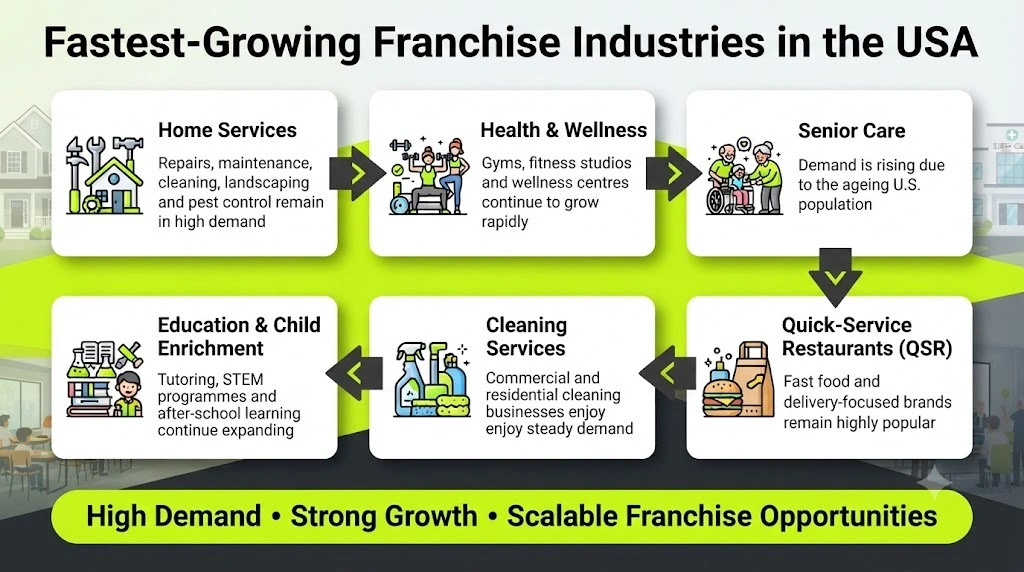
While choosing a well-known brand is important, selecting the right industry can have an even greater impact on long-term success. Consumer preferences, technological advancements, demographic shifts, and changing lifestyles continue to shape which franchise sectors are growing the fastest. Entrepreneurs who invest in expanding industries often benefit from stronger customer demand, higher revenue potential, and better opportunities for long-term growth.
Below are some of the fastest-growing franchise industries in the United States in 2026.
- Home Services: Home service franchises continue to experience strong demand as homeowners invest in property maintenance, repairs, renovations, landscaping, pest control, and cleaning services. Businesses in this sector often benefit from recurring customers and relatively low inventory requirements. Many home service franchises also operate with mobile teams, reducing the need for expensive retail locations.
- Health, Fitness, and Wellness:Growing awareness of physical and mental well-being has increased demand for gyms, fitness studios, recovery centres, personal training, and wellness services. Membership-based businesses also generate recurring monthly revenue, making this industry attractive for long-term investment.
- Senior Care: The ageing U.S. population continues to drive demand for non-medical home care, companionship services, mobility assistance, and senior support programmes. Senior care franchises are expected to remain one of the fastest-growing business categories over the coming years due to favourable demographic trends.
- Quick-Service Restaurants (QSR):Fast-food and quick-service restaurant franchises continue to perform well because of their convenience, strong brand recognition, and widespread customer demand. Digital ordering, delivery platforms, and drive-thru services have further strengthened the industry’s growth potential.
- Commercial and Residential Cleaning: Businesses, healthcare facilities, schools, and homeowners continue to prioritise cleanliness and hygiene. This has created steady demand for commercial cleaning, residential cleaning, and specialised disinfecting services, making cleaning franchises attractive for both first-time and experienced entrepreneurs.
- Education and Child Enrichment: Parents continue to invest in tutoring, STEM education, language learning, and after-school programmes to support their children’s academic development. Education franchises often benefit from recurring enrolments and relatively stable demand throughout the year.
Rather than choosing a franchise based solely on brand popularity, investors should consider industries that are expected to experience sustained demand over the next decade. Combining a growing industry with a strong franchise system significantly improves the chances of building a successful and profitable business.
Low-Cost Franchise Opportunities in the USA Under $50,000
Buying a franchise does not always require a six-figure investment. Many successful franchise brands offer best business opportunities for less than $50,000, making franchising more accessible to first-time entrepreneurs, career changers, and investors with limited capital. These franchises are commonly found in industries such as commercial cleaning, travel services, education, consulting, and home-based businesses.
While lower investment reduces financial risk, it is important to understand that startup cost alone should not determine your decision. You should also evaluate the brand’s reputation, training and support, revenue potential, ongoing fees, and demand in your local market. A lower-cost franchise with steady recurring income may provide better long-term returns than a more expensive business with high operating costs.
The table below highlights some of the popular low-cost franchise opportunities available in the United States.
| Franchise | Estimated Initial Investment | Industry |
| Cruise Planners | $3,000–$24,000 | Travel Services |
| JAN-PRO Cleaning & Disinfecting | $4,800–$58,000* | Commercial Cleaning |
| Kumon | $73,000–$165,000 (Not under $50K but relatively affordable) | Education |
| Dream Vacations | $2,500–$21,500 | Travel Services |
| Jazzercise | $1,500–$38,000 | Fitness |
| Buildingstars | $2,500–$53,000* | Commercial Cleaning |
*Some investment packages may exceed $50,000 depending on the market and business model.
Most franchises under $50,000 are service-based businesses that require little or no retail space. This keeps overhead costs low and allows owners to operate from home or with a small office. However, these businesses often rely heavily on local networking, customer acquisition, and relationship building. Before investing, review the Franchise Disclosure Document (FDD), understand all ongoing fees, and speak with existing franchisees to gain a realistic understanding of revenue potential.
Pros and Cons of Buying a Franchise
Owning a franchise offers several advantages, but it also comes with responsibilities and financial commitments. Understanding both sides of franchise ownership helps you decide whether it aligns with your business goals, investment capacity, and preferred management style.
Advantages
- Established brand recognition: Customers are already familiar with recognised franchise brands, making it easier to attract business and build trust from the beginning.
- Proven operating system: Franchisees receive tested business processes, operational manuals, marketing strategies, and training programmes. This reduces the uncertainty associated with launching a completely new business.
- Ongoing business support: Most franchisors provide continuous guidance through field support, technology platforms, supplier networks, and marketing assistance, helping franchisees improve operations over time.
- Easier access to suppliers: Franchise systems often negotiate bulk purchasing agreements, allowing owners to obtain products, equipment, and supplies at competitive prices.
- Lower startup risk: While every business carries risk, franchises generally have higher survival rates than many independent startups because they operate using established systems and recognised brands.
Disadvantages
- High ongoing fees: Franchisees typically pay royalty fees and contribute to national or regional marketing funds. These recurring expenses reduce the overall profit retained by the owner.
- Limited operational freedom: Owners must follow the franchisor’s standards regarding branding, products, suppliers, store design, and operating procedures. This leaves less flexibility for making independent business decisions.
- Significant upfront investment: Some of the best franchise opportunities in the USA require investments exceeding several hundred thousand dollars, making them inaccessible for many first-time entrepreneurs.
- Contractual obligations: Franchise agreements are legally binding and often span several years. Exiting the business early or transferring ownership may involve restrictions and additional costs.
- Performance depends on execution: Even with a recognised brand, success depends on factors such as location, employee management, customer service, cost control, and local competition.
For many entrepreneurs, the advantages outweigh the disadvantages when they choose the right brand and carefully evaluate the financial commitment. Conducting thorough research before investing is the best way to reduce risk and improve long-term profitability.
Top Franchise Opportunities in USA by Investment Level
Since every entrepreneur has a different budget, comparing franchises based on investment level makes the selection process much easier. The table below categorises some of the best franchises to own in the USA according to their estimated startup investment.
| Investment Level | Franchise Examples | Estimated Initial Investment | Suitable For |
| Under $50,000 | Cruise Planners, Dream Vacations, Jazzercise | Up to $50,000 | First-time entrepreneurs and home-based businesses |
| $50,000–$250,000 | The Maids, Mosquito Joe, Great Clips, Kumon | $50,000–$250,000 | Small business owners with moderate investment budgets |
| $250,000–$750,000 | Anytime Fitness, The UPS Store, SERVPRO | $250,000–$750,000 | Investors looking for scalable businesses with established demand |
| Above $750,000 | McDonald’s, Dunkin’, Ace Hardware, 7-Eleven | $750,000+ | Experienced investors seeking large-scale franchise operations |
Your investment budget should never be the only deciding factor. Consider additional aspects such as ongoing royalty fees, working capital requirements, expected revenue, industry demand, and the amount of time you can dedicate to managing the business.
How to Apply for a Franchise in the USA: A Step-by-Step Guide
Step 1: Decide Your Budget and Investment Capacity
Start by calculating how much you can realistically invest. Don’t just consider the franchise fee—factor in equipment, leasehold improvements, inventory, licences, insurance, employee salaries, marketing, and working capital for the first few months.
Many franchisors also require applicants to meet minimum net worth and liquid capital requirements. Knowing your financial position beforehand helps you narrow down franchises that fit your budget.
Step 2: Research Franchise Opportunities
Once you’ve established your budget, compare franchises operating in industries that interest you. Look beyond brand popularity and evaluate factors such as:
- Initial investment
- Franchise fee
- Royalty charges
- Market demand
- Training and support
- Growth potential
- Average revenue (where available)
Visit the franchisor’s official website and download any available franchise information.
Step 3: Submit an Initial Franchise Enquiry
Most franchisors have an online franchise enquiry form where you’ll provide basic details such as your contact information, location, investment capacity, and business experience.
Submitting an enquiry does not commit you to purchasing the franchise. It simply begins the evaluation process between you and the franchisor.
Step 4: Review the Franchise Disclosure Document (FDD)
After your initial screening, the franchisor will usually provide the Franchise Disclosure Document (FDD).
This is one of the most important documents in the buying process because it contains information about:
- Company history
- Initial investment
- Franchise fees
- Royalty structure
- Legal history
- Franchisee obligations
- Financial Performance Representation (Item 19), if provided
Take your time reviewing the FDD, and consider discussing it with a franchise attorney or financial advisor before making any commitments.
Step 5: Speak with Existing Franchise Owners
One of the best ways to understand a franchise is by talking to people who already operate it.
Ask them about:
- Actual operating costs
- Revenue expectations
- Support from the franchisor
- Daily challenges
- Staffing issues
- Profitability
- Whether they would invest in the franchise again
These conversations often provide practical insights that aren’t obvious from marketing materials alone.
Step 6: Attend Discovery Day
Many established franchise brands invite shortlisted candidates to a Discovery Day.
This is an opportunity to meet the leadership team, tour the corporate office or training centre, understand daily operations, and ask detailed questions about the business. It also allows the franchisor to evaluate whether you’re a good fit for their network.
Step 7: Secure Financing and Sign the Agreement
Once both parties decide to move forward, you’ll finalise financing, sign the franchise agreement, and pay the required franchise fee.
Depending on the franchise, financing may come from personal savings, bank loans, SBA-backed loans, or approved lending partners recommended by the franchisor.
Step 8: Complete Training and Launch Your Business
Before opening your business, you’ll typically complete the franchisor’s training programme. This covers operations, customer service, technology systems, marketing, inventory management system, and other day-to-day responsibilities.
After training, the franchisor assists with store setup, equipment installation, marketing, and the grand opening, helping you launch the business according to brand standards.
Following these steps carefully will help you choose a franchise that matches your financial goals and reduce the chances of making a costly investment decision.
Common Mistakes First-Time Franchise Buyers Make
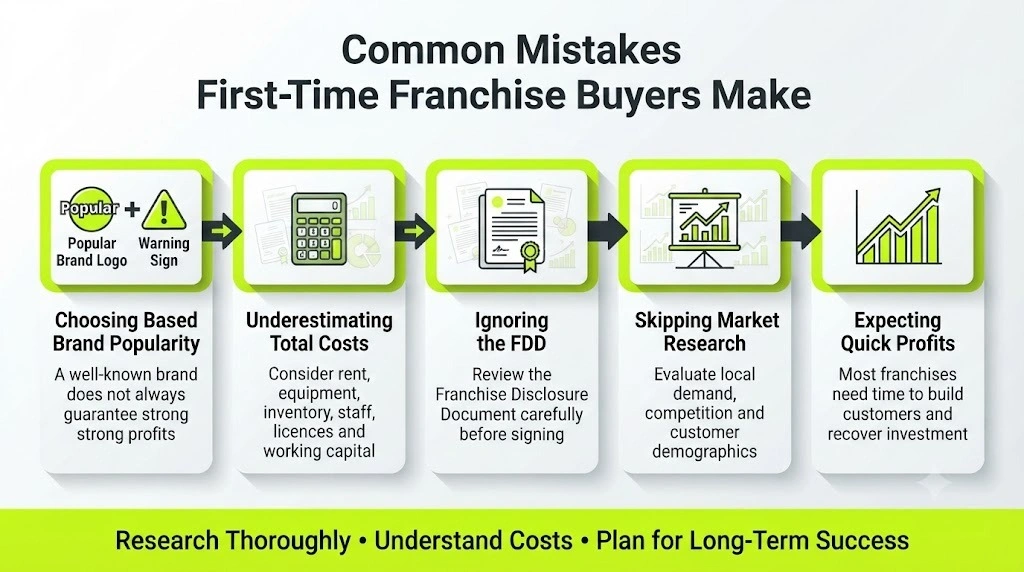
Buying a franchise is a significant financial commitment, and many first-time investors make avoidable mistakes by focusing only on the brand name or expected revenue. Even well-known franchises require careful planning, strong financial management, and realistic expectations to succeed.
Understanding these common mistakes can help you make a more informed investment decision.
- Choosing a Brand Based Only on Popularity: A famous brand may attract customers, but it isn’t automatically the best investment. Some well-known franchises require high operating costs, significant staffing, or expensive real estate, which can reduce profitability. Always evaluate the complete financial picture rather than relying on brand recognition alone.
- Underestimating the Total Investment: Many buyers focus only on the advertised franchise fee and overlook additional expenses such as equipment, inventory, leasehold improvements, insurance, licences, payroll, utilities, and working capital. These costs can significantly increase the actual investment required to start the business.
- Not Reading the FDD Carefully: The Franchise Disclosure Document contains essential information about fees, legal history, obligations, renewal terms, and financial performance. Skimming through this document without fully understanding its contents can lead to unexpected financial or operational challenges later.
- Ignoring Local Market Research: A franchise that performs well in one city may struggle in another due to competition, demographics, or consumer demand. Analysing the local market before investing helps determine whether the business has realistic growth potential in your chosen location.
- Overestimating Profit Expectations: Some new franchisees expect immediate profits because they’re buying an established brand. In reality, businesses often require time to build a loyal customer base, optimise operations, and recover the initial investment. Setting realistic financial expectations is essential.
Conclusion
Finding the best franchise to own in USA is not about choosing the biggest or most recognisable brand. The right franchise is one that aligns with your investment budget, business experience, lifestyle, and long-term financial goals. A well-researched decision can significantly improve your chances of building a profitable and sustainable business.
Before investing, compare the total startup cost, franchise fee, royalty structure, expected revenue, profit margins, and the level of support offered by the franchisor. Equally important is reviewing the Franchise Disclosure Document (FDD), speaking with existing franchisees, and analysing demand in your target market. These steps provide a much clearer picture of the opportunity than marketing materials alone.
Whether you’re looking for a low-cost home-based business or a large-scale franchise with national recognition, there are opportunities available across industries such as food service, fitness, education, home services, healthcare, and retail. By carefully evaluating each option and choosing a franchise that fits your goals, you’ll be in a stronger position to achieve long-term business success in 2026 and beyond.
Frequently Asked Questions
1. Which is the Best Franchise to Own in USA in 2026?
There isn’t a single franchise that’s best for everyone. The ideal choice depends on your investment budget, experience, and business goals. Brands such as McDonald’s, Dunkin’, The UPS Store, Anytime Fitness, and SERVPRO are popular choices due to their established business models and strong market presence.
2. How Much Money do I Need to Start a Franchise in the USA?
Startup costs vary widely depending on the franchise. Some home-based franchises can be started for less than $10,000, while large restaurant or retail franchises may require investments exceeding $1 million. Always review the latest Franchise Disclosure Document for accurate investment figures.
3. Are Franchises More Successful than Independent Businesses?
Franchises often have higher success rates because they operate using proven business systems, recognised brands, and ongoing support. However, success still depends on effective management, customer service, financial planning, and local market demand.
4. What is the Franchise Disclosure Document (FDD)?
The Franchise Disclosure Document (FDD) is a legal document that franchisors must provide to prospective franchisees. It outlines important information such as investment costs, franchise fees, royalty payments, legal history, obligations, and, in some cases, financial performance data.
5. Can I Own More Than One Franchise?
Yes. Many successful franchisees own multiple locations or invest in different franchise brands over time. Multi-unit ownership is common among experienced investors who have the financial resources and management systems to operate several businesses efficiently.