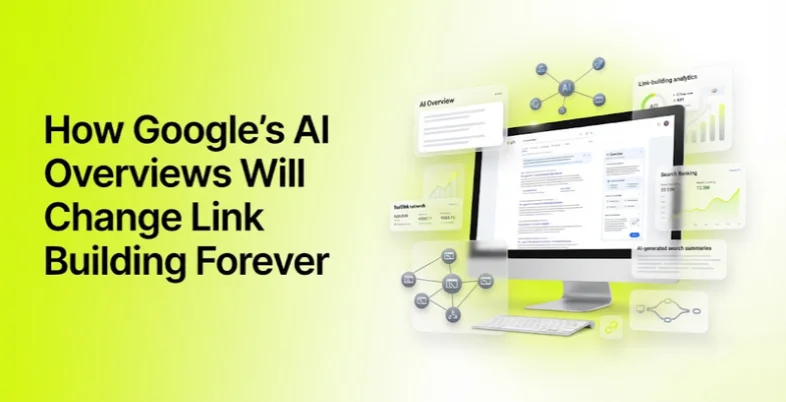
For years, link building has often been treated as a route to higher search rankings: earn links from relevant sites, improve a page’s authority and attract more visitors. Google’s AI Overviews are changing what businesses should expect from that effort. Understanding how Google’s AI Overviews will change link building forever means looking beyond rankings and asking whether your business is a source that search systems can understand, trust and cite.
AI Overviews provide an AI-generated response to some searches, drawing on information from web pages and showing links to sources. Their appearance can affect how people discover websites, but it does not make every search result or organic click disappear. The practical shift is that a link may support visibility in more than one way: by helping a page compete in conventional results, by bringing referral traffic directly, and by contributing to the broader reputation of a business or expert.
From Collecting Links to Earning Useful Recognition
A large number of links is not, by itself, a sound strategy. Links from unrelated sites, low-value directories or pages created mainly to manipulate rankings may do little for a business and can waste time. A stronger approach is to earn mentions and links from sources that make sense to real readers: trade publications, professional bodies, local organisations, specialist blogs and partners with relevant audiences.
That kind of recognition gives people a reason to follow a link even if an AI summary answers part of their question. A supplier quoted in a trade article, for instance, can gain credibility with prospective customers who want to check the source, compare options or speak to an expert. The link has value beyond its effect on a search algorithm.
Businesses should also make the pages they hope others will cite genuinely helpful. Original research, clear explanations, detailed case studies and practical guides are more reference-worthy than thin pages built around repeated keywords. Explain methods and limitations, identify who is responsible for the information, and keep important details current. For claims that could influence a financial, legal or health decision, accuracy and evidence matter especially.
Build Visibility for Specific Questions
AI-generated answers are often prompted by detailed questions rather than a broad product search. A potential customer might ask how a service works, what it costs, or which option suits a particular situation. Businesses can prepare by identifying the questions customers actually ask and answering them directly, using plain language and a structure that is easy to follow.
That does not mean writing pages to imitate an AI response. It means making useful information accessible: define specialist terms, separate distinct topics with clear headings, and support important claims with evidence. Where a page offers a comparison or recommendation, state the criteria behind it. A reader should be able to understand the answer without having to decode marketing language.
Links remain part of this picture, but relevance matters. A link from a respected source in the same field is more likely to send interested visitors than a link placed on an unrelated page. Businesses should assess potential link opportunities by asking who reads the source, whether the context is genuine, and whether the destination page will help those readers.
Local and Independent Businesses Need a Wider Footprint
For a UK business serving a particular town or region, accurate location details can help customers decide whether a service is relevant. Keep the business name, service area, contact information and opening details consistent across the places where people look. Local partnerships, community news and useful regional information can also create legitimate opportunities for discovery and referral links.
The same principle applies to freelancers, whose visibility depends on making their expertise easy to find and assess. On a marketplace such as Osdire, a complete profile with a clear location can help prospective buyers understand where a freelancer is based and whether they are a good fit. Its guidance on adding a location to an Osdire profile explains how that detail can improve profile visibility. Location is not a substitute for a strong portfolio, but it can add useful context when buyers are comparing candidates.
Measure the Results that Matter
Search visibility is harder to judge through rankings alone when an AI answer occupies part of the results page. Monitor referral visits, enquiries, leads and conversions alongside organic impressions and clicks. If a high-quality mention sends relevant visitors who become customers, it may be worthwhile even when its effect on a particular ranking is difficult to isolate.
It is also sensible to review the quality of links rather than pursue a target number. Record which pages attract genuine references, which sources send engaged visitors, and which content leads to enquiries. Avoid buying placements that promise guaranteed rankings or relying on bulk outreach with identical messages. Sustainable link building is rooted in useful work and real relationships.
Adapt the Purpose, Not the Principles
Google’s AI Overviews may change where people encounter information and how often they click through, but they do not remove the need for trustworthy sources. Businesses that publish clear, distinctive material and earn relevant recognition will be better placed to serve both searchers and potential partners. Treat links as evidence of useful connections, not as a score to inflate, and link building can remain a meaningful part of a broader visibility strategy.