
Have you ever imagined owning those iconic Golden Arches? Picture families walking into your restaurant, enjoying a Happy Meal or biting into a delicious McSpicy Paneer Burger. For decades, owning a McDonald’s franchise has been seen as a symbol of business success—and it’s easy to understand why.
But turning that dream into reality requires a significant investment and a clear understanding of the franchise process. If you’ve been wondering about the McDonalds franchise cost in India, you’re in the right place.
McDonald’s serves nearly 69 million customers every day across the globe. In India, the brand continues to expand rapidly, with an estimated 580–630 outlets expected by 2027. At the same time, the Indian quick service restaurant (QSR) industry is growing at an impressive pace, with a projected CAGR of over 18% in the coming years. This strong market growth, combined with McDonald’s trusted brand value, makes the McDonalds franchise cost in India one of the most searched and potentially rewarding business investments in 2026.
In this guide, we’ll break down everything you need to know—from the total investment required in 2026 to the application process, eligibility criteria, and key factors that can influence your profitability. By the end, you’ll have a clear understanding of whether a McDonald’s franchise is the right investment for you.
McDonalds Franchise Cost in India: Quick Summary
A McDonald’s franchise in India is a premium business opportunity backed by one of the world’s most recognised fast-food brands. While the investment required is substantial, franchise owners benefit from a proven business model, strong brand recognition, nationwide customer trust, and comprehensive operational support.
The total cost includes franchise fees, restaurant setup, equipment, interiors, staffing, inventory, and ongoing operational expenses, which vary depending on the outlet type and location. Success depends on selecting the right location, maintaining high service standards, managing costs effectively, and complying with McDonald’s operational guidelines. The company also provides extensive training, marketing support, and continuous business assistance to franchise partners.
Although profitability is influenced by factors such as customer footfall, competition, and operational efficiency, McDonald’s remains one of the most reliable franchise investments in India’s quick-service restaurant industry. Investors with adequate financial resources and a long-term business vision can achieve sustainable growth and attractive returns through a well-managed McDonald’s franchise.
McDonald’s In India - History, Growth, And Current Status (2026)
History
McDonald’s entered the Indian market in 1996 by opening its first restaurant in New Delhi. Recognising India’s diverse food preferences, the company adapted its global menu to local tastes by introducing vegetarian options and removing beef and pork from its offerings.
Over the years, McDonald’s established separate regional franchise partners to manage operations in North, East, South, and West India.
The brand focused on affordability, consistent quality, and family-friendly dining experiences, helping it gain widespread popularity among Indian consumers. Continuous innovation in menu offerings and digital services has strengthened its position in India’s quick-service restaurant industry.
Growth
- Expanded from a single outlet in 1996 to hundreds of restaurants across major cities and emerging urban markets.
- Introduced localized menu items such as McAloo Tikki, McSpicy Paneer, and Maharaja Mac to suit Indian tastes.
- Strengthened digital ordering through mobile apps, self-order kiosks, and food delivery partnerships.
- Invested in modern restaurant formats, including drive-thrus, McCafés, and compact urban outlets.
- Created thousands of direct and indirect employment opportunities across restaurant operations and supply chain networks.
- Increased sourcing from Indian suppliers, supporting local agriculture and manufacturing while maintaining global quality standards.
- Continued expanding into Tier-2 and Tier-3 cities to reach a broader customer base.
Current Status (2026)
As of 2026, McDonald’s remains one of India’s leading quick-service restaurant brands, operating hundreds of outlets across the country. The company continues to expand through franchise partnerships while investing in digital technology, sustainability initiatives, and customer experience improvements.
Its menu regularly evolves to meet changing consumer preferences, including healthier choices, premium burgers, and value meals. McDonald’s also focuses on eco-friendly packaging, faster delivery services, and technology-driven restaurant operations, reinforcing its strong presence in India’s highly competitive fast-food market.
McDonald’s Business Model In India – How It Actually Works
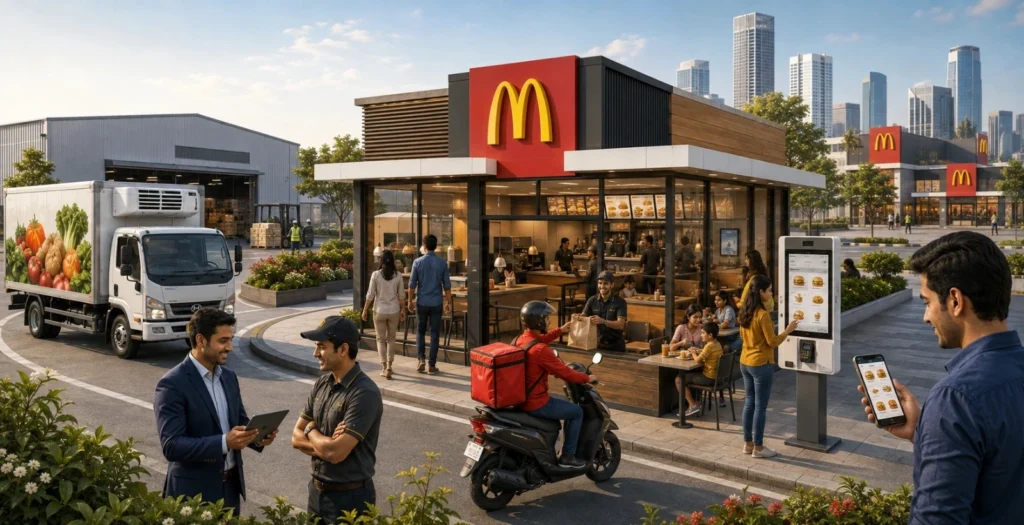
McDonald’s operates through a carefully structured business model that combines franchising, company support, localised operations, and strong supply chain management. Rather than directly owning every restaurant, the company collaborates with authorised partners while maintaining strict standards for quality, customer service, and operational efficiency.
Franchise Business Model
The franchise model is the foundation of McDonald’s expansion in India. Independent business partners invest in and operate restaurants under the McDonald’s brand while following its global operating standards.
How it works:
- Franchisees invest in setting up and operating restaurants.
- McDonald’s provides brand rights and operational guidelines.
- Franchisees pay franchise fees and ongoing royalties.
- Restaurants follow standardised menus and quality controls.
- McDonald’s offers continuous training and business support.
Master Franchise Model
Instead of managing every outlet directly, McDonald’s appoints regional master franchise partners responsible for developing and operating restaurants within specific territories in India.
How it works:
- A regional partner manages multiple outlets.
- The partner oversees expansion within its territory.
- It handles recruitment, operations, and local management.
- Regional teams ensure compliance with McDonald’s standards.
- The model enables faster business expansion.
Company Support Model
Although franchisees manage day-to-day operations, McDonald’s provides extensive support to ensure every restaurant delivers a consistent customer experience.
How it works:
- Employee training programs are provided.
- Marketing campaigns are managed nationally.
- Operational manuals and systems are supplied.
- Technology platforms are regularly updated.
- Continuous performance monitoring is conducted.
Localised Menu Model
McDonald’s adapts its products to Indian tastes while maintaining its global brand identity, making the menu relevant to local customers.
How it works:
- Vegetarian and chicken-based menus are emphasised.
- Beef and pork products are excluded.
- Indian-inspired burgers and snacks are introduced.
- Regional preferences influence product development.
- New menu items are tested before nationwide launch.
Supply Chain Model
McDonald’s works with approved Indian suppliers to maintain product quality, freshness, and consistency across all restaurants.
How it works:
- Raw materials are sourced from certified suppliers.
- Quality inspections are performed regularly.
- Cold-chain logistics preserve food freshness.
- Standardised ingredients are supplied nationwide.
- Inventory is centrally coordinated for efficiency.
Digital and Delivery Model
Technology plays a major role in McDonald’s operations by making ordering faster and improving customer convenience.
How it works:
- Customers order through the McDonald’s app.
- Online payments are securely processed.
- Self-order kiosks reduce waiting time.
- Delivery is supported through online platforms.
- Loyalty programs encourage repeat customers.
Revenue Model
McDonald’s generates revenue through multiple income streams instead of relying only on food sales.
How it works:
- Franchise fees generate recurring income.
- Royalties are collected from franchisees.
- Food and beverage sales contribute to revenue.
- Delivery and digital channels increase sales.
- Promotional campaigns boost customer spending.
Expansion Model
McDonald’s follows a long-term expansion strategy by opening restaurants in high-potential locations across metropolitan and emerging cities.
How it works:
- Market demand is carefully evaluated.
- High-footfall locations are prioritised.
- Drive-thru and McCafé formats are expanded.
- Tier-2 and Tier-3 cities receive increasing focus.
- Franchise partners support sustainable growth.
McDonald’s Outlet Formats In India
McDonald’s operates multiple restaurant formats in India to serve customers with different dining preferences, location requirements, and convenience needs. Each outlet format is designed to maximise customer experience while expanding the brand’s reach across urban and emerging markets.
Standalone Restaurant
A standalone restaurant is the traditional McDonald’s outlet located in busy commercial areas, residential neighborhoods, or shopping districts. These outlets offer complete dine-in facilities along with takeaway and delivery services. They typically feature the full McDonald’s menu, spacious seating, self-order kiosks, and dedicated customer service areas. Standalone restaurants are ideal for families, groups, and individuals looking for a complete dining experience.
Drive-Thru Outlet
Drive-thru restaurants are designed for customers who prefer ordering and collecting food without leaving their vehicles. These outlets are commonly located along highways, major roads, and busy city routes. Customers place their orders through an intercom system, make payments at designated counters, and receive their meals quickly. This format focuses on speed, convenience, and efficient service.
McCafé
McCafé is McDonald’s premium café concept that offers a wide selection of coffee, tea, desserts, pastries, and snacks alongside selected McDonald’s menu items. These outlets provide a relaxed atmosphere suitable for meetings, casual conversations, or individual work sessions. McCafé appeals to customers looking for high-quality beverages and light refreshments in a modern café environment.
Mall Food Court Outlet
Mall food court outlets operate within shopping malls and entertainment complexes where customer traffic is consistently high. These restaurants primarily focus on takeaway and quick service, although customers can use shared seating available in the food court. Their compact design allows efficient operations while serving shoppers, office workers, and visitors throughout the day.
Airport Outlet
Airport McDonald’s restaurants are located inside domestic and international airport terminals to serve travelers seeking quick, affordable meals before or after their journeys. These outlets generally operate for extended hours and provide fast service while maintaining the same food quality and menu standards expected from the McDonald’s brand.
Express or Compact Outlet
Express outlets are smaller-format restaurants established in locations with limited space, such as metro stations, educational institutions, office complexes, hospitals, and transport hubs. These outlets usually offer a selected menu featuring the brand’s most popular products, ensuring quick preparation and efficient customer service for people on the move.
Delivery-Focused Outlet (Cloud Kitchen)
In selected markets, McDonald’s also operates delivery-focused kitchens that primarily prepare food for online orders placed through the McDonald’s app and food delivery platforms. These facilities have minimal or no customer seating and are strategically located to improve delivery speed, expand service coverage, and meet growing demand for online food ordering.
Mcdonalds Franchise Cost In India – Full Investment Breakdown
Planning your investment carefully is essential before pursuing a McDonald’s business opportunity. However, it is important to note that McDonald’s is not currently accepting new franchise or sub-franchise applications in India. The brand operates through regional master licensees rather than offering direct individual franchises. Any investment figures below represent the estimated capital required to establish a McDonald’s restaurant of a comparable scale and are provided for informational purposes only.
| Investment Component | Estimated Cost (₹) |
| Franchise / Development Rights | Not Open for Individual Applications |
| Restaurant Setup & Interiors | ₹2–4 Crores |
| Kitchen Equipment & Machinery | ₹1–2 Crores |
| Initial Inventory | ₹20–40 Lakhs |
| Licenses & Registrations | ₹10–25 Lakhs |
| Working Capital | ₹50 Lakhs–₹1 Crore |
| Total Estimated Investment | ₹4–8 Crores |
McDonald’s India currently operates through authorized regional companies and is not accepting new individual franchise applications. Interested investors should rely only on official McDonald’s India announcements and beware of fraudulent franchise offers.
Ongoing Monthly Costs And Fees (What You Pay Every Month After Opening)
Opening a McDonald’s restaurant is only the beginning of the investment journey. After operations start, restaurant operators incur several recurring monthly expenses to ensure smooth business operations, maintain quality standards, and deliver a consistent customer experience. These costs vary depending on the outlet’s size, location, sales volume, and staffing requirements.
| Expense Category | Estimated Monthly Cost (₹) |
| Employee Salaries & Benefits | ₹8–25 Lakhs |
| Rent or Lease Payments | ₹5–30 Lakhs |
| Raw Materials & Inventory | ₹15–50 Lakhs |
| Utilities (Electricity, Water, Internet, Gas) | ₹2–8 Lakhs |
| Equipment Maintenance | ₹1–3 Lakhs |
| Marketing & Local Promotions | ₹1–5 Lakhs |
| Cleaning, Security & Housekeeping | ₹1–4 Lakhs |
| Technology & POS System Maintenance | ₹50,000–2 Lakhs |
| Miscellaneous Operating Expenses | ₹1–3 Lakhs |
Apart from these operational expenses, McDonald’s authorised operators also contribute toward royalty, brand support, and other contractual obligations as specified in their licensing agreements. Since McDonald’s currently operates in India through regional master licensees rather than offering direct individual franchises, the exact fee structure is governed by agreements with the authorised operating company.
McDonald’s Franchise Profit And ROI In India
Since McDonald’s does not currently offer individual franchise opportunities in India and operates through regional master franchisees, exact unit-level financial figures are not publicly disclosed. The estimates below reflect the typical financial performance of a large quick-service restaurant (QSR) outlet operating under the McDonald’s business model and should be treated as indicative rather than official.
| Financial Metric | Estimated Value (2026) |
| Average Gross Profit Margin | 60–70% |
| Average Net Profit Margin | 10–18% |
| Expected Monthly Revenue | ₹35 Lakhs–₹1 Crore+ |
| Estimated Monthly Net Profit | ₹3 Lakhs–₹15 Lakhs |
| Typical ROI Period | 5–8 Years |
| Break-even Timeline | 3–5 Years |
| Profit Drivers | Strong brand recognition, premium locations, high customer footfall, delivery sales, operational efficiency |
| Key Business Risks | High capital investment, rising labour costs, raw material inflation, expensive rentals, increasing QSR competition |
Explore More Franchise Option:
Eligibility Criteria To Own A McDonald’s In India
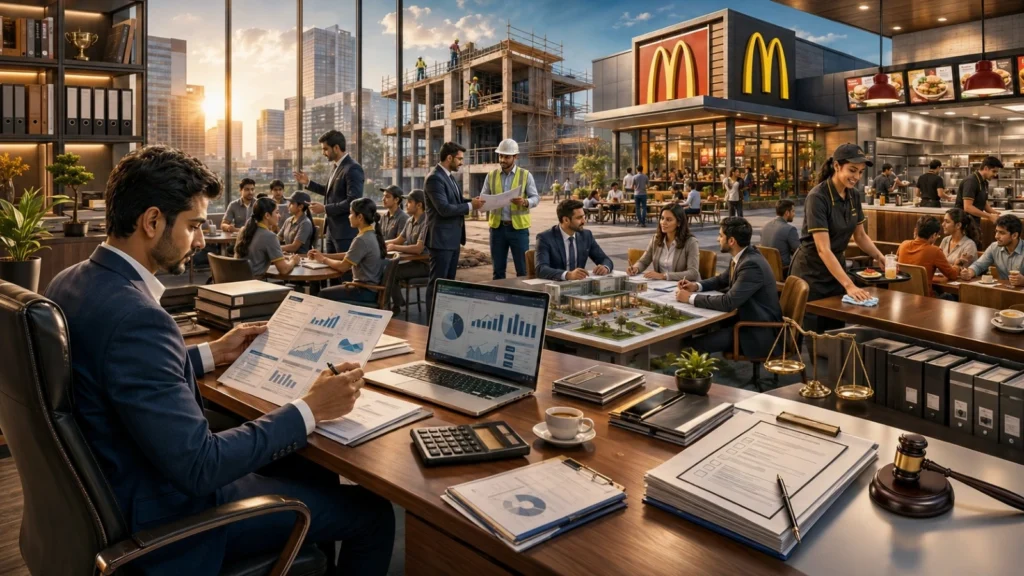
Owning a McDonald’s business in India requires meeting strict financial, operational, and business standards. The company carefully selects qualified partners capable of maintaining its global quality and service expectations.
- Strong Financial Capacity: Applicants must demonstrate substantial financial resources to support the high investment required for establishing and operating a McDonald’s restaurant.
- Proven Business Experience: Preference is given to individuals or organisations with successful experience in managing businesses, particularly in retail, hospitality, food service, or related industries.
- Leadership and Management Skills: Potential operators should possess strong leadership, decision-making, team management, and operational skills to efficiently run restaurant operations.
- Long-Term Business Commitment: McDonald’s looks for partners who are committed to growing the business over the long term rather than seeking short-term financial returns.
- Ability to Follow Brand Standards: Operators must strictly comply with McDonald’s global standards for food quality, customer service, hygiene, safety, and restaurant operations.
- Willingness to Complete Training: Selected partners are required to undergo comprehensive operational and management training provided by McDonald’s before managing restaurant operations.
- Suitable Business Location: The proposed restaurant location must meet McDonald’s site selection criteria, including accessibility, customer demand, visibility, and commercial viability.
- Legal and Regulatory Compliance: Applicants must comply with all applicable business regulations, taxation requirements, licensing norms, and other statutory obligations in India.
- Regional Operating Structure: Currently, McDonald’s operates in India through regional master licensees rather than offering direct individual franchises. Any future ownership opportunities are subject to the company’s official business model and partner selection process.
Documents Required To Apply
Preparing the required documents in advance helps simplify the evaluation process if McDonald’s invites applications for new business partners in the future. Since McDonald’s currently operates in India through regional master licensees rather than offering direct individual franchises, documentation requirements may vary depending on the operating partner and business structure.
- Identity Proof: Valid government-issued identification such as an Aadhaar Card, PAN Card, Passport, or Driving Licence for identity verification.
- Address Proof: Recent utility bill, Passport, Aadhaar Card, Voter ID, or any other government-approved document confirming your residential or business address.
- PAN Card: A valid PAN Card is required for taxation, financial verification, and business documentation.
- Financial Documents: Bank statements, income tax returns, net worth certificates, audited financial statements, and proof of investment capability demonstrating sufficient financial resources.
- Business Entity Documents: If applying through a company, LLP, or partnership firm, provide incorporation certificates, GST registration, PAN, partnership deed, and other applicable business registrations.
- Property Documents: Ownership documents or a lease agreement for the proposed restaurant location, if already identified, along with site details and commercial approvals where applicable.
- Passport-Size Photographs: Recent passport-size photographs of all primary applicants or authorised business representatives.
- Business Experience Documents: Records of previous business ownership, management experience, or hospitality and retail operations may strengthen your application.
- Additional Supporting Documents: McDonald’s or its authorised regional operating partner may request further documentation depending on the applicant’s financial profile, business experience, and proposed restaurant location during the evaluation process.
How To Apply For A McDonald’s Franchise In India – Step-By-Step Process
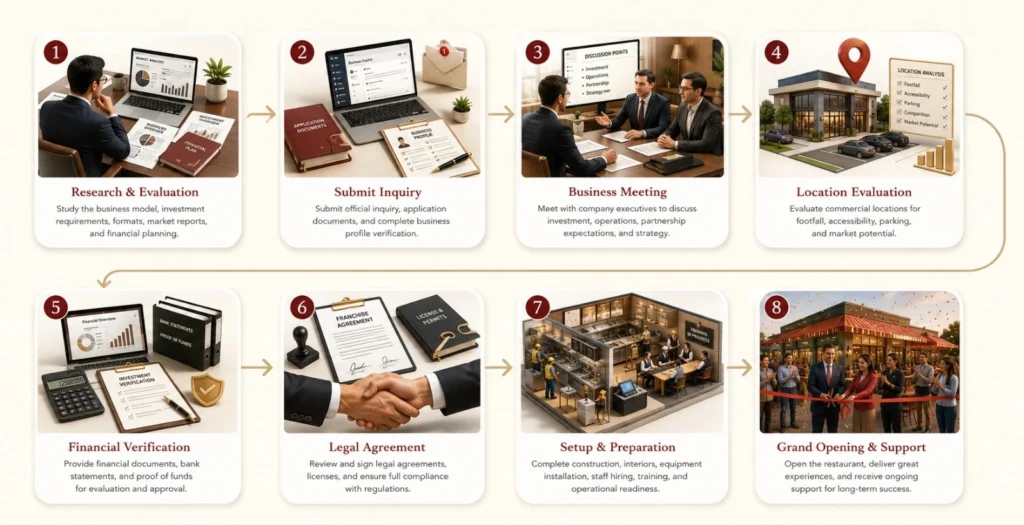
McDonald’s currently operates in India through authorised regional master licensees rather than offering direct individual franchises. If the company opens opportunities for new business partners, the application process is expected to involve detailed evaluation, financial verification, and operational planning. Following each step carefully improves your chances of qualifying as a potential business partner.
Step 1. Research the Business Model
Understand McDonald’s business structure, investment requirements, operational standards, restaurant formats, financial commitment, and long-term responsibilities before expressing your interest.
Step 2. Submit an Official Inquiry
Contact McDonald’s India or the relevant regional operating company through official communication channels and provide accurate personal, financial, and business information for preliminary evaluation.
Step 3. Attend the Initial Discussion
Participate in meetings with the company’s representatives to understand investment expectations, restaurant operations, business policies, contractual obligations, and partnership requirements.
Step 4. Site Selection and Location Evaluation
Identify a suitable commercial location or work with the company during site evaluation. Factors such as visibility, accessibility, customer footfall, demographics, parking, and business potential are carefully assessed.
Step 5. Financial Verification
Demonstrate adequate financial capacity by submitting proof of funds, bank statements, financial records, and other documents required to support the proposed investment.
Step 6. Complete Due Diligence and Agreement
Review all contractual terms, operational obligations, licensing conditions, and financial commitments before signing the formal business agreement with the authorized operating company.
Step 7. Restaurant Setup and Training
Complete restaurant construction, interior design, kitchen installation, technology setup, staff recruitment, and mandatory management training according to McDonald’s global operating standards.
Step 8. Final Inspection and Business Launch
Following successful inspections, operational approvals, and staff readiness, the restaurant begins operations with marketing support, standardised processes, and ongoing business guidance from the McDonald’s operating partner.
McDonald’s Franchise Vs Other Fast Food Brands – Full Comparison
Choosing the right fast-food franchise requires evaluating investment requirements, brand strength, customer demand, profitability, and long-term growth potential. The comparison below highlights how McDonald’s compares with other leading quick-service restaurant (QSR) brands in India.
| Factor | McDonald’s | KFC | Burger King | Subway |
| Brand Positioning | Global quick-service restaurant leader | Premium fried chicken brand | Value-focused burger chain | Healthy sandwich and salad brand |
| Estimated Investment | ₹4–8 Crores | ₹2–5 Crores | ₹2–5 Crores | ₹80 Lakhs–₹2 Crores |
| Product USP | Burgers, fries, beverages, localised menu | Signature fried chicken and wraps | Flame-grilled burgers | Fresh, customizable sandwiches |
| Target Customers | Families, students, professionals | Chicken lovers, families, young adults | Budget-conscious youth and families | Health-conscious consumers and office professionals |
| Store Format | Standalone restaurants, drive-thrus, McCafés, mall outlets | Standalone outlets, food courts, drive-thrus | Standalone restaurants, mall outlets | Restaurants, kiosks, food court outlets |
| Brand Recognition | Extremely high worldwide | Very High globally | High international recognition | Strong international presence |
| Business Scalability | Very High | High | High | Moderate to High |
| Best Suited for | Large-scale investors seeking long-term growth | Investors targeting premium QSR market | Entrepreneurs seeking a global burger brand | Investors targeting healthy fast-food customers |
McDonald’s currently operates in India through regional master licensees rather than offering direct individual franchises. Investment figures are indicative of operating a restaurant under the McDonald’s business model.
Challenges And Risks Of Owning A McDonald’s In India
Every large-scale restaurant investment involves both opportunities and risks. Understanding these challenges before investing helps entrepreneurs prepare realistic financial plans, manage operations efficiently, and make informed long-term business decisions.
- High Initial Investment: Establishing a McDonald’s restaurant requires significant capital for setup, equipment, interiors, technology, staffing, and working capital, making financial planning essential.
- Premium Location Costs: Successful McDonald’s outlets typically require high-footfall commercial locations where rentals, lease deposits, and property costs can be substantial.
- High Operating Expenses: Employee salaries, utilities, raw materials, maintenance, technology systems, and restaurant upkeep contribute to considerable recurring operational costs.
- Intense Market Competition: McDonald’s competes with international QSR brands, regional fast-food chains, cafés, cloud kitchens, and local restaurants for customer attention.
- Strict Brand Compliance: Operators must follow McDonald’s global standards for food quality, hygiene, service, operations, branding, and customer experience with very limited flexibility.
- Supply Chain Dependence: Restaurant operations rely on approved suppliers and standardised ingredients, making efficient inventory management and timely procurement extremely important.
- Changing Consumer Preferences: Growing demand for healthier food, sustainable packaging, and evolving dining habits requires continuous menu innovation and operational adaptation.
- Profitability Depends on Execution: Revenue and return on investment vary based on location quality, customer footfall, operational efficiency, cost control, staff performance, and effective restaurant management.
Top McDonald’s India Trends to Watch in 2026
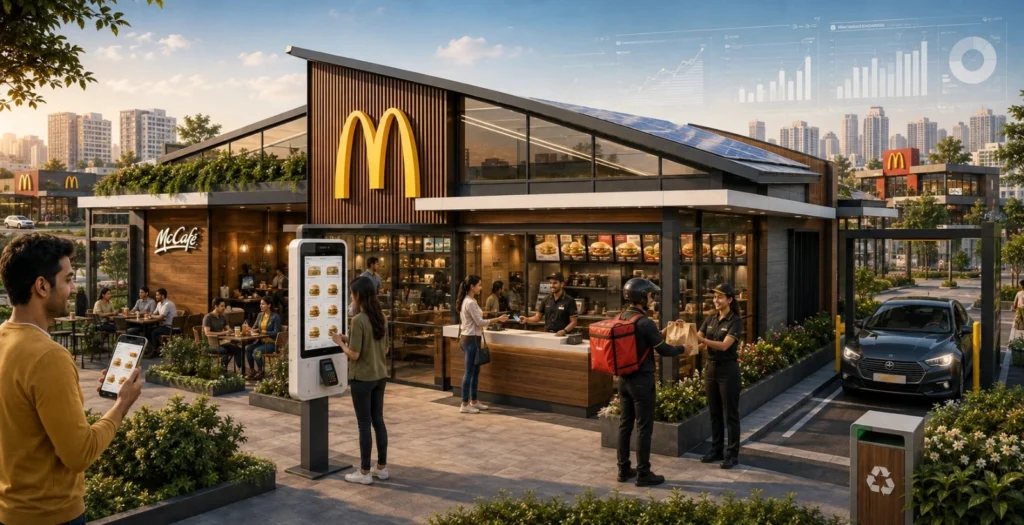
The quick-service restaurant (QSR) industry in India is evolving rapidly, and McDonald’s continues to adapt by embracing new technologies, changing consumer preferences, and sustainable business practices. These trends are shaping the brand’s growth strategy and customer experience in 2026.
- Digital Ordering and Mobile Apps: Customers increasingly prefer ordering through the McDonald’s mobile app, self-service kiosks, and online delivery platforms, making digital convenience a major growth driver.
- Expansion into Tier-2 and Tier-3 Cities: McDonald’s is expanding beyond metropolitan areas to capture growing demand in emerging cities with rising disposable incomes and changing lifestyles.
- Growth of Drive-Thru Restaurants: Drive-thru outlets continue to expand due to increasing vehicle ownership and customer demand for faster, more convenient dining experiences.
- Delivery-First Business Strategy: Online food delivery remains a key revenue source, with partnerships and app-based ordering contributing significantly to restaurant sales.
- Healthier and Localised Menu Options: The company continues introducing healthier choices, vegetarian products, region-specific flavours, and limited-time offerings to meet evolving customer preferences.
- Sustainability Initiatives: McDonald’s is focusing on eco-friendly packaging, waste reduction, responsible sourcing, and energy-efficient restaurant operations to support environmental sustainability.
- Technology-Driven Restaurant Operations: Artificial intelligence, data analytics, automated kitchen systems, and digital inventory management are improving operational efficiency and customer satisfaction.
Is McDonald’s Franchise Profitable in India? Final Verdict
A McDonald’s franchise can be a profitable business opportunity in India for investors with sufficient capital, long-term commitment, and strong operational capabilities. The brand’s widespread popularity, proven business model, loyal customer base, and continuous demand for quick-service restaurants contribute to its growth potential.
However, profitability depends on factors such as location, customer footfall, operating efficiency, staff management, and adherence to brand standards. Since the investment requirement is substantial, prospective franchisees should carefully evaluate financial commitments, expected returns, and market conditions before investing. With proper planning and execution, a McDonald’s franchise offers strong long-term business potential.