

The Anytime Fitness franchise is one of the biggest factors entrepreneurs consider before entering the fitness industry. With the health and wellness market continuing to grow, investing in a globally recognised gym brand has become an attractive option for many business owners seeking profitable business opportunities. However, owning a successful fitness franchise requires more than just paying the franchise fee. You also need to understand the total investment, recurring charges, operational costs, revenue potential, and the level of support provided by the franchisor.
Founded in 2002, Anytime Fitness has expanded into one of the world’s largest 24/7 gym chains, operating thousands of clubs across multiple countries. The brand is known for its convenient access model, technology-driven member experience, and relatively smaller club footprint compared to many traditional gyms. These factors have helped it attract a broad customer base ranging from working professionals to fitness enthusiasts.
This guide covers everything you need to know about the Anytime Fitness franchise cost in 2026. You’ll learn about the complete investment breakdown, monthly fees, financial eligibility requirements, expected revenue, profit margins, break-even period, franchise agreement terms, and the support provided to franchise owners. We also compare Anytime Fitness with other leading gym franchises to help you determine whether it is the right investment for your business goals.
Anytime Fitness Brand Overview: Why It Is One of the World’s Largest Fitness Franchises

Anytime Fitness is an international fitness franchise that operates 24 hours a day, 365 days a year, giving members the flexibility to work out whenever it suits their schedule. The brand was founded in 2002 in Minnesota, United States, by Chuck Runyon, Dave Mortensen, and Jeff Klinger. Over the past two decades, it has grown from a single gym concept into one of the largest fitness franchise networks in the world.
Today, Anytime Fitness operates more than 5,500 gyms across over 40 countries and territories, serving millions of members worldwide. The company is part of Self Esteem Brands, a health and wellness group that also owns several other fitness and wellness businesses. This strong parent company provides franchisees with operational expertise, technology, and business support that help maintain consistent standards across locations.
One of the biggest reasons behind the brand’s success is its business model. Unlike large commercial gyms that require significant floor space and extensive staffing, Anytime Fitness clubs are designed to operate efficiently with a comparatively smaller footprint. Members receive secure key-fob or mobile app access, allowing them to use the gym at any time while reducing operational costs for franchise owners.
For entrepreneurs evaluating the Anytime Fitness franchise cost, the brand’s established reputation, international presence, scalable business model, and comprehensive franchise support make it one of the most recognised names in the global fitness franchise industry. While success ultimately depends on factors such as location, competition, membership growth, and operational efficiency, investing in a well-established franchise can reduce many of the challenges associated with launching an independent gym.
Anytime Fitness Franchise at a Glance: Key Facts You Should Know Before Investing
Anytime Fitness follows a membership-based business model, where recurring monthly memberships form the primary source of revenue. Franchisees can further increase their income by offering personal training sessions, small-group fitness classes, wellness coaching, and other value-added services. Since the brand operates 24/7 with technology-enabled access, many clubs can function efficiently without requiring full-time staffing throughout the day.
The table below highlights the most important facts about the Anytime Fitness franchise in 2026.
| Particular | Details |
| Brand Name | Anytime Fitness |
| Industry | Health & Fitness |
| Founded | 2002 |
| Founder | Chuck Runyon, Dave Mortensen, and Jeff Klinger |
| Parent Company | Self Esteem Brands |
| Headquarters | Woodbury, Minnesota, United States |
| Franchise Model | Single-unit and multi-unit opportunities |
| Total Investment | Approximately $381,575–$783,897 (varies by location and club format) |
| Initial Franchise Fee | Typically $42,500 |
| Royalty Fee | 8% of monthly gross revenue (subject to franchise agreement terms) |
| Brand Marketing Fee | Up to 2% of gross revenue |
| Typical Club Size | Around 4,500–6,000 sq. ft. |
| Operating Hours | 24/7 member access |
| Primary Revenue Sources | Memberships, personal training, coaching programmes, retail products, and wellness services |
| Franchise Term | 10 years (renewal subject to agreement) |
| Global Presence | 5,500+ clubs across 40+ countries and territories |
| Training & Support | Initial training, site selection assistance, marketing support, operational guidance, and technology systems |
These key facts provide a snapshot of what prospective franchisees can expect before diving deeper into the Anytime Fitness franchise, ongoing fees, revenue potential, and franchise agreement. In the following sections, we’ll break down each cost component in detail so you can better estimate the total investment required to open and operate an Anytime Fitness club in 2026.
How Much Does the Anytime Fitness Franchise Cost in India in 2026?
Understanding the Anytime Fitness franchise is essential before making an investment decision. In India, opening an Anytime Fitness gym requires a significant capital investment because the business involves premium fitness equipment, commercial real estate, interior development, technology systems, and ongoing operational expenses. While the exact investment varies depending on the city and the size of the club, investors should be prepared for a substantial upfront commitment.
According to the latest information available from Anytime Fitness India and Franchise India, the total investment required to open an Anytime Fitness franchise typically ranges between ₹2 crore and ₹5 crore. The investment is generally higher in metropolitan cities due to increased rental costs, interior fit-outs, and larger operational expenses.
Apart from the initial investment, franchisees should also budget for recurring costs such as employee salaries, rent, utilities, equipment maintenance, local marketing, and franchise-related fees. These expenses play a major role in determining the profitability of the business and should be considered while preparing a financial plan.
The table below provides an estimated breakdown of the Cost of Anytime Fitness franchise in India.
| Expense Category | Estimated Investment (INR) |
| Franchise Fee | ₹20 lakh |
| Gym Equipment | ₹70 lakh–₹1.2 crore |
| Interior Fit-out & Civil Work | ₹40 lakh–₹90 lakh |
| Security & Access Control Systems | ₹8 lakh–₹15 lakh |
| Furniture & Reception Setup | ₹10 lakh–₹20 lakh |
| Branding & Signage | ₹5 lakh–₹15 lakh |
| Licences & Professional Charges | ₹3 lakh–₹10 lakh |
| Initial Marketing & Launch Activities | ₹5 lakh–₹15 lakh |
| Working Capital (First 3–6 Months) | ₹20 lakh–₹50 lakh |
| Total Estimated Investment | ₹2 crore–₹5 crore |
Note: The above figures are indicative estimates based on publicly available information from Anytime Fitness India and Franchise India. The final investment depends on factors such as city, property size, construction costs, and equipment selection.
Initial Franchise Fee: What Do You Get for the Investment?
The initial franchise fee is one of the first expenses you’ll incur when opening an Anytime Fitness club. In India, the franchise fee is approximately ₹20 lakh, although the final amount may vary depending on the agreement and the market. This fee grants you the right to operate under the Anytime Fitness brand and use its established business model, trademarks, and operating systems.
However, it is important to understand that the franchise fee is only one part of the overall Anytime Fitness franchise cost. It does not include expenses such as leasing a commercial property, purchasing gym equipment, constructing the facility, hiring employees, or covering day-to-day operating costs. These expenses are separate and make up the majority of the total investment.
By paying the franchise fee, franchisees typically receive access to several resources that help simplify the process of setting up and running the business. These include:
- Brand rights and business model: The franchise fee allows you to legally operate under the Anytime Fitness brand. Since the company already has a strong reputation in the fitness industry, franchisees benefit from an established brand image rather than building customer trust from scratch.
- Initial training programmes: Franchise owners and key staff members receive training on club operations, membership sales, customer service, staff management, and business processes. This helps maintain consistent service standards across all Anytime Fitness locations.
- Site selection and club planning support: Choosing the right location plays a major role in the success of a fitness centre. The franchisor generally assists franchisees in evaluating potential locations and provides design guidelines to ensure the club meets brand standards.
- Technology and operational systems: Franchisees gain access to proprietary software for membership management, billing, access control, reporting, and day-to-day operations. These systems help streamline administrative tasks and improve the overall member experience.
Although the franchise fee may appear significant, it represents the value of joining a proven business model with established operational processes and ongoing support. Investors should evaluate this fee alongside the total project cost to understand the complete financial commitment required.
Ongoing Monthly Fees and Operating Expenses
Paying the initial investment is only the beginning. To continue operating under the Anytime Fitness brand, franchisees are required to pay certain ongoing fees while also managing regular business expenses. These recurring costs should be carefully considered when estimating the long-term profitability of the gym.
Some of the major recurring expenses include:
- Royalty fee: Franchisees pay a royalty fee to the franchisor for the continued use of the brand, operating systems, and business support. The exact percentage may vary depending on the franchise agreement, so investors should carefully review the terms before signing.
- Marketing contribution: A separate marketing fee is generally collected to support national and regional advertising campaigns, brand promotions, and digital marketing initiatives. These campaigns help strengthen brand awareness and attract new members across different markets.
- Technology and software charges: Anytime Fitness uses digital platforms for membership management, access control, billing, and business reporting. Franchisees may need to pay recurring fees to maintain access to these systems and receive software updates.
Apart from franchise-related fees, club owners should also budget for operational expenses such as:
- Monthly rent or lease payments.
- Employee salaries and staff incentives.
- Electricity and utility bills.
- Equipment servicing and maintenance.
- Housekeeping and security services.
- Local advertising and promotional campaigns.
- Insurance and statutory compliance costs.
These expenses continue throughout the life of the business and directly impact monthly cash flow. Preparing realistic financial projections before investing can help franchisees manage costs effectively and maintain healthy profit margins.
Royalty Conversion Clause: A Key Clause Every Investor Should Understand
When evaluating the Anytime Fitness franchise cost, most investors focus on the initial investment and monthly operating expenses. However, it is equally important to read the franchise agreement carefully, especially the sections related to royalty payments and future financial obligations.
One provision that often attracts attention is the Royalty Conversion Clause. This clause allows the franchisor, under specific circumstances mentioned in the franchise agreement, to modify the way royalty payments are calculated. The exact conditions vary depending on the agreement signed by the franchisee and should always be reviewed before making any investment decision.
Although this clause may never affect many franchise owners, understanding it is important because royalty payments have a direct impact on monthly profitability. Investors should avoid assuming that all financial terms will remain unchanged throughout the entire franchise period.
Before signing the agreement, it is advisable to:
- Read the Franchise Disclosure Document (FDD) and franchise agreement carefully.
- Discuss financial clauses with a franchise consultant or legal advisor.
- Understand how royalty payments are calculated and whether they can change in the future.
- Clarify any additional fees, renewal charges, or operational obligations that may arise during the franchise term.
Taking the time to understand these contractual terms can prevent future disputes and help you make a more informed investment decision. While the initial Anytime Fitness franchise is important, long-term success also depends on having complete clarity about the financial commitments outlined in the franchise agreement.
Space Requirements and Setup Costs: Choosing the Right Location for Your Anytime Fitness Club
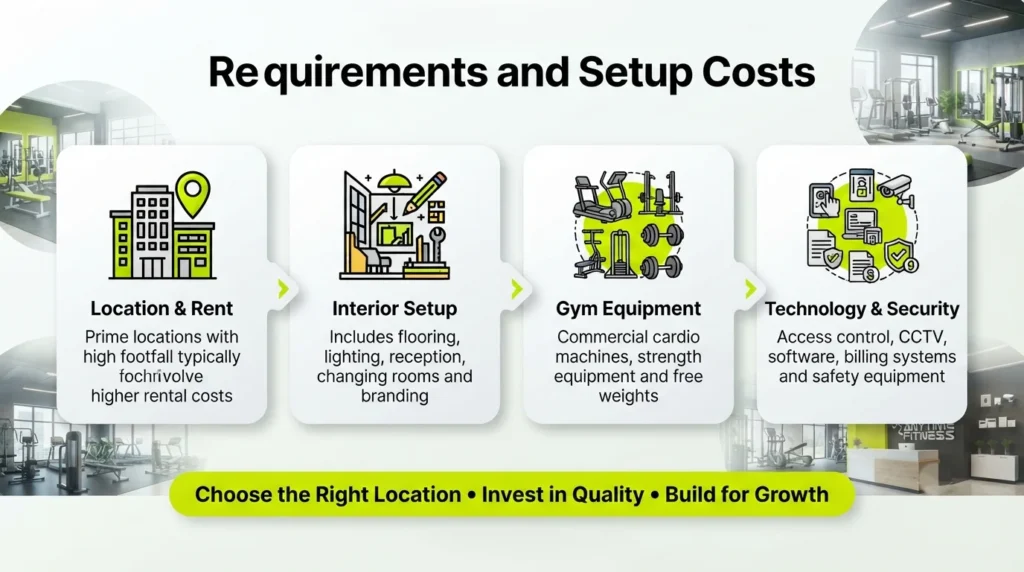
Selecting the right location is one of the most important decisions when opening an Anytime Fitness franchise. Even if you invest in high-quality equipment and marketing, the success of the business largely depends on where the gym is located. A well-connected location with good visibility and easy accessibility can help attract more members and improve long-term profitability.
In India, Anytime Fitness typically recommends a space of around 3,500 to 5,000 sq. ft., although the exact requirement may vary depending on the city, local demand, and club format. The property should have sufficient room for workout zones, cardio equipment, strength training areas, functional training space, changing rooms, showers, reception, staff office, and storage.
The setup cost is a major part of the overall Anytime Fitness franchise cost. Apart from the franchise fee, investors need to budget for civil work, interiors, gym equipment, branding, technology systems, and safety installations. The total setup cost can vary significantly depending on whether the property requires extensive renovations or is already suitable for a fitness centre.
Some of the key factors that influence setup costs include:
- Location and rental cost: Commercial properties in metro cities such as Delhi, Mumbai, Bengaluru, Hyderabad, and Pune generally have higher rental and lease costs than those in Tier-2 or Tier-3 cities. A location near residential societies, business districts, educational institutions, or shopping complexes usually attracts higher footfall but also comes with a higher rental expense.
- Interior design and construction: Every Anytime Fitness club must follow the brand’s design standards. This includes flooring, lighting, wall finishes, reception area, changing rooms, showers, mirrors, ventilation, and branding elements. Depending on the condition of the property, interior development can account for a significant share of the total investment.
- Gym equipment: Fitness equipment is one of the largest expenses while setting up the club. A standard Anytime Fitness gym includes treadmills, cross trainers, stationary bikes, strength machines, free weights, benches, functional training equipment, and stretching zones. Since the brand maintains quality standards across its clubs, franchisees are expected to install commercial-grade equipment.
- Technology and security systems: Anytime Fitness is known for its 24/7 access model. Therefore, every club requires secure access control systems, CCTV surveillance, member management software, internet connectivity, billing systems, and emergency safety equipment. These systems ensure smooth operations while allowing members to access the gym even outside staffed hours.
Choosing the right property and planning the setup carefully can help reduce unnecessary expenses while creating a better experience for members. Before finalising any location, franchisees should evaluate local competition, parking availability, population density, and future growth potential to maximise the return on their investment.
Anytime Fitness Franchise Revenue and Profit Potential
One of the biggest questions investors ask is whether the Anytime Fitness franchise cost can generate attractive returns. While profitability depends on several business factors, the franchise follows a recurring revenue model that provides a relatively stable source of income once the membership base is established.
The primary source of revenue comes from monthly and annual membership plans. Since members pay recurring subscription fees, the business benefits from predictable monthly cash flow. In addition to memberships, franchise owners can increase their earnings through personal training sessions, small-group fitness programmes, nutrition coaching, fitness assessments, and the sale of branded merchandise or supplements where permitted.
The actual revenue of an Anytime Fitness club depends on several factors, including its location, membership count, pricing strategy, operating expenses, and customer retention rate. Clubs located in densely populated urban areas with strong demand for fitness services generally have greater revenue potential than those in markets with limited demand.
Let’s look at the expected profit margins and the average time it may take for franchisees to recover their initial investment, helping you better evaluate the financial viability of the Anytime Fitness franchise in India.
What Is the Profit Margin for an Anytime Fitness Franchise?
The profit margin of an Anytime Fitness franchise varies depending on operational efficiency and the number of active members. There is no fixed profit percentage because each club operates under different market conditions. However, once a gym reaches a stable membership base and manages its operating expenses effectively, it can generate healthy profits.
Some of the factors that have the biggest impact on profitability include:
- Membership growth and retention.
- Rental and utility expenses.
- Staff salaries and operational efficiency.
- Revenue from personal training and additional services.
- Local competition and pricing strategy.
- Equipment maintenance and operating costs.
Industry estimates suggest that professionally managed fitness centres with strong occupancy and effective cost control can achieve operating profit margins of around 20% to 30%. However, actual results may vary depending on the performance of the individual franchise.
How Long Does It Take to Break Even?
The break-even period refers to the time required for a franchise owner to recover the initial investment through business profits. For an Anytime Fitness franchise in India, this period generally depends on factors such as the total investment, membership growth, operating expenses, and the local market.
According to publicly available franchise information, many Anytime Fitness clubs aim to recover their investment within approximately 2 to 3 years. However, this is not a guaranteed timeline and may vary significantly from one location to another.
Franchisees can improve their chances of achieving a faster break-even by:
- Selecting a high-demand location with strong visibility.
- Investing in local marketing before and after launch.
- Focusing on member retention and customer satisfaction.
- Increasing revenue through personal training and wellness programmes.
- Managing operating expenses without compromising service quality.
A realistic business plan, sufficient working capital, and consistent operational management play a crucial role in determining how quickly an Anytime Fitness franchise becomes profitable. Before investing, prospective franchisees should prepare detailed financial projections based on the specific market in which they plan to operate.
Financial Eligibility Requirements for an Anytime Fitness Franchise
Opening an Anytime Fitness franchise requires a substantial financial commitment. Apart from arranging the total investment, the franchisor also evaluates whether a prospective franchisee has the financial capacity to establish and sustain the business. This assessment helps ensure that the franchise has sufficient funds to cover setup costs as well as operating expenses during the initial months.
In India, the total investment required to open an Anytime Fitness club generally ranges between ₹2 crore and ₹5 crore. Since setting up a premium fitness centre involves significant expenditure, applicants are expected to demonstrate strong financial stability. The franchisor may review your personal net worth, available liquid capital, funding sources, and ability to secure additional financing if required.
Before applying, ensure you are financially prepared for both the initial investment and ongoing operational expenses.
| Financial Requirement | Typical Expectation |
| Total Investment Capacity | ₹2 crore–₹5 crore |
| Franchise Fee | Approximately ₹20 lakh |
| Liquid Capital | Sufficient to cover setup costs and initial operations |
| Funding Options | Personal investment, bank loan, or business financing |
| Business Experience | Preferred but not mandatory |
| Working Capital | Adequate funds for the first 3–6 months of operations |
Having a strong financial profile not only improves your chances of franchise approval but also provides greater flexibility during the early stages of the business. Investors should also maintain a financial buffer to handle unexpected expenses or slower-than-expected membership growth.
Anytime Fitness Franchise Agreement: Key Terms Every Franchisee Should Know
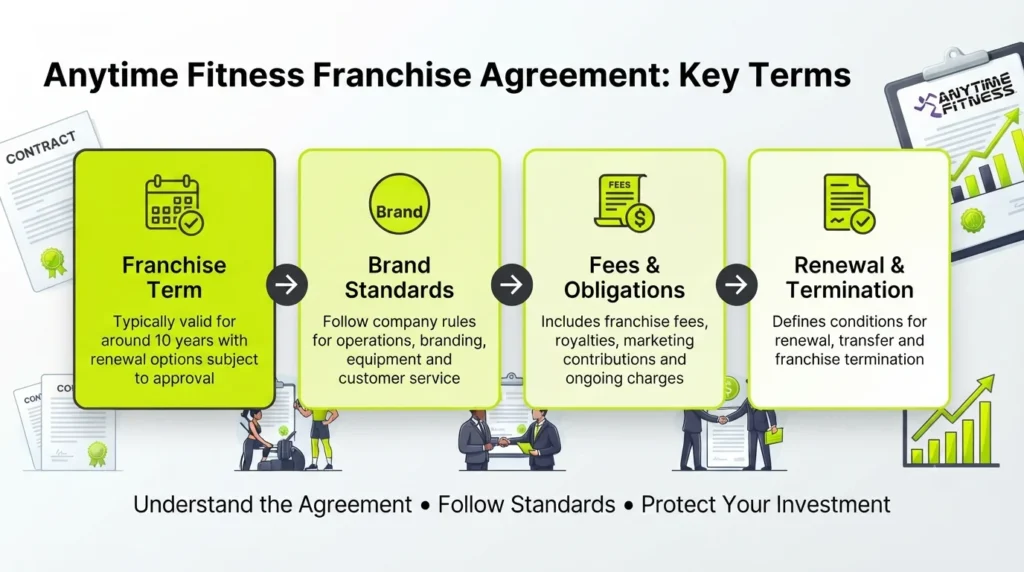
Before investing in the Anytime Fitness franchise, it is essential to understand the franchise agreement. This legal document defines the rights and responsibilities of both the franchisor and the franchisee. It covers important aspects such as the franchise term, renewal conditions, royalty payments, operational standards, brand usage, and termination clauses.
Reading the agreement carefully is just as important as understanding the Anytime Fitness franchise cost. While the investment figures help you estimate the financial commitment, the franchise agreement explains how the business will be operated throughout the partnership.
Some of the key terms generally included in the agreement are:
- Franchise term: The standard franchise agreement typically runs for around 10 years. At the end of the term, franchisees may have the opportunity to renew the agreement, provided they meet the renewal requirements and comply with the franchisor’s policies.
- Brand standards: Franchisees must operate the gym according to the company’s established guidelines. This includes maintaining equipment standards, following approved branding, delivering consistent customer service, and complying with operational procedures to ensure a uniform member experience across all clubs.
- Fees and financial obligations: The agreement outlines all financial commitments, including the franchise fee, royalty payments, marketing contributions, technology fees, and any other charges applicable during the franchise term. Understanding these obligations helps franchisees prepare realistic long-term financial projections.
- Renewal and termination conditions: The agreement also specifies the circumstances under which the franchise can be renewed, transferred, or terminated. It may include conditions related to operational performance, compliance with brand standards, or breach of contractual obligations.
Since a franchise agreement is a legally binding contract, prospective franchisees should consult a qualified legal professional before signing. Taking the time to review every clause can help avoid misunderstandings and ensure you fully understand your rights and obligations as a franchise owner.
Anytime Fitness Franchise Growth and Market Performance
A franchise’s growth is often a good indicator of its long-term stability and brand strength. Anytime Fitness has built a strong presence in the global fitness industry through consistent expansion, making it one of the largest fitness franchise networks in the world.
The brand currently operates more than 5,500 clubs across over 40 countries and territories. In India, Anytime Fitness has steadily expanded into major metropolitan cities as well as several Tier-2 cities, reflecting the growing demand for organised fitness services. Rising health awareness, increasing disposable incomes, and changing lifestyles have all contributed to this growth.
For potential investors, the brand’s expansion demonstrates that there is sustained interest in the Anytime Fitness business model. However, it is equally important to evaluate the performance of the local market rather than relying solely on the brand’s global success.
Some factors that indicate the strength of the Anytime Fitness franchise system include:
- A globally recognised fitness brand with over two decades of industry experience.
- Presence in multiple international markets, reducing dependence on a single region.
- A recurring membership-based revenue model that supports predictable cash flow.
- Continuous investment in digital technology, member engagement, and operational improvements.
- Ongoing franchise support in areas such as training, marketing, and business development.
Although these strengths make Anytime Fitness an attractive franchise opportunity, individual club performance ultimately depends on factors such as location, competition, management quality, pricing strategy, and member retention. Investors should conduct a detailed market analysis of their preferred city before making a final investment decision.
Anytime Fitness vs Other Gym Franchises in India: A Detailed Comparison
Choosing the right fitness franchise involves more than comparing the initial investment. Investors should also evaluate factors such as brand recognition, revenue potential, support offered by the franchisor, target audience, and long-term growth opportunities. While Anytime Fitness is one of the most recognised global fitness brands, it competes with several established players in the Indian market.
The table below compares Anytime Fitness with some of the leading gym franchises in India to help you make a more informed investment decision.
| Feature | Anytime Fitness | Gold’s Gym India | Snap Fitness | Cult Fit (Partner Model)* |
| Brand Origin | USA | USA | USA | India |
| Estimated Investment | ₹2 crore–₹5 crore | ₹1.5 crore–₹3 crore | ₹1.5 crore–₹3 crore | Varies by partnership model |
| Franchise Fee | Approximately ₹20 lakh | Varies | Varies | Not publicly standardised |
| Operating Model | 24/7 Gym Access | Full-Service Gym | 24/7 Gym Access | Fitness Centres & Studios |
| Main Revenue Source | Memberships, Personal Training, Wellness Services | Memberships, Training Programmes | Memberships, Personal Training | Memberships & Fitness Programmes |
| Global Presence | 5,500+ Clubs | 700+ Locations Worldwide | 1,000+ Clubs Worldwide | Primarily India |
| Technology Integration | High | Moderate | High | High |
| Training & Business Support | Comprehensive | Comprehensive | Comprehensive | Varies by partnership |
Each brand has its own strengths, and the right choice depends on your investment capacity, business objectives, and target market. If your goal is to operate a premium 24/7 fitness centre backed by a globally recognised brand, Anytime Fitness offers a strong value proposition. However, investors should compare the total investment, expected operating costs, and local market demand before making a final decision.
Training and Franchise Support: What Assistance Does Anytime Fitness Provide?
One of the biggest advantages of investing in a franchise instead of starting an independent gym is the support provided by the franchisor. Anytime Fitness offers guidance throughout the setup process and continues to assist franchisees after the club becomes operational. This support can be particularly valuable for first-time business owners who may not have prior experience in the fitness industry.
The support generally covers different stages of the business, including planning, launch, and day-to-day operations.
Pre-opening Support
Before the gym opens, franchisees receive assistance in setting up the business according to the brand’s standards. This support may include:
- Site selection and location evaluation to identify suitable commercial spaces.
- Club layout and design guidance to ensure consistency across all Anytime Fitness locations.
- Assistance with equipment planning and procurement.
- Support during the pre-opening phase to help prepare the club for launch.
Training Programmes
Anytime Fitness provides training to help franchise owners and their teams understand how to operate the business efficiently. The training generally focuses on:
- Club operations and daily management.
- Membership sales and customer relationship management.
- Staff recruitment and team management.
- Marketing strategies and member acquisition.
- Operational systems and technology platforms.
These programmes are designed to help franchisees maintain consistent service quality while improving business performance.
Ongoing Business Support
Support does not end after the club opens. Franchisees typically continue to receive assistance in several operational areas, including:
- Marketing resources and promotional campaigns.
- Access to operational guidelines and business tools.
- Technology updates and software support.
- Performance monitoring and business reviews.
- Guidance on improving membership growth and member retention.
This ongoing support enables franchisees to adapt to changing market trends while maintaining the standards associated with the Anytime Fitness brand.
How to Apply for an Anytime Fitness Franchise in India
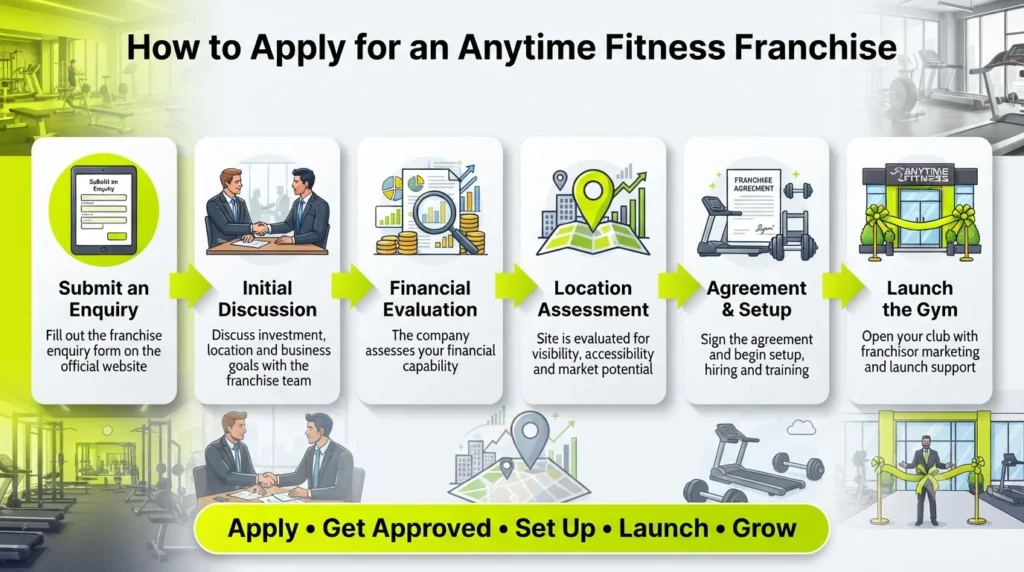
- Step 1: Submit an Enquiry: Visit the official Anytime Fitness India website and fill out the franchise enquiry form. You will typically be asked to provide your contact details, preferred city, investment capacity, and basic business information.
- Step 2: Initial Discussion with the Franchise Team: After reviewing your enquiry, the franchise development team may contact you to discuss your business goals, financial capability, and preferred location. This conversation helps determine whether you meet the brand’s initial eligibility requirements.
- Step 3: Financial Evaluation: The franchisor may assess your financial strength to ensure you have adequate funds for the investment. You may also be asked to provide information about your funding sources or business background.
- Step 4: Location Assessment: If your application progresses, the proposed property will be evaluated based on factors such as visibility, accessibility, surrounding population, parking availability, and market potential. Selecting the right location is a critical part of the approval process.
- Step 5: Agreement and Club Development: Once the location is approved and both parties agree to the terms, the franchise agreement is signed. The setup process then begins, including interior development, equipment installation, technology integration, staff recruitment, and training.
- Step 6: Launch Your Gym: After completing all necessary preparations and approvals, the club is ready for its grand opening. The franchisor may also provide marketing support during the launch phase to help attract initial members and build awareness in the local market.
Following these steps carefully can help ensure a smoother setup process and increase the likelihood of building a successful Anytime Fitness franchise in India.
Pros and Cons of Owning an Anytime Fitness Franchise
Like any business investment, owning an Anytime Fitness franchise comes with both advantages and challenges. While the brand offers a proven business model and strong market recognition, prospective franchisees should also consider the financial commitment, competition, and operational responsibilities before investing. Evaluating both sides will help you decide whether the Anytime Fitness franchise cost aligns with your business goals and risk appetite.
Pros of an Anytime Fitness Franchise
- Globally recognised brand: Anytime Fitness is one of the largest fitness franchise brands in the world, with thousands of clubs operating across multiple countries. Its established reputation helps franchisees gain customer trust more quickly than an independent gym, reducing the effort required to build brand awareness from scratch.
- Proven business model: The franchise operates on a membership-based model that generates recurring monthly revenue. In addition to membership fees, owners can earn from personal training, group fitness sessions, wellness coaching, and retail products, creating multiple income streams that improve overall business stability.
- Comprehensive franchise support: Franchisees receive assistance throughout the business journey, from site selection and club design to staff training, marketing, and operational guidance. This support can be especially valuable for entrepreneurs entering the fitness industry for the first time.
Cons of an Anytime Fitness Franchise
- High initial investment: The cost of Anytime Fitness franchise in India generally ranges between ₹2 crore and ₹5 crore, making it one of the more expensive fitness franchise opportunities. Investors need significant capital and should also keep additional funds available for working capital and unforeseen expenses.
- Ongoing operational expenses: Apart from the initial investment, franchisees must manage recurring costs such as rent, employee salaries, equipment maintenance, utilities, local marketing, and franchise-related fees. These expenses can affect profitability, particularly during the early months of operation.
- Location-dependent success: The performance of a fitness centre largely depends on its location. A poor site selection can make it difficult to attract members, even if the facility offers excellent equipment and services. Conducting detailed market research before signing a lease is therefore essential.
Considering these advantages and challenges will help you assess whether investing in an Anytime Fitness franchise is the right decision based on your financial capacity, business experience, and long-term objectives.
Final Verdict
The Anytime Fitness franchise is a strong option for entrepreneurs looking to enter the premium fitness industry with the support of a globally recognised brand. Its 24/7 operating model, recurring membership-based revenue, technology-driven operations, and comprehensive franchise support provide a solid foundation for building a sustainable business.
However, the Anytime Fitness franchise cost is substantial, with an estimated investment ranging from ₹2 crore to ₹5 crore in India. This means the franchise is better suited for investors who have adequate financial resources and are prepared to manage a long-term business rather than seeking quick returns. Success also depends on choosing the right location, hiring a capable team, maintaining high service standards, and implementing effective local marketing strategies.
Another important factor to consider is the growing demand for organised fitness services in India. As more people prioritise health and wellness, the market for premium gyms continues to expand. Franchisees who focus on member retention, personalised fitness experiences, and operational excellence are likely to be better positioned for long-term growth.
Overall, if you have the required investment, understand the local market, and are committed to actively managing the business, the Anytime Fitness franchise can be a rewarding investment in 2026. Before making a final decision, review the Franchise Disclosure Document, carefully study the franchise agreement, prepare detailed financial projections, and seek professional legal and financial advice. Taking these steps will help ensure that your investment decision is well-informed and aligned with your long-term business goals.