
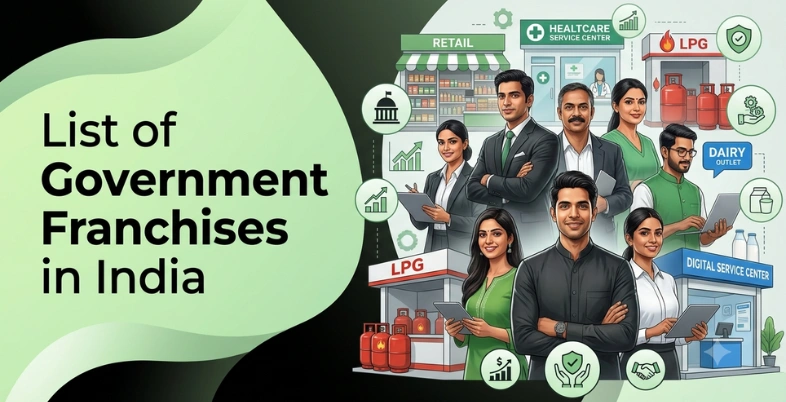
Government-backed business opportunities have become one of the most reliable ways to start a business in India. Instead of building a brand from scratch, entrepreneurs can partner with government-approved programmes to offer essential public services while earning a steady income. From digital citizen services and affordable healthcare to banking and postal services, these opportunities continue to expand as the government strengthens digital infrastructure and public service delivery.
The demand for Government Franchises in India has grown significantly over the past few years. Initiatives such as Digital India, financial inclusion programmes, and rural entrepreneurship have created new business opportunities for individuals looking for relatively low-investment ventures with long-term earning potential. Many of these models also serve areas where access to government services is still limited, making them beneficial for both entrepreneurs and local communities.
This guide covers the best franchises in India in 2026, along with their investment requirements, eligibility, profit potential, application process, and key factors to consider before getting started.
What Are Government Franchises in India? Understanding the Business Model
Government Franchises in India are business opportunities where individuals or organisations are authorised to provide government-related services on behalf of a government department, public sector undertaking (PSU), or an approved agency. Unlike traditional franchises that sell branded products, these businesses focus on delivering public services that people use regularly.
For example, a Common Service Centre (CSC) helps citizens apply for government certificates, pay utility bills, access digital services, and enrol in welfare schemes. Similarly, a Jan Aushadhi Kendra sells affordable generic medicines under a government initiative, while an India Post Franchise provides selected postal services in areas where a full-fledged post office may not be available.
Although the word “franchise” is widely used, many of these opportunities operate under different business models. Some function as authorised service centres, some work on dealership models, while others are managed through public-private partnerships or authorised agencies. The common factor is that they operate under government guidelines and approvals.
Most Government Franchises in India generate income through commissions, transaction fees, service charges, or incentives instead of direct product sales. Since many of these services are required throughout the year, business owners often benefit from a consistent customer base.
Before investing, applicants should always verify whether the opportunity is officially recognised by the relevant government department. Checking the official website, eligibility criteria, investment requirements, and licensing process can help avoid fraudulent schemes and ensure the business is genuine.
Why Government Franchises in India Are Growing Rapidly in 2026
Government Franchises in India are witnessing strong growth in 2026 because the government is continuously expanding digital public services and improving access to essential facilities across the country. Whether it is banking, healthcare, postal services, digital documentation, or welfare schemes, many services are now delivered through authorised private partners instead of government offices alone. This approach helps improve service delivery while also creating self-employment opportunities for entrepreneurs.
Another major reason behind this growth is the increasing adoption of digital governance. Through initiatives like Digital India, citizens can now access several government services online. However, many people, especially in rural and semi-urban areas, still require assistance with applications, documentation, online payments, and identity verification. This has increased the demand for authorised service centres that can bridge the gap between government departments and citizens.
Apart from better service accessibility, government-backed businesses are generally considered more reliable than many conventional franchise models. They often benefit from steady customer demand because the services they provide are essential rather than seasonal. While earnings depend on the number of transactions and the specific franchise model, the demand for citizen services remains consistent throughout the year.
With increasing internet penetration, smartphone usage, and government investment in digital infrastructure, Government Franchises in India are expected to remain one of the most promising business opportunities for aspiring entrepreneurs in 2026.
Benefits Of Investing in Government Franchises in India
Choosing a government-backed business model offers several advantages over starting an independent business. Since these franchises are associated with recognised government programmes or authorised agencies, they often enjoy higher public trust and consistent demand. While every opportunity has different investment requirements and earning potential, many Government Franchises in India offer a relatively stable business model compared to traditional retail franchises. Some of the key benefits include:
- Lower investment compared to many private franchises: Several Government Franchises in India can be started with a modest investment. Unlike large retail or food franchises that require significant capital for branding and infrastructure, many government-authorised service centres primarily require a suitable workspace, basic equipment, and compliance with eligibility criteria.
- Consistent customer demand: Services such as Aadhaar updates, banking transactions, medicine purchases, postal services, utility bill payments, and government scheme registrations are required throughout the year. This helps franchise owners attract repeat customers instead of depending only on seasonal demand.
- Strong credibility and public trust: People generally feel more confident using services that are officially authorised by government departments or public sector organisations. This trust can help franchise owners build a loyal customer base and establish their business more quickly within the local community.
- Multiple sources of income: Many government franchise models do not rely on a single service. For example, a Common Service Centre (CSC) can offer certificate applications, insurance services, banking facilities, digital payments, PAN card services, and several other government-related services. This creates multiple revenue streams from one business location.
- Opportunities in both urban and rural areas: Many government-backed businesses are specifically designed to improve service accessibility in underserved regions. As a result, entrepreneurs in small towns and villages can often benefit from less competition while serving a growing customer base.
Key Sectors Offering Government Franchise Opportunities in India
Government-backed business opportunities are available across multiple sectors, allowing entrepreneurs to choose a model that matches their investment capacity, location, and business goals. While some franchises focus on delivering citizen services, others are designed to improve access to healthcare, banking, postal services, and digital infrastructure. Understanding these sectors can help you identify the right Government Franchise in India based on local demand.
Digital Citizen Services
Digital service centres have become one of the fastest-growing government-backed business models. These centres assist citizens with services such as certificate applications, Aadhaar-related services, utility bill payments, PAN card applications, pension services, and registrations for various government schemes. Since people regularly require these services, digital service centres enjoy consistent footfall throughout the year.
Banking and Financial Services
To promote financial inclusion, several banks appoint authorised Business Correspondents (BCs) to provide banking facilities in locations where full-scale branches may not be available. These centres offer services like account opening, cash deposits and withdrawals, fund transfers, loan assistance, insurance enrolment, and Aadhaar-enabled payment services.
Healthcare and Pharmaceuticals
The healthcare sector offers government-supported franchise opportunities through initiatives such as Jan Aushadhi Kendras. These centres provide quality generic medicines at affordable prices, making healthcare more accessible while creating a profitable business opportunity for entrepreneurs.
Postal and Logistics Services
India Post has introduced franchise models to improve postal service accessibility in underserved locations. Franchise owners can provide services such as stamp sales, parcel booking, speed post bookings, and selected postal products while earning commission on transactions.
Agriculture and Rural Development
The government also promotes entrepreneurship in the agriculture sector through authorised centres that provide farming inputs, soil testing, agricultural advisory services, and support for various farmer welfare schemes. These opportunities are particularly suitable for entrepreneurs operating in rural areas.
Public Utility and Essential Services
Several government-authorised centres also provide services related to electricity bill payments, water bill collection, digital payments, FASTag services, insurance, and other essential citizen services. Combining multiple services under one centre helps increase customer visits and improves overall earning potential.
Quick Comparison Of he Best Government Franchises In India (2026)
The table below provides a general comparison of some of the most popular Government Franchises in India. Actual investment, earnings, and eligibility may vary depending on the scheme, location, and operational guidelines issued by the concerned authority.
| Franchise Name | Sector | Approximate Investment | Profit Potential |
| Common Service Centre (CSC) | Digital Citizen Services | ₹50,000 – ₹2 lakh | Medium to High (Commission-based from multiple government and private services) |
| Pradhan Mantri Bhartiya Janaushadhi Kendra (PMBJK) | Healthcare & Pharmaceuticals | ₹2 lakh – ₹5 lakh | High (Medicine sales + government incentives) |
| India Post Franchise | Postal & Citizen Services | ₹5,000 security deposit + ₹50,000–₹1 lakh setup | Medium (Commission on postal and citizen services) |
| Banking Correspondent (BC) | Banking & Financial Services | ₹50,000 – ₹2 lakh | Medium to High (Transaction-based commissions) |
| Aadhaar Seva Kendra (Authorised Centre) | Digital Identity Services | ₹1 lakh – ₹3 lakh* | Medium (Authorised service charges) |
| Fair Price Shop (Ration Shop) | Public Distribution System (PDS) | ₹1 lakh – ₹3 lakh | Medium (Fixed government commission) |
| Passport Seva Kendra (Authorised Partner Model) | Passport & Citizen Services | Varies as per government contract | Medium to High (Contract-based revenue) |
| Jan Aushadhi Suvidha Distribution (through PMBJK) | Healthcare Products | Minimal additional investment | Medium (Additional retail margins on healthcare products) |
| IndianOil LPG Distributorship | LPG & Energy | ₹15 lakh – ₹25 lakh+ | High (Recurring LPG distribution commissions) |
| Bharat Petroleum (BPCL) LPG Distributorship | LPG & Energy | ₹15 lakh – ₹30 lakh+ | High (Recurring LPG distribution commissions) |
List of Top Government Franchises in India
1. Common Service Centre (CSC)
Official Website: https://www.csc.gov.in
The Common Service Centre (CSC) is one of the most successful government-backed business opportunities in India. Launched under the Digital India Programme, CSCs function as digital service delivery centres that bring government and private services closer to citizens, especially in rural and semi-urban areas.
A CSC is operated by a Village Level Entrepreneur (VLE) who acts as an authorised service provider. Instead of visiting multiple government offices, citizens can access numerous services at a single location. These include Aadhaar-related assistance, PAN card services, passport applications, utility bill payments, banking, insurance, pension schemes, telemedicine, education services, income certificate applications, and various government welfare schemes.
As India continues to expand its digital infrastructure, CSCs have become an essential bridge between citizens and government services while creating a sustainable source of income for entrepreneurs.
Investment Required
Starting a Common Service Centre generally requires an investment of ₹50,000 to ₹2 lakh, depending on the infrastructure already available and the services you plan to offer.
The investment usually covers:
- Computer or laptop
- High-speed internet connection
- Printer and scanner
- Biometric authentication device
- UPS or power backup
- Office furniture
- Basic office setup
Applicants must also meet the eligibility requirements prescribed by CSC e-Governance Services India Limited before registration.
Profit Potential
A CSC offers multiple income streams since operators earn commissions for every service they provide. Earnings depend on factors such as location, daily customer footfall, transaction volume, and the number of services offered.
Many successful Village Level Entrepreneurs increase their income by providing banking services, insurance, telemedicine, digital documentation, education programmes, and various government registrations. CSCs located in villages and underserved areas often witness higher demand due to limited access to government offices.
How to Apply
Interested applicants can register through the official CSC portal after checking the eligibility criteria.
The application process generally includes:
- Verify eligibility requirements.
- Register online through the CSC portal.
- Submit identity and address documents.
- Arrange the required infrastructure.
- Complete verification.
- Receive approval and begin operations as a Village Level Entrepreneur (VLE).
2. Pradhan Mantri Bhartiya Janaushadhi Kendra (PMBJK)
Official Website: https://janaushadhi.gov.in
The Pradhan Mantri Bhartiya Janaushadhi Kendra (PMBJK) operates under the Pradhan Mantri Bhartiya Janaushadhi Pariyojana (PMBJP), an initiative launched by the Government of India to make quality generic medicines available at affordable prices across the country. It is considered one of the leading government franchises in India, providing entrepreneurs an opportunity to contribute to affordable healthcare services.
These centres sell government-approved generic medicines that meet prescribed quality standards while costing significantly less than many branded alternatives. Apart from medicines, many stores also offer surgical products, healthcare devices, wellness products, and sanitary hygiene items.
The government supports entrepreneurs through incentives and promotional schemes, making PMBJK one of the most attractive government franchises opportunities in the healthcare sector. With increasing awareness of affordable medicines, customer demand continues to grow across both urban and rural markets.
Investment Required
The approximate investment ranges between ₹2 lakh and ₹5 lakh, depending on the location, shop size, interiors, inventory, and infrastructure.
The investment generally includes:
- Commercial shop
- Furniture and storage racks
- Computer and billing system
- Air conditioning (where required)
- Initial medicine inventory
- Drug licence and registration expenses
Eligible applicants may also receive financial assistance and incentives under the PMBJP guidelines.
Profit Potential
Store owners earn income through the sale of generic medicines while also benefiting from government incentives offered under the scheme. Since medicines remain an essential daily requirement, customer demand is generally stable throughout the year.
Profitability depends on the location of the store, nearby hospitals and clinics, prescription volume, and awareness among customers regarding affordable generic medicines. Many entrepreneurs further increase their revenue by offering healthcare products and wellness essentials.
How to Apply
Interested applicants can submit their application through the official PMBJP portal.
The process generally involves:
- Check eligibility requirements.
- Arrange suitable commercial premises.
- Obtain the required drug licence.
- Submit the online application.
- Complete document verification.
- Receive approval and start operations.
3. India Post Franchise

Official Website: https://www.indiapost.gov.in
The India Post Franchise Scheme allows individuals and businesses to provide selected postal services in areas where establishing a full-fledged post office may not be practical. Introduced by the Department of Posts, this initiative helps expand postal services while creating self-employment opportunities for entrepreneurs.
Depending on the approved franchise model, operators can offer services such as booking Speed Post articles, selling postage stamps and stationery, handling registered mail, and providing selected retail postal products. Franchisees work under the guidelines of India Post and earn commissions on the services they provide.
With the rapid growth of e-commerce and courier demand, India Post franchises continue to play an important role in improving postal accessibility, particularly in small towns, rural regions, and developing urban localities.
Investment Required
Compared to many other business opportunities, an India Post Franchise requires relatively low investment.
Applicants generally need:
- Security deposit as prescribed by India Post
- Small commercial premises
- Computer and internet connection
- Office furniture
- Printer and basic operational equipment
The overall investment typically ranges between ₹50,000 and ₹2 lakh, depending on the franchise model and the infrastructure already available.
Profit Potential
Income is commission-based and depends on the number of postal transactions completed each month. Franchisees earn commissions on services such as Speed Post bookings, registered articles, sale of postal stationery, and retail postal products.
Locations with higher parcel movement, growing business activity, and increasing e-commerce deliveries generally offer better earning potential. Providing efficient customer service can also help increase repeat customers and monthly income.
How to Apply
Interested applicants can apply whenever India Post releases official franchise notifications.
The application process generally includes:
- Check the eligibility criteria.
- Submit the prescribed application form.
- Provide identity and address documents.
- Deposit the required security amount.
- Complete document verification.
- Receive approval and begin franchise operations.
4. Aadhaar Seva Kendra (Authorised UIDAI Centre)\

Official Website: https://uidai.gov.in
An Aadhaar Seva Kendra (ASK) is an authorised service centre established by the Unique Identification Authority of India (UIDAI) to provide Aadhaar enrolment and update services. These centres help citizens apply for new Aadhaar cards, update demographic information, register biometric details, and make corrections to existing Aadhaar records.
Unlike a traditional franchise, Aadhaar Seva Kendras cannot be purchased directly by individuals. They are operated by UIDAI or through authorised agencies and registrars approved by the government. Organisations interested in operating these centres must receive official authorisation and comply with UIDAI’s operational guidelines.
Since Aadhaar is one of the most widely used identity documents in India, authorised centres experience consistent customer demand throughout the year, making them a reliable government-backed business opportunity for eligible organisations.
Investment Required
The required investment depends on the operational model and the infrastructure specified by the authorised agency.
Typical requirements include:
- Computer system
- Certified biometric authentication device
- Iris scanner
- Webcam
- Printer and scanner
- High-speed internet connection
- Office space as per UIDAI standards
The overall investment generally ranges between ₹1 lakh and ₹3 lakh.
Profit Potential
Revenue is earned through authorised service charges for Aadhaar enrolment and update requests. Since millions of Aadhaar-related services are processed every year, centres located in high-demand areas can generate regular transaction-based income.
Many authorised operators also provide additional digital services such as PAN card applications, government registrations, and document services, helping improve their overall earnings.
How to Apply
Interested organisations cannot directly purchase an Aadhaar franchise.
Instead, they should:
- Monitor official UIDAI notifications.
- Apply through authorised registrars or empanelled agencies.
- Meet the prescribed infrastructure requirements.
- Complete operator certification and training, where applicable.
- Obtain official approval before commencing operations.
5. IndianOil (Indane) LPG Distributorship

Official Website: https://iocl.com
The IndianOil (Indane) LPG Distributorship is one of the most recognised government-backed business opportunities in India. Operated by Indian Oil Corporation Limited (IOCL), the country’s largest public sector oil marketing company, Indane distributors supply domestic and commercial LPG cylinders to households, businesses, and institutions.
Authorised distributors are responsible for managing LPG inventory, processing new connection requests, handling refill bookings, ensuring timely cylinder deliveries, maintaining safety standards, and providing customer support. Since LPG is an essential household requirement, the business benefits from consistent demand throughout the year.
IndianOil regularly invites applications for new distributorships across different regions based on market demand and expansion plans.
Investment Required
The investment required depends on the category of distributorship and the location.
The investment generally includes:
- Security deposit
- Land for showroom and LPG godown
- Delivery vehicles
- Office infrastructure
- Computer systems
- Safety equipment
- Initial operational expenses
The total investment may range from approximately ₹15 lakh to ₹30 lakh or more, depending on the distributorship category and infrastructure requirements.
Profit Potential
Distributors earn income through the commission received on every LPG cylinder supplied. Since LPG is a necessity for households and commercial establishments, demand remains steady throughout the year.
Profitability depends on factors such as the number of active customers, refill bookings, commercial cylinder sales, operational efficiency, and service quality. Expanding residential areas generally offer better long-term business opportunities.
How to Apply
Interested applicants can apply whenever IndianOil releases official distributorship advertisements.
The application process generally includes:
- Check official vacancy notifications.
- Verify the eligibility criteria.
- Submit the online application.
- Participate in the selection process.
- Complete document verification.
- Develop the required infrastructure before commencing operations.
Exlpore More Franchise:
6. Bharat Petroleum (BharatGas) LPG Distributorship
Official Website: https://www.bharatpetroleum.in
The BharatGas LPG Distributorship is offered by Bharat Petroleum Corporation Limited (BPCL), one of India’s leading public sector oil marketing companies. Through its BharatGas network, the company supplies LPG cylinders to residential, commercial, and industrial customers across the country, making it one of the most trusted government franchises in the energy sector.
Authorised distributors manage customer registrations, refill bookings, cylinder deliveries, safety inspections, complaint resolution, and after-sales support while operating according to BPCL’s prescribed standards. As the demand for clean cooking fuel continues to increase, BharatGas distributorships remain among the most stable government-backed business opportunities available.
BPCL regularly announces new distributorship opportunities in locations where additional LPG distribution infrastructure is required.
Investment Required
The investment varies depending on the distributorship category and location.
The investment generally covers:
- Commercial land
- LPG storage godown
- Office infrastructure
- Delivery vehicles
- Computer systems
- Safety equipment
- Working capital
Applicants should refer to the latest BPCL guidelines for the exact investment requirements applicable to their chosen location.
Profit Potential
Distributors earn commission on LPG cylinder sales and related services. Since LPG is an essential commodity used daily by households and businesses, distributors generally benefit from recurring customer demand.
Revenue depends on the number of domestic and commercial customers, refill frequency, operational efficiency, and service quality. Areas experiencing residential and commercial growth often provide greater long-term earning potential.
How to Apply
Applications are accepted whenever BPCL publishes official distributorship notifications.
The application process generally includes:
- Monitor official distributorship advertisements.
- Check the prescribed eligibility criteria.
- Submit the online application with supporting documents.
- Participate in the selection process.
- Complete document verification.
- Establish the required infrastructure before beginning operations.
7. Hindustan Petroleum (HP Gas) LPG Distributorship

Official Website: https://www.hindustanpetroleum.com
The HP Gas LPG Distributorship is offered by Hindustan Petroleum Corporation Limited (HPCL), one of India’s leading public sector oil and gas companies. Through its HP Gas network, the company supplies LPG cylinders to domestic households, commercial establishments, and industrial customers across the country.
Authorised distributors are responsible for managing LPG inventory, processing new customer registrations, handling refill bookings, ensuring timely cylinder deliveries, maintaining safety standards, and providing customer support. Since LPG is an essential household fuel, distributors benefit from steady demand throughout the year.
HPCL periodically announces new distributorship opportunities in eligible locations based on market demand and network expansion plans.
Investment Required
The investment required depends on the category of distributorship and the location.
The investment generally includes:
- Land for showroom and LPG godown
- Office infrastructure
- Delivery vehicles
- Computer systems
- Safety equipment
- Security deposit
- Initial working capital
The overall investment generally ranges from approximately ₹15 lakh to ₹30 lakh or more, depending on the location and infrastructure requirements.
Profit Potential
HP Gas distributors earn commission on every LPG cylinder supplied to customers. Since LPG is an essential product used by millions of households and businesses, demand remains consistent throughout the year.
Income depends on the number of active customers, refill bookings, commercial cylinder sales, operational efficiency, and customer service. Distributors operating in rapidly developing residential areas often experience better long-term growth and profitability.
How to Apply
Interested applicants can apply whenever HPCL releases official distributorship advertisements.
The application process generally includes:
- Check official distributorship notifications.
- Verify the eligibility criteria.
- Submit the online application.
- Participate in the selection process.
- Complete document verification.
- Develop the required infrastructure before starting operations.
8. Mother Dairy Booth / Franchise

Official Website: https://www.motherdairy.com
Mother Dairy operates one of India’s largest milk and dairy retail networks. Established under the National Dairy Development Board (NDDB), the company offers entrepreneurs the opportunity to operate authorised Mother Dairy booths and retail outlets that sell milk, dairy products, fresh fruits and vegetables, edible oils, frozen foods, and other consumer products. It is considered one of the most trusted government fccvvccranchises in India’s dairy retail sector.
Authorised booth operators receive products directly through Mother Dairy’s distribution network and sell them at company-approved prices. With strong brand recognition and a loyal customer base, Mother Dairy outlets enjoy regular footfall and consistent sales throughout the year.
As demand for quality dairy products continues to grow, Mother Dairy booths remain a popular business opportunity for entrepreneurs looking for a trusted and established brand.
Investment Required
The investment depends on the outlet type, size, and location.
The investment generally includes:
- Commercial retail space
- Refrigeration and cooling equipment
- Display counters
- Storage facilities
- Billing system
- Initial inventory
- Interior setup
The overall investment typically ranges between ₹5 lakh and ₹10 lakh, depending on the outlet format and location.
Profit Potential
Outlet owners earn profit through the sale of milk, dairy products, ice cream, fresh produce, and other authorised products. Since dairy products are purchased regularly by households, the business benefits from recurring customer demand.
Profitability depends on location, daily customer footfall, product range, and efficient inventory management. Outlets located in residential neighbourhoods, commercial markets, and high-traffic areas generally generate higher sales.
How to Apply
Interested applicants can apply through Mother Dairy whenever dealership or booth opportunities are announced.
The application process generally includes:
- Check dealership availability.
- Submit the application form.
- Meet the infrastructure requirements.
- Complete document verification.
- Sign the dealership agreement.
- Receive approval and commence business operations.
9. Amul Preferred Outlet (Amul Parlour)

Official Website: https://amul.com
Amul Preferred Outlet, commonly known as an Amul Parlour, is an authorised retail outlet operated under the Gujarat Cooperative Milk Marketing Federation (GCMMF). As India’s largest dairy cooperative, Amul offers entrepreneurs an opportunity to sell its extensive range of dairy and food products through company-approved outlets.
Amul Parlours stock products such as milk, butter, cheese, paneer, curd, ice cream, chocolates, beverages, and other packaged food items. The company supplies products through its established distribution network, allowing franchise owners to focus on sales and customer service rather than manufacturing or sourcing.
With its strong brand reputation, wide product portfolio, and consistent consumer demand, an Amul Parlour is considered one of the most profitable cooperative-backed business opportunities in India.
Investment Required
The investment depends on the type of Amul outlet and its location.
The investment generally includes:
- Commercial retail space
- Refrigeration and deep freezers
- Display counters and shelving
- Billing system
- Initial product inventory
- Interior setup and branding
The overall investment typically ranges between ₹2 lakh and ₹6 lakh, depending on the outlet format and infrastructure requirements.
Profit Potential
Amul outlet owners earn profit margins on the sale of various dairy and food products. Since products like milk, curd, butter, cheese, and ice cream have regular consumer demand, the business enjoys recurring sales throughout the year.
Profitability depends on factors such as outlet location, customer footfall, product availability, and inventory management. Stores located in residential areas, educational institutions, shopping complexes, and commercial markets generally perform well.
How to Apply
Interested applicants can apply through the official Amul website.
The application process generally includes:
- Visit the official Amul website.
- Choose the preferred outlet model.
- Submit the online application.
- Provide the required documents.
- Complete verification by the company.
- Sign the agreement and begin operations.
10. Nandini Milk Parlour
Official Website: https://www.kmfnandini.coop
The Nandini Milk Parlour is an authorised retail outlet operated under the Karnataka Milk Federation (KMF), one of India’s largest dairy cooperative organisations. The parlours are established to make fresh dairy products easily accessible while creating self-employment opportunities for entrepreneurs.
Authorised parlours sell a wide range of Nandini products, including milk, curd, butter, ghee, paneer, flavoured milk, sweets, ice cream, and other dairy-based products. Products are supplied through KMF’s distribution network, ensuring regular stock availability and consistent quality.
Backed by a trusted cooperative brand and a strong customer base, Nandini Milk Parlours continue to be a popular business opportunity, particularly in Karnataka and neighbouring states where the brand has a significant presence.
Investment Required
The investment depends on the outlet type and location.
The investment generally includes:
- Commercial retail space
- Refrigeration equipment
- Display counters
- Billing system
- Initial inventory
- Interior setup
- Basic working capital
The overall investment generally ranges between ₹2 lakh and ₹5 lakh, depending on the outlet size and infrastructure requirements.
Profit Potential
Parlour owners earn income through the sale of milk and other dairy products. Since dairy items are everyday household essentials, customer demand remains stable throughout the year.
Revenue depends on factors such as location, customer footfall, product availability, and operational efficiency. Parlours located near residential areas, schools, offices, and busy marketplaces generally generate higher sales.
How to Apply
Interested applicants can apply whenever the Karnataka Milk Federation announces new parlour opportunities.
The application process generally includes:
- Check dealership or parlour notifications on the official website.
- Verify the eligibility criteria.
- Submit the application form.
- Arrange the required infrastructure.
- Complete document verification.
- Receive approval and commence business operations.
Government Franchise Opportunities In Different States Of India
Although most Government Franchises in India operate under central government schemes, the availability of specific opportunities often varies from one state to another. Factors such as population, local demand, urbanisation, and state government initiatives influence the number and type of authorised centres established in different regions.
For example, states with a large rural population often have a greater demand for Common Service Centres (CSCs), Banking Correspondents, and India Post franchises because these services improve access to banking, digital governance, and public welfare programmes. On the other hand, metropolitan states usually witness higher demand for healthcare, digital services, passport assistance, and other citizen-centric facilities.
Some state governments also introduce their own entrepreneurship programmes or collaborate with central government schemes to expand public service delivery. Entrepreneurs should therefore explore opportunities offered by both the Central Government and their respective State Government before making an investment.
Before applying, consider the following factors for your state:
- Population density and customer demand.
- Number of existing authorised centres in the area.
- Availability of government welfare schemes.
- Competition from nearby franchise operators.
- State-specific eligibility criteria, if applicable.
Researching local demand and selecting a service that addresses the needs of your community can significantly improve the long-term success of your government-backed business.
Since you’ve replaced the list, the “Most Profitable” section should also reflect the new franchises. You don’t need the long explanation—just a concise intro and the top 5 list.
Which Is The Most Profitable Government Franchise In India in 2026?
The profitability of a government-backed franchise depends on factors such as customer demand, location, investment, operational efficiency, and recurring business. While earnings vary from one location to another, some opportunities consistently offer better income potential due to their strong brand presence and steady customer demand.
The table below highlights the top 5 most profitable government-backed franchises and distributorships in India in 2026.
| Franchise | Profitability Level | Reason |
| Common Service Centre (CSC) | High | Offers multiple government and private services, creating several recurring income streams. |
| Pradhan Mantri Bhartiya Janaushadhi Kendra (PMBJK) | High | Growing demand for affordable generic medicines along with government support and incentives. |
| IndianOil (Indane) LPG Distributorship | High | Essential household product with recurring refill bookings and a large customer base. |
| BharatGas LPG Distributorship | High | Stable commission-based income driven by consistent demand for LPG cylinders. |
| HP Gas LPG Distributorship | High | Strong nationwide network, recurring customers, and reliable long-term earning potential. |
Instead of selecting a franchise solely based on expected profits, entrepreneurs should also consider local demand, competition, investment requirements, and long-term growth prospects. Choosing a business that aligns with the needs of the local market can lead to more sustainable and consistent returns.
Can You Start a Government Franchise In India with Zero Investment?
Many entrepreneurs search for “free government franchises” or “zero-investment government business opportunities.” In reality, there are very few Government Franchises in India that require absolutely no investment. Even if the government does not charge a franchise fee, applicants are usually expected to arrange basic infrastructure such as office space, furniture, computers, internet connectivity, biometric devices, printers, and other operational equipment.
However, several government-backed opportunities have relatively low entry costs compared to private franchises. Some schemes may also provide financial assistance, incentives, or support through government programmes, reducing the overall investment burden.
If you are looking for low-cost opportunities, consider the following:
- Common Service Centres (CSCs): While there is no large franchise fee, operators must invest in basic infrastructure such as computers, biometric devices, printers, internet connectivity, and office furniture.
- India Post Franchise: India Post franchises generally require a much lower initial investment than many commercial franchises. Apart from the prescribed security deposit, applicants need to arrange a suitable business location and basic office setup.
- Banking Correspondent (BC) Model: Several banks appoint Business Correspondents through authorised corporate partners. Although infrastructure costs apply, the investment is usually moderate and depends on the bank’s operational requirements.
Entrepreneurs should be cautious of advertisements claiming to offer “100% free government franchises” without any official verification. Genuine Government Franchises in India are always announced through authorised government departments, public sector organisations, or officially appointed agencies. Before making any payment, applicants should verify the scheme through the concerned department’s official website and carefully review the eligibility criteria and application process.
Factors To Consider Before Investing In a Government Franchise
Although Government Franchises in India offer promising business opportunities, selecting the right franchise requires careful planning. Investing without understanding the operational requirements or local demand can affect the long-term success of the business. Evaluating a few important factors beforehand can help you make a more informed decision.
Before applying for any government-backed franchise, consider the following:
- Verify the authenticity of the scheme: Always confirm that the opportunity is officially recognised by the relevant government department, public sector undertaking (PSU), or authorised agency. Avoid making payments based solely on advertisements or third-party claims.
- Understand the investment requirement: Calculate the total investment, including security deposits, office setup, equipment, internet connectivity, licences, employee salaries, and other operational expenses. This helps you estimate the actual cost of starting the business.
- Study local demand: A franchise should address the needs of the surrounding community. For example, rural areas may have higher demand for banking correspondents and Common Service Centres, while urban locations may benefit from healthcare or digital documentation services.
- Check earning potential: Understand how the business generates revenue. Some Government Franchises in India earn through commissions, while others combine incentives, service charges, and product sales. Knowing the income structure will help you estimate profitability.
- Review eligibility criteria: Different franchises have different educational qualifications, age limits, infrastructure requirements, and documentation standards. Ensure you meet all the conditions before submitting your application.
- Evaluate long-term growth: Choose a business model that can adapt to future government initiatives and digital services. Franchises offering multiple services often have greater growth potential than those dependent on a single source of income.
Taking the time to research these factors can reduce investment risks and help you choose a Government Franchise in India that aligns with your budget, skills, and long-term business goals.
Documents Required To Apply For a Government Franchise In India
The documents required for Government Franchises in India vary depending on the department, organisation, or scheme you are applying for. However, most government-backed franchises follow a standard verification process to confirm the applicant’s identity, eligibility, financial capability, and business location. Keeping these documents ready in advance can make the application process smoother and reduce delays during verification.
The following are the documents commonly required for most government franchise applications.
- Identity Proof: Applicants must provide a valid government-issued identity proof such as an Aadhaar Card, PAN Card, Passport, Voter ID, or Driving Licence. These documents are used to verify the applicant’s identity during the registration process.
- Address Proof: A recent address proof is generally required to verify the applicant’s residential address. Commonly accepted documents include an Aadhaar Card, Passport, Electricity Bill, Water Bill, or Bank Passbook, depending on the guidelines of the concerned department.
- PAN Card: A PAN Card is mandatory for most franchise applications, especially where financial transactions, taxation, or business registration are involved.
- Educational Qualification: Certain Government Franchises in India, such as Common Service Centres (CSCs), may specify minimum educational qualifications. Applicants should keep copies of their educational certificates ready if required.
- Business Premises Documents: Applicants usually need to submit proof of ownership or a valid rental agreement for the proposed business location. Some departments may also ask for photographs of the premises during inspection.
- Passport-size Photographs: Recent passport-size photographs are commonly required for application forms, identity verification, and official records.
- Bank Account Details: Most government departments transfer commissions, incentives, or other payments directly to the franchise owner’s bank account. Therefore, applicants are generally required to provide cancelled cheque leaves or bank account details.
- Business Registration Documents (If Applicable): Depending on the franchise model, documents such as GST registration, Shop and Establishment Licence, partnership deed, or company registration certificate may also be required.
Before submitting your application, always refer to the official guidelines of the respective department, as additional documents may be requested based on the nature of the franchise.
How To Apply For a Government Franchise In India in 2026
Step 1: Choose the Right Franchise
Begin by identifying a franchise that matches your investment capacity, business experience, and local demand. Compare different options such as Common Service Centres, Jan Aushadhi Kendras, Banking Correspondent models, or India Post Franchises before making a decision.
Step 2: Check Eligibility Criteria
Visit the official website of the concerned department and review the eligibility requirements carefully. Check the educational qualifications, age criteria, infrastructure requirements, investment amount, and other conditions before proceeding.
Step 3: Arrange the Required Infrastructure
Most government-backed businesses require a suitable office space, computer systems, internet connection, printers, biometric devices, and other equipment. Ensure your setup complies with the prescribed guidelines.
Step 4: Keep All Documents Ready
Collect all the required documents, including identity proof, address proof, PAN Card, educational certificates, bank account details, and business premises documents. Having these documents prepared in advance can speed up the application process.
Step 5: Submit the Application
Complete the online or offline application form through the official portal or authorised agency. Upload or submit the required documents and pay the application or security fee, if applicable.
Step 6: Verification and Inspection
After receiving the application, the concerned department may verify your documents and inspect your proposed business premises to ensure it meets operational requirements.
Step 7: Approval and Training
Once your application is approved, some departments may provide orientation or operational training before granting authorisation. After completing the required formalities, you can begin offering services under the approved franchise model.
Tips to Increase Profits from Your Government Franchise
Starting a Government Franchise in India is only the first step. Long-term success depends on how efficiently you manage operations, attract customers, and expand the range of services offered. Since many government-backed businesses earn through commissions and transaction-based income, increasing customer visits can directly improve profitability.
Here are some practical tips to maximise your earnings:
- Offer multiple services: Choose a franchise that allows you to provide several services from a single location. For example, centres that offer banking, bill payments, insurance, government scheme registrations, and digital documentation can generate income from multiple sources instead of relying on just one service.
- Select a strategic location: Set up your business in an area with high public demand and limited competition. Locations near residential areas, markets, educational institutions, or government offices often receive higher customer footfall.
- Deliver fast and reliable service: Citizens usually prefer service centres that complete their work quickly and accurately. Reducing waiting time and maintaining professionalism can encourage repeat visits and positive word-of-mouth referrals.
- Stay updated with new government schemes: Government departments frequently introduce new welfare programmes and digital services. Offering newly launched services early can help you attract more customers and increase transaction volumes.
- Maintain proper records: Keeping accurate financial records, customer details, and transaction reports not only helps with compliance but also improves overall business management and reduces operational errors.
Conclusion
Government Franchises in India offer a practical way to start a business while contributing to the delivery of essential public services. Unlike many traditional franchise models that rely heavily on brand recognition or consumer trends, government-backed businesses cater to everyday needs such as banking, healthcare, digital documentation, postal services, and citizen welfare. This creates consistent demand and provides entrepreneurs with opportunities for long-term growth.
However, selecting the right franchise requires more than comparing investment costs or expected profits. It is equally important to understand the business model, assess local demand, verify the authenticity of the scheme, and review the eligibility requirements before applying. Choosing a franchise that aligns with your budget, location, and business goals can significantly improve your chances of success.
Whether you are a first-time entrepreneur or an existing business owner looking to diversify, Government Franchises in India can provide a stable and rewarding business opportunity when approached with proper planning and due diligence.