

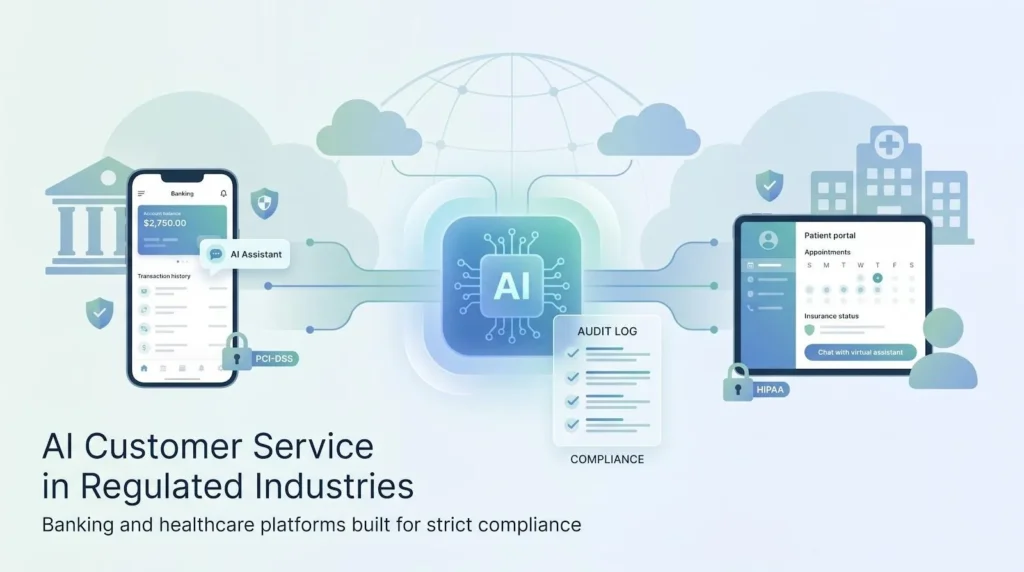
AI is reshaping customer service in regulated industries. Banks slash fraud-check queues, and hospitals answer midnight insurance questions—all while guarding account balances and protected health information under the strictest rules.
A new class of platforms meets that bar. Tools such as Comm100 bake SOC 2, HIPAA, PCI-DSS, and GDPR controls into every workflow. Agent-assist copilots avoid training on your data, and voice bots log each decision for auditors, proving that automation can satisfy even the toughest compliance teams.
In this guide, we’ll show you what makes a bot “bank-grade,” then compare the leading cross-industry, banking-specific, and healthcare-specific options so you can choose the right fit.
How we chose each platform?
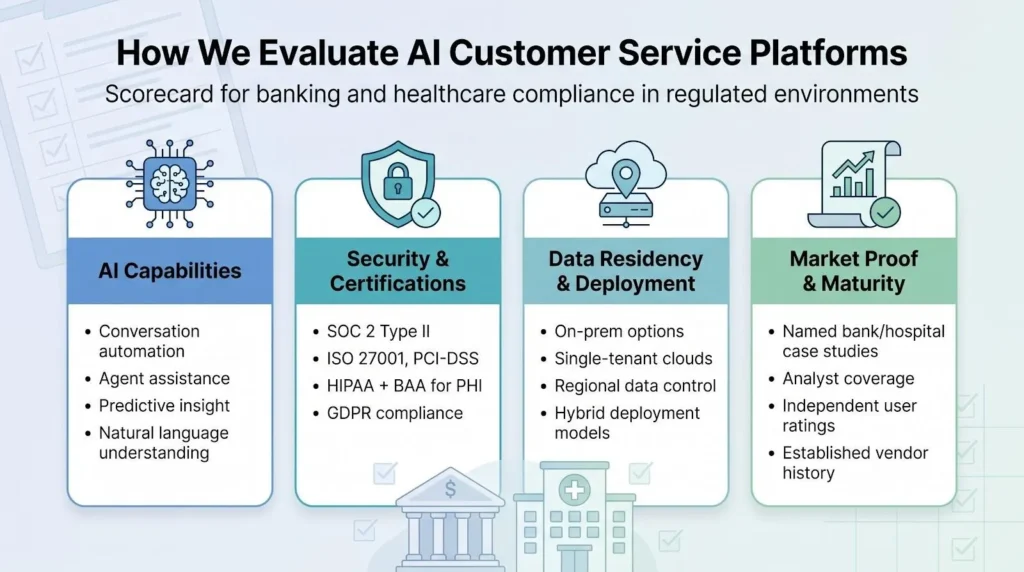
Before we highlight a tool, we need a shared yardstick. Compliance is a checklist that consultants and regulators study line by line, so we built a scorecard and ran every contender through it.
First, we verified real AI horsepower. A platform had to deliver conversation automation, agent assistance, or predictive insight powered by machine learning rather than rules-based scripts.
Second, we demanded security proof. Certifications that matter in boardrooms (SOC 2 Type II, ISO 27001, PCI-DSS for card data, and HIPAA with a signed BAA for PHI) were non-negotiable.
Third, we weighed data residency and deployment flexibility. Banks often need on-premises installs, while multi-region health systems prefer single-tenant clouds to keep PHI local. Platforms that offer both scored higher.
Finally, we checked market traction. Case studies with named banks or hospitals, analyst coverage, and independent user ratings signaled maturity.
Only software that cleared every bar appears in the list ahead. Now let’s see who earned their stripes.
Cross-industry platforms with deep compliance controls
Comm100
Comm100 feels like the pragmatic middle ground between heavyweight contact-center suites and lightweight chat widgets. Its unified console blends live chat, tickets, social messaging, and SMS so agents never juggle tabs. The real draw for regulated teams is under the hood: every interaction runs on infrastructure audited for SOC 2 Type II, ISO 27001, PCI-DSS, and, crucial for hospitals, HIPAA with a signed BAA. Need all data locked on-prem? Comm100 offers that too, a rare option outside seven-figure enterprise deals.
In 2025 the company rolled out an AI suite, and its AI-powered customer service software for regulated industries has since been tested to automate up to 80% of routine inquiries across banking and healthcare deployments. The flagship AI Agent deflects repetitive questions; AI Copilot suggests next-best replies for live agents; and AI Insights surfaces sentiment trends managers can act on. All learning stays within each customer’s tenant, so your transcripts never train a public model.
Banks appreciate the PCI layer and detailed audit logs; teaching hospitals lean on the on-prem deployment to keep PHI inside the firewall. Both groups benefit from deep CRM integrations with Salesforce, Dynamics 365, and HubSpot, plus connectors into Zendesk and ServiceNow for escalations.
Bottom line: if you want broad channel coverage wrapped in certifications your CISO can sign off on, Comm100 deserves a top spot on the shortlist.
eGain
eGain has spent two decades fine-tuning digital customer service for highly regulated teams. Today its Knowledge Hub sits at the core, feeding answers to chatbots, IVR, and human agents from a single, version-controlled source. That audit trail matters when an examiner asks who told a customer what and when.
Security paperwork is equally buttoned up. eGain Cloud runs on FedRAMP-authorized infrastructure, carries SOC 2 Type II reports, and offers HIPAA alignment for providers that sign its BAA. While the platform is cloud-first, banks that require local data residency can spin up a single-tenant instance in their chosen region.
AI features focus on guided decision trees and case-based reasoning. Instead of free-form generative replies, eGain’s “Virtual Financial Coach” and “Virtual Health Coach” walk customers through policy-driven workflows that cut error rates, ideal when a misplaced decimal could breach consumer-protection rules.
Integrations cover the usual suspects such as Salesforce, Microsoft Dynamics, and ServiceNow, but many enterprises rely on eGain’s open REST APIs to pipe conversation records into risk engines or EHRs for longitudinal analysis.
If your risk committee frowns on hallucinating chatbots yet still wants clear AI productivity gains, eGain offers a deterministic approach wrapped in enterprise-grade controls.
NICE CXone
NICE CXone sits at the enterprise end of the spectrum. It pairs a full contact-center stack (ACD, IVR, workforce management) with Enlighten AI, a library of pre-built models that score sentiment, predict churn, and coach agents in real time. Those models, trained on billions of anonymized interactions, feel seasoned out of the box.
On compliance, NICE checks boxes few rivals touch. The CXone cloud is FedRAMP authorized for U.S. public-sector work, carries PCI-DSS Level 1 for card payments, and offers a HIPAA Business Associate Agreement so hospitals can route protected health information without legal gymnastics. For global banks that keep data within borders, single-tenant regional pods handle residency rules with minimal fuss.
Security is not the only draw. Enlighten Autopilot lets teams spin up task-specific chatbots for balance look-ups, claims status, or password resets, while Enlighten Actions surfaces customer-level insights that risk officers can export directly into GRC tools. The result is smarter self-service on the front end and cleaner audit trails on the back.
If you need AI that scales across thousands of agents and satisfies regulators on three continents, CXone delivers industrial strength without the forklift-upgrade headache of legacy on-prem systems.
Zendesk
Zendesk started life as a help desk for scrappy startups, but its Enterprise Suite has grown into a compliance-ready workhorse. The platform encrypts data in transit and at rest, offers role-based access controls, and publishes annual SOC 2 Type II reports that calm most auditors. For healthcare buyers, a HIPAA BAA is available on the Suite Professional tier and above.
AI shows up in two places. Zendesk AI triages tickets, predicts intent, and suggests macros so agents respond faster. The Advanced Data Privacy add-on can also strip sensitive fields from training sets, a small but welcome nod to data-minimization rules in finance.
Banks like Zendesk because it plugs neatly into Salesforce, nCino, and Temenos without mountains of custom code. Hospitals rely on its HL7-friendly webhooks to sync case notes back to EHRs. Either way, setup stays light thanks to the marketplace of more than 1,300 pre-built apps.
Is it the cheapest option? Not by a long shot. Yet if you want polished omnichannel workflows and a compliance story the board will understand, Zendesk holds its seat at the table.
Intercom
Intercom made its name with slick in-app messengers, and that DNA still shows. Customers can chat from a banking app or patient portal without switching channels, while behind the curtain agents work from a single inbox that merges email, chat, and social.
For regulated buyers, the headline is Intercom Fin, a deployment option that isolates data in region-specific clouds and adds audit logging built for PCI and SOC 2 reviewers. Healthcare teams can turn on the HIPAA add-on, which encrypts PHI, redacts sensitive fields in analytics, and comes with a signed BAA.
The AI story centers on Fin AI Copilot. It searches connected knowledge bases, drafts answers, and warns agents when a reply may violate policy. There is also Fin Self-Serve, a chatbot that can handle password resets or coverage checks without touching production databases, thanks to a secure functions layer.
Intercom’s marketplace is not as vast as Zendesk’s, but banking plugins for Plaid and Stripe, plus EHR connectors from Redox and Healthie, cover common compliance integrations. Setup remains developer-friendly with webhooks and GraphQL APIs for edge cases.
If you need consumer-grade UX with enterprise-grade controls and have engineers who enjoy tinkering, Intercom provides a balanced choice.
Freshworks (Freshchat + Freshdesk)
Freshworks built its reputation on fast deployment, and that ethos carries into regulated industries. Spin up Freshchat for real-time messaging and Freshdesk for ticketing, then stitch them together with a toggle. Because both modules live in the same AWS footprint, single sign-on and audit trails work out of the box.
On the compliance front, Freshworks publishes SOC 2 Type II and ISO 27001 reports annually, plus PCI-DSS attestation for in-chat payments. Healthcare customers can turn on a HIPAA mode that masks PHI in logs and locks data to a U.S.-only cluster under a Business Associate Agreement.
The Freddy AI engine handles intent detection, suggested replies, and bot workflows. While it lacks the deep sentiment scoring of NICE, Freddy’s strength is approachability: non-technical teams can drag-and-drop flows that pull balance data from core banking APIs or appointment slots from EHRs without writing code.
Integrations are another highlight. More than 1,200 marketplace apps connect to Salesforce, Epic, FIS, and DocuSign, so regulated teams rarely start from scratch. Pricing also stays friendly, with per-agent seats often lower than larger suites, freeing budget for security add-ons such as IP whitelisting and custom data retention rules.
For teams that want enterprise-grade guardrails without enterprise-grade complexity, Freshworks offers a clean, modular path into AI-assisted support.
Banking-specific platforms
Kasisto (KAI)
Kasisto was born inside the banking stack, not bolted on later, and that pedigree shows. Its KAI platform speaks the language of core deposits, card disputes, and Reg E timelines right out of the box, freeing teams from month-long intent-training projects.
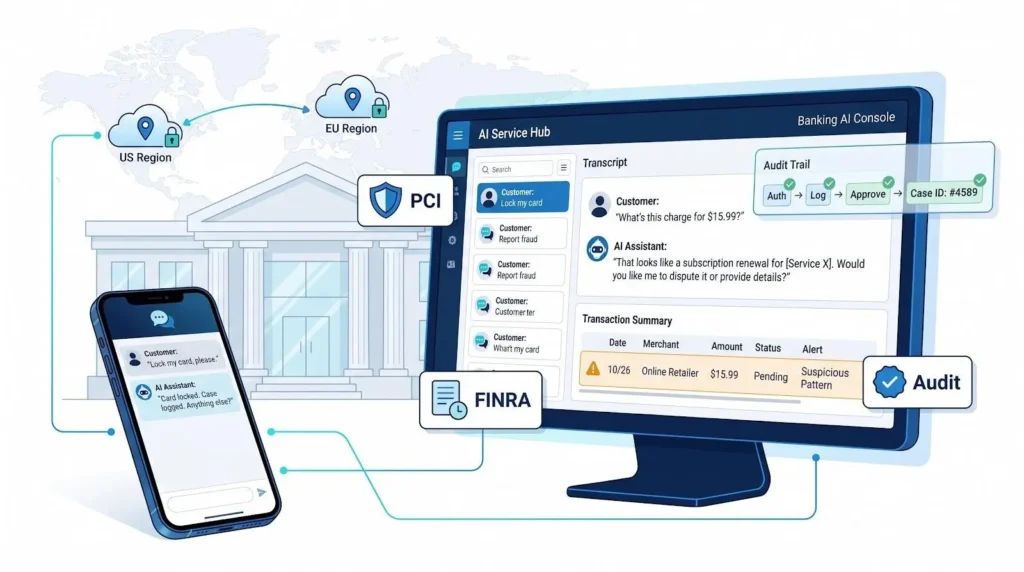
Compliance sits at the architecture level. Every conversation is tokenized, encrypted, and stamped with a non-repudiable audit hash. The company maintains PCI-DSS compliance for card flows and supports FINRA text-retention rules so records slot straight into enterprise archives. Regional cloud deployment keeps data within national borders, a critical feature for banks under strict residency laws.
On the AI side, the new KAIgentic release moves beyond scripted chatbots. Picture agentic workflows that fetch a customer’s balance, flag a suspicious ACH, and offer to lock the debit card, all without an agent touching the keyboard. Kasisto reports 85 percent containment rates and a 50 percent cut in service costs.
Integration work is light. REST connectors talk to FIS, Fiserv, and Temenos cores, while pre-built skills handle more than 120 common banking tasks, from bill-pay setup to Zelle enrollment. That speed to value explains why regional credit unions sit alongside multinational banks on the roster.
If you want a chatbot that already thinks like a seasoned banker and keeps examiners calm, Kasisto is an easy first call.
Glia
Glia rethinks customer service as a single “digital branch.” When a cardholder gets stuck online, an agent can jump in with chat, audio, or video with no downloads and no channel switch. That real-time co-browsing has made Glia a favorite among community banks and credit unions that want white-glove help without brick-and-mortar costs.
Security stays front and center. All media streams are WebRTC encrypted, each click is logged for FINRA retention, and a PCI-compliant secure zone masks sensitive fields before screen sharing begins. For institutions facing FFIEC scrutiny, Glia’s regional hosting and granular role controls satisfy examiner checklists.
AI arrives through Glia Virtual Assistants. Built on intent libraries tuned to banking tasks such as card-activation glitches or mortgage payoff questions, they can hand off context to a live agent with a single click. Supervisors see sentiment analytics and resolution times in dashboards ready for quarterly risk reports.
Integration is pragmatic. Glia overlays existing online banking systems such as Fiserv, Jack Henry, and Q2 through a lightweight JavaScript snippet, so projects wrap in weeks rather than quarters. That speed, paired with co-browsing that feels like a branch visit, explains why membership-driven institutions keep rolling it out.
For banks that value human touch but need tighter margins, Glia provides concierge-level support without the real estate bill.
Personetics
Personetics sees itself as the brain behind a bank’s front line, not the front line itself. Its AI analyzes transaction data in real time to surface proactive “financial wellness” insights like missing paycheck alerts, upsell offers, or spending nudges, then delivers them through the bank’s existing mobile app or web portal.
This data-first model brings compliance advantages. Processing happens inside the bank’s secure environment, and Personetics never stores raw customer data in its own cloud. The platform supports GDPR and CCPA data-subject rights, publishes SOC 2 Type II reports, and maintains PCI-DSS Level 1 for card analytics. For institutions under OCC model-risk guidelines, Personetics ships transparent rule explanations and challenger models so risk teams can validate outputs.
Rather than rely on a standalone chatbot, Personetics embeds its intelligence directly into existing digital banking platforms. In June 2026 the company announced an integration with Fiserv Experience Digital (XD) that lets institutions deliver real-time, contextual guidance inside their apps.
Integration is API-driven. Banks feed Personetics daily or real-time transaction streams, and the platform returns insight objects ready for display in Jack Henry Banno, Q2, or custom apps. Time to launch averages four to six months, a fraction of typical core modernization projects.
If your goal is to turn raw transaction data into helpful, compliant coaching instead of basic chat deflection, Personetics brings the analytics muscle to make it happen.
Boost.ai
Norway-based Boost.ai started in Nordic banking, where regulators are famously strict. That crucible produced a conversational AI platform that treats compliance as a design principle rather than an afterthought.
Each bot runs on a self-hosted language model that lives inside the bank’s cloud tenancy, so chat transcripts never leave the institution’s perimeter. Role-based controls define who can review training data, and immutable audit logs record every model update for internal model-risk committees.
Scale sets Boost apart. Its intent engine can juggle more than 10,000 topics without degradation, letting banks cover esoteric queries such as “How do I change the PIN on my prepaid gift card?” alongside mortgage basics. An intent hierarchy groups similar questions so risk teams can approve answers in bulk, cutting compliance review cycles from weeks to days.
Clients integrate via REST or a low-code builder that connects to core systems like Temenos T24, SAP Fioneer, or even green-screen AS/400 setups through RPA connectors. Deployment time averages three months, and once live, the bot typically automates 60 percent of inbound chats, freeing agents for fraud or retention calls.
If your institution fields a sprawling question set across multiple languages and must track every AI tweak for regulators, Boost.ai delivers industrial-grade governance with Nordic efficiency.
Healthcare-specific platforms
Nuance Patient Engagement
Nuance spent decades perfecting medical speech-to-text, so it already lives deep inside many hospital workflows. Its Patient Engagement suite brings that expertise to front-end support with voice and chatbots that understand clinical language and insurance jargon in equal measure.
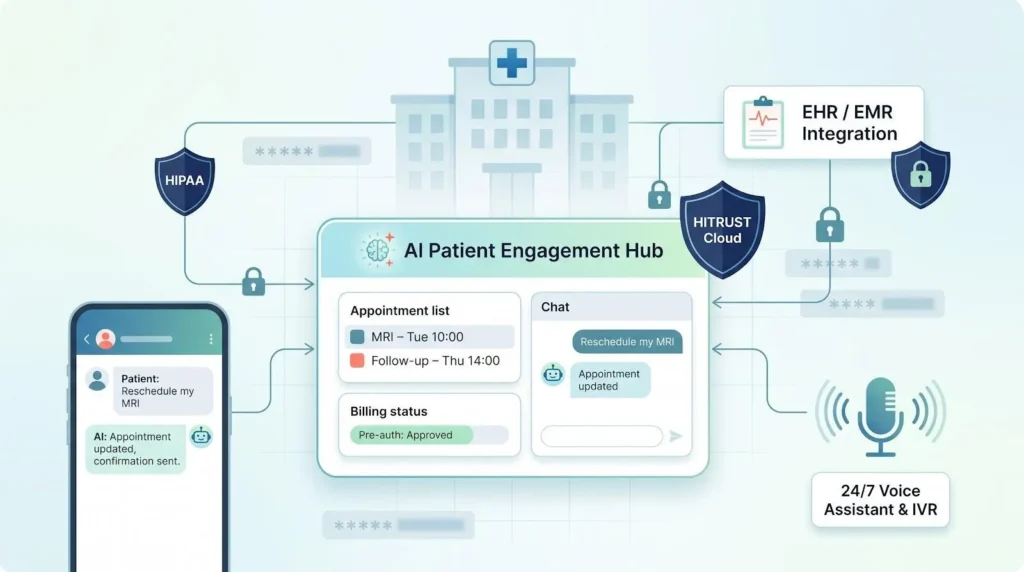
Security is a selling point. Nuance runs on Microsoft Azure’s HITRUST-certified cloud, signs HIPAA BAAs by default, and redacts protected health information from training data before tuning begins. Real-time anomaly detection flags suspicious access, an audit win for CIOs concerned about ransomware.
The Intelligent Virtual Assistant stands out. Patients can reschedule an MRI, check pre-auth status, or pay a bill through conversational prompts tied directly into Epic, Cerner, or MEDITECH via HL7 and FHIR connectors. If the bot hits an edge case, it hands off context and the transcribed call to a live agent so no one repeats details.
Automating high-volume tasks such as appointment reminders frees nursing staff for hands-on care, while quicker bill-pay interactions improve cash flow. Because the same natural-language engine powers Dragon Medical, clinicians trust that diagnoses and drug names stay accurate.
If you want to lighten call-center load without risking HIPAA or clinical accuracy, Nuance provides proven reliability wrapped in familiar integrations.
Hyro
Hyro calls itself “the adaptive communications platform,” and the label fits. Instead of training rigid intents, Hyro uses a knowledge graph and large language models to parse any scheduling, billing, or triage question patients ask. The result is a chatbot that feels conversational yet still respects HIPAA guardrails.
Hyro’s architecture keeps PHI safe. Encryption keys stay in the customer’s cloud tenancy, transcripts are tokenized, and a zero-trust access model means even Hyro engineers cannot peek without explicit approval. An automated redaction layer strips identifiers before logs feed analytics, so data science never clashes with privacy.
Deployment is swift. Drop a JavaScript snippet on your site or an SDK in your mobile app, connect your EHR via FHIR, and Hyro auto-discovers appointment types, clinician calendars, and insurance workflows. Go-live can take as little as 30 days, a relief for resource-strapped IT teams.
Routing prescription refills, password resets, and parking questions to self-service frees call-center nurses for complex cases. Real-time dashboards show deflection percentages alongside patient-satisfaction scores, turning anecdote into evidence.
For quick wins without a six-month NLP tuning project, Hyro offers plug-in AI that respects both clinicians’ time and regulators’ rules.
Luma Health
Luma Health tackles patient access from every angle: text reminders, smart waitlists, referral outreach, and now conversational AI at the center. Patients chat with Luma’s “Patient Success Bot” to find an open slot, upload insurance cards, or check imaging prep instructions, trimming the back-and-forth that clogs call queues.
HIPAA is table stakes, but Luma adds extras that hospital CISOs value. Data flows through a HITRUST-certified AWS environment, audit logs feed directly into Splunk or Datadog, and role-based masking hides Social Security numbers from contact-center temps. If your health system operates across state lines, regional data pods keep PHI inside designated jurisdictions for privacy-shield compliance.
The AI engine relies on deep EHR hooks. Using FHIR APIs, it can surface a surgeon’s real-time schedule, auto-verify insurance eligibility, and trigger post-op surveys without middleware. These closed-loop integrations shrink no-show rates and boost completed referrals, two metrics that directly hit revenue.
Administrators can tweak bot language, add pre-visit forms, or set escalation rules without code. Dashboards track deflection rates and patient satisfaction so operations teams see value in hard numbers, not anecdotes.
For health systems seeking operational efficiency and patient-friendly digital front doors, Luma Health delivers an AI layer that feels personal yet stays rigorously compliant.
Orbita
Orbita focuses on voice-first experiences, a priority when patients have low vision, limited mobility, or simply prefer speaking to typing. Its HIPAA-compliant platform powers voice assistants on smart speakers, bedside devices, and mobile apps, letting patients refill prescriptions or check post-op instructions hands-free.
Data security meets hospital expectations. PHI is encrypted end to end, voice recordings are anonymized before NLP processing, and all assets sit in a HITRUST-certified cloud with regional data residency options. Detailed audit logs capture every utterance and intent match for compliance reviews.
The magic lives in Orbita’s clinical workflow builder. Drag-and-drop connectors tie voice commands to Epic, Cerner, or custom REST endpoints, so a request like “When is my next physical therapy session?” pulls real-time scheduling data instead of canned responses. A fallback pathway escalates to live nursing staff via secure callback if the bot senses frustration or low confidence.
Voice appointment reminders cut no-shows among elderly patients who rarely check email, while medication adherence bots nudge chronically ill users at the exact time they need to take pills. These gains feed into better HCAHPS scores and, in turn, reimbursement metrics.
If accessibility, hands-free convenience, and strict HIPAA controls are priorities, Orbita gives you a voice channel that speaks healthcare’s language.
Memora Health
Memora Health takes a care-pathway angle rather than a call-center one. Its AI platform guides patients through prenatal care, chronic-disease management, and post-surgical recovery with automated SMS check-ins that feel like a friendly nurse texting, “How’s the pain today?”
Because the conversations collect vitals and medication-adherence data, Memora runs inside a HIPAA-certified, HITRUST CSF environment. Every reply is time-stamped, encrypted, and surfaced to clinicians through FHIR APIs into Epic or Cerner, creating a closed loop between outreach and charting.
The AI triages responses. If a new mom texts “I’m bleeding heavily,” the system routes the ticket to an on-call nurse within seconds. If a diabetes patient reports stable glucose, it logs the metric and sends an encouragement snippet pulled from evidence-based libraries. This smart routing deflects up to 30 percent of calls, giving teams bandwidth for critical cases.
Implementation is light: import care plans, map escalation rules, and connect EHR credentials. Clinicians can adjust question cadences or education modules without code, so programs stay aligned with evolving protocols.
For health systems focused on longitudinal outcomes and value-based reimbursement, Memora’s mix of conversational AI and care-plan logic drives measurable engagement while staying safely inside HIPAA guardrails.
How the contenders stack up
| Platform | Industry focus | Stand-out AI modules | Key certifications | Deployment flexibility | Notable integrations |
| Comm100 | Banking & healthcare | AI Agent, Copilot, Insights | SOC 2, ISO 27001, PCI-DSS, HIPAA | Cloud or on-prem | Salesforce, Epic (FHIR), Twilio |
| Zendesk | Cross-industry | Zendesk AI, macros, intent routing | SOC 2, HIPAA (add-on) | Multi-tenant cloud | nCino, Epic (HL7), Stripe |
| NICE CXone | Cross-industry | Enlighten Autopilot, Actions | FedRAMP, PCI-DSS, HIPAA | Regional single-tenant pods | Salesforce, Genesys, ServiceNow |
| eGain | Cross-industry | Virtual Financial/Health Coach | SOC 2, FedRAMP, HIPAA-aligned | Single-tenant cloud | Microsoft Dynamics, Epic |
| Intercom | Cross-industry | Fin AI Copilot, Self-Serve | SOC 2, PCI controls, HIPAA (add-on) | Region-specific clouds | Plaid, Redox |
| Freshworks | Cross-industry | Freddy AI bots, analytics | SOC 2, ISO 27001, PCI-DSS, HIPAA mode | Multi-tenant cloud; US-only cluster | Epic (FHIR), DocuSign |
| Kasisto KAI | Banking | KAIgentic agentic AI | PCI-DSS, regional residency | Bank-hosted cloud or on-prem | FIS, Temenos |
| Glia | Banking | Co-browse, Virtual Assistants | SOC 2, PCI-DSS, FINRA logging | Regional clouds | Jack Henry, Q2 |
| Personetics | Banking | Predictive cash-flow coaching | SOC 2, PCI-DSS, GDPR | Bank-hosted processing | Jack Henry Banno, Q2 |
| Boost.ai | Banking | Large-scale intent engine | SOC 2, regional residency | Customer cloud tenancy | Temenos, SAP Fioneer |
| Nuance | Healthcare | Intelligent Virtual Assistant | HIPAA, HITRUST | Azure HITRUST cloud | Epic, Cerner |
| Hyro | Healthcare | Knowledge-graph conversational AI | HIPAA, HITRUST | Customer cloud keys | FHIR, Redox |
| Luma Health | Healthcare | Patient Success Bot | HIPAA, HITRUST | Regional data pods | Epic, Athenahealth |
| Orbita | Healthcare | Voice assistants, workflow builder | HIPAA, HITRUST | Regional clouds | Epic, Cerner |
| Memora Health | Healthcare | Care-pathway SMS AI | HIPAA, HITRUST | HITRUST cloud | Epic, Cerner |
Conclusion
Use this grid as a launchpad. List the certifications your auditors require, note where data must live, and shortlist vendors that meet both. The earlier profiles help you separate slick demos from real-world track records.