
The Hitachi ATM franchise is one of the most searched topics among entrepreneurs looking for a low-maintenance business opportunity with the potential to generate passive income. As India’s digital banking network continues to expand, ATMs remain an essential part of the country’s financial infrastructure, especially in areas where cash transactions are still common. This has created growing interest in ATM deployment businesses and site partnerships offered by leading ATM service providers.
The total investment can vary significantly based on the ATM model, location, civil work required, security arrangements, and infrastructure available at the site. Apart from the initial setup cost, investors should also understand the eligibility criteria, space requirements, documentation process, commission structure, and ongoing responsibilities before applying.
In this guide, you’ll find everything you need to know about the Hitachi ATM franchise cost in India for 2026, including the available ATM models, estimated investment, monthly earnings, application process, eligibility requirements, and practical tips to maximise your returns. Whether you’re a property owner or someone looking for a stable business opportunity, this article will help you make an informed decision.
What Is a Hitachi Money Spot ATM Franchise?

Although the term “Hitachi ATM franchise” is widely used online, the business model is different from a traditional franchise. Hitachi Payment Services, one of India’s leading ATM and payment solutions providers, installs and manages ATMs on behalf of banks and financial institutions. Rather than selling franchises in the conventional sense, the company works with property owners and business partners who provide suitable locations for ATM installation.
Under this arrangement, the partner typically provides the commercial space and ensures that the location meets the company’s infrastructure requirements. Hitachi is generally responsible for installing the ATM, integrating it with the banking network, and managing technical operations and maintenance. Depending on the agreement, the site owner may receive a fixed monthly rental, transaction-based commission, or another mutually agreed payment structure.
This business model has become popular because it requires comparatively less day-to-day involvement than many other businesses. Once the ATM is installed and operational, routine maintenance, cash replenishment, and technical servicing are generally handled by authorised agencies or banking partners, allowing the site owner to earn income with limited operational responsibilities.
Before applying, investors should verify that they are dealing directly with Hitachi Payment Services or an authorised business partner. Many fraudulent websites and agents claim to offer ATM franchises by requesting advance payments or registration fees. Always confirm the authenticity of any offer through the company’s official channels before sharing documents or making any payment.
Why ATM Franchises Continue to Be a Smart Business in India (2026 Market Overview)
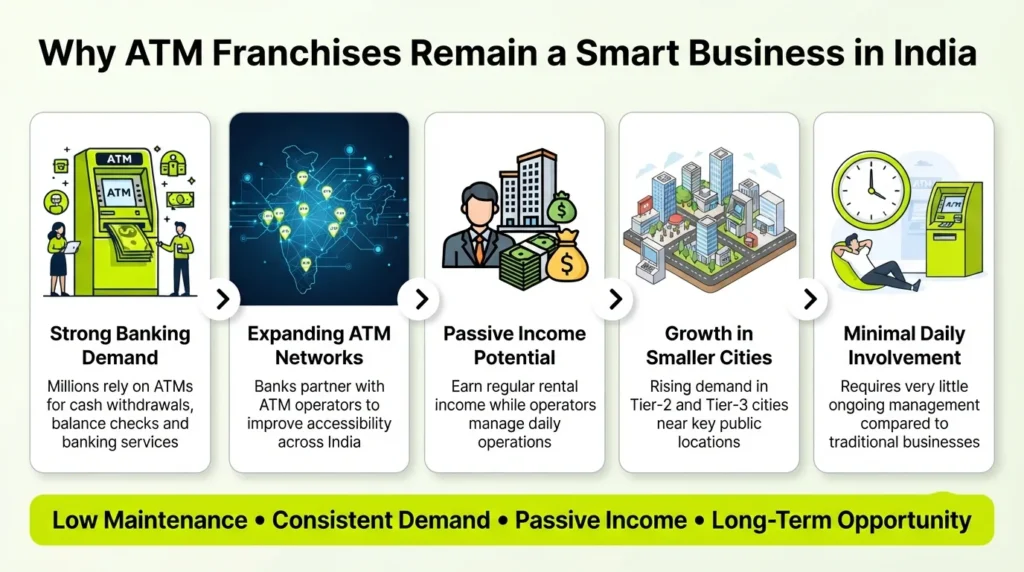
India is witnessing continuous expansion in banking services due to financial inclusion initiatives, increasing bank account penetration, and the growing demand for accessible banking infrastructure. As banks aim to improve customer convenience without opening new branches, ATMs continue to be a cost-effective solution. This creates opportunities for property owners who have commercial spaces in high-footfall locations.
Some of the key reasons why ATM businesses continue to remain relevant include:
- Growing demand for banking access: Although online banking has become common, millions of people still depend on ATMs for cash withdrawals, balance enquiries, mini statements, PIN generation, and other banking services. Small businesses, daily wage workers, and customers in areas with limited banking infrastructure continue to rely heavily on ATM services.
- Expansion of banking services: Public and private sector banks continue to expand their ATM networks to improve customer accessibility. Instead of establishing new bank branches, many financial institutions partner with ATM service providers such as Hitachi Payment Services to deploy ATMs at strategic locations, making ATM sites an important part of India’s banking infrastructure.
- Stable passive income opportunity: For property owners, leasing commercial space for an ATM can provide a relatively stable source of income. Since the ATM operator is generally responsible for installation, maintenance, and technical operations, the day-to-day involvement required from the site owner is limited compared to running a retail business.
- Demand in Tier-2 and Tier-3 cities: Smaller cities and developing towns continue to experience increasing demand for banking facilities. Locations near hospitals, bus stands, railway stations, educational institutions, residential colonies, and local markets often witness regular ATM usage due to consistent public footfall.
Although digital payments will continue to grow, ATMs are expected to remain an essential banking channel for the foreseeable future. Choosing the right location with strong daily footfall remains the biggest factor in maximising the earning potential of a Hitachi ATM partnership.
Hitachi ATM Models Explained: Basic, Emerald, and Topaz
Hitachi Payment Services offers different ATM deployment models to meet the varying requirements of banks and locations. While the exact specifications may differ based on the banking partner and project requirements, the company generally categorises its ATM solutions into Basic, Emerald, and Topaz models. Each model is designed for different transaction volumes, customer needs, and site conditions.
Understanding these models can help prospective partners identify which type of ATM is best suited for their available space and expected customer traffic.
Basic Model
The Basic model is designed for locations with moderate customer traffic where the primary requirement is reliable cash withdrawal services. These ATMs generally occupy less space and require a lower infrastructure setup compared to larger deployment models.
The Basic model is commonly installed at:
- Residential neighbourhoods
- Small commercial complexes
- Local markets
- Educational institutions
- Semi-urban locations
This model is suitable for locations where daily transactions are consistent but not exceptionally high.
Emerald Model
The Emerald model is intended for medium to high-traffic commercial locations. These ATMs are often equipped with additional features and are deployed where customers require faster and more efficient banking services throughout the day.
Typical installation locations include:
- Shopping malls
- Business districts
- Large residential townships
- Hospitals
- Commercial office complexes
Because these locations generally attract more visitors, Emerald ATMs often process a higher number of daily transactions than the Basic model.
Topaz Model
The Topaz model is designed for high-volume locations where customer demand is consistently strong. These ATMs are commonly installed at major transportation hubs and premium commercial areas that experience heavy footfall throughout the day.
Common locations include:
- Railway stations
- Airports
- Metro stations
- Major business centres
- High-street commercial areas
Since these sites usually generate a higher number of ATM transactions, they may offer better earning potential for property owners, provided the location meets all operational requirements and receives approval from the ATM service provider.
The final ATM model selected for a location depends on several factors, including customer demand, available space, infrastructure, security, accessibility, and the requirements of the partnering bank. During the site evaluation process, Hitachi Payment Services assesses these factors before determining the most suitable deployment option for the proposed location.
Suggested Read:
Hitachi ATM Franchise Cost in India: Complete Investment Breakdown (2026)
One of the biggest reasons people search for the cost of Hitachi ATM franchise is to understand how much capital is required to start the business. Unlike traditional franchises, there is no standard franchise package with a fixed investment. The actual cost depends on whether you are simply leasing your property for ATM installation or partnering under a specific deployment model.
If the location already has the required infrastructure, the initial investment can be considerably lower. On the other hand, if major civil work or utility upgrades are required, the setup cost will naturally increase. Before making any investment, it is advisable to obtain a written estimate from the authorised representative handling your application.
The table below provides an estimated cost breakdown for setting up a Hitachi ATM site in India.
| Expense | Estimated Cost (₹) |
| Security Deposit (if applicable) | Depends on agreement |
| Civil Work & Site Preparation | ₹50,000–₹2 lakh |
| Electrical Installation | ₹20,000–₹75,000 |
| Internet & Communication Setup | ₹10,000–₹30,000 |
| Air Conditioner (if required) | ₹30,000–₹60,000 |
| CCTV & Security Arrangements | ₹25,000–₹1 lakh |
| Signage & Exterior Improvements | ₹15,000–₹50,000 |
| Miscellaneous Expenses | ₹20,000–₹50,000 |
| Estimated Initial Investment* | ₹1.5 lakh–₹5 lakh |
*The above figures are indicative estimates. The final investment depends on the condition of the property, infrastructure already available, location, and the agreement signed with Hitachi Payment Services or the partnering bank.
What Factors Affect the Total Investment?
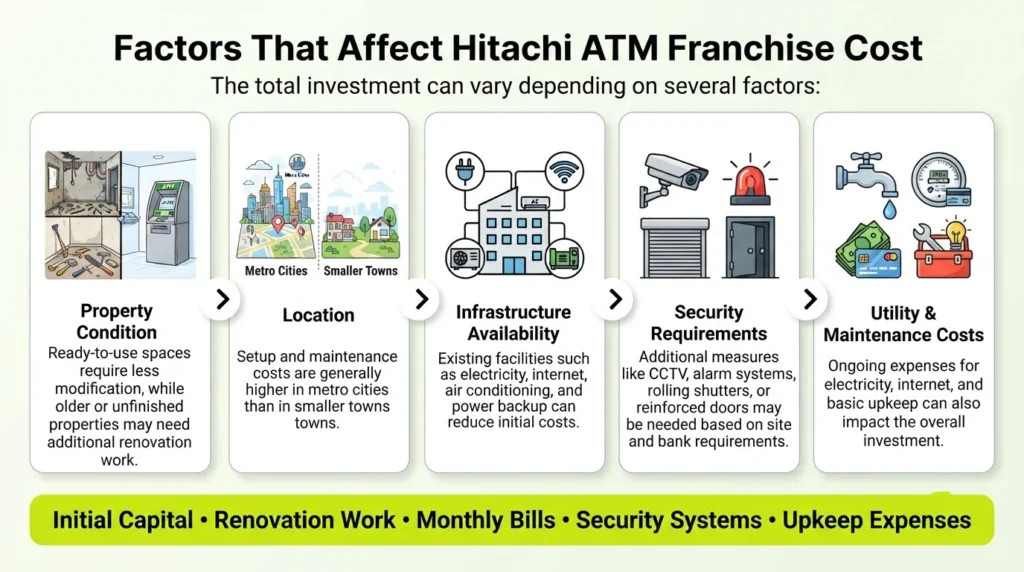
The total Hitachi ATM franchise cost is not the same for every applicant. Several factors influence the amount you may need to invest before the ATM becomes operational.
- Property condition: A ready-to-use commercial property with proper flooring, electricity, and internet connectivity usually requires fewer modifications. Older properties or unfinished commercial spaces may require additional civil work, increasing the overall setup cost.
- Location of the site: ATMs installed in metropolitan cities generally involve higher construction and maintenance costs than those in smaller towns. Rental values, labour charges, and utility expenses can also vary significantly from one city to another.
- Infrastructure availability: If facilities such as uninterrupted power supply, air conditioning, CCTV surveillance, and internet connectivity are already available, the initial investment can be considerably lower.
- Security requirements: Depending on the site and the partnering bank’s guidelines, additional security measures such as rolling shutters, alarm systems, or reinforced doors may be required before installation approval is granted.
Understanding these factors will help you estimate your investment more accurately and avoid unexpected expenses during the setup process.
Hitachi ATM Commission Structure and Monthly Earnings
One of the biggest attractions of a Hitachi ATM partnership is the opportunity to earn regular income from a commercial property without actively managing a day-to-day business. However, the amount you earn depends on the agreement, the location of the ATM, and the number of transactions it processes each month.
There is no fixed nationwide commission structure published by Hitachi Payment Services because payment terms may differ depending on the partnering bank, deployment model, and contractual arrangement. In most cases, property owners earn through one of the following methods.
Fixed Monthly Rent
Some agreements provide a fixed monthly rental for the commercial space where the ATM is installed. This model offers predictable income regardless of the number of customer transactions.
The rental amount generally depends on:
- City and locality.
- Size of the commercial space.
- Daily footfall.
- Market rental rates.
- Bank or ATM operator’s requirements.
Transaction-Based Commission
In certain cases, earnings may be linked to the number of successful ATM transactions completed every month. Locations with higher customer traffic usually generate more transactions, resulting in higher income.
The monthly commission largely depends on:
- Number of daily ATM users.
- Type of transactions performed.
- Cash withdrawal frequency.
- Nearby competition from other ATMs.
- Overall banking activity in the area.
Combination of Rent and Performance-Based Earnings
Some commercial arrangements may combine a fixed rental payment with performance-based incentives linked to transaction volume. The exact payment structure varies depending on the contract and should always be confirmed before signing the agreement.
How Much Can You Earn Per Month?
There is no guaranteed monthly income because earnings vary from one location to another. However, ATM sites situated in high-footfall commercial areas such as markets, hospitals, transportation hubs, office complexes, and residential neighbourhoods generally have better earning potential than locations with lower customer activity.
Before accepting any proposal that promises unusually high monthly returns, verify the information directly with Hitachi Payment Services or the partnering bank. Be cautious of websites or agents claiming “guaranteed income” without providing official documentation, as genuine earnings always depend on the terms of the agreement and the performance of the ATM location.
Eligibility Criteria to Get a Hitachi ATM Partnership
Before approving a new ATM location, Hitachi Payment Services carefully evaluates both the applicant and the proposed site. Since ATMs are installed to provide banking services to the public, the company ensures that the location is commercially viable, secure, and capable of handling uninterrupted operations. Understanding the Hitachi ATM franchise cost and meeting the basic eligibility requirements can improve the chances of your application being shortlisted, although the final approval depends on the company’s internal assessment and the partnering bank’s requirements.
While the eligibility criteria may vary slightly depending on the deployment model and the city, most applicants are expected to satisfy the following requirements:
You Must Own or Have Legal Rights to the Property
The applicant should either own the commercial property or have a valid lease agreement that allows the space to be used for ATM installation. During the verification process, you may be required to provide ownership documents or a registered lease agreement as proof.
The Property Should Be Commercially Suitable
Not every location qualifies for an ATM installation. The site should ideally be situated in an area with good public visibility, easy accessibility, and consistent customer footfall. Locations near markets, hospitals, educational institutions, residential societies, petrol pumps, railway stations, and business centres generally have a higher chance of approval.
Basic Infrastructure Should Be Available
The proposed site should have the necessary infrastructure required for ATM operations. This typically includes:
- Continuous electricity supply.
- Stable internet or communication connectivity.
- Proper lighting around the ATM.
- Adequate ventilation or air conditioning.
- Space for CCTV cameras and security equipment.
If these facilities are not already available, the applicant may need to arrange them before the ATM is installed.
Compliance with Local Regulations
The property should comply with applicable municipal regulations and should not be involved in any legal disputes. Depending on the location, additional approvals or permissions may also be required before installation.
Meeting these eligibility requirements does not guarantee approval, but it significantly increases the likelihood of your application moving to the site inspection stage. The final decision is based on factors such as market demand, transaction potential, and the business requirements of Hitachi Payment Services and its banking partners.
Space and Infrastructure Requirements for a Hitachi ATM
One of the most important factors in obtaining a Hitachi ATM partnership is selecting the right location. Since the Hitachi ATM Franchise cost involves significant investment, choosing a suitable site becomes crucial for long-term success. Even if all documents are complete, an unsuitable site may not receive approval. The company evaluates the property’s size, accessibility, security, and transaction potential before deciding whether an ATM should be installed.
Generally, the following infrastructure requirements should be met:
| Requirement | Typical Specification |
| Minimum Space | Approximately 50–80 sq. ft. |
| Property Type | Ground floor commercial space preferred |
| Electricity | 24×7 power supply with proper wiring |
| Internet Connectivity | Stable broadband or leased-line connection |
| Accessibility | Easy public access throughout the day |
| Visibility | Main road or high-footfall location preferred |
| Security | CCTV surveillance and adequate lighting |
| Air Conditioning | Required for smooth ATM operation |
| Parking | Preferred, especially in commercial areas |
Apart from the physical infrastructure, the surrounding environment also plays an important role in the approval process.
Some of the key factors considered during site evaluation include:
- Customer footfall: Locations with a large number of daily visitors generally perform better because they generate more ATM transactions. Commercial markets, hospitals, shopping complexes, office buildings, transport hubs, and residential neighbourhoods are usually preferred.
- Safety and security: The ATM should be installed in a well-lit area with proper surveillance. Safe locations not only protect customers but also reduce operational risks such as theft or vandalism.
- Ease of access: Customers should be able to reach the ATM conveniently without unnecessary restrictions. Ground-floor properties with direct road access are generally preferred over locations that require climbing multiple floors or passing through restricted premises.
- Availability of utilities: Continuous electricity, internet connectivity, and sufficient ventilation are essential for uninterrupted ATM operations. Frequent power failures or poor network connectivity can lead to downtime, affecting customer experience and transaction volume.
Providing a well-located property with the required infrastructure can significantly improve the chances of approval while also increasing the ATM’s long-term earning potential.
Documents Required for a Hitachi ATM Partnership Application
Once your property meets the eligibility criteria, you will need to submit supporting documents for verification. These documents help the company confirm your identity, verify property ownership, and assess whether the proposed site is suitable for ATM installation.
Although document requirements may vary depending on the project and the partnering bank, applicants are generally expected to provide the following:
| Document | Purpose |
| Aadhaar Card | Identity verification |
| PAN Card | Financial and tax verification |
| Passport-size Photographs | Applicant identification |
| Property Ownership Documents or Registered Lease Agreement | Proof of legal possession of the site |
| Electricity Bill | Address and utility verification |
| Bank Account Details | For future payments, if approved |
| Cancelled Cheque | Bank account verification |
| Site Photographs | Preliminary evaluation of the proposed location |
Before submitting your application, ensure that all documents are valid, updated, and consistent with the details provided in the application form. Incomplete documentation can delay the verification process or lead to rejection.
It is also advisable to submit documents only through official channels. Avoid sharing personal information with unknown agents or third-party websites that claim to offer guaranteed ATM franchises. Always verify that you are communicating directly with Hitachi Payment Services or an authorised representative before providing sensitive information or signing any agreement.
Step-by-Step Process to Apply for a Hitachi ATM Partnership
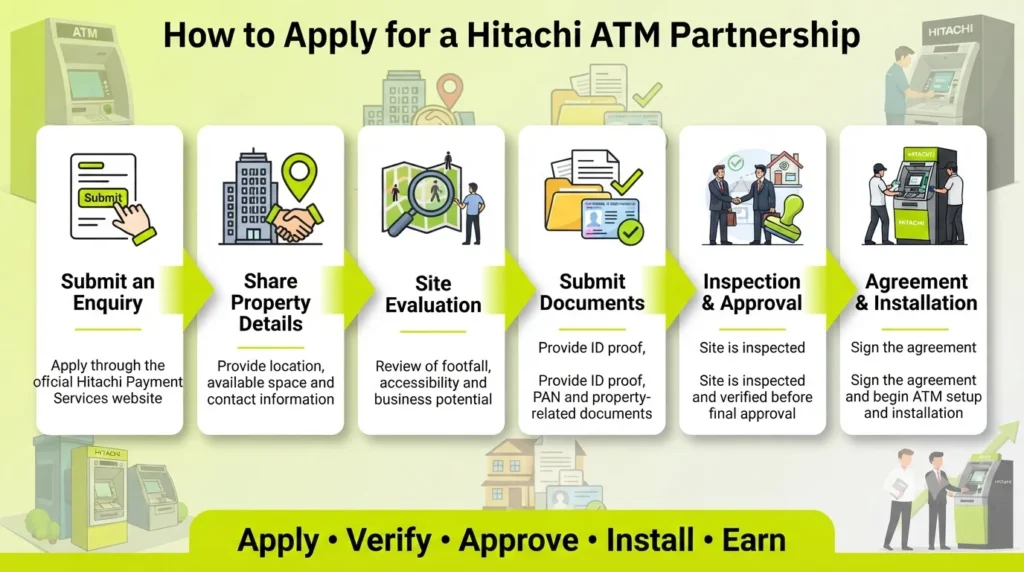
If you have a suitable commercial property and meet the basic eligibility requirements, you can begin the application process for a Hitachi ATM partnership. The approval process involves multiple stages, including document verification, site inspection, and feasibility assessment. Since ATM installations are based on business requirements and transaction potential, every application is evaluated individually.
Follow these steps to apply for a Hitachi ATM partnership in India:
Step 1: Visit the Official Website
Start by visiting the official website of Hitachi Payment Services and navigate to the section related to ATM solutions or business enquiries. Always use the company’s official website to avoid fraudulent portals that promise guaranteed franchise approvals.
Step 2: Submit Your Business Enquiry
Fill in the enquiry or contact form with accurate information, including:
- Applicant’s name
- Mobile number and email address
- Property address
- City and state
- Available space
- Type of commercial property
Providing complete and accurate details helps the company assess whether your property meets its initial requirements.
Step 3: Property Evaluation
Once your enquiry is received, the company or its authorised representative may evaluate your proposed location. During this stage, factors such as customer footfall, accessibility, nearby banks, competing ATMs, security, and commercial viability are assessed.
If additional information is required, you may be asked to share photographs or conduct a preliminary discussion with the company’s team.
Step 4: Submit Required Documents
If the location appears suitable, you will be asked to submit the necessary documents for verification. These may include identity proof, PAN card, property ownership or lease documents, electricity bill, bank account details, and other supporting documents.
The company verifies these documents before moving to the next stage of the approval process.
Step 5: Site Inspection and Approval
After successful document verification, an authorised representative may conduct a physical inspection of the proposed site. The inspection ensures that the property satisfies the required infrastructure, safety, and operational standards.
If the site meets all the necessary requirements and aligns with the company’s deployment plans, the application may be approved.
Step 6: Agreement and ATM Installation
Once approval is granted, both parties sign the agreement outlining the commercial terms and responsibilities. The ATM installation process then begins, including civil modifications (if required), electrical work, internet connectivity, branding, security systems, and machine installation.
After successful testing and activation, the ATM becomes operational and starts serving customers.
Pros and Cons of a Hitachi ATM Partnership
Before investing your time and property in an ATM partnership, it is important to evaluate both its advantages and limitations. While the business offers relatively stable income with minimal operational involvement, it also depends heavily on location and transaction volume. Understanding the Hitachi ATM Franchise cost and associated requirements can help you make a more informed investment decision.
Pros
- Passive income opportunity: Once the ATM is installed and operational, the day-to-day involvement required from the property owner is generally limited. This makes it an attractive option for individuals looking to generate income from an unused commercial property.
- Low operational responsibility: In most cases, technical maintenance, software updates, cash management, and machine servicing are handled by the ATM operator or the partnering bank. This significantly reduces the management effort compared to operating a retail business.
- Long-term commercial utilisation: Leasing space for an ATM allows property owners to generate income from locations that might otherwise remain vacant. Well-performing ATM sites may continue operating for several years, providing a relatively stable revenue stream.
- Growing banking infrastructure: As banking services continue to expand across India, ATMs remain an important part of financial inclusion, particularly in areas where cash transactions are still common.
Cons
- No guaranteed approval: Meeting the eligibility criteria does not guarantee that your application will be accepted. The company evaluates each site based on business feasibility, market demand, and existing ATM coverage.
- Income depends on location: The earning potential of an ATM is closely linked to customer traffic. Locations with low footfall may generate fewer transactions, resulting in lower returns than expected.
- Limited control over operations: Since the ATM is managed by the operator or partnering bank, the property owner has limited control over operational decisions such as cash replenishment schedules, maintenance activities, or service upgrades.
- Possibility of site closure: If an ATM consistently records low transaction volumes or the business requirements change, the operator may decide to relocate or discontinue the ATM in accordance with the agreement.
Considering these factors will help you determine whether a Hitachi ATM partnership is suitable for your property and financial goals.
Tips to Maximise Your Hitachi ATM Earnings
Although ATM operators manage the technical aspects of the business, property owners can still take several steps to improve transaction volume and maximise their earnings. Choosing the right location and maintaining a customer-friendly environment play a significant role in the long-term performance of the ATM.
Some practical ways to improve earning potential include:
- Choose a high-footfall location: Install the ATM in areas with consistent public movement, such as shopping markets, hospitals, petrol pumps, bus terminals, railway stations, office complexes, or densely populated residential areas. Higher footfall generally leads to more transactions.
- Ensure easy accessibility: Customers should be able to access the ATM conveniently throughout the day. A ground-floor location with clear visibility from the main road often performs better than a hidden or difficult-to-reach site.
- Maintain cleanliness and lighting: A clean, well-lit ATM site creates a safer and more comfortable experience for customers. Proper maintenance can encourage repeat usage and improve customer confidence.
- Provide uninterrupted utilities: Reliable electricity and stable internet connectivity are essential for smooth ATM operations. Frequent service interruptions may reduce transaction volume and negatively affect customer experience.
- Avoid unnecessary competition: Before applying, assess the number of existing ATMs in the surrounding area. Locations with high customer demand but limited ATM availability generally offer better earning potential than areas already served by multiple machines.
By selecting the right property and ensuring that the site remains accessible and well-maintained, property owners can improve the long-term performance of their ATM partnership while increasing the likelihood of consistent monthly earnings.
Hitachi Payment Services Contact Details and How to Avoid ATM Franchise Scams
As the popularity of ATM business opportunities has grown, so has the number of fraudulent websites and fake agents claiming to offer ATM franchises. Many scammers misuse the names of reputed companies such as Hitachi Payment Services and promise guaranteed approvals or unusually high monthly earnings in exchange for registration fees or security deposits. Before sharing any personal information or making any payment, it is essential to verify that you are dealing with an authorised representative.
If you are interested in installing a Hitachi ATM, always initiate your enquiry through the company’s official channels. Genuine representatives will guide you through the application process, explain the eligibility requirements, and conduct proper site verification before discussing any commercial terms.
You can use the following official contact details to submit an enquiry or verify any communication you receive.
| Contact Information | Details |
| Company Name | Hitachi Payment Services Pvt. Ltd. |
| Official Website | https://www.hitachi-pays.com |
| Customer Support | Available through the official website |
| Business Enquiries | Submit the enquiry form on the official website |
| Headquarters | Mumbai, Maharashtra, India |
Before proceeding with any ATM partnership, keep the following precautions in mind:
- Never pay an upfront registration fee without verification. Genuine ATM operators generally do not ask applicants to transfer money to personal bank accounts for franchise registration or guaranteed approval. If someone requests immediate payment to reserve an ATM location, verify the request directly with Hitachi Payment Services.
- Verify the website before sharing documents. Fraudsters often create websites that closely resemble official company portals. Always check the website URL carefully and ensure you are communicating through the official Hitachi Payment Services website or authorised email addresses.
- Be cautious of guaranteed income claims. No ATM company can guarantee fixed monthly earnings because income depends on factors such as location, transaction volume, and the terms of the agreement. Be wary of advertisements promising exceptionally high returns with little or no investment.
Taking these precautions can help you avoid financial fraud and ensure that your application is processed through genuine channels.
Conclusion
A Hitachi ATM partnership can be a suitable business opportunity for individuals who own commercial property in a high-footfall location and are looking to generate a steady source of income. Unlike a traditional franchise, the business primarily involves providing a suitable site for ATM installation, while the technical operations and maintenance are generally managed by Hitachi Payment Services and its banking partners.
The overall Hitachi ATM franchise cost depends on factors such as the property’s condition, infrastructure requirements, and the specific agreement between the parties. While the initial investment is generally lower than many retail franchise businesses, investors should carefully evaluate the location’s transaction potential, expected earnings, and long-term commercial viability before applying.
It is equally important to apply only through official channels and avoid agents or websites that promise guaranteed approvals or unrealistic monthly returns. Conducting proper due diligence, understanding the agreement, and selecting a commercially viable location can significantly improve your chances of building a successful ATM partnership.
If you have a well-located commercial property that meets the required infrastructure standards, a Hitachi ATM partnership could be a practical way to utilise your space while contributing to India’s expanding banking network.