
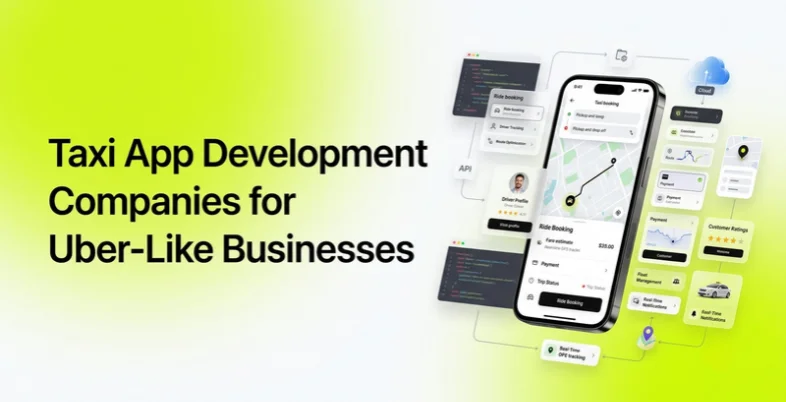
Starting a taxi or ride-hailing business today usually comes down to one early decision: build the app in-house, or hire a company that already knows this space. Most founders go with the second option, mainly because taxi apps have a lot of moving parts; live tracking, dispatch logic, payments, driver payouts and getting all of it right from scratch takes time most businesses don’t have.
The tricky part is that there are dozens of companies claiming to build “the best Uber clone,” and most websites look nearly identical. So instead of another generic list, this post breaks down seven companies that actually work in this space regularly, what they tend to be good at, and what you should personally verify before signing anything.
What Actually Separates One Taxi App Company From Another
Before jumping into the list, it helps to know what to look for, because the differences between these companies aren’t always obvious from their homepage.
Ownership of the code. Some companies hand over full source code once the project is done. Others keep you tied to their platform through licensing. This single point can affect your business for years.
Depth of customization. A lot of companies say “fully customizable,” but in practice, some only let you change colors and logos, while others allow real changes to how dispatch, pricing, or driver matching works.
Post-launch involvement. Apps break. Payment gateways change their APIs. Google Maps pricing updates. A company that disappears after delivery leaves you stuck the first time something needs fixing.
Experience with your specific model. A company great at building simple city taxi apps might not have the same depth in something like intercity ride booking or B2B employee transport.
Keep these four points in mind while going through the list below they matter more than any feature list a company shows you.
List of 7 Taxi App Development Companies Leading the Market
1. Uberclone.co
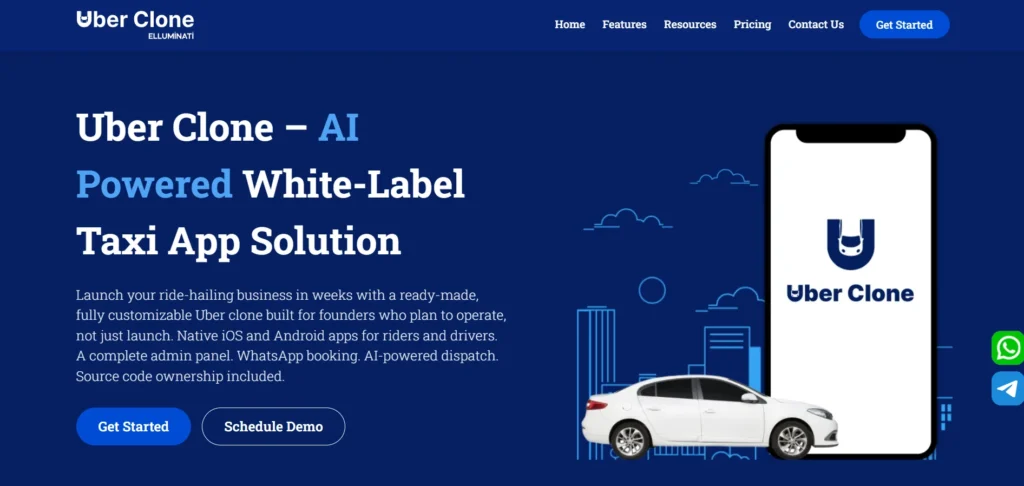
Uberclone.co provides businesses with a faster way to launch an app without requiring them to use a rigid one-size-fits-all service. Uberclone.co builds a foundation using a ready-made base which greatly decreases both time and money involved in app development. The platform also allows customization to be done based on the market which gives businesses added flexibility as they can adjust as their needs evolve. Uberclone.co is especially great for businesses that want to do the lean start up in one city then add on more cities and regions later as the business grows.
They offer both a white-label option and a custom-build route, so the decision isn’t forced early. A founder testing a market can start with the ready-made version and move toward deeper customization later, once the business has actual usage data to work from instead of guesses.
- Rider app, driver app, and admin panel are delivered together as one package, not sold as add-ons
- Both white-label and custom development paths are available under one provider
- Being narrowly focused on ride-hailing means less distraction, but also less breadth if your business needs services well outside standard taxi booking
Best suited for: founders who want a single, connected platform to launch with quickly, and plan to ask upfront how far the customization actually goes before assuming it covers everything they need.
2. Elluminati
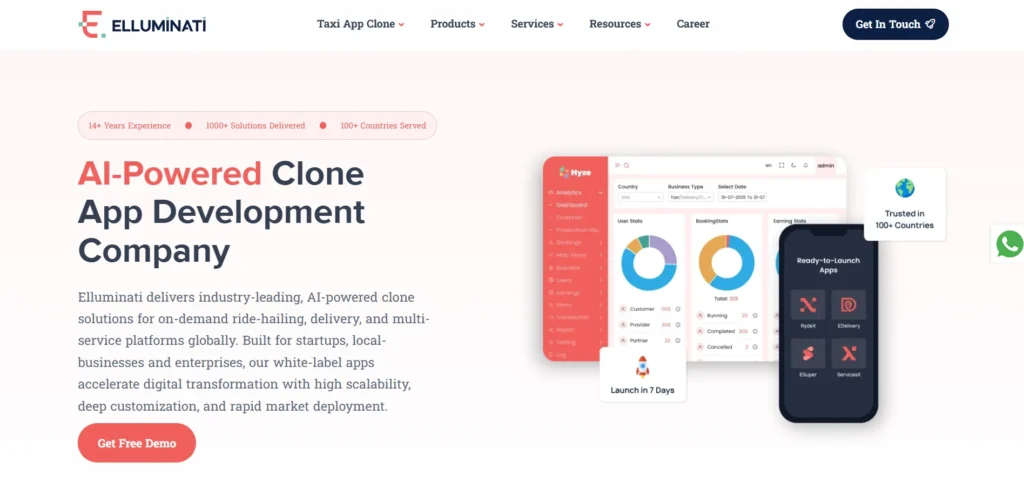
Elluminati stands out with Rydex because it offers a ride-hailing platform. This platform includes rider apps and driver apps. It also has admin panels and dispatcher panels. The system provides payment options with dispatch features. The platform is described as being used by 450 plus mobility businesses. These businesses are in 100 plus countries. This gives it a track record. The track record is good for businesses that want to launch and scale.
What stands out is the multi-vehicle support. Taxis, bike taxis, and auto-rickshaws all run within the same system. That’s a bigger deal than it sounds for operators in South or Southeast Asia, where ride categories rarely fit into one neat type. Trying to bolt on vehicle categories a platform was never built for tends to cause problems that only get worse over time.
- Fare management, driver and rider apps, and an admin panel come as part of the standard package
- The platform has already been through multiple continents and compliance environments
- It’s built for a fairly standard ride-hailing model if you need heavily custom dispatch logic, you’ll hit its ceiling fast
Best suited for: operators running a fairly standard ride-hailing setup who want to launch quickly and don’t need deep customization.
3. Appicial Technologies
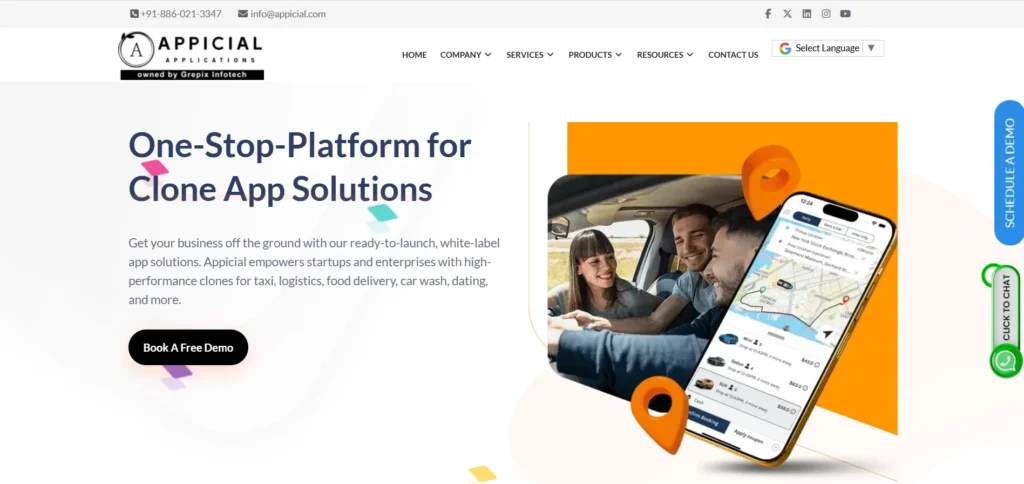
Appicial stuck to one domain and built everything around it, and that focus shows in the admin panel. Driver document compliance, city-level pricing, promo codes, surge zone management all of it can be handled from the operator side without pulling in a developer for routine changes. For anyone running drivers across several cities, that kind of self-service control ends up mattering a lot once things scale.
The corporate booking module deserves a separate mention, mainly because most platforms at this price point skip it entirely. Businesses that serve corporate clients need central invoicing, approval flows for bookings, and account-level reporting. Appicial has this built in already, so founders going after corporate transport accounts don’t need to treat it as a whole separate build.
- Driver document review and approval happens right inside the admin panel
- Fleet earnings can be broken down by driver, city, and time period
- It’s a white-label platform, so customization only goes so far worth knowing exactly where that limit is before you commit
Best suited for: fleet operators and founders planning to serve corporate transport accounts alongside regular consumer rides on the same platform.
4. Yalantis
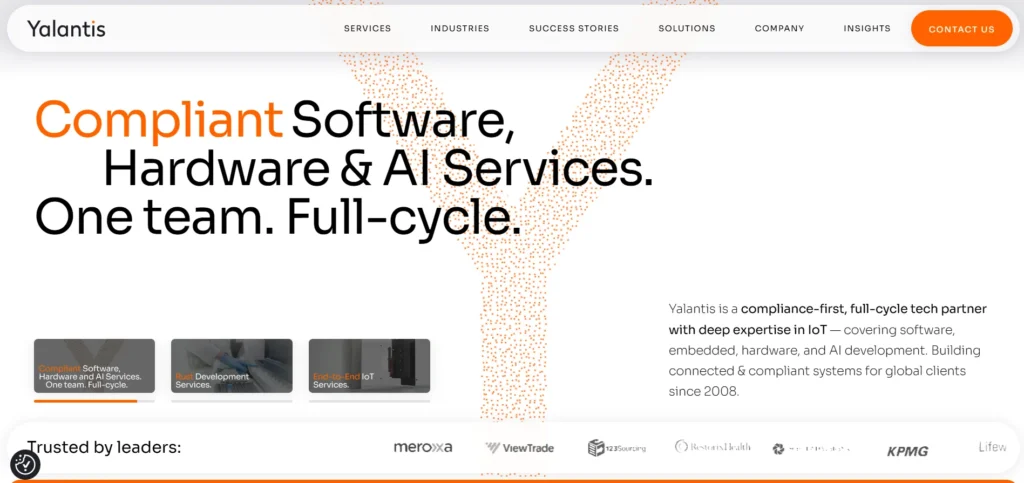
Yalantis works differently from everything else on this list. They’re not offering a platform at all they build software from the ground up based on what a client actually needs. Their background is in mobility, logistics, and transportation, which usually means non-standard dispatch systems, real-time fleet analytics, and integrations with enterprise tools that off-the-shelf products don’t touch.
That difference changes the entire nature of working with them. A custom build means the codebase belongs to you, shaped entirely around your requirements, with no platform roadmap or third-party limitations to work around. It also means the cost in both time and budget is noticeably higher than picking up a white-label product.
- Past work includes non-standard dispatch logic, real-time fleet analytics dashboards, and integrations with third-party fleet management tools
- Everything delivered is built specifically for the client there’s no existing platform being reskinned underneath
Best suited for: operators who’ve already proven out their business model, have technical needs that off-the-shelf platforms just can’t handle, and have the budget to support a full custom build.
5. SpotnRides
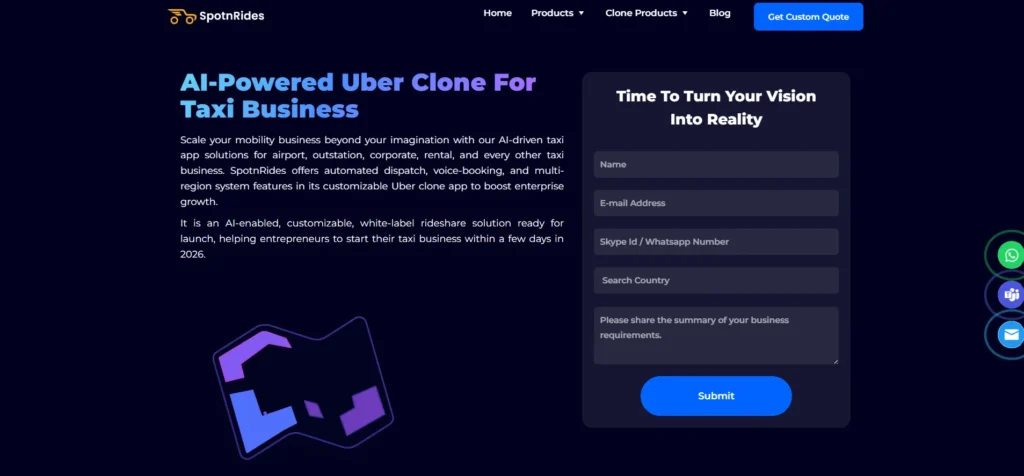
SpotnRides sits at a price point that makes sense for founders who need something functional without a big upfront spend. It’s built on React Native, so one codebase covers both iOS and Android, and it’s set up so clients can configure it without needing a technical team of their own.
What sets SpotnRides apart from other budget options is their track record outside standard ride-hailing. They’ve deployed the platform for school transport, medical transport, and shuttle services verticals that come with their own compliance rules and booking logic entirely different from a regular taxi app. That kind of experience actually matters if you’re building in one of those niches.
- One React Native build covers both iOS and Android
- Prior deployments include school transport, medical transport, and shuttle services
- Pricing sits on the more accessible end of the market
Best suited for: early-stage founders and operators working in niche transport school, medical, shuttle who need something deployable without a large starting cost.
6. Mobisoft Infotech
Mobisoft Infotech technology firm where ride-hailing is one part of a broader service list. They build both white-label taxi products and fully custom applications. What sets them apart from more narrowly focused competitors is the range of what they can deliver alongside the core app backend APIs, web portals, and third-party integrations are all part of their documented work.
For founders who need more than just the mobile app itself, that range has real practical value. Working with a single firm across the app, backend, and any connected portals means skipping the coordination headache of managing several vendors at once.
- Client work spans transportation projects across North America and the Middle East
- Services go beyond mobile apps into backend development, web portals, and third-party integrations
- Their portfolio covers multiple industries, so it’s worth asking specifically for live ride-hailing examples before deciding
Best suited for: mid-size operators who want a development partner capable of handling broader technical work, not just the core app.
7. RipenApps
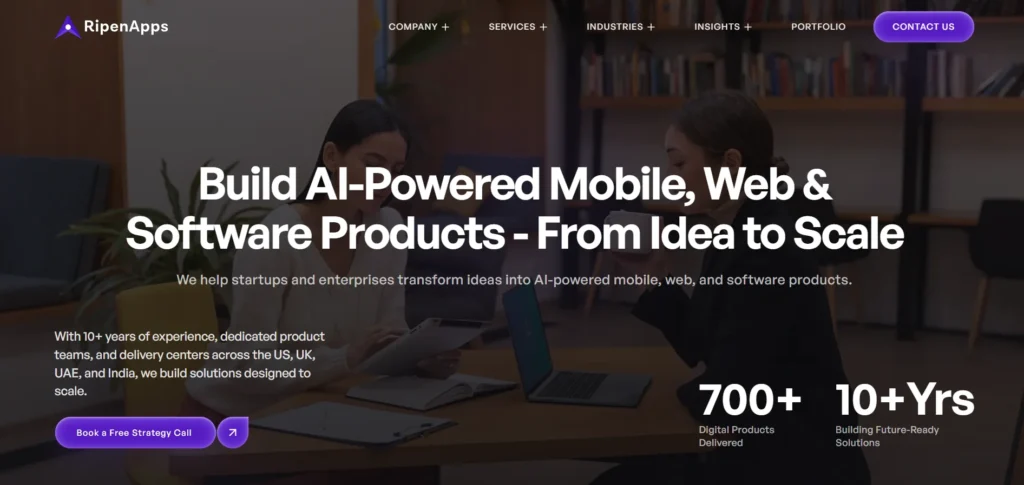
RipenApps works mainly with startups and growing businesses, and that shapes both their pricing and how they structure projects. Their ride-hailing work spans several regions, and one area they’ve paid particular attention to is how driver-facing apps run on mid-range Android devices. That’s a real, practical concern in markets where a lot of drivers aren’t using the latest phones, an app that lags or drains battery fast becomes a driver retention problem almost immediately.
Their process follows a fairly standard structure: discovery, design, development sprints, QA, then post-launch support. Nothing flashy about it, but it’s dependable. For founders who want reliable delivery without paying enterprise-level rates, they’re worth putting on the shortlist.
- Both white-label and custom development options are available
- Projects are structured around sprints, with a defined post-launch support phase
- Pricing and working style are geared toward startups and early-growth teams
Best suited for: startups and growing teams that want solid execution on a mid-range budget, without needing the scale or cost of a larger enterprise firm.
Questions Worth Asking Before You Sign With Anyone
Every company on this list will present itself well that’s expected. What matters more is how they answer direct, specific questions:
- Do we own the full source code once the project is delivered?
- What happens if a third-party API (maps, payments, SMS) changes and breaks something after launch?
- Can you show us a live, working app you’ve built for a business similar to ours?
- What does your support agreement actually cover, and for how long?
- If we want to switch developers later, will we be able to?
A confident, specific answer to these questions tells you more than any portfolio page.
In-House Development: Still an Option, Just a Slower One
Not every business needs to go with an external company. If you already have a technical co-founder or an in-house development team, building from scratch gives you complete control and no dependency on an outside vendor. The trade-off is time a fully custom taxi platform built in-house usually takes several months longer than working with a company that already has core components ready.
For businesses in a hurry to test a market, working with an established provider first and using project management tools to coordinate the development process before considering an in-house rebuild later once the business has proven itself is often the more practical path.
Final Thoughts
None of these seven companies are a universal “best choice.” The right one depends on your budget, how much control you want over the codebase, and how specific your business model is compared to a standard city taxi service. The important part is to ask questions, check out some of their past work and what will happen once the app is launched – rather than focusing on its demo version only.