

Tea is one of the most popular beverages in India, making tea shops and cafés a familiar business concept across cities and smaller towns. The growth of branded tea outlets has also created opportunities for entrepreneurs who want to start a food and beverage business without developing a brand completely from scratch.
Tea Time is one of the established tea franchise chains operating in India. For entrepreneurs exploring Tea Time Franchise Cost in India, the company says it started its journey in 2016 and has expanded to more than 4,000 outlets across India. Its menu includes different varieties of tea along with coolers, milkshakes, flavored milk, and other beverages.
For entrepreneurs considering this opportunity, the official Tea Time website currently states that its unit franchise requires an investment of around ₹5 lakh. The company says this amount includes the franchise fee, movable equipment, and initial stock required to start the business.
About Tea Time

Tea Time is a tea and beverage franchise brand operated by Desi Tea Time Ltd. The company was founded by Uday Srinivas Tangella and began its journey with a tea shop in Rajahmundry, Andhra Pradesh. According to the company’s website, the brand has expanded to more than 4,000 outlets and has a presence across more than 20 states.
The brand focuses on affordable beverages and offers different types of tea, coolers, shakes, premium milkshakes, and flavored milk. Its menu and outlet model are designed around quick-service consumption rather than a large full-service restaurant format.
Tea Time primarily promotes its unit franchise model for individual entrepreneurs. It also offers a master franchise model for entrepreneurs interested in developing a larger territory and managing multiple franchise outlets.
Is Tea Time Franchise Profitable in India?
Tea Time can be a potentially profitable franchise opportunity because its model focuses on relatively affordable beverages and a compact outlet format. The brand states that its products are priced from around ₹15 for dum tea to ₹99 for premium milkshakes, allowing it to target customers looking for affordable beverages.
According to Tea Time’s official franchise information, its profit margin ranges from 40% to 80%, and the average payback period is stated as 5 to 10 months. These are figures published by the brand and should be treated as indicative rather than guaranteed returns for every franchise outlet. Actual profitability can vary depending on location, customer footfall, rent, staffing, product sales, wastage, and operating expenses.
The location of the outlet can have a particularly strong effect on sales. Tea Time recommends busy locations near places such as bus stops, highways, hospitals, markets, railway stations, IT campuses, and colleges.
Before investing, prospective franchisees should prepare their own revenue and expense calculations rather than relying only on the brand’s published margin or payback figures.
Tea Time Franchise Models
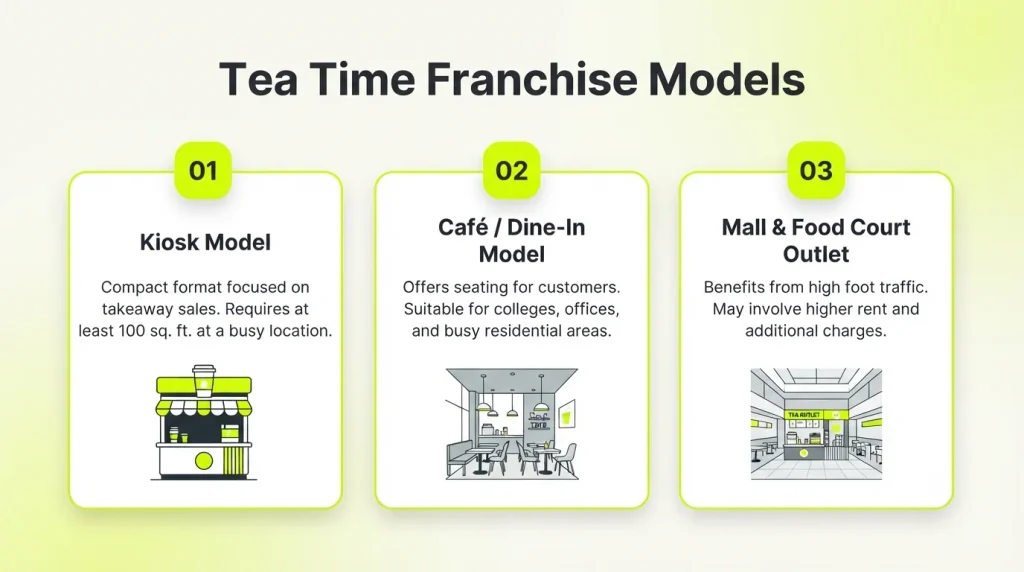
1.Kiosk Model
- A kiosk-style Tea Time outlet is suitable for entrepreneurs looking for a compact format focused mainly on takeaway sales. It can work in locations where customers want quick beverages without requiring a large seating area.
- The official Tea Time unit-franchise information specifies a minimum 100 sq. ft. outlet at a busy location. The company also states that the franchise package includes movable kitchen equipment and initial stock, while the franchisee needs to arrange certain basic outlet requirements such as flooring, kitchen partition, water connection, and the outlet counter.
2.Café / Dine-In Model
- A café or dine-in format can provide additional seating for customers who want to spend more time at the outlet. This can be suitable for locations near colleges, offices, shopping areas, and residential communities.
- A larger seating area can increase the investment required for furniture, interiors, lighting, air conditioning, and other infrastructure. Tea Time’s official website does not currently publish a separate investment figure specifically for a dine-in model, so the final cost should be confirmed with the franchise team based on the proposed outlet.
3.Mall & Food Court Outlet
- A Tea Time outlet in a mall or food court can provide access to a concentrated customer base and high pedestrian traffic. However, these locations can also involve higher rent, deposits, common-area charges, and operating restrictions.
- The official Tea Time website does not currently provide a separate published cost for a mall or food-court format. Entrepreneurs considering this option should therefore obtain a location-specific quotation from the company before signing a lease.
Tea Time Franchise Cost in India
The current official Tea Time website states that ₹5 lakh is the total amount required to start its unit franchise. The company says this amount includes the franchise fee, movable equipment such as a refrigerator, deep freezer, stoves, and utensils, as well as initial stock.
However, this should not be interpreted as the complete amount that every entrepreneur will spend from beginning to opening day. Tea Time states that the franchisee needs to arrange certain basic infrastructure, including tile flooring, kitchen partition, water connection, and an outlet counter. Other expenses such as rent deposits, local registrations, utilities, staff salaries, and working capital may also need to be considered.
| Cost Component | Tea Time Unit Franchise |
| Franchise Fee & Package | Included in ₹5 lakh package |
| Movable Equipment | Included |
| Initial Stock | Included |
| Minimum Outlet Size | 100 sq. ft. |
| Flooring | Franchisee arranged |
| Kitchen Partition | Franchisee arranged |
| Water Connection | Franchisee arranged |
| Outlet Counter | Franchisee arranged |
| Rent / Security Deposit | Additional, location dependent |
| Working Capital | Additional, depending on business needs |
The ₹5 lakh figure is therefore best used as the official starting investment for the Tea Time unit franchise. The actual amount required to launch an outlet will depend on the property and the infrastructure already available at the location.
Tea Time Franchise Profit Margin
- Tea Time currently states that its franchise outlets can generate profit margins ranging from 40% to 80%. The company also states that its average payback period is between 5 and 10 months.
- These figures represent the company’s published claims and should not be considered guaranteed results. Profitability depends on the difference between sales and all operating expenses. A location with strong footfall and controlled rent can have a different financial outcome from an outlet with lower sales or higher fixed costs.
- The brand has also published a franchisee success story in which one franchise owner reported profits ranging between 40% and 80% after starting the business. This is an individual case study published by the company and should not be treated as a typical result for every franchisee.
- For a more realistic projection, calculate expected daily orders, average customer spending, monthly sales, employee costs, rent, electricity, raw materials, maintenance, and other expenses. This will help you understand the potential net profit of the specific location you are considering.
Explore more franchise options:
Space & Location Requirements
- Tea Time’s official unit franchise page specifies a minimum outlet size of 100 sq. ft. and recommends a busy location. The company specifically mentions areas near bus stops, highways, hospitals, markets, railway stations, IT campuses, and colleges as examples of suitable locations.
- The company also states that the franchisee needs to arrange tile flooring, a kitchen partition, water connection, and the outlet counter. Tea Time provides branding elements and movable kitchen equipment as part of its stated unit-franchise package.
- When selecting a property, consider visibility, accessibility, pedestrian movement, nearby offices or colleges, parking, competition, rent, and the purchasing power of the local customer base. A small outlet in a high-demand location can potentially perform differently from a larger outlet in an area with limited customer traffic.
Documents Required for Tea Time Franchise
Before applying for a franchise, entrepreneurs should be prepared to provide basic personal, business, and location information. The exact documentation can vary depending on the applicant and outlet structure, so the current requirements should be confirmed directly with Tea Time.
Common documents and information may include:
- Aadhaar card or other identity proof
- PAN card
- Address proof
- Passport-size photographs
- Bank or financial details
- Proposed outlet address
- Property ownership or rental documents
- Business registration documents, where applicable
- GST registration, where applicable
- FSSAI registration or licence, where applicable
- Local trade or municipal permissions, where applicable
It is important to distinguish between documents required to apply for the franchise and licences required to operate the outlet. The franchise team can clarify which registrations need to be completed before opening.
How to Apply for Tea Time Franchise
The application process starts by contacting Tea Time through its official franchise channel. The company provides a franchise enquiry facility and lists its franchise contact details on its website.
- 1. Submit a Franchise Enquiry: Start by contacting the Tea Time franchise team and providing your basic details, preferred location, and business requirements.
- 2. Discuss the Franchise Opportunity: Discuss the proposed location, investment, outlet format, expected requirements, and available franchise model with the company.
- 3. Finalize the Location: Tea Time recommends a minimum 100 sq. ft. outlet in a busy location. The proposed property should be discussed with the franchise team before you make a long-term commitment to the premises.
- 4. Complete the Franchise Formalities: Once the business proposal and location are approved, complete the required franchise documentation and payment formalities as specified by the company.
- 5. Prepare the Outlet: Arrange the infrastructure that is the franchisee’s responsibility, including the required flooring, kitchen partition, water connection, and outlet counter.
- 6. Complete Training: Tea Time provides training to franchise staff. The company states that its chef trains two employees to operate the business and that employees can learn the complete menu in around three days.
- 7. Launch the Outlet: Once the outlet setup, equipment, stock, training, and required formalities are completed, the franchise can begin operations.
- Official Tea Time contact: Tea Time Franchise Enquiry
- Tea Time currently lists franchise@teatimegroup.com and +91 968 566 7676 as franchise contact details.
Support Provided by Tea Time
- Tea Time provides several forms of support as part of its franchise model. The company states that its unit franchise package includes movable kitchen equipment such as a refrigerator, deep freezer, high-pressure stove, induction stove, utensils, and other equipment, along with initial stock.
- The brand also provides outlet branding. Its franchise information mentions an outlet name board, lollipop board, menu board, photo frames, foam boards, and other branding elements.
- Training is another part of the support system. Tea Time says that two employees are trained by its chef and that the complete menu can be learned in approximately three days.
- The company also describes support with promotion and advertising, supplier coordination, ingredients, and other resources. In one of its published franchisee stories, Tea Time states that it assisted the franchisee with promotion, advertising, supplier communication, and essential resources.
Advantages of Owning a Tea Time Franchise
- 1.Established Brand Presence: Tea Time already operates a large franchise network. The company currently states that it has more than 4,000 outlets across India, giving prospective franchisees access to an established brand rather than starting an independent tea shop from zero.
- 2.Relatively Low Official Starting Investment: The brand currently advertises its unit franchise at ₹5 lakh, including the franchise fee, movable equipment, and initial stock. This can make the model accessible to entrepreneurs with a limited starting budget, although additional property and operating expenses still need to be considered.
- 3.Compact Space Requirement: The minimum stated outlet requirement of 100 sq. ft. allows the business to operate from a relatively compact location. This can give entrepreneurs more flexibility when searching for suitable commercial premises.
- 4.Training and Operational Support: Tea Time provides staff training and support related to equipment, products, branding, suppliers, and promotion. This can be useful for first-time entrepreneurs who do not have previous experience running a tea or beverage outlet.
- 5.Multiple Beverage Categories: The business is not limited to traditional tea. Tea Time’s menu includes teas, coolers, shakes, premium milkshakes, and flavored milk, allowing outlets to serve customers looking for different types of beverages.
Challenges & Risks in Tea Time Franchise Business
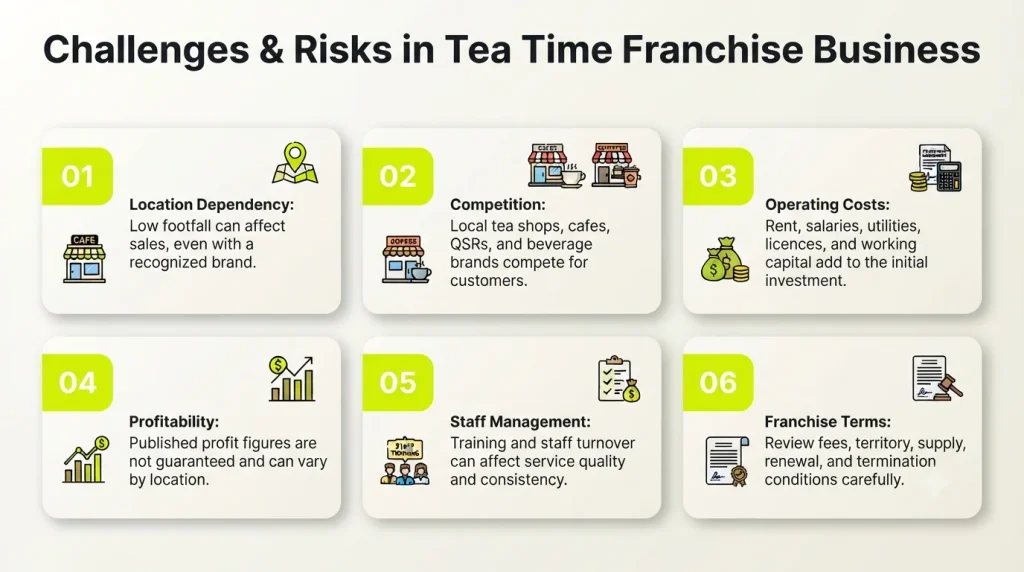
- 1.Location Dependency: A tea outlet depends heavily on regular customer traffic. Even a recognized brand can face difficulty if the outlet is located in an area with insufficient footfall. Rent should therefore be compared with realistic sales expectations before finalizing a property.
- 2.Competition: Tea shops, cafés, QSRs, street vendors, and other beverage brands can compete for the same customers. A franchisee still needs to maintain product quality, service speed, cleanliness, and customer relationships despite operating under an established brand.
- 3.Operating Cost Management: The ₹5 lakh official franchise package does not mean that ₹5 lakh will cover every expense associated with operating the business. Rent, deposits, salaries, utilities, local licences, maintenance, and working capital may require additional funds.
- 4.Published Profit Figures Are Not Guarantees: Tea Time publishes profit margins of 40%–80% and an average payback period of 5–10 months. However, these figures are brand-provided claims and actual results can differ between locations and franchisees.
- 5.Staff Management: Although the outlet format is relatively compact, employees still need to maintain product consistency, hygiene, customer service, and speed. Staff turnover or inadequate training can affect the customer experience.
- 6.Franchise Agreement Conditions: Before investing, entrepreneurs should carefully review the franchise agreement, including fees, renewal conditions, territory rights, supply arrangements, branding requirements, termination clauses, and responsibilities of both parties.
Conclusion
Tea Time offers a franchise model for entrepreneurs interested in entering India’s tea and beverage market under an established brand. The company currently states that it has more than 4,000 outlets and operates across more than 20 states.
For its unit franchise, Tea Time currently advertises an investment of ₹5 lakh, which it says includes the franchise fee, movable equipment, and initial stock. The company specifies a minimum outlet size of 100 sq. ft. and recommends busy locations with strong customer movement.
Tea Time also states that franchise outlets can achieve profit margins of 40%–80% with an average payback period of 5–10 months. For those researching Tea Time Franchise Cost in India, these figures should be considered indicative because actual profitability depends on location, sales, rent, staffing, operating costs, and other local factors.
Before investing, prospective franchisees should obtain the latest franchise agreement and a complete cost sheet from Tea Time. They should also evaluate the proposed location, calculate working-capital requirements, understand ongoing obligations, and confirm all current franchise terms directly with the company.