
A product can go viral overnight, but a profitable business rarely does. In 2026, dropshipping continues to attract entrepreneurs because it allows sellers to enter e-commerce without investing heavily in inventory upfront. Yet the low-entry barrier has created a crowded marketplace where copying trending products is rarely enough.
Success now depends on sharper product research, dependable suppliers, efficient fulfilment, competitive pricing, strong branding, and measurable customer acquisition. For business-minded entrepreneurs, the key question is not simply how to start dropshipping, but how to build a model that can generate sustainable margins. From selecting a profitable niche and validating demand to launching a store, managing orders, and scaling proven products, every decision affects the bottom line.
This blog explains the essential steps How to start a dropshipping business in 2026 while avoiding costly mistakes.
What Is Dropshipping?
Dropshipping is an e-commerce business model where a seller markets and sells products without keeping them in stock. When a customer places an order, the seller purchases the product from a third-party supplier, who then ships it directly to the customer. This model reduces upfront inventory costs and makes it easier for beginners to start an online store. However, dropshipping is not a risk-free or effortless business.
Sellers often face low profit margins, intense competition, supplier delays, inconsistent product quality, and limited control over shipping. Success depends on choosing reliable suppliers, pricing products strategically, creating strong marketing campaigns, and providing good customer service. Therefore, dropshipping can reduce inventory risks, but it does not eliminate the broader challenges of running a profitable e-commerce business.
Is Dropshipping Legal in India?

Yes, dropshipping is legal in India when operated as a legitimate e-commerce business and all applicable laws are followed. Sellers must comply with business registration, taxation, consumer protection, payment, and product-specific regulations. Depending on turnover, business structure, and products sold, GST registration may be required. Sellers should also issue proper invoices, clearly disclose product details, pricing, shipping information, return policies, and customer rights.
Products such as food, cosmetics, medicines, and certain imported goods may require additional licences or compliance. Import-related dropshipping can also involve customs duties and documentation. The business model itself is not illegal; the main concern is whether the seller operates transparently and follows applicable Indian regulations. Before starting, it is advisable to verify current GST, consumer, import, and product-specific requirements.
Is Dropshipping Profitable In India?
Dropshipping can be profitable in India, but market growth does not automatically mean easy profits. India’s e-commerce market is projected to reach about US$345 billion by 2030, growing at an estimated 18.4% CAGR, creating a larger customer base for online sellers. However, dropshipping remains highly competitive.
The main attraction is lower upfront investment because sellers do not need to purchase or store inventory. This can reduce financial risk and allow entrepreneurs to test products quickly. Yet profitability depends on product selection, supplier pricing, advertising costs, shipping reliability, returns, taxes, and customer acquisition. Thin margins can disappear quickly when advertising becomes expensive or suppliers raise prices.
Therefore, dropshipping should be viewed as a business model, not a guaranteed income stream. Sellers who build a focused niche, negotiate reliable supply, control marketing costs, and provide strong customer service create better conditions for sustainable profits. The opportunity exists, but execution remains critical consistently.
How To Start A Dropshipping Business In India Step By Step
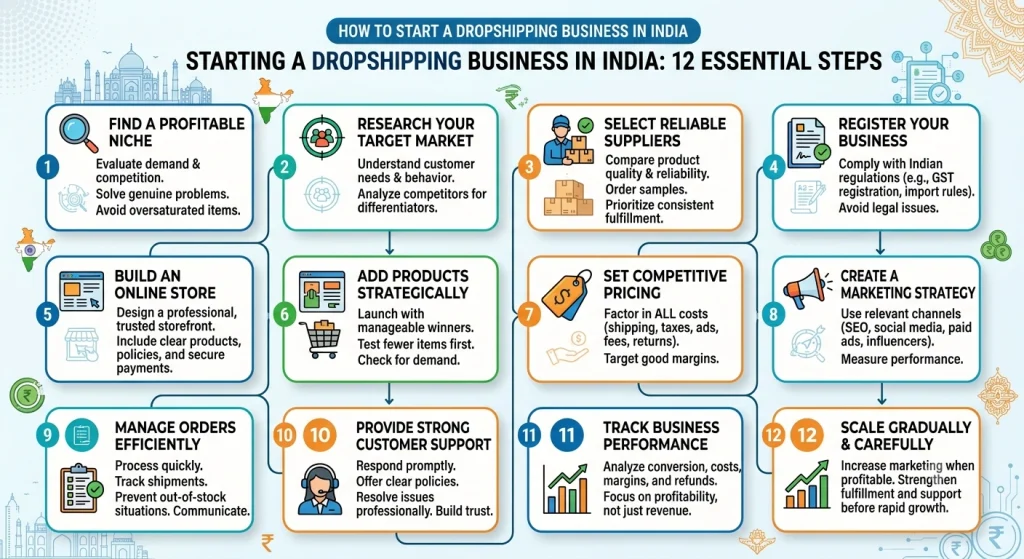
Starting a dropshipping business requires strategic planning, not merely uploading products. Each stage, from niche selection and supplier research to marketing and scaling, directly affects costs, customer trust, margins, and profitability.
Step 1. Choose a Profitable Niche
Choose a focused niche by evaluating customer demand, competition, pricing potential, and product availability. Look for products solving genuine problems or serving specific interests. Avoid extremely saturated categories where advertising costs are high and differentiation is difficult. Consider shipping complexity, return frequency, product durability, and potential for repeat purchases before committing.
Step 2. Research Your Target Market
Understand who is most likely to purchase your products before investing in marketing. Study customers’ needs, preferences, budgets, purchasing behaviour, and common pain points. Analyse competitors to identify pricing patterns, popular products, marketing approaches, reviews, and service weaknesses. Use these insights to develop a sharper, differentiated selling proposition.
Step 3. Find Reliable Suppliers
Supplier reliability can determine whether your business earns repeat customers or receives complaints. Compare suppliers based on product quality, wholesale pricing, fulfilment speed, packaging, stock availability, communication, and return policies. Order product samples before launching. A slightly higher supplier cost may be worthwhile if it reduces refunds, delays, and quality-related complaints.
Step 4. Register Your Business
Set up your business according to your planned operations and complete applicable registrations. Determine whether GST registration is required based on your circumstances, sales model, and turnover. Also consider consumer protection requirements, payment compliance, import regulations, and product-specific licences. Proper compliance helps prevent avoidable financial, operational, and legal problems.
Step 5. Build an Online Store
Create a professional online store that makes purchasing simple and trustworthy. Use clear product descriptions, accurate specifications, quality images, transparent prices, shipping timelines, return policies, contact information, and secure payment methods. Keep navigation straightforward and mobile-friendly. A polished storefront can improve credibility, while confusing information can quickly increase abandoned carts.
Step 6. Add Products Strategically
Avoid launching with hundreds of products simply to make your store look larger. Begin with a manageable selection that has demonstrated demand, reasonable margins, dependable supply, and practical customer value. Testing fewer products allows you to understand customer behaviour, improve listings, identify winners, and control marketing expenses before expanding.
Step 7. Set Competitive Prices
Pricing should reflect your complete cost structure rather than the supplier’s product price alone. Include shipping, taxes, payment processing, advertising, returns, refunds, platform charges, and your desired margin. Compare competitors without blindly matching their prices. Excessive discounting may generate sales temporarily but can weaken cash flow and long-term profitability.
Step 8. Create a Marketing Strategy
Build a marketing strategy around the channels where your target customers actually spend time. Combine SEO, social media, short-form content, influencer partnerships, email marketing, smo tools, and paid advertising where appropriate. Track impressions, clicks, conversions, acquisition costs, and revenue. Stop ineffective campaigns quickly and reinvest strategically in channels producing measurable business value.
Step 9. Manage Orders Efficiently
Accurate order processing becomes increasingly important as sales grow, especially when using cloud based productivity apps to streamline business operations. Forward customer orders correctly, confirm supplier fulfilment, and monitor shipping updates and delivery timelines. Maintain accurate inventory information to prevent selling unavailable products. When delays or stock problems occur, communicate proactively with customers instead of allowing uncertainty to damage trust and satisfaction.
Step 10. Provide Strong Customer Support
Customer support directly influences reviews, refunds, repeat purchases, and brand reputation. Respond promptly to questions, complaints, returns, and refund requests using clear communication. Publish straightforward policies so customers understand expectations before purchasing. When problems occur, focus on practical resolutions rather than avoiding responsibility. Strong service can differentiate smaller stores from competitors.
Step 11. Track Business Performance
Revenue alone does not reveal whether your dropshipping business is healthy. Track conversion rates, customer acquisition costs, average order value, gross margins, refunds, return rates, repeat purchases, and advertising performance. Review these numbers regularly to identify profitable products and inefficient spending. Remove consistently weak products rather than protecting poor performers emotionally.
Step 12. Scale Carefully
Scaling should follow evidence, not excitement. Once products demonstrate consistent demand and positive unit economics, increase marketing gradually and negotiate improved supplier rates. Expand product ranges carefully while strengthening fulfilment, customer support, and inventory monitoring. Rapid expansion without operational capacity can create delayed orders, rising costs, poor reviews, and avoidable customer dissatisfaction.
Best Dropshipping Suppliers In India
The suppliers below cover different business models, from print on demand websites to general product sourcingCompare margins, fulfilment, COD availability, and scalability rather than choosing only on catalogue size.
| Supplier | Product Categories | Pricing | Shipping | COD | Best For |
| Qikink | Apparel, accessories, home décor | Pay per order | 2–5 days | Yes | Print-on-demand |
| Baapstore | Fashion, lifestyle, gadgets | Supplier-based | Pan-India | Yes | Beginners |
| DeoDap | Gadgets, gifts, home goods | Wholesale pricing | Pan-India | Available | Trending products |
| Printrove | Apparel, accessories, stationery | Product-based | Pan-India | Available | Custom products |
| IndiaMART | Multiple categories | Supplier-dependent | Supplier-dependent | Supplier-dependent | Bulk sourcing |
| Seasonsway | Fashion, lifestyle | Supplier-based | Pan-India | Available | Fashion sellers |
Best Platforms For Starting A Dropshipping Business In India
For business-focused sellers, platform choice should balance startup cost, store control, payment integration, scalability, automation, reseller apps, and dropshipping support. The cheapest option is not always the most economical at scale.
| Platform | Starting Cost | Store Control | Dropshipping Support | Payment & Shipping | Best For |
| Shopify | ₹1,499/month yearly | High | Excellent | Strong | Serious D2C brands |
| WooCommerce | Free platform | Very High | Excellent | Flexible | Cost-conscious businesses |
| Wix | Paid plans | High | Good | Good | Beginners & small stores |
| Dukaan | Plan-dependent | Moderate | Good | India-focused | Mobile-first sellers |
| Instamojo | Plan-dependent | Moderate | Basic–Good | India-focused | Small businesses |
| Ecwid | Free/paid plans | High | Good | Multi-channel | Testing & small stores |
Common Dropshipping Mistakes To Avoid
Dropshipping looks simple because inventory is outsourced, but profitability depends on disciplined execution. Avoiding these common mistakes can protect margins, customer trust, cash flow, and long-term growth.
- Choosing Products Without Research: Selling products based only on trends can create weak demand, intense competition, poor margins, and unsold opportunities once customer interest declines.
- Ignoring Supplier Reliability: Choosing suppliers solely for low prices can cause delayed deliveries, inconsistent quality, stock problems, refunds, complaints, and unnecessary damage to your brand reputation.
- Underestimating Total Costs: Ignoring advertising, shipping, payment fees, taxes, returns, and refunds can make apparently profitable products unprofitable after actual business expenses are calculated.
- Setting Unrealistic Prices: Prices that are too high reduce conversions, while extremely low prices destroy margins. Compare competitors and calculate every cost before setting your selling price.
- Depending Only on Paid Ads: Relying entirely on advertising creates rising acquisition costs and fragile cash flow. Build organic traffic through SEO, content, social media, referrals, and retention.
- Neglecting Customer Service: Slow responses and unclear policies quickly damage trust. Provide accurate information, handle complaints professionally, and communicate proactively about delays, refunds, and returns.
- Offering Too Many Products: Adding hundreds of products without testing demand spreads marketing budgets, complicates operations, and makes it harder to identify genuinely profitable products.
- Scaling Before Validating: Increasing advertising before confirming product demand, margins, fulfilment quality, and conversion rates can multiply losses instead of creating sustainable revenue growth.
Tips To Build A Successful Dropshipping Business In India

Building a profitable dropshipping business requires more than finding trending products. Focus on margins, supplier reliability, customer trust, efficient marketing, and repeat purchases to create sustainable growth.
- Choose a Focused Niche — Target a specific customer group instead of selling unrelated products across multiple categories.
- Prioritise Reliable Suppliers — Test suppliers before partnering and evaluate quality, fulfilment speed, packaging, communication, and return handling.
- Calculate Real Profit Margins — Include product costs, shipping, GST, payment fees, advertising, returns, and refunds before pricing products.
- Offer Multiple Payment Options — Support payment methods relevant to Indian customers, including UPI, cards, wallets, and COD where commercially viable.
- Build a Trustworthy Store — Use clear product information, transparent pricing, contact details, shipping timelines, and straightforward return policies.
- Invest in Organic Marketing — Combine SEO, social media, short-form content, email marketing, and creator partnerships to reduce dependence on paid advertising.
- Track Business Metrics — Monitor conversion rate, customer acquisition cost, average order value, refunds, repeat purchases, and contribution margins.
- Scale Only Proven Products — Increase inventory alternatives, advertising, and supplier negotiations only after consistent demand and positive unit economics are established.
Conclusion
Dropshipping in India presents an accessible route into e-commerce, but easy entry should not be confused with easy profitability. The model removes much of the inventory burden, yet it shifts the challenge toward supplier management, customer acquisition, pricing, fulfilment, and retention. For business-minded entrepreneurs, the real opportunity lies in building a system that consistently turns demand into profitable orders.
Selecting the right niche, validating products, controlling acquisition costs, and partnering with dependable suppliers can create a stronger foundation for growth. At the same time, changing customer expectations, intense competition, returns, and thin margins require constant monitoring. Ultimately, dropshipping is not a shortcut to quick money. It is a commercial model where disciplined testing, financial control, customer trust, and strategic scaling determine whether revenue becomes a sustainable business.
FAQs
Is dropshipping legal in India?
Yes. Dropshipping is legal when sellers comply with applicable GST, consumer protection, taxation, and product-specific regulations.
How much money is needed to start dropshipping?
Startup costs vary depending on your platform, domain, marketing budget, supplier model, and business registrations.
Is dropshipping profitable in India?
It can be profitable, but margins depend on product costs, advertising expenses, shipping, returns, competition, and pricing.
Can I offer COD for dropshipping?
Yes, COD can be offered through suitable suppliers or shipping partners, subject to their availability and terms.
Do I need GST registration for dropshipping?
GST requirements depend on factors such as turnover, sales channels, location, and the nature of transactions.
What products are suitable for dropshipping?
Products with consistent demand, manageable shipping, reasonable margins, low return rates, and reliable supplier availability are generally easier to operate.