

SEO Lead Generation focuses on attracting potential customers through organic search and converting relevant website visitors into qualified leads. Unlike strategies that depend entirely on paid advertising, SEO can build sustainable visibility by targeting keywords related to customer needs, problems, products, and services. Effective lead-generation SEO combines keyword research solutions, helpful content, on-page optimization, technical SEO, internal linking, and conversion-focused landing pages.
Businesses can also use tools such as Google Search Console to monitor search performance and identify opportunities for improvement. By aligning search intent with valuable content and clear calls to action, businesses can attract relevant audiences and create more opportunities for enquiries, registrations, consultations, and sales.
In this blog, we will take a look at the SEO for Lead Generation.
What Is SEO Lead Generation?
SEO Lead Generation is the process of using search engine optimization to attract people who are actively searching for a business’s products, services, or solutions and turn them into potential customers. It involves targeting relevant keywords, creating useful content, improving website visibility, and optimising pages for conversions.
The goal is not simply to increase website traffic but to attract visitors who are more likely to enquire, submit forms, request consultations, or make purchases. Google recommends creating helpful, people-first content rather than using tactics designed primarily to manipulate search rankings.
The SEO Lead Generation Funnel
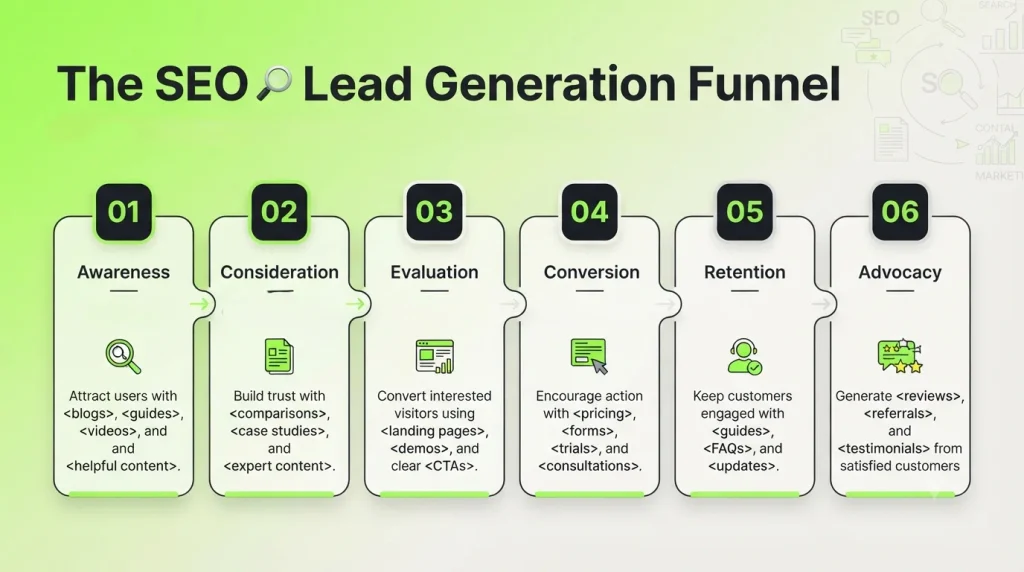
The SEO lead generation funnel guides potential customers from initial search discovery to conversion by using targeted content, relevant keywords, trust-building information, and strategic calls-to-action.
1. Awareness: Attract the Right Audience
At the awareness stage, potential customers are identifying a problem, researching a topic, or seeking basic information. Their searches might include “how to generate more leads” or “what is SEO?”
Educational blog posts, guides, checklists, videos, and informative resources can attract these users. The objective is to introduce your brand, answer their questions, and establish expertise without immediately pushing a sale.
2. Consideration: Build Interest and Trust
At the consideration stage, users understand their problem and begin researching different solutions, providers, products, or services. Searches might include “best SEO tools for lead generation” or “SEO agency vs freelancer.”
Detailed comparison articles, case studies, webinars, expert guides, and solution-focused content can help users evaluate their options. The goal is to demonstrate value, address concerns, and encourage visitors to explore your offerings further.
3. Evaluation: Capture Qualified Leads
At the evaluation stage, potential customers are seriously considering a purchase and looking for specific information about pricing, features, results, or providers. Searches might include “SEO agency pricing” or “best lead generation service.”
Landing pages, product comparisons, testimonials, case studies, demos, and downloadable resources can support their decision-making. Clear forms and calls-to-action can also convert interested visitors into identifiable leads.
4. Conversion: Turn Visitors into Customers
At the conversion stage, users have gathered enough information and are ready to take action. They may search for terms such as “buy SEO software” or “hire SEO consultant.”
Optimized service pages, free trials, consultations, contact forms, pricing pages, and strong calls-to-action can encourage users to take the next step. The objective is to reduce friction and make conversion simple.
5. Retention: Encourage Repeat Engagement
After conversion, SEO can continue supporting customer relationships through useful content, product guides, tutorials, FAQs, and industry updates. Existing customers may return to the website when they need additional information.
Helpful post-purchase content can improve customer experience, encourage repeat visits, and create opportunities for additional service. Satisfied customers may also provide reviews, testimonials, referrals, and other forms of valuable advocacy.
6. Advocacy: Turn Customers into Promoters
At the advocacy stage, satisfied customers can become valuable sources of referrals and social proof. Their reviews, testimonials, case studies, and recommendations can influence potential customers researching similar solutions.
Businesses can encourage advocacy by requesting feedback, showcasing customer success stories, and maintaining strong relationships. This creates additional trust signals that can support future organic traffic and lead generation.
Why SEO Is Important For Lead Generation?
SEO is important for lead generation because it helps businesses reach people who are already searching for information, products, or services related to their needs. When a website appears for relevant searches, it can attract targeted organic traffic without requiring payment for every visitor.
SEO also helps businesses build visibility and credibility by providing useful, search-focused content that answers potential customers’ questions an authority-building effort frequently scaled with the help of a managed link building service. Google recommends creating helpful, reliable, people-first content, making relevance and user experience important parts of an effective search strategy.
Optimized landing pages, clear calls to action, contact forms, and relevant internal links can help turn website visitors into leads. SEO can also support long-term lead generation because well-optimized pages may continue attracting search traffic after publication. By tracking organic visits, keyword performance, conversions, and lead quality, businesses can identify opportunities to improve their SEO and lead-generation efforts over time.
List Of Top 11 SEO For Lead Generation
Effective SEO lead generation combines search visibility with valuable content, strong user intent, conversion-focused pages, and continuous optimisation to attract qualified prospects and turn them into customers.
1. Identify High-Intent Keywords
Start by researching keywords that reflect what your potential customers need, rather than focusing only on search volume. The best opportunities often connect directly with problems, solutions, products, or services.
Consider different types of search intent:
- Informational: Users are looking for answers or learning resources.
- Commercial: Users are comparing products, services, or providers.
- Transactional: Users are ready to purchase, contact, or sign up.
- Navigational: Users are searching for a specific company or website.
For lead generation, prioritise commercial and transactional keywords while maintaining informational content that brings prospects into the funnel.
2. Build Content Around Customer Needs
SEO content should answer genuine customer questions at different stages of the buying journey. Creating useful resources helps attract visitors and supports SEO for lead generation by gradually introducing them to your products or services. A CMS for SEO can also make it easier to organize, publish, and optimize content consistently across your website.
Create content such as:
- How-to guides
- Industry reports
- Problem-solving articles
- Comparison posts
- Buying guides
- Case studies
- Service explainers
Connect informational content with relevant product or service pages, using content optimization tools to improve relevance, structure, and search performance while giving visitors a clear next step after finding the information they need.
3. Create Dedicated Landing Pages
A dedicated landing page gives search visitors a focused destination that matches their query and encourages a specific action. Generic pages may not address the visitor’s exact requirement.
Build targeted landing pages for:
- Individual services
- Specific industries
- Geographic locations
- Customer segments
- Individual solutions
- Specific use cases
Include relevant keywords, clear benefits, supporting evidence, and a prominent call-to-action to encourage visitors to submit their details or request further information.
4. Optimize Calls-to-Action
Even strong organic traffic may generate few leads if visitors cannot easily identify what to do next. Calls-to-action should clearly communicate the action you want users to take.
Useful CTAs include:
- Request a Free Consultation
- Book a Demo
- Get a Quote
- Download the Guide
- Start a Free Trial
- Contact an Expert
Place relevant CTAs naturally throughout pages, particularly after sections that address customer problems, explain benefits, or provide convincing evidence.
5. Strengthen Local SEO
Businesses serving particular locations can use local search and local SEO to reach prospects searching for nearby services. Local searches often indicate a stronger connection between the user’s requirement and a potential purchase, making SEO for Lead Generation particularly useful for businesses targeting location-based prospects.
Focus on:
- Location-specific landing pages
- Google Business Profile optimization
- Local keywords
- Customer reviews
- Consistent business information
- Local business directories
- Location-based content
Make sure each location page provides genuinely useful information instead of simply repeating the same content with different city names.
6. Use Long-Tail Keywords
Long-tail keywords usually contain more specific phrases and can reveal exactly what a searcher wants. Although individual terms may receive less traffic, they can attract highly relevant visitors.
For example, instead of targeting “digital marketing,” a company could target “digital marketing agency for small businesses in Delhi.” Specific searches can help businesses reach audiences with clearly defined requirements and potentially stronger commercial intent.
7. Optimize Existing Content
SEO lead generation does not always require publishing new articles. Existing pages may already receive impressions and clicks but fail to generate meaningful leads.
Review pages for:
- Declining rankings
- Outdated information
- Weak CTAs
- Missing internal links
- Poor keyword targeting
- Unanswered search queries
- Low-converting landing pages
Updating valuable content and improving its conversion path can help turn existing organic traffic into more useful business opportunities.
8. Build Strong Internal Linking
Internal links help visitors move between related pages while also helping search engines understand the structure and relevance of your website. Understanding the types of backlinks can also help businesses develop a more effective off-page SEO strategy. They can guide users from educational content toward conversion-focused pages, making internal linking an important part of SEO for Lead Generation.
For example, an article about SEO strategies could link naturally to a relevant SEO service page, case study, or consultation page. Use descriptive anchor text and prioritise links that provide genuine value to the reader.
9. Use Case Studies and Social Proof
Potential customers often want evidence that a business can deliver the results it promises. Case studies, testimonials, reviews, statistics, and customer examples can provide additional confidence.
Include:
- Customer success stories
- Before-and-after results
- Client testimonials
- Relevant performance data
- Industry-specific examples
- Customer reviews
Place these elements on commercial pages where visitors are evaluating whether your business is suitable for their needs.
10. Improve Technical SEO and Page Experience
Technical problems can prevent important pages from being discovered, indexed, or properly experienced by visitors. A technically sound website provides a stronger foundation for both SEO visibility and lead generation.
Pay attention to:
- Mobile usability
- Page loading speed
- Crawlability
- Indexing
- Broken links
- HTTPS security
- Core Web Vitals
- Structured data
Regular technical audits can identify issues that may reduce organic visibility or create unnecessary friction for potential leads.
11. Measure Leads and Continuously Optimize
Ranking highly is not the final objective of SEO for lead generation. Businesses should measure whether organic visitors actually contribute to meaningful conversions and then improve their strategy accordingly. Businesses can use SEO optimization tools to identify keyword opportunities, analyze competitors, improve content, monitor rankings, and find technical issues that may affect organic visibility.
Track metrics such as:
- Organic traffic
- Keyword rankings
- Click-through rates
- Conversion rates
- Form submissions
- Consultation requests
- Cost per lead
- Lead quality
Comparing traffic with actual conversions helps identify which keywords, pages, and content types are generating valuable prospects rather than simply producing visits.
Comparison Table Of SEO Lead Generation Tools
| Tools | Best For | Keyword Research | Competitor Analysis | Content Optimization | Lead Generation Use |
| Semrush | All-in-one SEO | Excellent | Excellent | Excellent | Finding high-intent keywords and converting organic traffic |
| Ahrefs | Backlinks & SEO research | Excellent | Excellent | Excellent | Finding search opportunities, content gaps, and backlink prospects |
| HubSpot SEO Tools | SEO + marketing conversion | Good | Good | Excellent | Connecting SEO traffic with content, forms, CRM, and marketing campaigns |
| Google Search Console | Google Search Performance | Good | Limited | Basic | Identifying queries and pages that can generate more organic traffic |
| Surfer SEO | Content optimization | Good | Good | Excellent | Creating optimized content designed to attract targeted search traffic |
| Screaming Frog SEO Spider | Technical SEO audits | Limited | Limited | Good | Fixing technical issues that may prevent lead-generating pages from ranking |
| Moz Pro | SEO Management | Excellent | Good | Good | Finding keywords and improving website visibility for potential customers |
| Mangools | Beginner-friendly SEO | Excellent | Good | Good | Finding low-competition and relevant keywords for targeted traffic |
| SE Ranking | SEO campaigns & agencies | Exclusive | Excellent | Good | Tracking rankings and identifying opportunities to increase qualified traffic |
| SpyFu | Competitor & keyword research | Excellent | Excellent | Good | Finding competitors’ profitable keywords and SEO opportunities |
How SEO Generates Leads For Your Business?
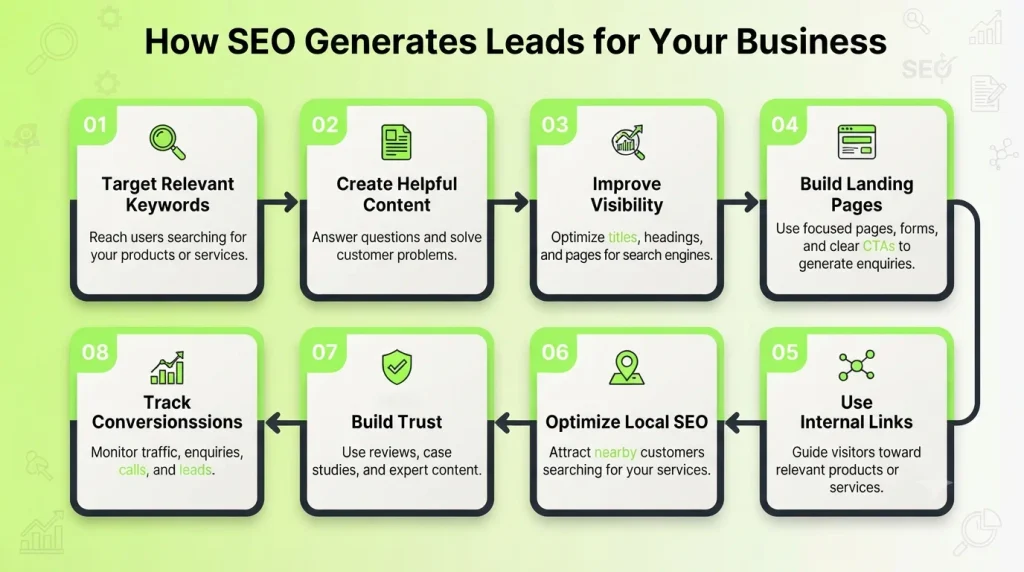
SEO generates leads by connecting your business with people actively searching for relevant solutions, guiding them from search results toward meaningful actions through website experiences and strong calls to action.
- Target Relevant Keywords: Use search terms that match customer needs and buying intent, helping qualified users find your business online.
- Create Helpful Content: Answer common questions and solve customer problems with useful information that builds interest and encourages further engagement.
- Improve Search Visibility: Optimize pages, headings, titles, and descriptions so search engines understand your content and show relevant results.
- Build Landing Pages: Direct visitors to focused pages with clear information, simple forms, and calls to action that encourage enquiries and conversions.
- Use Internal Links: Connect related content with service or product pages, helping visitors explore relevant offerings and move closer toward conversion.
- Optimize for Local Searches: Improve location-based pages and business information to attract nearby customers searching for relevant products or services.
- Build Trust Through Content: Share expertise, reviews, case studies, and useful resources that help potential customers feel confident contacting your business.
- Track Lead Conversions: Monitor organic traffic, enquiries, forms, calls, and conversion rates to identify which SEO activities generate valuable leads.
Common SEO Lead Generation Mistakes To Avoid
Avoiding common SEO mistakes helps businesses attract relevant visitors, maintain search visibility, and convert organic traffic into qualified leads through useful content and effective optimization.
- Targeting Irrelevant Keywords: Choosing keywords without considering search intent can attract visitors who are unlikely to need your products or services.
- Keyword Stuffing: Repeating keywords unnaturally can reduce readability and create poor user experiences while potentially violating Google’s spam policies.
- Ignoring Search Intent: Creating content that does not match what users want can increase weak traffic and reduce potential lead conversions.
- Creating Low-Value Content: Publishing unoriginal or shallow content primarily for rankings may provide little value and weaken your website’s overall search performance.
- Using Poor Quality Links: Buying links or creating excessive link exchanges solely to manipulate rankings can violate Google’s spam policies and hurt visibility.
- Neglecting Conversion Elements: Driving organic visitors without clear forms, contact options, landing pages, or calls to action can limit lead generation opportunities.
- Failing to Track Results: Not monitoring organic traffic, enquiries, conversions, and lead quality makes it difficult to identify successful SEO strategies and improvements.
Conclusion
SEO for lead generation can help businesses attract relevant prospects by improving organic visibility for searches connected to their products, services, and customer needs. A successful strategy requires more than ranking for keywords; it involves creating useful content, understanding search intent, optimising website performance, and providing clear conversion opportunities.
Landing pages, forms, calls to action, internal links, and strong content can help turn visitors into potential customers. Regularly monitoring organic traffic, rankings, conversions, and user behavior also helps identify areas for improvement. By combining search visibility with a user-focused website experience, businesses can build a sustainable channel for attracting and nurturing qualified leads over time.
FAQs
1. What Is SEO Lead Generation?
SEO Lead Generation is the process of improving a website’s organic search visibility to attract potential customers and encourage enquiries or conversions.
2. How Does SEO Generate Leads?
SEO attracts users searching for relevant products, services, or solutions. Optimized content and conversion-focused landing pages can then encourage visitors to submit forms, contact businesses, or request information.
3. Which SEO Strategies Are Useful For Lead Generation?
Keyword research, search-intent optimization, helpful content, technical SEO, internal linking, local SEO, landing-page optimization, and clear calls to action can support lead generation.
4. How Long Does SEO Take To Generate Leads?
SEO results vary depending on competition, website authority, content quality, industry, and existing optimization. Consistent improvements may produce stronger results over several months.
5. How Can Businesses Measure SEO Lead Generation?
Businesses can monitor organic traffic, keyword rankings, form submissions, phone calls, conversion rates, qualified leads, and revenue attributed to organic search using analytics and search-performance tools.