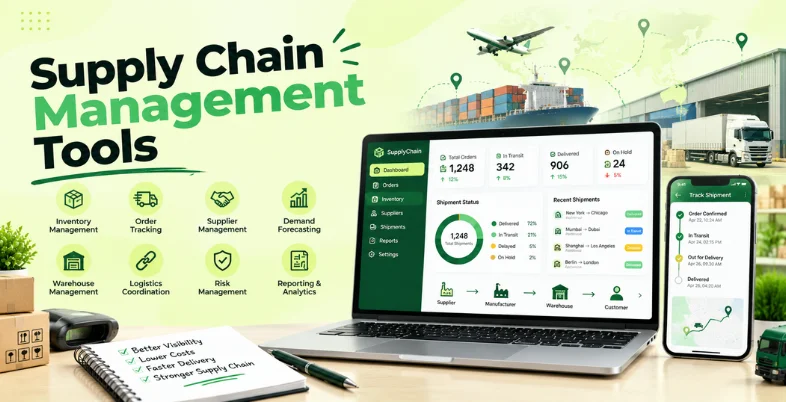
Imagine losing customers because products are out of stock, shipments arrive late, or suppliers fail to deliver on time. These challenges can disrupt business operations, increase costs, and affect customer satisfaction. This is where supply chain management tools make a difference. These software solutions help businesses streamline procurement, optimize inventory, forecast demand, track shipments, and strengthen supplier relationships through centralized data and automation. With advanced technologies such as artificial intelligence (AI), machine learning, and real-time analytics, modern platforms also help businesses identify potential disruptions and make faster, data-driven decisions.
However, choosing the right software depends on your business size, operational complexity, budget, and specific supply chain requirements. From supplier visibility solutions to comprehensive enterprise planning platforms, there are several options available. In this guide, we’ll explore the best supply chain management tools, highlighting their key features, best use cases, and benefits to help you find the right fit for your business.
What Are Supply Chain Management Tools?
Supply chain management tools are software solutions that help businesses plan, monitor, and manage the entire journey of products, from sourcing raw materials to delivering finished goods to customers. These tools connect key business activities, including procurement, production, inventory management, warehousing, transportation, and order fulfillment, within a centralized system. This allows teams to access accurate information, coordinate operations, and make informed decisions throughout the supply chain.
Modern supply chain management software offers capabilities such as demand forecasting, inventory optimization, supplier relationship management, shipment tracking, logistics planning, and performance analytics. Many platforms also incorporate artificial intelligence (AI) and machine learning to analyze historical data, anticipate demand changes, identify potential supply disruptions, and improve planning accuracy.
For example, a retail business can use these tools to predict seasonal demand, replenish inventory before products run out, and coordinate shipments across multiple warehouses. This helps reduce stockouts, avoid excess inventory, control operational costs, and ensure timely deliveries. Ultimately, supply chain management tools enable businesses to improve efficiency, strengthen supplier collaboration, and build more resilient supply chain operations.
List of 10 Best Supply Chain Management Tools
1. Tradeverifyd

- Website: https://tradeverifyd.com
- Best for: Businesses seeking multi-tier supplier visibility, risk assessment, and supply chain transparency.
Tradeverifyd helps businesses improve supply chain transparency by providing insights into supplier networks, compliance, sustainability, and potential operational risks. Its approach focuses on understanding relationships across multiple supplier tiers rather than limiting visibility to direct suppliers. Businesses can use its supplier assessment and risk detection capabilities to identify potential issues before they disrupt procurement, production, or delivery schedules.
By consolidating supplier information and mapping supply chain relationships, Tradeverifyd supports better-informed decisions and more proactive risk management software. It is particularly useful for organizations that need to strengthen supplier accountability, monitor regulatory exposure, and improve visibility across complex global supply chains.
Key Features:
- Supplier scoring to assess reliability, compliance, and risk exposure.
- Multi-tier supply chain mapping to visualize supplier relationships.
- AI-powered risk detection to identify potential supplier-related issues.
- Supplier transparency tools to improve access to relevant supply chain information.
- Risk monitoring capabilities to support proactive decision-making.
Pricing:
- Custom pricing
2. SAP Integrated Business Planning (IBP)

- Website: https://www.sap.com/products/scm/integrated-business-planning.html
- Best for: Mid-sized and large enterprises requiring advanced planning capabilities and integration with SAP systems.
Sap integrated business planning (ibp) is a cloud-based supply chain planning platform and one of the supply chain management tools that helps businesses coordinate demand forecasting, inventory optimization, supply planning, and sales and operations planning. it enables teams to evaluate changing market conditions, align supply with customer demand, and assess the impact of different business scenarios.
By connecting planning activities across departments, sap ibp helps organizations improve forecasting accuracy, manage inventory efficiently, and respond to unexpected supply chain disruptions. its integration with the broader sap ecosystem makes it suitable for businesses seeking connected planning processes and data-driven decision-making across multiple locations and business units.
Key Features:
- AI-supported demand forecasting to anticipate future customer requirements.
- Inventory optimization to balance product availability and carrying costs.
- Supply planning to coordinate production, procurement, and inventory needs.
- Sales and operations planning to align business and operational objectives.
- Scenario modeling to evaluate alternative supply and demand situations.
Pricing
- Custom Pricing
3. Oracle Fusion Cloud SCM
- Best for: Large enterprises with complex supply chains and existing Oracle business systems.
- Website: https://www.oracle.com/in/scm
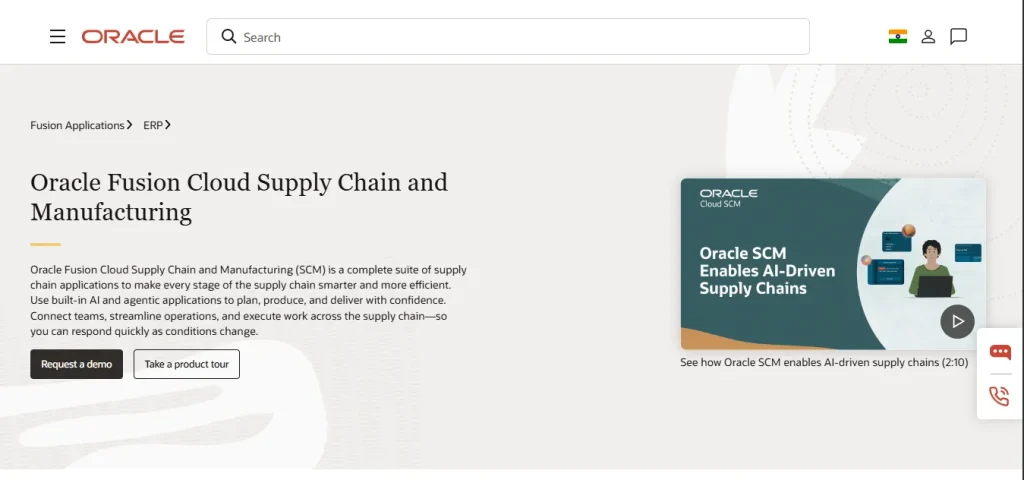
Oracle Fusion Cloud Supply Chain Management (SCM) is an integrated cloud platform that helps organizations manage procurement, manufacturing, inventory, logistics, order fulfillment, and supply chain planning. It connects operational workflows with business data, enabling teams to monitor performance, coordinate purchasing activities, and improve visibility across the supply chain.
Businesses can use the platform to manage production schedules, streamline supplier interactions, and make informed decisions using analytics and AI-supported capabilities. Its integration with Oracle’s broader enterprise applications also helps organizations connect supply chain operations with finance and other business functions. The platform is particularly valuable for enterprises managing complex processes, multiple locations, and large-scale operations.
Key Features:
- Procurement management to streamline purchasing and supplier relationships.
- Supply chain planning to coordinate demand, supply, and inventory.
- Manufacturing management to support production scheduling and execution.
- Logistics and order management to improve fulfillment coordination.
- Analytics and AI capabilities to identify trends and support operational decisions.
Pricing:
- Custom pricing
4. Blue Yonder

- Best for: Retailers, manufacturers, distributors, and logistics companies seeking connected supply chain planning and execution.
- Website: https://blueyonder.com
Blue yonder provides supply chain planning and execution solutions and is one of the supply chain management tools that helps businesses coordinate demand forecasting, inventory management, transportation, warehousing, and fulfillment. its platform connects planning decisions with operational activities, allowing organizations to respond more effectively to changing customer demand and supply chain disruptions. businesses can use its ai-driven capabilities to analyze demand patterns, improve product availability, optimize logistics operations, and evaluate alternative supply chain scenarios.
Blue yonder supports organizations across retail, manufacturing, and distribution, helping teams coordinate activities across different stages of the supply chain. its connected planning and execution approach makes it useful for businesses seeking greater operational visibility and more responsive decision-making.
Key Features:
- Demand planning to forecast customer needs using historical and current data.
- Inventory optimization to improve stock availability and control costs.
- Transportation management to coordinate freight and delivery operations.
- Supply chain orchestration to connect planning, logistics, and fulfillment.
- Scenario analysis to evaluate disruptions and alternative operational strategies.
Suggested Read:
5. Kinaxis Maestro

- Website: https://www.kinaxis.com/en
- Best for: Global manufacturers and enterprises requiring responsive planning and advanced scenario modeling.
Kinaxis Maestro is a supply chain orchestration platform that helps businesses coordinate planning activities and respond quickly to changes in supply and demand. It connects demand, supply, inventory, and operational planning so teams can understand how decisions in one area affect the wider supply chain. For example, businesses can evaluate the impact of a supplier delay on production schedules, inventory availability, and customer commitments before selecting an appropriate response.
The platform supports scenario modeling, advanced analytics, and AI-powered decision support to improve planning agility. Its capabilities are particularly valuable for organizations operating across multiple markets, managing complex supplier networks, and dealing with frequent supply chain fluctuations.
Key Features:
- Concurrent planning to coordinate supply, demand, and inventory activities.
- Scenario modeling to compare possible outcomes under changing conditions.
- Supply chain analytics to monitor performance and identify planning issues.
- AI-powered decision support to evaluate options and prioritize responses.
- Risk analysis to assess the potential impact of supply chain disruptions.
Pricing:
- Custom pricing
6. Infor Nexus
- Website: https://www.infor.com/solutions/scm/infor-nexus
- Best for: Global enterprises managing international supplier networks and complex logistics operations.
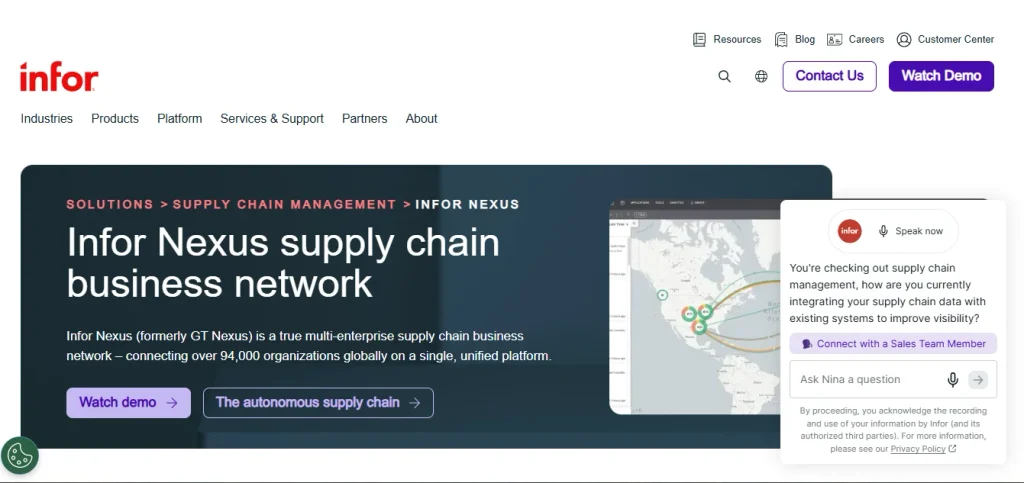
Infor nexus is a network-based supply chain platform and one of the supply chain management tools that connects businesses with suppliers, manufacturers, logistics providers, and other trading partners. it helps organizations improve visibility across international supply chains, where products and materials often move through multiple parties before reaching customers.
By centralizing relevant supply chain information, the platform enables businesses to monitor orders, coordinate shipments, and identify potential delays. its collaboration and analytics capabilities support communication between supply chain participants and help organizations respond more effectively to changing operational conditions. infor nexus is particularly useful for enterprises managing international sourcing, complex transportation networks, and multiple trading partners that require coordinated workflows.
Key Features:
- End-to-end visibility to monitor orders and shipments across supply chain partners.
- Supplier collaboration to improve communication and coordination.
- Logistics management to support transportation planning and shipment monitoring.
- Supply chain analytics to identify delays and operational risks.
- Trade and financial workflow support to coordinate relevant business processes.
7. E2open
- Website: https://www.e2open.com
- Best for: Global enterprises in manufacturing, technology, aerospace, and pharmaceutical industries.
E2open provides connected supply chain planning, global trade, logistics, and channel management capabilities. It helps businesses coordinate activities across suppliers, manufacturers, carriers, and distribution partners through connected operational data. Organizations operating internationally can use the platform to manage transportation requirements, monitor supply and demand, and support trade compliance processes.
By connecting planning with execution, E2open helps businesses improve supply chain visibility and respond to changes in shipping schedules, inventory availability, and supplier performance. Its capabilities are particularly relevant for industries with complex global operations, where coordinating multiple partners and navigating international trade requirements are essential for maintaining efficient supply chain processes.
Key Features:
- Connected planning to coordinate supply, demand, and inventory decisions.
- Global trade management to support international shipping and compliance workflows.
- Transportation management to improve freight planning and logistics coordination.
- Multi-tier supply chain visibility to monitor activities across trading partners.
- Channel management to strengthen coordination across distribution networks.
Pricing:
- Custom Pricing
8. Logility
- Best for: Mid-sized and large businesses requiring advanced forecasting and inventory planning capabilities.
Logility offers supply chain planning solutions that help businesses manage demand forecasting, inventory optimization, supply planning, and network optimization. its platform is one of the supply chain management tools that focuses on helping organizations move from reactive decision-making toward proactive, data-driven operations. businesses can analyze historical demand, estimate future inventory requirements, and evaluate alternative supply chain strategies to improve operational efficiency.
These capabilities help organizations balance product availability with inventory costs while responding to changing market conditions. logility supports businesses across several industries, including consumer packaged goods, manufacturing, and life sciences. its planning and analytics capabilities make it a useful option for organizations seeking to improve forecasting, streamline inventory decisions, and strengthen overall supply chain performance.
Key Features:
- Demand forecasting to estimate future requirements using available data.
- Inventory planning to determine appropriate stock levels across locations.
- Supply planning to align supply requirements with anticipated demand.
- Scenario planning to compare potential outcomes before making changes.
- Network optimization to identify opportunities for more efficient operations.
Pricing: Custom pricing
9. Manhattan Active Supply Chain Planning

- Best for: Large retailers, wholesalers, and businesses managing complex distribution networks.
Manhattan Active Supply Chain Planning is a cloud-based planning solution designed to help retailers and wholesalers coordinate demand forecasting, inventory allocation, and replenishment activities. It supports businesses that need to maintain product availability across multiple stores, distribution centers, and fulfillment channels. By connecting planning processes, the platform helps teams respond to changing customer demand and make more informed inventory decisions.
Retailers can use its capabilities to coordinate stock distribution, improve replenishment planning, and reduce the risk of product shortages or excess inventory. The solution is particularly relevant for large retail operations with extensive product catalogs and complex distribution networks that require responsive and coordinated supply chain planning.
Key Features:
- Demand forecasting to estimate customer requirements using statistical and AI-supported methods.
- Inventory allocation to distribute products across stores and distribution centers.
- Replenishment planning to determine when and where stock is needed.
- Unified planning to connect forecasting and inventory decisions.
- Inventory optimization to reduce stockouts and unnecessary inventory accumulation.
Pricing: Custom pricing
10. RELEX Solutions

- Best for: Retailers, grocery chains, CPG manufacturers, and distributors seeking integrated retail and supply chain planning.
Relex solutions provides supply chain planning and optimization software for retailers, consumer packaged goods (cpg) manufacturers, and distributors. it is one of the supply chain management tools that connects demand forecasting, inventory optimization, replenishment, merchandising, and supply planning to help businesses maintain product availability while controlling costs. Retail and cpg organizations can use its capabilities to account for seasonal demand, promotional activity, changing consumer preferences, and variations in product sales.
By coordinating inventory and replenishment decisions across stores and distribution centers, relex helps businesses improve planning efficiency and reduce waste. its retail-focused functionality makes it particularly suitable for organizations that need to connect merchandising decisions with supply chain operations and respond quickly to changing market conditions.
Key Features:
- AI-powered demand forecasting to analyze sales patterns and changing customer behavior.
- Inventory optimization to maintain suitable stock levels across locations.
- Automated replenishment to support timely inventory restocking.
- Merchandising optimization to coordinate product availability with retail requirements.
- Supply chain planning to connect demand, supply, and inventory decisions.
Benefits of Using Supply Chain Management Tools
Supply chain management software can improve business performance by connecting information, automating routine work, and helping teams make decisions using more reliable data.
- Improved Supply Chain Visibility: A centralized platform can help businesses monitor suppliers, inventory, orders, shipments, and delivery status. Better visibility makes it easier to identify bottlenecks and respond before minor problems become major disruptions.
- Better Inventory Management: Inventory management tools help businesses determine how much stock they need and when to replenish it. This can reduce excess inventory, prevent stockouts, and limit the costs associated with storing unsold products.
- More Accurate Demand Forecasting: Forecasting capabilities help businesses estimate future demand using historical sales, seasonal patterns, market signals, and other relevant data. Better forecasts can improve purchasing decisions, production schedules, and distribution planning.
- Reduced Operational Costs: Automation can reduce repetitive data entry, manual reporting, and inefficient coordination. Improved transportation planning and inventory control can also help businesses manage logistics expenses and working capital.
- Stronger Supplier Collaboration: Supply chain platforms can centralize supplier information, purchasing requirements, and order updates. This makes it easier for procurement and operations teams to communicate with suppliers and coordinate responses to unexpected changes.
- Faster Risk Detection and Response: Analytics and AI-driven capabilities can help identify warning signs, such as supplier delays, changing demand, or potential inventory shortages. Businesses can use these insights to evaluate alternatives and improve operational resilience.
- Better Customer Satisfaction: Accurate inventory information, reliable delivery planning, and improved order fulfillment help businesses deliver products on time. These improvements can support stronger customer relationships and fewer order-related complaints.
How to Choose the Best Supply Chain Management Tool
Choosing the right supply chain management tool isn’t just about finding software with the most features. It’s about understanding your business needs, simplifying daily operations, and improving efficiency without increasing unnecessary costs. Here are steps to help you find the right solution for your business.
Step 1: Identify Your Supply Chain Challenges
- Before comparing software, take a closer look at the problems your business faces every day. Are you struggling with inaccurate demand forecasts, delayed shipments, excess inventory, or poor communication with suppliers? Identifying these challenges helps you understand which capabilities matter most. For example, if products frequently go out of stock, prioritize inventory optimization and demand forecasting.
- If supplier delays are affecting production, look for tools that offer supplier monitoring and real-time visibility. Start with your biggest operational challenges so you can focus on solutions that address actual business needs instead of paying for unnecessary features.
Step 2: Assess Your Business Size and Complexity
- The right supply chain management tool should match the size and complexity of your operations. A small business managing one warehouse may only need basic inventory tracking, order management, and purchasing features. However, a large manufacturer operating across several countries may require advanced forecasting, multi-warehouse coordination, supplier collaboration, and global logistics management.
- Consider how many suppliers, products, warehouses, and business locations you manage today. It’s also worth thinking about your growth plans. Choosing a platform that can accommodate additional users, locations, and transactions as your business expands can help you avoid costly software changes later.
Step 3: Compare Essential Features
- Once you understand your requirements, compare the features offered by different platforms. Not every business needs a complete enterprise supply chain suite, so focus on capabilities that support your priorities. For example, demand forecasting and automated replenishment are valuable for businesses dealing with fluctuating customer demand, while supplier mapping and risk monitoring are more relevant to organizations managing complex supplier networks.
- You should also consider procurement management, warehouse operations, transportation tracking, reporting, and analytics. Make a list of essential features and separate them from optional ones. This approach makes it easier to compare vendors objectively and choose software that provides practical value for your operations.
Step 4: Check Integration Capabilities
- Your supply chain management software should work smoothly with the other systems your business already uses. These may include enterprise resource planning (ERP) software, accounting applications, warehouse management systems, customer relationship management (CRM) platforms, and e-commerce tools. When these systems share data effectively, employees can access more consistent information without repeatedly entering the same details.
- Before selecting a platform, check whether it supports your existing applications through built-in integrations, APIs, or other suitable connections. Also, ask how data synchronization works and whether additional integration costs apply. Strong integration capabilities can reduce manual work, improve reporting accuracy, and help different departments coordinate their activities more efficiently.
Step 5: Evaluate Ease of Use and Implementation
- Even feature-rich software may not deliver the expected results if employees find it difficult to use. Look for a platform with an intuitive interface, clear dashboards, straightforward workflows, and accessible support resources. You should also understand how long implementation may take and what will be required for configuration, data migration, and employee training.
- Ask vendors to demonstrate common tasks, such as creating purchase orders, checking inventory levels, or tracking shipments. Whenever possible, involve employees from procurement, warehouse management, logistics, and finance in the evaluation. Their feedback can help you identify usability issues early and choose a solution that your team can adopt with minimal disruption.
Step 6: Understand the Total Cost of Ownership
- Software pricing involves more than the initial subscription or license fee. To understand the actual investment, consider implementation, configuration, data migration, integration, employee training, ongoing support, and maintenance costs. Some platforms may also charge extra for additional users, advanced modules, or higher usage levels. For example, a solution with a lower subscription price may become more expensive if it requires extensive customization or third-party integrations.
- Request a detailed quote from shortlisted vendors and clarify which services are included. Compare the estimated costs against the benefits you expect, such as reduced inventory waste, fewer manual tasks, or improved order fulfillment. This helps you select a solution that fits your budget while supporting measurable business outcomes.
Step 7: Test the Software Before Committing
- Before making a final decision, request a product demonstration, trial, or proof of concept whenever available. Testing allows you to see how the software performs in realistic business situations rather than relying entirely on marketing claims. For example, check whether it can identify potential stock shortages, generate useful demand forecasts, track shipments, or highlight supplier-related risks.
- Evaluate how quickly employees can complete routine tasks and whether reports provide the information your team needs. It’s also helpful to define success criteria before testing, such as reducing manual reporting, improving inventory visibility, or making planning decisions faster. Comparing shortlisted tools against the same criteria will help you make a more confident and informed choice.
Step 8: Consider Scalability and Future Needs
- Your supply chain requirements may change as your business grows, introduces new products, enters new markets, or works with additional suppliers. That’s why it’s important to choose software that can support future operational demands without requiring a complete system replacement. Check whether the platform can accommodate more users, warehouses, transactions, integrations, and business locations.
- You should also evaluate the vendor’s product development plans, security practices, support services, and investment in automation and AI capabilities. However, avoid paying for advanced features simply because they might become useful someday. Instead, look for a flexible solution that meets your current needs while offering a practical upgrade path as your business evolves.
Common Mistakes to Avoid When Choosing Supply Chain Software
Even a capable platform may fail to deliver results if it does not match your business requirements. Avoid these common mistakes when making your decision.
- Choosing based only on price: A low subscription cost may be offset by implementation expenses, limited functionality, or expensive integrations.
- Ignoring integration requirements: Disconnected systems can lead to duplicate data and unreliable reporting.
- Buying unnecessary features: An overly complex platform may increase costs and make employee adoption more difficult.
- Overlooking employee training: Teams need appropriate training to use the software consistently and correctly.
- Failing to define success metrics: Without measurable goals, it becomes difficult to determine whether the investment is delivering value.
- Ignoring data quality: Inaccurate supplier, inventory, or sales data can undermine even advanced forecasting and analytics capabilities.
- Underestimating implementation time: Data migration, process changes, testing, and employee onboarding can require significant planning.
Conclusion
choosing the right supply chain management tools can help your business improve inventory control, streamline procurement, strengthen supplier relationships, and manage logistics more efficiently. from tradeverifyd’s supplier visibility capabilities to sap ibp’s advanced planning features and relex solutions’ retail-focused tools, each platform offers different advantages depending on your operational requirements. before making a decision, consider your business size, essential features, integration needs, implementation costs, and future growth plans.
It’s also worth testing shortlisted platforms to understand how they perform in real-world scenarios. Ultimately, the best supply chain management software is one that addresses your current challenges, reduces manual work, and helps your team make smarter, data-driven decisions. With the right solution in place, your business can build a more efficient, flexible, and resilient supply chain.
Frequently Asked Questions
1. What Are the Best Supply Chain Management Tools in 2026?
Some popular options include Tradeverifyd, SAP Integrated Business Planning, Oracle Fusion Cloud SCM, Blue Yonder, Kinaxis Maestro, Infor Nexus, E2open, Logility, Manhattan Active Supply Chain Planning, and RELEX Solutions.
2. What Features Should I Look for in Supply Chain Management Software?
Look for essential features such as demand forecasting, inventory optimization, supplier management, procurement, shipment tracking, logistics planning, reporting, and integration with your existing business systems.
3. How Much Does Supply Chain Management Software Cost?
The cost depends on the platform, business size, features, number of users, and implementation requirements. Enterprise solutions often require customized pricing, while some smaller platforms offer subscription-based plans.
4. Can Small Businesses Use Supply Chain Management Tools?
Yes, small businesses can use these tools to track inventory, manage purchase orders, monitor deliveries, and forecast demand. The ideal solution should fit their budget, operational complexity, and growth plans.
5. How Does AI Improve Supply Chain Management?
AI helps businesses forecast demand, identify potential disruptions, optimize inventory levels, analyze supplier risks, and evaluate alternative supply chain scenarios. These capabilities support faster decisions and more efficient operations.